
Before you decide
This is general information, not medical advice. Your prescriber and pharmacist know your full medication list, your kidney function, and your reasons for taking the pill, and they should sign off on any new supplement.
The people who worry most about this combination fall into two camps. Some fear that magnesium will quietly make their contraception fail. Others have read that the pill drains magnesium and wonder whether they now need to supplement.
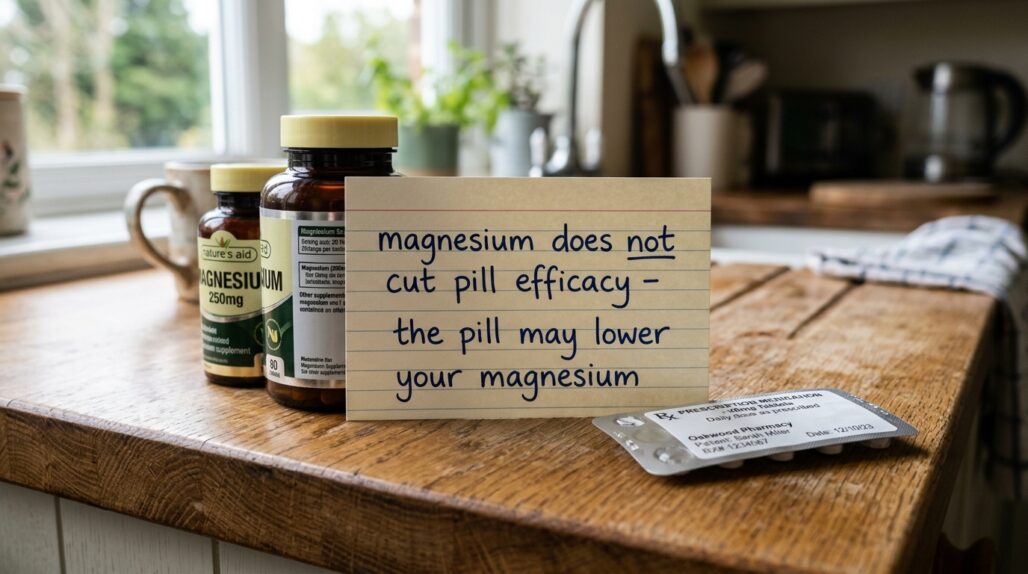
Both questions have answers, and they point in opposite directions. Magnesium does not appear to weaken hormonal birth control. The pill, on the other hand, is linked to slightly lower magnesium levels in several studies. The practical takeaway is reassuring, but the nuance is worth understanding.
Highest-risk readers here are not the ones combining magnesium with the pill. They are people who also take other medications magnesium can bind to, those with reduced kidney function who clear magnesium poorly, and anyone reaching for an enzyme-inducing herb that genuinely does threaten contraceptive efficacy.
Does magnesium make birth control less effective?
The short answer is no, not in any way the evidence supports. Birth control pills fail mainly when the hormones are broken down too fast or absorbed too poorly, and magnesium does neither of those things.
The hormones in combined pills – ethinylestradiol and a progestin – are cleared by liver enzymes, chiefly CYP3A4. The supplements and drugs that truly cut efficacy are the ones that speed up those enzymes, so the body chews through the hormones before they can do their job. Magnesium is not an enzyme inducer.
For contrast, the one botanical with strong evidence of causing trouble is St. John's wort. In a randomized controlled trial of St. John's wort and low-dose oral contraceptives, the herb increased hormone metabolism and produced more breakthrough bleeding, a recognized warning sign of reduced protection. Magnesium has no comparable record. We cover the genuine offenders in our guide to what supplements make birth control less effective.
There is one old, theoretical footnote. Magnesium-containing antacids could in principle alter how some oral drugs dissolve, but no firm evidence shows this meaningfully affects the pill. A standalone magnesium supplement taken for sleep, cramps, or general health is not a contraceptive concern.
The real story: the pill may lower your magnesium
The more interesting direction is depletion. Several studies have found that women on combined oral contraceptives tend to carry somewhat lower serum magnesium than women not on the pill.
One frequently cited study followed women starting a levonorgestrel-ethinylestradiol pill and reported that serum magnesium fell from a mean of 0.82 to 0.61 mmol/L over six months. That is a measurable drop, though it came from a small sample and serum magnesium is an imperfect snapshot of total body stores.
A larger real-world dataset comes from a Russian analysis of several observational studies of women with hormone-related conditions, where among roughly 1,500 hormonal contraceptive users, below-reference magnesium readings were common – though prevalence depended heavily on the cutoff used and was actually lower than in pregnant women. The authors suggested that higher estrogen exposure may shift how the body handles magnesium, which would fit the pattern seen in pregnancy and estrogen therapy too.
A fair reading of this literature: the effect is real but modest for most users, the studies vary in quality, and a low serum value does not automatically mean a deficiency that needs treating. It is a reason to pay attention to intake, not a reason to panic. For the wider set of nutrients involved, see our overview of whether birth control depletes B vitamins, folate, and magnesium.
What about cramps and PMS?
Magnesium gets recommended a lot for period symptoms, and many people on the pill are taking it for exactly that reason. The evidence is softer than the marketing suggests.
A systematic review and meta-analysis of serum magnesium and premenstrual syndrome found no consistent difference in magnesium levels between people with PMS and those without, once heterogeneous studies were pooled. Some small supplementation trials have hinted at benefit for mood or fluid symptoms, but the overall picture is mixed rather than settled.
So magnesium may help some people with menstrual or premenstrual symptoms, and it is low-risk to try at a sensible dose. Just go in with realistic expectations rather than treating it as a guaranteed fix. If symptoms are severe or disabling, that is a clinician conversation, not a supplement-aisle decision.

How much magnesium, and which form
If you decide to supplement, start from the recommended intakes and the safety ceiling rather than from a marketing claim. According to the NIH Office of Dietary Supplements magnesium fact sheet, the RDA is 310 mg per day for women aged 19 to 30 and 320 mg per day from age 31, counting food and supplements together.
The number that matters most for supplements is the ceiling. The tolerable upper intake level for magnesium from supplements is 350 mg per day, separate from what you get in food. Going above that without medical guidance is the main way people run into trouble.
The most common side effect is the laxative one. As the Harvard T.H. Chan School of Public Health magnesium overview notes, high supplemental doses can cause diarrhea, nausea, and cramping, and poorly absorbed forms like magnesium oxide are the usual culprits.
On forms, the practical hierarchy looks like this:
| Form | Absorption | Best for | Watch-out |
|---|---|---|---|
| Magnesium glycinate | Good; gentle on the gut | Daily top-up, sleep, sensitive stomachs | Costs more per dose |
| Magnesium citrate | Good; well studied | General use, mild constipation | Loosens stools at higher doses |
| Magnesium oxide | Poor for raising levels | Occasional antacid or laxative use | High elemental dose, frequent diarrhea |
For a deeper breakdown of forms and absorption data, see our magnesium forms and bioavailability comparison, and for the full picture our complete guide to magnesium.
Timing: the pill is fine, but space it from these
You do not need to separate magnesium from your birth control pill. There is no binding or absorption clash between the two, so take them whenever fits your routine.
The timing rule applies to other medications you might be taking at the same time. Magnesium can form complexes with certain drugs and blunt their absorption. Per the NIH fact sheet, separate magnesium from these by a couple of hours:
- Tetracycline and quinolone antibiotics (for example doxycycline, ciprofloxacin) – take the antibiotic at least 2 hours before, or 4 to 6 hours after, magnesium.
- Oral bisphosphonates for bone density (for example alendronate) – keep at least 2 hours apart.
- Some thyroid medication and other minerals – spacing magnesium from large doses of iron, calcium, or zinc helps each absorb better.
If you take any of these, your pharmacist can map out a simple daily schedule. A free tool like our drug-supplement interaction checker can also flag obvious clashes before you ask.

When supplementing makes sense – and when it doesn't
Reaching for magnesium is reasonable if your diet is genuinely low in it, if you have symptoms that could fit (muscle cramps, poor sleep, premenstrual complaints), or if your clinician has flagged a low reading. A modest dose of a well-absorbed form is low-risk for most healthy people on the pill.
It is unnecessary if you already eat plenty of magnesium-rich foods – leafy greens, legumes, nuts, seeds, whole grains – and feel fine. The pill-related dip is modest, and food is the safest way to cover it. A balanced diet plus a quality multivitamin handles most people's needs.
Supplementing is not a substitute for medical evaluation if you have ongoing symptoms. Persistent fatigue, palpitations, or muscle problems deserve a proper workup rather than self-dosing. People with reduced kidney function should not take magnesium supplements without medical supervision, because they clear it poorly and can build up dangerous levels. This overlaps with hormonal-symptom management covered in our best supplements for PCOS guide, where magnesium often comes up.
If you want a place to keep your pill and any supplements logged in one spot – useful for that pharmacist conversation – an app like StackMyMed can record your stack and surface common interaction flags to raise with a professional. It organizes the conversation; it does not replace clinical judgment.
When to see a clinician
Most magnesium-and-pill questions are routine, but a few situations warrant a call.
Reach out to your prescriber or pharmacist if you start a new prescription that magnesium might bind to, if you have kidney disease or take medications that affect potassium and magnesium, or if you are considering doses above the 350 mg supplemental ceiling. Get prompt care for signs of very high magnesium – nausea, flushing, muscle weakness, slow or irregular heartbeat – which is rare but more likely with impaired kidneys.
And if you are thinking about an herbal product for mood or energy, ask first. That is where a genuine contraceptive interaction can hide, magnesium aside.
FAQ
Will magnesium stop my birth control from working? No good evidence shows that magnesium reduces hormonal contraceptive effectiveness. It does not speed up the liver enzymes that break down the pill’s hormones, which is the usual mechanism behind reduced efficacy.
Does the pill actually deplete magnesium? Several studies link combined oral contraceptive use to modestly lower serum magnesium, with one small study showing a drop over six months. The effect is real but generally modest, and a low blood reading does not always mean a true deficiency.
Do I need to take magnesium and my pill at different times? No. There is no absorption clash between magnesium and birth control pills, so you can take them together. Spacing only matters for certain antibiotics, bisphosphonates, and large mineral doses.
Which magnesium form is best alongside the pill? Well-absorbed, gut-friendly forms like magnesium glycinate or citrate are sensible choices. Magnesium oxide is poorly absorbed for raising levels and is more likely to cause diarrhea.
How much magnesium is safe to add? Adult women need about 310 to 320 mg daily from all sources, and the upper limit from supplements is 350 mg per day. Stay at or below that ceiling unless a clinician advises a higher therapeutic dose.
Can magnesium help with period or PMS symptoms on the pill? It may help some people, but the evidence is mixed and a meta-analysis found no consistent magnesium-PMS link. A low dose is low-risk to try, though severe symptoms deserve a clinician’s input.
Conclusion: a two-way story with a calm answer
The fear that magnesium sabotages birth control is not supported by the evidence. Magnesium is not an enzyme inducer, and a standalone supplement is not a contraceptive risk – unlike St. John's wort, which genuinely is. If you want magnesium, take it whenever suits you and keep supplemental intake at or below 350 mg per day.
The direction worth your attention is depletion: the pill is associated with slightly lower magnesium, so covering your intake through food or a sensible, well-absorbed supplement is reasonable. For anything beyond a routine top-up – new prescriptions, kidney concerns, or stubborn symptoms – loop in your pharmacist or prescriber. The full map of these combinations lives in our ultimate drug-supplement interactions guide.
This article is for general education and does not replace personalized medical advice. Talk to your doctor or pharmacist before starting, stopping, or changing any supplement or medication.
Reviewed by the UsefulVitamins Editorial Team.
