
Affiliate disclosure: this article contains affiliate links. As an Amazon Associate, UsefulVitamins.com earns from qualifying purchases at no extra cost to you.
Before you decide
This article is general information, not medical advice. Benzodiazepine withdrawal sits in a high-stakes category, and your own plan should come from the clinician managing your taper.
People reach for magnesium during a taper because the symptoms it might soften – muscle tension, twitching, anxiety spikes, broken sleep – overlap with everyday magnesium-deficiency complaints. That overlap is why the supplement gets so much airtime in tapering communities. It is also why expectations often run ahead of the evidence.
The people who should be most careful are those with kidney disease, anyone on multiple medications, and anyone tapering quickly or without supervision. If that describes you, read the safety sections below and bring them to your prescriber before changing anything.
What the magnesium-and-benzo idea actually rests on
Benzodiazepines work by amplifying GABA, the brain's main calming signal. When you reduce them, that calming tone drops while excitatory glutamate signaling runs comparatively hot, which is the rough chemistry behind withdrawal symptoms.
Magnesium touches that balance. It helps block the excitatory NMDA receptor, according to mechanistic reviews of magnesium's role in the nervous system. On paper, that is the same seesaw a taper disturbs.
Animal work adds a second thread. In rodent models, magnesium deficiency tracks with more anxiety-like behavior and a stressed-out HPA axis, and repleting magnesium tends to calm those signals, as described in research on magnesium deficiency and HPA-axis dysregulation.
So the mechanism is biologically reasonable. That is the strongest honest claim available, and it is not the same as proof that magnesium shortens or blunts benzo withdrawal in people.

How strong is the evidence, really
Here is the part the taper forums usually skip. There are no good clinical trials testing magnesium specifically for benzodiazepine withdrawal. The case for it is built sideways, from studies on general anxiety and stress.
The most-cited summary is a 2017 systematic review of magnesium for subjective anxiety and stress. It pulled together 18 studies and found only modest, low-quality support, mostly in people already prone to anxiety, with large placebo effects muddying the picture. A separate review of magnesium and brain function reached the same cautious verdict: a possible benefit for mild-to-moderate anxiety, but methodologically weak.
Translate that to a taper and you get a fair expectation. Magnesium might take a little edge off anxiety, cramps, or sleep for some people. It will not reliably stop withdrawal, and anyone promising that is selling something.
We say this plainly because the gap between hope and data is where people get hurt. Read our supplement review standards for how we weigh evidence like this, and the broader drug and supplement interactions guide for the wider picture.
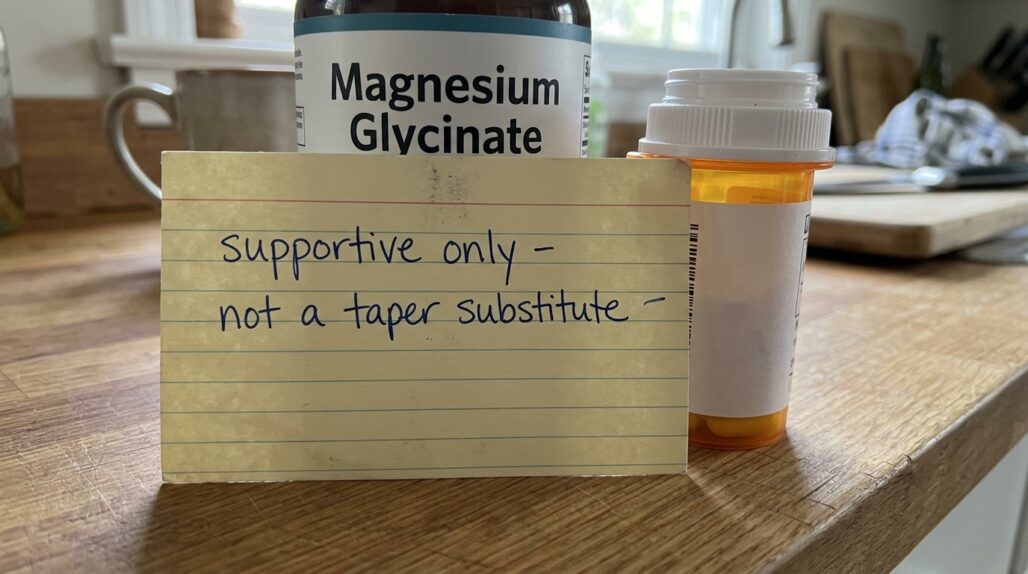
Why it is supportive only, never a taper substitute
A benzodiazepine taper is the actual treatment. Magnesium, at most, rides alongside it.
The reason this matters is safety. Stopping or cutting a benzo too fast can trigger severe, sometimes life-threatening withdrawal, including seizures. That risk is serious enough that the FDA strengthened the benzodiazepine boxed warning to flag physical dependence and dangerous withdrawal from abrupt discontinuation or rapid dose reduction.
The standard answer to that risk is a slow, structured reduction, the approach popularized by the Ashton Manual. Reductions are typically small and spaced out over weeks to months, set by a clinician to your situation. No supplement changes that math.
So the right mental model is simple. The taper does the work; magnesium is comfort support, like a good sleep routine or stress skills. If you ever feel pulled to lean on magnesium instead of the taper, that is the moment to call your prescriber, not the supplement aisle.

Best forms and how to take it
If your clinician signs off, the form matters more for comfort than for any anti-withdrawal effect. The practical goal is decent absorption without a sprint to the bathroom.
| Form | Absorption and feel | GI tolerance |
|---|---|---|
| Magnesium glycinate | Well absorbed, gentle, often chosen for sleep and calm | Usually easy on the gut |
| Magnesium citrate | Well absorbed, reasonably priced | Can loosen stools at higher amounts |
| Magnesium oxide | Poorly absorbed, cheap, high elemental content | Most likely to cause diarrhea |
For comfort during a taper, glycinate is the form most people tolerate best, with citrate a common second choice. The NIH Office of Dietary Supplements magnesium fact sheet notes that forms dissolving better in fluid, like citrate, tend to absorb better than poorly soluble oxide.
On amounts, take the cue from a professional rather than a forum thread. The NIH sets a tolerable upper intake level of 350 mg per day for supplemental magnesium in adults, separate from what you get in food, and going past that mainly buys you diarrhea, cramping, and nausea. Splitting a dose and taking it with food tends to be gentler than one large slug.
A few habits help. Start low, give it several days, and watch how your gut and sleep respond rather than chasing a bigger number.
What to take


As an Amazon Associate, UsefulVitamins.com earns from qualifying purchases at no extra cost to you.
UsefulVitamins may earn a commission if you buy through links in this section, at no extra cost to you. It does not change our picks or our review standards.
For more on choosing between products, see our breakdowns of magnesium forms and bioavailability and the best magnesium for sleep, plus the complete guide to magnesium if you want the full background.
Who needs to be extra careful
Magnesium is not risk-free, and a taper is exactly when small problems get amplified.
The biggest flag is your kidneys. They clear excess magnesium, so in kidney disease or reduced kidney function, supplements can build to dangerous levels, a caution the NIH magnesium fact sheet spells out. If your kidney function is anything other than normal, magnesium is a prescriber-only decision.
Medications matter too. Magnesium can bind certain drugs and reduce their absorption, including some antibiotics and bisphosphonates, so spacing and timing belong in a pharmacist conversation. A simple way to keep that conversation accurate is to track everything you take. The free app StackMyMed lets you log your full stack and flag possible interactions to raise with a pharmacist, though it does not replace clinical judgment.
Two more reminders. Magnesium is not a detox and will not pull benzos out of your system, despite the framing you may see online. And if a symptom scares you – a seizure, severe confusion, a racing heart, or anything that feels like an emergency – skip the supplement question entirely and get urgent medical care.

When to bring in a clinician
For anyone tapering benzodiazepines, the honest answer is from the start. A taper should be planned and monitored, not improvised.
Loop in your prescriber or pharmacist before adding magnesium, especially if you take other medicines or have any kidney concern. Ask them which form and amount fit you, and whether timing around your other drugs needs adjusting.
If your taper feels too hard, the fix is a gentler taper schedule, not a stronger supplement. That is a conversation worth having early and often. For the anxiety side of the picture, our overview of natural anxiety support options and the note on melatonin with Xanax cover other commonly asked combinations, again as background, not as clearance to mix things on your own.
FAQ
Does magnesium stop benzo withdrawal symptoms? No. There is no solid evidence that magnesium stops withdrawal. At best it may modestly ease anxiety, cramps, or sleep for some people, while the supervised taper does the real work.
Which magnesium is best during a taper? Most people tolerate magnesium glycinate well, with citrate as a common alternative. Oxide is poorly absorbed and most likely to cause diarrhea. Confirm any choice with your clinician.
How much magnesium is safe to take? The NIH sets a tolerable upper limit of 350 mg per day for supplemental magnesium in adults, on top of food. Your prescriber should set your actual amount, and splitting it with food is gentler on the gut.
Can magnesium replace my taper or help me quit faster? No. Stopping a benzo too quickly can cause severe, sometimes life-threatening withdrawal, including seizures. Magnesium is comfort support only and never a reason to speed up or skip steps.
Is magnesium safe with my other medications? It can be, but magnesium may reduce absorption of some drugs, such as certain antibiotics and bisphosphonates, and it is risky in kidney disease. Have a pharmacist review your full list before you start.
Is magnesium a benzo detox? No. Magnesium does not clear benzodiazepines from your body. It is a mineral that may offer mild symptom comfort, nothing more.
Conclusion: support, not a shortcut
Magnesium has a plausible reason to help around a benzo taper and a real shot at easing cramps, restlessness, or sleep for some people. What it does not have is evidence that it treats withdrawal or replaces a careful taper.
So use it the right way if your clinician agrees: a well-absorbed form like glycinate, a sensible amount within the 350 mg supplemental upper limit, taken alongside a slow, supervised reduction. The next step is a short conversation with the person managing your taper, not a bigger bottle.
This article is for general education and does not replace personalized medical advice. Benzodiazepine withdrawal can be dangerous; never start, stop, or change a benzodiazepine or a supplement without your prescriber or pharmacist.
Reviewed by the UsefulVitamins Editorial Team.
