
Affiliate disclosure: this article contains affiliate links. As an Amazon Associate, UsefulVitamins.com earns from qualifying purchases at no extra cost to you.
Before you buy
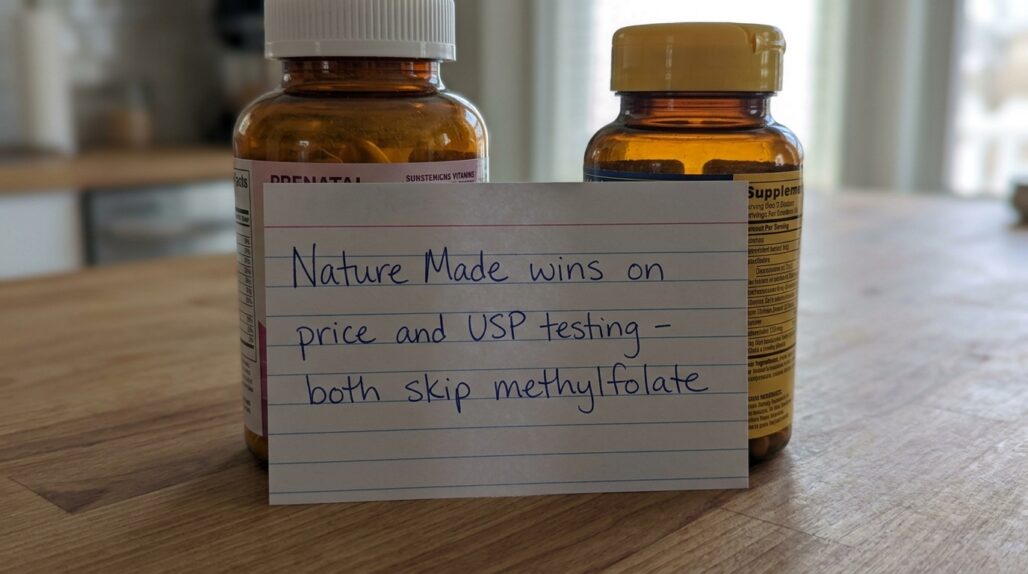
Both of these sit on the same drugstore shelf, both are one-softgel-a-day prenatals, and both are bought by the millions. So the real question is not "are they good enough" – for a lot of people they are. The question is which one gives you more for your money, and whether either is the right fit at all.
Here is the honest framing. A prenatal is mostly about three things during the first trimester: enough folate to lower neural-tube-defect risk, enough iron to keep up with blood-volume changes, and a reasonable iodine dose. Both of these hit those marks. Where they differ is price, the exact DHA dose, and whether the bottle has been tested by an outside lab.
There is also a quieter issue. Neither one uses methylfolate, and neither comes close to the choline most pregnancy nutrition researchers now flag as the weak spot in mainstream prenatals. If those words mean nothing to you yet, the sections below explain why they might matter – and when they genuinely do not.
If you already take a prescription or another supplement, run your full list through our drug and supplement interaction checker before you add a prenatal. Iron in particular interacts with several common medications.
What is inside each one
The two formulas are closer than the marketing suggests. Both are single-softgel daily multis built on folic acid, iron, iodine, and a small DHA dose.
Nature Made Prenatal Multi + DHA gives you 800 mcg folic acid (1,330 mcg DFE), 200 mg DHA (within 260 mg total omega-3, including 60 mg EPA), 27 mg iron as ferrous fumarate, 150 mcg iodine, and 25 mcg (1,000 IU) vitamin D3, across 19 nutrients. It does not contain choline.
One A Day Women's Prenatal 1 is built the same way: 800 mcg folic acid, around 200 mg DHA, 27 mg iron (as carbonyl iron), 150 mcg iodine, plus the standard vitamin and mineral spread. It also has no choline in the standard version.
So the headline difference on paper is small. The two deliver the same 200 mg DHA, and they use different iron forms – ferrous fumarate versus carbonyl iron. Both forms are absorbable; carbonyl iron releases more slowly and is sometimes gentler on the stomach, while ferrous fumarate is the more studied, more concentrated salt. Neither is clearly superior for most people.
The folate question
Here is the thing the premium brands hammer on. Both of these use folic acid, the synthetic form, not methylfolate (the active 5-MTHF form).
For most people that is completely fine. Folic acid has the longest track record for preventing neural tube defects, and it is the form used in the studies that built the public-health recommendation. The NIH Office of Dietary Supplements folate fact sheet and ACOG's pregnancy nutrition guidance both treat folic acid as the standard, effective choice.
The exception: if your doctor has flagged an MTHFR variant or you have been told you convert folic acid poorly, a methylfolate prenatal makes more sense. Neither of these drugstore picks gives you that. If that is you, jump to our best prenatal vitamins without iron and full-dose comparisons instead, where methylfolate is standard.
DHA, iron, iodine, and choline compared
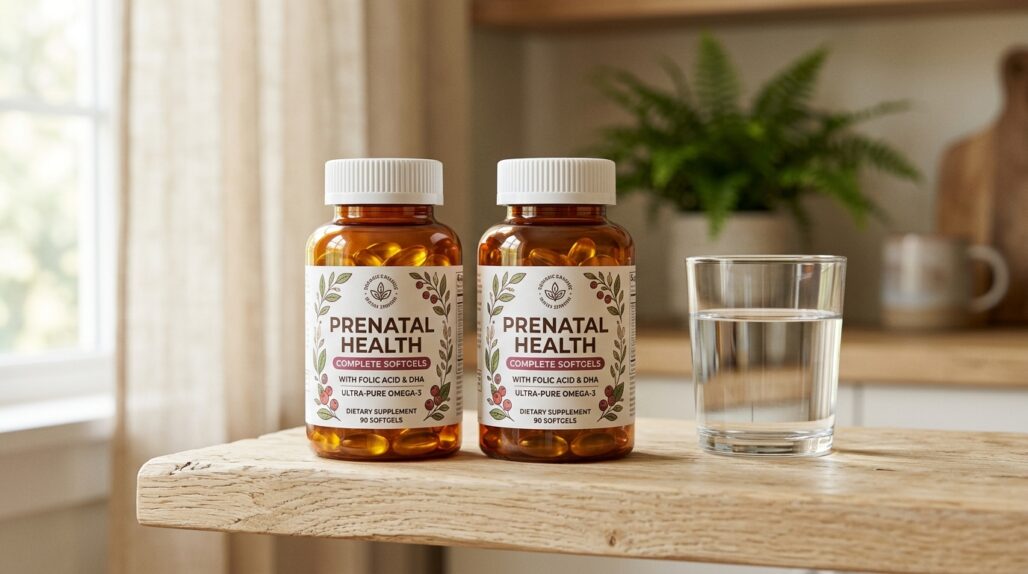
DHA is effectively a tie. Both deliver 200 mg DHA per serving; Nature Made's label lists 260 mg total omega-3 (200 mg DHA plus 60 mg EPA), but the DHA portion matches One A Day's 200 mg. Both are below the 300 mg many experts suggest in pregnancy, so if DHA is a priority you may add a separate prenatal fish oil regardless of which multi you pick.
Iron and iodine are effectively a tie. Both deliver 27 mg iron and 150 mcg iodine, which is the standard prenatal dose. That iron level is plenty for most pregnancies, though it is also the most common cause of constipation and nausea with either brand.
Choline is the real shared gap. Both standard formulas contain zero choline, and the amount the NIH choline fact sheet lists for pregnancy is 450 mg a day. One A Day sells a separate "Prenatal Advanced" version that adds a 110 mg choline tablet, but that is still well short, and it costs more. If choline is on your radar, no single-softgel drugstore prenatal will get you there.
| Nutrient or feature | Nature Made Prenatal Multi + DHA | One A Day Women’s Prenatal 1 |
|---|---|---|
| Folate form | Folic acid, 800 mcg (1,330 mcg DFE) | Folic acid, 800 mcg |
| DHA per serving | 200 mg DHA (260 mg total omega-3, incl. 60 mg EPA) | 200 mg DHA |
| Iron | 27 mg (ferrous fumarate) | 27 mg (carbonyl iron) |
| Iodine | 150 mcg | 150 mcg |
| Choline | None | None (110 mg in separate Advanced version) |
| Vitamin D3 | 25 mcg (1,000 IU) | Standard prenatal level |
| Third-party testing | USP Verified | No USP or NSF mark listed |
| Pills per day | 1 softgel | 1 softgel |
| Cost per day (approx) | ~$0.15 | ~$0.40 to $0.50 |
Third-party testing: the real separator
This is where Nature Made pulls clearly ahead. Nature Made Prenatal Multi + DHA carries the USP Verified mark, which means the USP Verified Products program has checked that the softgel contains what the label says, in the stated potency, made under controlled conditions, and screened for certain contaminants.
One A Day does not list a USP or NSF certification on its prenatal. That does not make it unsafe – Bayer, the company behind One A Day, manufactures to standard regulatory requirements. But there is no independent stamp confirming the contents, and for a category where you are taking the product daily through pregnancy, an outside check is worth something.
If third-party testing is your deciding factor, Nature Made is the obvious pick here, and it happens to be the cheaper one too. You rarely get both at once.
Cost per day and Subscribe & Save
This is the part the premium-focused reviews skip, and it is where the matchup is decided.
- Nature Made runs around $17 for a 110-day supply on Amazon (about $0.15 a day) as of writing – check current price. Subscribe & Save typically knocks another 5 to 15 percent off.
- One A Day Prenatal 1 runs around $15 for a 30-count at major retailers (roughly $0.50 a day), or close to $15 for the same count at Walmart. Larger bottles bring that down, but it rarely beats Nature Made per day.
So even before the testing difference, Nature Made costs roughly a third as much per day for a near-identical formula. Subscribe & Save on either brand smooths out the every-month repurchase, but it does not close that gap.
If you are comparing across the wider market on price, our Needed prenatal worth-it breakdown shows what you are actually paying for when you go premium, and our Needed vs FullWell comparison covers the methylfolate-plus-choline tier head to head.


As an Amazon Associate, UsefulVitamins.com earns from qualifying purchases at no extra cost to you.
UsefulVitamins may earn a commission from purchases made through the links above, at no extra cost to you. This never affects our verdicts.
When to step up to a practitioner brand
Drugstore prenatals like these two do the core job well, and for a healthy pregnancy with a varied diet they are often enough. But there are clear cases where you should spend more.
Step up if any of these apply:
- You have an MTHFR variant or were told to use methylfolate. Neither brand offers it.
- You want meaningful choline. Both fall far short of the 450 mg pregnancy target.
- You want full-dose DHA without a second pill. Both sit under 300 mg.
- You prefer a brand built around third-party purity testing as the core promise, not just a single verified SKU.
Practitioner-style prenatals cost more and usually mean more capsules per day, but they close those gaps. The tradeoff is real, and it is not for everyone. For most first-time buyers on a budget, the smarter move is the cheap, tested option now, and a conversation with your OB about whether you personally need the upgrade.
FAQ
Is Nature Made or One A Day prenatal better? Nature Made, for most people. The formulas are close, and both deliver the same 200 mg DHA, but Nature Made holds the USP Verified mark and costs roughly a third as much per day.
Do either of these use methylfolate? No. Both use folic acid, the standard synthetic form. That is effective for most people, but if you have an MTHFR variant, look at a methylfolate prenatal instead.
Is One A Day prenatal third-party tested? One A Day does not list a USP or NSF certification on its prenatal. Nature Made’s prenatal is USP Verified, which is an independent check on contents and potency.
Do these prenatals have enough choline? No. Both standard versions contain zero choline, and even One A Day’s Advanced version (110 mg) is well below the 450 mg the NIH lists for pregnancy. You would need a separate choline source.
How much do they cost per day? Nature Made is around $0.15 a day, and One A Day is around $0.40 to $0.50 a day as of writing. Check current prices, since drugstore promotions shift often.
Should I take a separate DHA supplement with either? Possibly. Both sit under the 300 mg DHA many experts suggest in pregnancy, so some people add a prenatal-safe fish oil. Ask your OB before stacking.
The verdict
If you want a plain answer: buy Nature Made. It matches One A Day on the nutrients that matter, including the same 200 mg DHA, carries an independent USP check One A Day lacks, and costs a fraction as much per day. One A Day is not a bad product – it is just the more expensive way to get a nearly identical folic-acid formula.
The bigger caveat applies to both. Neither uses methylfolate, and neither delivers meaningful choline. For a typical healthy pregnancy with good diet and an OB in the loop, that is usually fine. If you have a known MTHFR variant or want the fuller modern formula, skip both and price out a practitioner brand before you commit.
Your next step: confirm with your doctor what your iron, folate, and DHA needs actually are, then check whatever you choose against the rest of your medications. Start with our full drug and supplement interaction guide so the prenatal does not collide with anything you already take.
This article is for general information and is not medical advice. Supplement formulas, certifications, and prices change – verify the current label and price before buying, and talk to your doctor or midwife before starting any prenatal, especially if you are pregnant, trying to conceive, or taking medication.
Reviewed by the UsefulVitamins Editorial Team.
