
Affiliate disclosure: this article contains affiliate links. As an Amazon Associate, UsefulVitamins.com earns from qualifying purchases at no extra cost to you.
Before you buy
FullWell shows up in nearly every "best prenatal" list now, almost always praised for one number: 300 mg of choline, which is more than most prenatals on the shelf carry. That number is real, and it matters. But a prenatal is a daily habit you keep for a year or more, so the question is not whether the formula looks good on paper. It is whether you will actually take it.
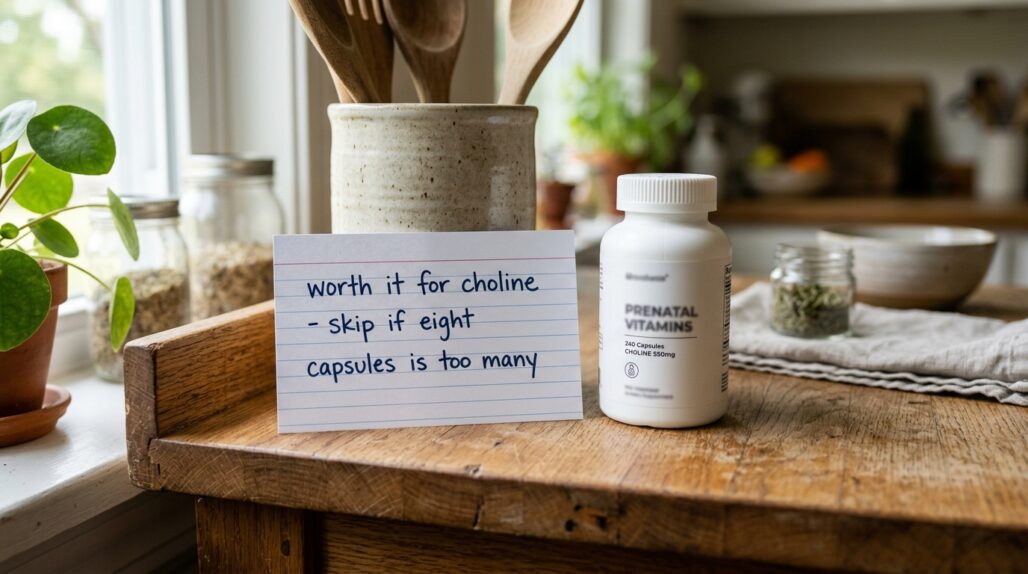
That is where FullWell gets divisive. The full daily dose is 8 capsules. Not two, not three. Eight. For some people that is a non-issue; for others it ends the conversation.
The other thing to know up front: FullWell deliberately leaves out iron and DHA. The brand sells those separately. That is a defensible choice for absorption reasons, but it means the bottle on its own is not a complete prenatal for everyone, and the "real" monthly cost can climb once you add the pieces back.
So this review is really about three trade-offs, the dose, the capsule count, and the cost, and who comes out ahead taking it.
What FullWell actually is
FullWell is a registered-dietitian-founded prenatal brand that sits in the "practitioner" tier alongside names like Needed and Theralogix, rather than the drugstore tier. The flagship is the Women's Prenatal Multivitamin, sold mostly direct and on Amazon.
The pitch is full-dose, evidence-based nutrient forms rather than the cheaper, lower-dose versions common in mass-market prenatals. In practice that means a few specific choices worth calling out.
- Active folate, not folic acid. The label lists 1,360 mcg DFE of folate as L-5-methyltetrahydrofolate plus calcium folinate, the forms the body uses directly.
- High choline. A full serving delivers 300 mg of choline (as choline bitartrate).
- No iron. This is intentional, and we get into why below.
- No DHA. Sold as a separate fish oil, because omega-3s can degrade when packed into a multivitamin.
The container holds 30 servings, which lines up with one month at the full 8-capsule dose.
The 8-capsule daily load, and why
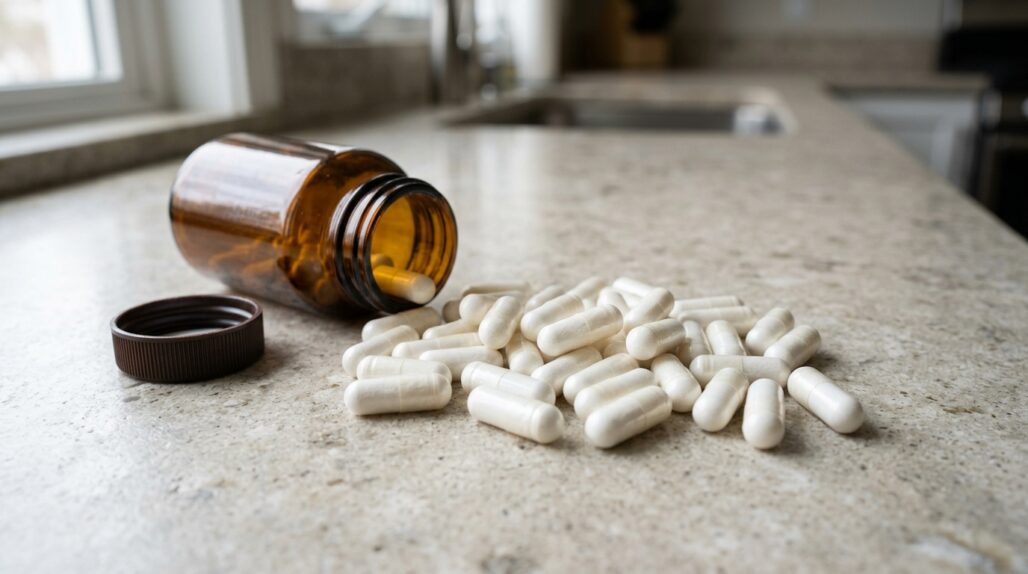
Here is the honest tension. You cannot fit FullWell's nutrient doses into two or three pills. Choline is bulky. Magnesium is bulky. Calcium is bulky. Brands that promise full-dose everything in a tiny pill are almost always rounding down somewhere.
FullWell's answer is to spread the formula across 8 capsules a day, which you can split across meals (4 in the morning, 4 later, for example). That is a reasonable design decision, not a gimmick. The cost is purely practical: more pills to remember and more to swallow when nausea hits in the first trimester.
If you are someone who already struggles to take one prenatal, be honest with yourself before you buy. A perfect formula you skip is worse than a good-enough formula you take every day. This is the single biggest reason FullWell is not right for everyone, and no amount of nutrient density changes that.
There is a half-measure here too. Some people take a partial dose (4 capsules) on rough days and the full 8 when they can. It is not ideal, but a partial dose of a strong formula can still beat a full dose of a weak one.
Choline, folate, vitamin D and magnesium – the part that earns the price
This is where FullWell justifies its tier. The doses are not just present; they are at levels backed by actual intake recommendations.
Choline is the headline, and it is a real gap in most diets. The Adequate Intake during pregnancy is 450 mg per day, and according to the NIH Office of Dietary Supplements, most pregnant people in the US fall short. The American Academy of Pediatrics flagged choline as a brain-building nutrient back in 2018. FullWell's 300 mg does not cover the full 450 mg AI by itself, but combined with food it gets most people meaningfully closer than the typical prenatal, many of which carry under 100 mg or none at all.
Folate is dosed in the active form. At 1,360 mcg DFE of methylfolate and calcium folinate, it clears the standard prenatal target and skips folic acid entirely. If you carry an MTHFR variant or simply prefer the pre-converted form, this is the form you want.
Vitamin D is on the higher side at 4,000 IU (100 mcg). That is above the basic prenatal level and within the range many practitioners use, though if you already supplement D separately, factor that in so you are not stacking high doses without reason.
Magnesium is included at 300 mg, as magnesium bisglycinate, a gentler and well-absorbed form. Plenty of prenatals skip magnesium entirely (Needed's standard Essentials does), so its presence here is a genuine point in FullWell's favor.
The formula also carries iodine, zinc as a chelate, vitamin K2 as MK-7, B12 as methylcobalamin, and B6 as P-5-P. None of this is filler-grade. It is a serious formula.

The no-iron decision
FullWell's prenatal contains no iron, and that surprises people. The brand's reasoning is that iron competes with other minerals for absorption and is better taken on its own, away from calcium especially.
There is logic to this. Iron absorption is finicky, and many people get GI side effects from iron in a multi. Taking it separately lets you match the dose to your actual bloodwork rather than a one-size guess.
But read the trade-off clearly. Pregnancy iron needs are high, and many people do need supplemental iron – your provider may well prescribe it based on your ferritin and hemoglobin. So FullWell is not "iron-free is better for everyone." It is "iron is a separate decision," which puts more responsibility on you and your provider.
If you specifically want a prenatal without iron, FullWell is a strong fit, and we cover the wider category in our roundup of prenatals without iron.
Third-party testing and quality
Quality testing is where premium prenatals should earn trust, and FullWell does reasonably well here without overselling.
The brand states that every lot is tested by an independent ISO-certified lab for heavy metals and other contaminants, with results held below California Prop 65 levels. FullWell publishes test results and makes Certificates of Analysis available, and will share the COA for your specific lot on request.
One honest caveat: FullWell is not carried by a formal certification program like USP or NSF at the time of writing, the way some drugstore prenatals are. Its testing is real and lot-level, but it relies on the brand's own published COAs rather than an outside seal. That is common for practitioner brands, and the published results are a fair substitute – just know the difference if a third-party seal is a hard requirement for you. For broader context on contaminant testing, the FDA's guidance on dietary supplement quality is a useful baseline.
Cost per day vs Needed and mainstream picks
Here is the math that actually decides it. FullWell runs around $49.95 a month direct (roughly $1.67 a day) as of writing, a little less on subscription. That is not cheap, but it is in line with its tier – and notably it is a 30-day supply of 8 capsules, not a thinner serving stretched to look affordable.
| Prenatal | Capsules/day | Choline | Folate form | Iron / DHA | Cost/day (approx) |
|---|---|---|---|---|---|
| FullWell | 8 | 300 mg | Methylfolate + folinate | Neither (sold separately) | ~$1.67 |
| Needed (Essentials) | 3 | 200 mg | Methylfolate | Neither (sold separately) | ~$1.43 |
| Nature Made Prenatal + DHA | 1 | None | Folic acid | DHA yes / iron yes | ~$0.50 |
A few things stand out. FullWell and Needed are close on price and quality, and the real difference is the capsule count, 8 versus 3, plus FullWell's higher choline and included magnesium. We break that matchup down fully in our FullWell vs Needed comparison, and if you are weighing Needed on its own, start with our Needed prenatal review.
Nature Made is dramatically cheaper and USP Verified, and it actually includes DHA and iron in the box. Its tradeoffs are folic acid instead of methylfolate and a slightly lower nutrient ceiling. For a lot of people, that is a perfectly fine prenatal, the "good enough you'll take it" option.
One more cost note: if you add FullWell's separate DHA fish oil, your real monthly spend goes up, so compare total stacks, not just the multi.
Who FullWell suits, and who should buy cheaper
Buy FullWell if you want maximum choline and active folate, you are fine taking 8 capsules, and you prefer to dose iron separately based on bloodwork. For that person, it is one of the best formulas available and the price is fair.


As an Amazon Associate, UsefulVitamins.com earns from qualifying purchases at no extra cost to you.
UsefulVitamins may earn a commission from purchases made through links on this page, at no extra cost to you. This never changes our verdicts.
Buy cheaper if any of these are true:
- Pill count is a dealbreaker. Needed gives you a comparable practitioner-grade formula in 3 capsules. The choline is a bit lower, but you will actually take it.
- Budget is tight. Nature Made's Prenatal + DHA is USP Verified, includes DHA and iron, and costs a fraction as much.
- You want everything in one bottle. FullWell's no-iron, no-DHA design means a more complete single-bottle prenatal may suit you better.
Whatever you land on, check anything you take against your other medications, especially if you are on thyroid medication or anything affected by minerals – our supplement and medication interaction guide is a good place to start, and always confirm with your provider.
FAQ
How many capsules of FullWell do you take per day? Eight capsules a day for the full dose. You can split them across meals, and some people take a partial dose on rough days, but the formula is designed around the full 8.
Does FullWell prenatal have iron? No. FullWell leaves iron out on purpose because it competes with other minerals for absorption, and recommends taking it separately based on your bloodwork. Many people in pregnancy do need supplemental iron, so discuss it with your provider.
Does FullWell contain DHA? No, the multivitamin does not. FullWell sells a separate prenatal fish oil because DHA can degrade when packed into a multivitamin. Factor the extra cost in if you add it.
Is FullWell third-party tested? Yes. The brand says every lot is tested by an independent ISO-certified lab and publishes results, with a Certificate of Analysis available on request. It is not USP or NSF certified, so it relies on its own published COAs.
Is FullWell better than Needed? They are close. FullWell has more choline and includes magnesium; Needed needs only 3 capsules instead of 8. The better pick depends mostly on whether the capsule count matters to you.
How much does FullWell cost per day? Around $1.67 a day, or roughly $49.95 a month direct as of writing, a little less on subscription. Check the current price before buying, since pricing changes.
The verdict
FullWell earns its place among the better prenatals. The choline is high, the folate is in the active form, magnesium is included, and the testing is real even without a third-party seal. The formula is not the weak point – the 8-capsule load and the separate iron and DHA are.
So the honest call is conditional. If you will take all 8 capsules, FullWell is worth the price. If you know yourself and 8 pills a day will not happen, buy Needed for a similar formula in 3 capsules, or Nature Made if budget is the deciding factor – a prenatal you take every day beats a better one you abandon.
Next step: be realistic about the capsule count, decide separately with your provider whether you need iron and DHA, and price the full stack rather than the multi alone before you commit.
This article is for general information and is not medical advice. Supplement needs in pregnancy vary, and you should discuss any prenatal, iron, or DHA decision with your healthcare provider.
Reviewed by the UsefulVitamins Editorial Team.
