
Affiliate disclosure: this article contains affiliate links. As an Amazon Associate, UsefulVitamins.com earns from qualifying purchases at no extra cost to you.
Before you buy
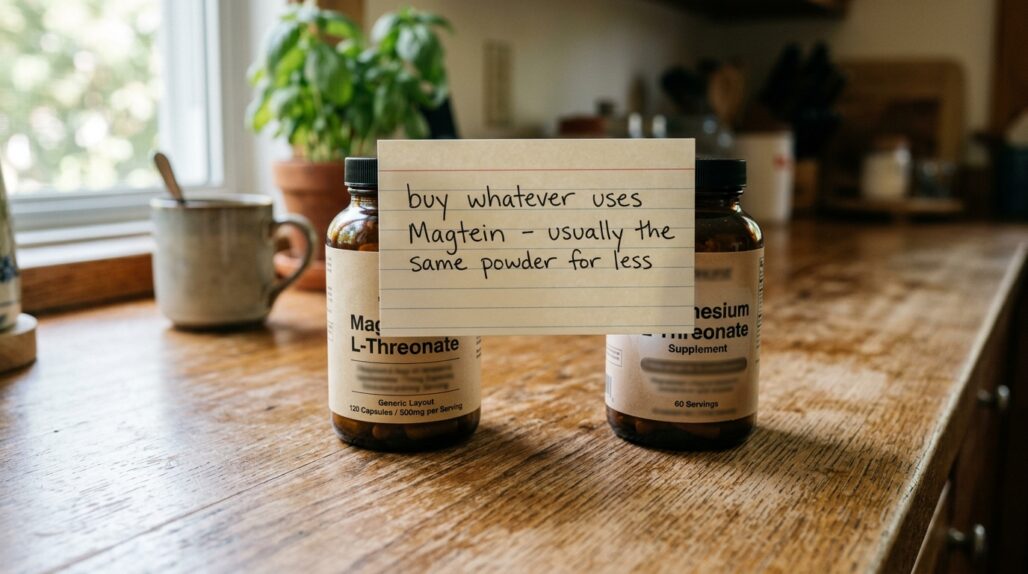
The question in the headline sounds sharper than the reality. People picture expensive patented Magtein on one side and a cheap unbranded "magnesium L-threonate" on the other, and assume they are paying extra for a logo.
In practice that split barely exists. Magtein is the patented, trademarked version of the ingredient, and most of the magnesium L-threonate sold on Amazon is licensed Magtein under a different brand name. Double Wood, Sports Research, NOW Foods, and Life Extension's Neuro-Mag all list Magtein as the actual raw material.
So the honest framing is this. You are usually not choosing between Magtein and a generic – you are choosing between two bottles that both contain Magtein, sold by companies with different markups and different testing.
The decision that does matter: whether magnesium L-threonate in any form is worth buying at all, given a thin pile of small, industry-funded studies and a dose that delivers very little actual magnesium. That is what the rest of this comes down to.
What Magtein actually is
Magtein is a branded form of magnesium L-threonate, a compound that pairs magnesium with threonic acid, a substance derived from vitamin C metabolism.
The form traces back to a 2010 rat study published in Neuron by researchers connected to MIT and Tsinghua University, covered at the time by ScienceDaily's writeup of the magnesium-and-memory work. The pitch was that this particular salt raises magnesium levels in the brain better than older forms, which in rats tracked with better learning and memory.
The trademark is owned by Magceutics and distributed by the ingredient supplier AIDP, which holds U.S. patents on the compound and its use, per AIDP's patent announcement in Nutritional Outlook. When a supplement label says "Magtein," that is the studied, patented material.
When a label just says "magnesium L-threonate" with no Magtein trademark, it may be a different, unstudied source. That is the only version that counts as a true generic – and it is less common than the marketing of either side suggests.
How little magnesium you actually get
Here is the part the brain-health framing tends to skip. Magnesium L-threonate is a heavy molecule, so a large dose of it carries a tiny amount of elemental magnesium.
The standard serving is 2,000 mg of magnesium L-threonate, which works out to roughly 144 mg of elemental magnesium – about 8 percent of the compound by weight. That is also the dose used in the trials.
For comparison, the NIH Office of Dietary Supplements magnesium fact sheet puts the adult RDA at 310 to 420 mg of elemental magnesium per day. A full L-threonate serving covers under half of that, and it does it with a hefty capsule load: most brands need three or four capsules per serving.
So if your goal is simply to fix a magnesium shortfall – the kind tied to muscle cramps, sleep, or regularity – L-threonate is an expensive, bulky, low-yield way to get there. Plain magnesium glycinate or citrate delivers far more elemental magnesium per dollar. Our magnesium forms and bioavailability breakdown lays out where each form fits.
The whole case for L-threonate rests on the brain-specific claim, not on general magnesium status. So that claim has to carry the price.
What the cognition research really shows
The research is genuinely interesting and genuinely thin. Read it as promising, not settled.
The strongest recent data is a 2026 randomised, double-blind, placebo-controlled trial in 100 healthy adults aged 18 to 45 with poor self-reported sleep, published in Frontiers in Nutrition. After six weeks on 2 g of Magtein daily, the Magtein cognition and sleep trial reported a significant overall cognition improvement and faster reaction time, headlined as a "7.5-year reduction in estimated brain age."
The caveats are doing a lot of work, though. The study was funded by an ingredient company and supplied with its product, the cohort was young and already cognitively above average, and the sleep benefit showed up in questionnaires but not in objective wearable measurements. The authors themselves flag the short duration and warn the results should not be stretched to other magnesium forms.
A separate 30-day Nutrients trial in 102 healthy adults aged 18 to 65 tested a Magtein-based combination formula (with phosphatidylserine and vitamins) and reported significant memory-quotient gains, with older participants benefiting most. Because it was a multi-ingredient blend, it cannot pin the effect on L-threonate alone.
Put bluntly: the human evidence is a handful of small, short, industry-funded trials, mostly with subjective endpoints. That is enough to make L-threonate worth a try for someone targeting focus and memory. It is not enough to treat it as proven.
Magtein vs generic: what differs and what costs
Because the studied material and most "generic" bottles are the same Magtein powder, the real differences are testing, capsule count, and price – not the active ingredient.
| Dimension | Branded "Magtein" bottle (e.g. Sports Research, Double Wood) | True non-Magtein generic |
|---|---|---|
| Active ingredient | Patented Magtein magnesium L-threonate | Unbranded magnesium L-threonate, source varies |
| Used in the human trials | Yes – this is the studied material | No – not the exact material tested |
| Elemental magnesium per serving | Around 144 mg (from 2,000 mg L-threonate) | Usually similar if dosed the same |
| Capsules per serving | 3 to 4 | 3 to 4 |
| Third-party testing | Often NSF and per-batch heavy-metal testing | Inconsistent; verify before buying |
| Typical monthly cost | Around $15 to $35, as of writing | Sometimes cheaper, but not always |
On price, the numbers undercut the premium story. A 90-capsule Sports Research bottle that uses Magtein runs around $30 list, and has dropped near $15 with coupon and Subscribe & Save, per its Sports Research Magtein listing. Double Wood, also Magtein-based, lists around $31 for 120 capsules as of writing. Check current prices, since coupons move.
So a brand carrying the patented ingredient can still be the cheapest option on the shelf. Paying more for "Magtein" specifically only makes sense when the alternative is a no-name L-threonate that skips the trademark and the testing. In that case the small premium buys you the studied material and, usually, cleaner third-party verification.
Cost per serving, and where the money should go
Think in elemental magnesium, not pill count. At roughly 144 mg elemental per serving for about $0.50 to $1.20 a day, L-threonate is one of the priciest ways to buy magnesium – because you are paying for the brain-targeting claim, not the mineral.
If general magnesium is the goal, that money is better spent elsewhere. A month of solid magnesium glycinate often costs less and delivers two to three times the elemental magnesium. Our roundup of cheap magnesium glycinate on Amazon covers the value picks, and the broader complete guide to magnesium explains how much you actually need.
Reserve L-threonate for the narrow case it was built for: a focus, memory, or sleep-quality experiment you want to run on yourself, on top of meeting your baseline magnesium needs another way.

Top picks and the honest call
When you do want to try it, the rule is simple. Buy a bottle that clearly states Magtein and shows real third-party testing, at the lowest price per serving you can find. The patented material and clean testing matter more than the logo on the front.


As an Amazon Associate, UsefulVitamins.com earns from qualifying purchases at no extra cost to you.
Some links on this page are affiliate links. If you buy through them we may earn a commission at no extra cost to you, and it never changes our verdicts.
A few practical notes on the picks above. Favor brands with NSF certification or published per-batch heavy-metal results, since L-threonate is taken daily and capsule loads are high. Sports Research and Double Wood both carry Magtein and list third-party testing, which is why they tend to be the safe defaults rather than a random unbranded jar.
If you decide magnesium L-threonate is not pulling its weight, a high-dose glycinate is the smarter swap for most goals – cheaper, gentler, and far more elemental magnesium per capsule.
FAQ
Is generic magnesium L-threonate the same as Magtein? Often, yes. Most “generic-looking” bottles on Amazon – Double Wood, Sports Research, NOW, Life Extension – actually use licensed Magtein. A true generic only exists when a label says magnesium L-threonate with no Magtein trademark, and that is less common than people assume.
Is Magtein worth paying extra for? Only when the cheaper option is a non-Magtein L-threonate. If two bottles both contain Magtein, buy the one with better testing and a lower price per serving; the active ingredient is identical.
How much elemental magnesium is in a serving? A standard 2,000 mg serving of magnesium L-threonate provides only about 144 mg of elemental magnesium, well under the adult RDA of 310 to 420 mg. It is a low-yield way to raise magnesium status.
Does the cognition research prove it works? Not yet. The human trials are small, short, and largely funded by ingredient companies, with several benefits showing up only in subjective questionnaires. The signal is promising but far from settled.
Should I take it for sleep or muscle cramps? Probably not. For sleep, cramps, or regularity, cheaper magnesium glycinate or citrate delivers far more usable magnesium per dollar. L-threonate’s only real selling point is the brain-targeting claim.
How many capsules do I have to take? Most brands require three or four capsules to reach the studied 2,000 mg dose, often split between morning and evening. If swallowing several capsules a day is a dealbreaker, this form is not for you.
The verdict
The "patent vs generic" debate is mostly a marketing illusion. The cheaper bottles usually contain the very same patented Magtein, so there is rarely a real premium to argue about – just brands with different markups and testing.
The honest call is twofold. If you want to test magnesium L-threonate for focus, memory, or sleep quality, pick any well-tested Magtein bottle at the lowest price per serving and treat it as a personal experiment backed by early, industry-funded research. But if you just need magnesium, skip L-threonate and buy glycinate or citrate – you will get far more elemental magnesium for less money.
Your next step: check whether the bottle in your cart actually lists Magtein and third-party testing, then compare its price per serving against a plain glycinate. If you are still deciding which magnesium form fits your goal, start with our complete guide to magnesium. Curious how the hyped multi-form blends stack up? See whether Magnesium Breakthrough is worth it before paying for one.
This article is for general information and is not medical advice. Supplements can interact with medications and conditions; talk to your doctor or pharmacist before starting magnesium L-threonate, especially if you take other medications or have kidney issues.
Reviewed by the UsefulVitamins Editorial Team.
