
Affiliate disclosure: this article contains affiliate links. As an Amazon Associate, UsefulVitamins.com earns from qualifying purchases at no extra cost to you.
Before you buy
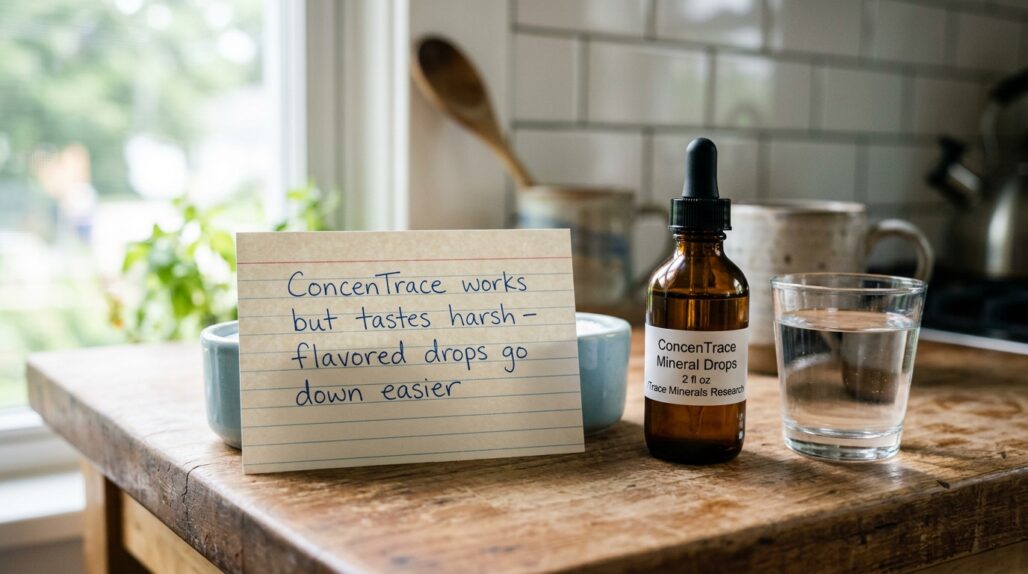
ConcenTrace is a concentrated liquid mineral made from Great Salt Lake water with about 99% of the sodium stripped out. It works. The reason people search for an alternative is almost never the minerals – it is the taste.
The brand itself tells you to mix the full dose into juice or food, which is a polite way of saying the concentrate is intense on its own. That is the real decision here: you are not replacing a broken product, you are buying something easier to actually keep using.
So before you swap, get clear on what you want the drops to do. Three jobs get blurred together in this category, and the best pick is different for each one.
- Remineralize plain or filtered water so it tastes less flat and gives you a light mineral profile.
- Replace electrolytes lost through sweat, heat, or a low-carb diet.
- Hit a meaningful magnesium dose for sleep, cramps, or regularity.
A trace-mineral drop is genuinely good at the first job, fine at the second, and a poor choice for the third. Keep that split in mind and the rest of this is easy.
What ConcenTrace actually delivers
ConcenTrace is the benchmark in this niche for a reason. According to the official Trace Minerals product page, it provides more than 70 naturally occurring ionic trace minerals sourced from the Great Salt Lake, including magnesium, chloride, potassium, sulfate, boron, and lithium.
The serving size matters more than most people realize. A full dose is about 40 drops (half a teaspoon), and that full dose carries roughly 250 mg of magnesium plus a heavy slug of chloride. That is a real magnesium amount – but almost nobody takes the full 40 drops, because that is exactly the dose that tastes the strongest.
In practice, people use 10 to 20 drops in a bottle of water, which drops the magnesium down to something modest while keeping the broad mineral spread. So the honest read is this: at a tolerable taste level, you get a wide trace-mineral profile and only a small fraction of a magnesium dose.
On quality, Trace Minerals lists ConcenTrace as Non-GMO Project Verified and says it is third-party tested for quality and purity. That is reasonable, though the company does not publish a specific certifier the way an NSF or USP seal would. An 8 fl oz bottle is labeled at 96 servings, which is why the per-serving cost stays low even at a $30-40 bottle price (check current price).
The competing trace-mineral and electrolyte options
Here is where the alternatives split into two camps: near-flavorless drops that try to disappear into your drink, and flavored concentrates and powders that lean into a taste you might actually enjoy.
Buoy Hydration Drops – the easy-to-drink swap
Buoy is the most direct "better-tasting" answer. Per its official product page, it delivers 87+ trace minerals from sea salt plus a B-vitamin and antioxidant blend, and it is built to be purposefully unflavored so it slides into water, coffee, or a smoothie without tasting like brine.
The trade-off is dosing. Buoy is a light daily-hydration product, not a mineral megadose – its magnesium and calcium each sit around 1% of the daily value per serving. So you get the easy taste and the broad spread, but not a magnesium dose worth counting.
Anderson's Sea M.D. – the close ConcenTrace clone
If you like ConcenTrace's concept and just want options or a different price, Anderson's Sea M.D. Concentrated Trace Mineral Drops is the nearest twin. The Amazon listing describes 79 trace minerals with magnesium, sodium, and chloride, in the same sea-derived concentrate format.
Be honest with yourself, though: this is the same category of strong mineral taste. It is an alternative brand, not an escape from the flavor. Buy it for choice or stock, not because it will solve the taste complaint.
40,000 Volts – same maker, electrolyte focus
Trace Minerals' own 40,000 Volts concentrate is the electrolyte-leaning sibling. The official 40,000 Volts page positions it for hydration and stamina with ionic magnesium, sodium, and potassium. It is still unflavored and salty, so it has the same "mix it into something" caveat – it just shifts the balance toward sweat replacement.
Power Pak – the flavored fix from the same brand
If the goal is "make it taste good," the cleanest answer is the brand's own Power Pak flavored powder. Per the Power Pak product page, each effervescent packet carries 1,200 mg of vitamin C, zinc, B vitamins, and a full ionic trace-mineral spread, in flavors like acai berry, lemon lime, and citrus.
This is the one that solves the actual problem most searchers have. You keep the trace minerals, you add real electrolytes, and you trade an eyedropper of seawater for a drink people genuinely like. The cost is a little sugar (about 1 g) and packet packaging instead of a bottle.
When a dedicated magnesium beats any trace-mineral drop
This is the part the category gets wrong. People reach for ConcenTrace expecting it to be their magnesium supplement, and at a normal taste-tolerant dose, it is not.
Adults need a fair bit of magnesium. The NIH Office of Dietary Supplements lists the RDA at roughly 400-420 mg per day for men and 310-320 mg for women, and sets the upper limit for supplemental magnesium at 350 mg to avoid the loose-stool effect.
To get a meaningful 200-400 mg from a trace-mineral drop, you would need the full high-drop dose – the same dose that tastes the worst and that the label tells you to dilute. That is backwards. If magnesium is your goal:
- Buy a magnesium glycinate, which is well absorbed and gentle on the gut.
- Common Amazon options run 200 mg to 400 mg per serving for roughly $15-25 a bottle as of writing (check current price). Note the NIH supplemental upper limit is 350 mg per day to avoid the loose-stool effect, so many people do well starting at 200 mg and only going higher if needed and tolerated.
- Take it for sleep, cramps, or regularity, and let a trace-mineral drop handle the broad-mineral, water-flavor job separately.
For a deeper breakdown of why the form matters, our guide to magnesium and the rundown on magnesium forms and bioavailability are worth a read. If you want specific budget picks, see our list of the cheapest magnesium glycinate on Amazon.
How the options compare
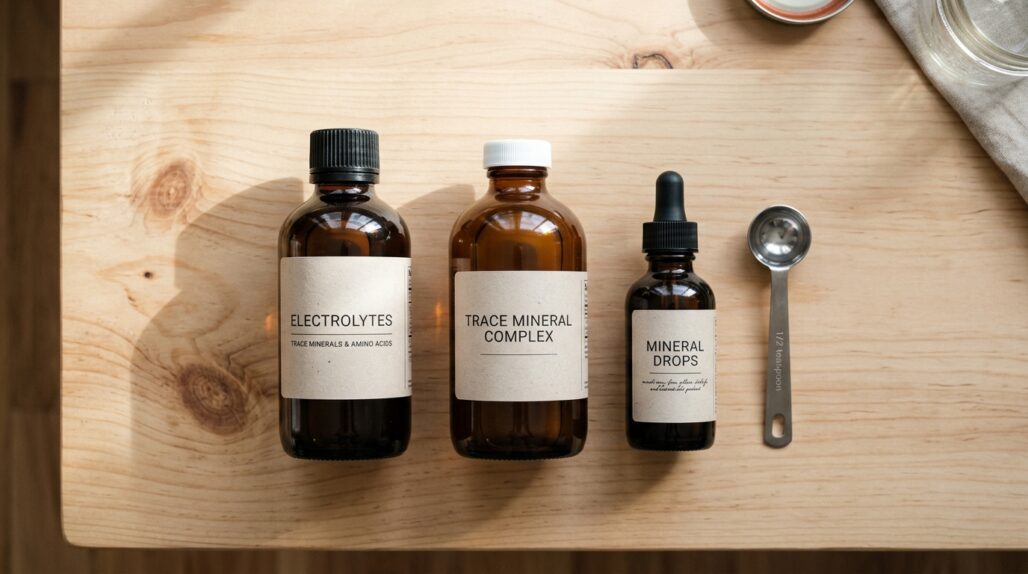
The table sorts the field by what you are actually trying to do. Notice that almost nothing here is a real magnesium product – that is the whole point.
| Product | Format | Taste | Magnesium reality | Best job |
|---|---|---|---|---|
| ConcenTrace | Ionic drops | Strong, must dilute | ~250 mg only at full 40-drop dose | Broad remineralizing (the benchmark) |
| Buoy Drops | Ionic drops | Near flavorless, easy | Trace (~1% DV per serving) | Easy daily hydration in any drink |
| Anderson’s Sea M.D. | Ionic drops | Strong, like ConcenTrace | Modest at tolerable dose | A ConcenTrace-style alternative brand |
| 40,000 Volts | Liquid concentrate | Salty, unflavored | Modest, electrolyte-focused | Sweat and endurance electrolytes |
| Power Pak | Flavored powder packets | Genuinely pleasant | Modest, plus vitamin C and zinc | Flavored daily electrolyte drink |
| Magnesium glycinate | Capsules | None (swallow) | Real 200-400 mg dose | Sleep, cramps, regularity |
Top picks by what you are trying to do
There is no single winner here, because these products do different jobs. Match the pick to your reason for buying.


As an Amazon Associate, UsefulVitamins.com earns from qualifying purchases at no extra cost to you.
Some links on this page are affiliate links. If you buy through them we may earn a small commission at no extra cost to you. It never changes our verdict.
- Want minerals in plain water without the seawater taste? Go with Buoy for the near-flavorless drop, or Power Pak if you would rather have a flavored drink.
- Want a true ConcenTrace experience, just shopping brands? Anderson's Sea M.D. is the closest match, but expect the same strong taste.
- Sweating hard or low-carb and cramping? A flavored electrolyte like Power Pak or the brand's 40,000 Volts fits better than a trace-only drop.
- Actually want magnesium for sleep or cramps? Skip the drops for that purpose and buy a magnesium glycinate. It is the cheaper, more honest answer.
If you are still on the fence about the original product, our full take on whether ConcenTrace mineral drops are worth it walks through the same evidence in more detail.

FAQ
Does ConcenTrace really taste that bad? On its own, yes – it is a concentrated seawater mineral, and the maker itself recommends diluting the full dose in juice or food. Most people tolerate a smaller drop count in a large glass of water, but the full magnesium dose is where the taste peaks.
Which alternative tastes the most neutral? Buoy Hydration Drops are built to be near flavorless, so they disappear into water, coffee, or smoothies better than any of the strong sea-derived concentrates.
Are trace-mineral drops a good magnesium supplement? Not at a normal, taste-tolerable dose. To get a meaningful 200-400 mg of magnesium you would need the strongest, least pleasant dose. For magnesium specifically, a dedicated magnesium glycinate is cheaper and easier.
What is the difference between ConcenTrace and 40,000 Volts? They share the same brand and sea-mineral base, but 40,000 Volts is tuned toward electrolytes for hydration and stamina, while ConcenTrace is the broad trace-mineral baseline. Both are unflavored and need diluting.
Is a flavored powder like Power Pak as good as the drops? For most people it is better, because they will actually keep drinking it. You get the trace minerals plus added vitamin C and zinc, at the cost of a little sugar and packet packaging.
Do I need any of these if I eat a balanced diet? Often no. Trace minerals matter, but most come from food and water. These products help if your water is heavily filtered, you sweat a lot, or you simply prefer mineralized water. Talk to your clinician before adding minerals if you have kidney concerns.
The verdict
ConcenTrace is a solid product with one stubborn flaw: the taste is the reason people stop using it. If that is your only complaint, the fix is simple – switch to a near-flavorless drop like Buoy or a flavored powder like Power Pak, and you keep the trace minerals without the wince.
The bigger lesson is to match the tool to the job. A trace-mineral drop is for broad remineralizing and light electrolytes, not for a real magnesium dose. If you wanted magnesium all along, a magnesium glycinate is the cheaper, more effective buy, and you can run it alongside any of these drops.
Your next step: decide which of the three jobs you actually care about – water flavor, electrolytes, or magnesium – then buy the one product that nails it instead of hoping a single bottle does all three.
This article is for general information only and is not medical advice. Supplements are not a substitute for a balanced diet or treatment, and high-dose magnesium can interact with certain medications and kidney conditions. Talk to your doctor or pharmacist before starting any new supplement.
Reviewed by the UsefulVitamins Editorial Team.
