
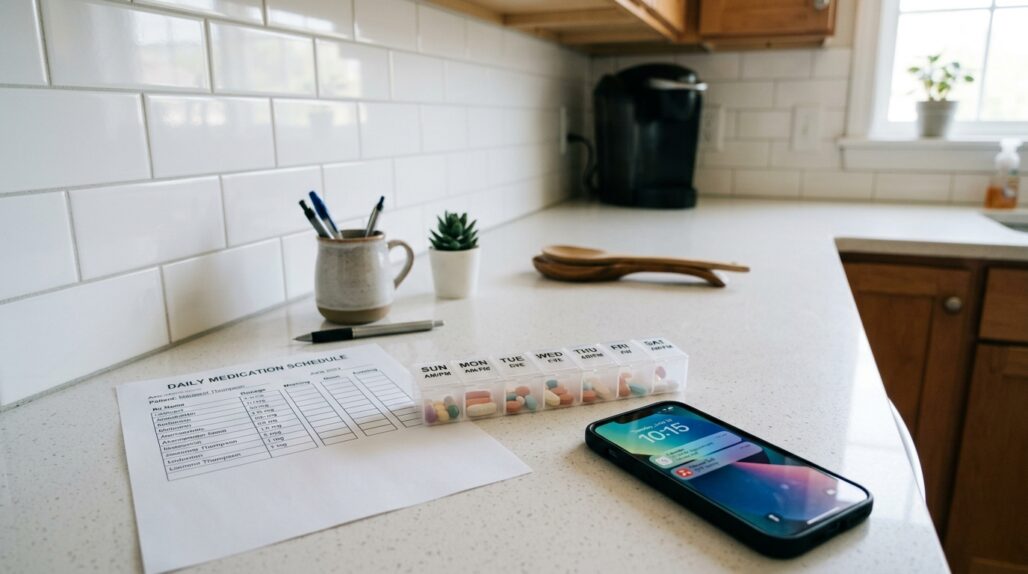
Why this list matters most when you have the least time
An emergency room visit is loud, fast, and stressful. Somebody asks you what your mother takes, and your mind goes blank. You half-remember a blue pill, something for blood pressure, a vitamin she swears by. That gap is exactly where mistakes start.
Researchers who study what happens when older adults move between home, the hospital, and back have found that medication errors cluster at these transition points. In one study of older patients, 68% had at least one unintentional medication discrepancy somewhere along the way, and patients with those mismatches had roughly twice the risk of a return emergency visit within 30 days, according to work published in the National Library of Medicine's PMC archive. A clear, current list does not fix everything, but it removes one of the biggest sources of that confusion.
The good news is that the fix is low-tech and free. You build the list once, keep it current, and store it where anyone can grab it. The rest of this guide walks through what goes on it, how to make one you can print today, and how to keep it from going stale.
What the ER team actually needs, fast
Emergency clinicians are not trying to read a novel. They want a short, accurate snapshot they can scan in under a minute. Here is what belongs on it.
- Current medications and doses. Name, strength, and how often. Include the times of day if a drug is timing-sensitive.
- Supplements and over-the-counter products. Vitamins, minerals, herbal products, fish oil, melatonin, antacids – all of it.
- Allergies and reactions. Not just the drug name but what it did (rash, swelling, trouble breathing).
- Major medical conditions. Diabetes, heart conditions, kidney problems, a pacemaker, recent surgeries.
- Recent changes. Anything started, stopped, or adjusted in the last few weeks, with the date if you have it.
- Emergency contacts. Two names with phone numbers, and who holds power of attorney if anyone does.
- Advance directive status. Whether one exists and where the document lives.
Federal patient-safety guidance lines up with this. The Agency for Healthcare Research and Quality recommends keeping a personal medicines list that names each medicine, its strength, what it is for, and when and how much you take, and updating it whenever something starts or a dose changes, in its guide on how to create a My Medicines list. The same agency offers a printable medicine wallet card built to live in a wallet or purse.
You do not need their template to start. You need the habit of writing it down.
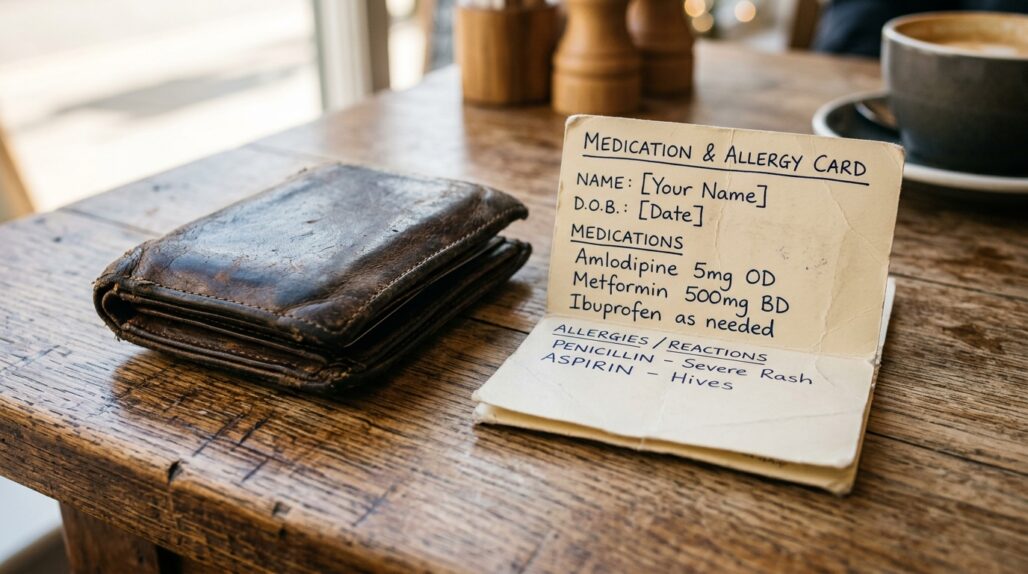
Build the list today: a printable you can copy by hand
You can make a usable version right now with a sheet of paper and a pen. Copy the layout below, fill in one row per item, and you have a document the ER can read. Keep it to one page if you can.
| Field | What to write | Example |
|---|---|---|
| Medicine or supplement | Exact name on the label | Metformin / Vitamin D3 |
| Strength | The number on the bottle | 500 mg / 2000 IU |
| How often | Times per day and when | Twice daily, with meals |
| What it is for | Plain-language reason | Blood sugar / bone health |
| Prescriber | Doctor’s name if known | Dr. Alvarez |
| Started or changed | Date of any recent change | Dose raised Jan 3 |
Under that grid, add three short blocks:
- Allergies: drug, and what reaction it caused.
- Conditions: the big ones, and any implanted devices.
- Contacts: two people, their numbers, and who can make decisions.
Date the page. A list with no date forces the ER team to guess how old it is, which defeats the purpose.
If your parent uses a pharmacy that prints a full medication profile, ask for one and staple it behind your page. It is a useful backup, though it usually will not show supplements or anything bought elsewhere, so your handwritten sheet still does real work.
Do not skip the supplements
Families often leave supplements off because they feel harmless. In an emergency they can matter more than people expect. Several common supplements affect how blood clots, which is relevant if your parent is bleeding, may need a procedure, or already takes a blood thinner.
The U.S. Food and Drug Administration warns that dietary supplements can interact with medicines and that some can affect bleeding or your response to anesthesia, which is why it urges people to tell every health care provider about all supplements they take, in its consumer update on mixing medications and dietary supplements. Fish oil, vitamin E, ginkgo, garlic pills, and turmeric extracts are the ones that come up most around bleeding and surgery.
The NIH Office of Dietary Supplements makes the same point plainly: keep a record of every supplement you take and share it with all of your providers, since they cannot account for what they do not know about, in its overview on dietary supplements and what you need to know. That record costs nothing and may change what the ER team does next.
To be clear, listing a supplement is not the same as stopping it. Do not stop or change anything on your own before a visit. If you are unsure whether a supplement matters, or whether two products contain the same ingredient, that is a question for a pharmacist. Our own interaction checker and the deeper guide to drug and supplement interactions can help you flag candidates to raise, and the broader question of whether a parent's supplements are safe alongside prescriptions is worth a calm review before anything urgent comes up.
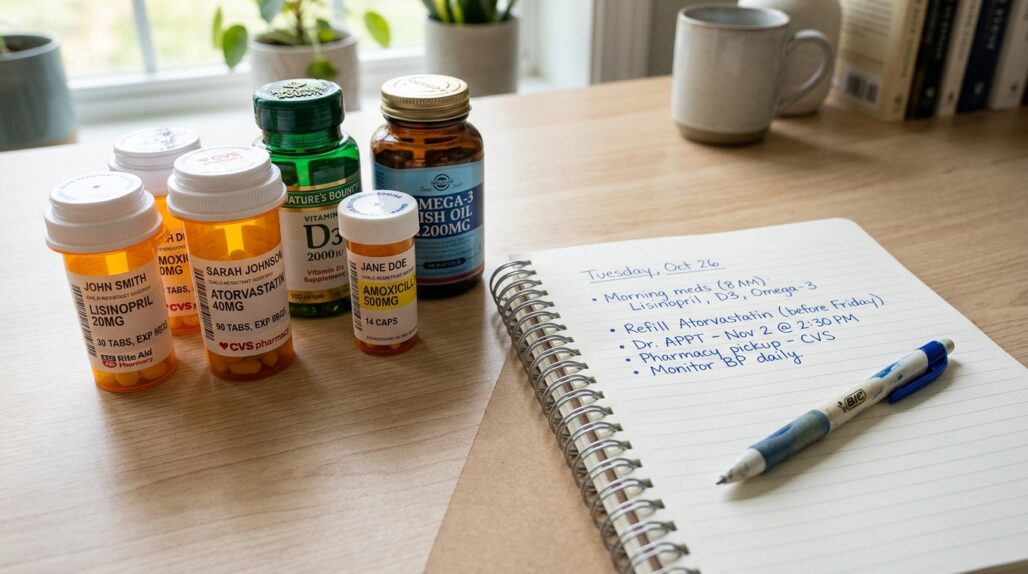
Keep it current and easy to grab
A perfect list helps no one if it is two years old or locked in a drawer nobody can reach. Two habits keep it useful.
First, update it the moment anything changes. A new prescription, a stopped drug, a dose adjustment, a new supplement – each one is a one-line edit. The natural time to refresh the whole thing is after any doctor visit or after a hospital stay, which is also when changes are most likely. If your parent has been in the hospital recently, our checklist on what to check when medications change after discharge pairs well with this habit, since discharge is when lists drift the most.
Second, keep a copy in more than one place so any family member can produce it. A printed card in the wallet or purse. A photo of that card on a phone. A magnet-held copy on the fridge for paramedics, who are trained to look there. The point is redundancy: if one copy is missing, another is reachable.
Once the manual list exists, the daily challenge is just keeping it from going stale – which is the part paper struggles with, because edits live on whatever copy you happened to update. In an emergency you will not have time to reconstruct anything, so a phone-based copy that updates in seconds is a practical backstop. StackMyMed (our own free app) keeps the current meds, doses, and allergies on your phone so you can show or export them the moment you reach the desk, and it flags possible interactions to raise with your pharmacist rather than clearing anything itself. If an app is not your thing, the fridge card and the wallet copy do the same job – the rule that matters is that a current copy exists somewhere you can hand over fast. For the medical calls, the ER team and your pharmacist decide; the list just makes sure they are deciding with the full picture.
A short pre-trip routine when you are already on the way
If something is happening right now, you do not have time to build a list from scratch. Grab whatever exists and go. On the way or in the waiting room, do this:
- Take a clear photo of every pill bottle and supplement jar you can reach, labels facing the camera.
- Note anything started or stopped in the last few weeks.
- Write down two phone numbers for family who should know.
Photos of labels are a rough but real fallback when no list exists. The ER can read a strength off a bottle far faster than they can decode your memory of a blue pill. When the dust settles, that pile of photos becomes the raw material for the proper list you build for next time. Many families also keep a packed bag with copies of ID, insurance cards, and any advance directive, so the paperwork is not a second emergency.
FAQ
Do I need to bring the actual pill bottles to the ER? A written list with doses is usually enough, and many hospitals prefer to dispense their own medications. Bottles or clear label photos help as backup, especially if you are unsure of a strength.
Should supplements really go on the list? Yes. Some supplements affect bleeding or interact with medicines and anesthesia, so the FDA and the NIH Office of Dietary Supplements both advise telling every provider about all of them. Leaving them off hides information the team may need.
What if I do not know all my parent’s medications? Photograph every bottle you can find and bring those. Afterward, ask the pharmacy for a printed medication profile and use it to build a complete list for next time. A pharmacist can also help fill gaps.
How often should I update the list? Whenever anything starts, stops, or changes dose, and as a routine refresh after any doctor visit or hospital stay. AHRQ recommends adding new medicines the moment you start them so the list never drifts out of date.
Where should I keep the list so it is found in an emergency? In at least two places: a wallet or purse card, and a copy on the fridge where paramedics are trained to look. A phone copy adds a third. Redundancy is the point.
Can I stop a supplement before an ER or surgery visit to be safe? Do not stop anything on your own. List it, bring it up, and let a pharmacist or the clinical team decide. Changing or stopping a product without guidance can cause its own problems.
The bottom line
The single most useful thing you can do is build one current, one-page list – medicines, doses, supplements, allergies, conditions, and contacts – and keep a copy somewhere a stranger could find it in a hurry. That work happens calmly, before any crisis, which is exactly why it holds up during one.
This is preparation, not medical advice. The ER team makes the decisions; your job is to hand them an accurate picture. When you are unsure whether a supplement or a recent change belongs on the list, ask your pharmacist before the next emergency, not during it.
This article is for general information and is not medical advice. It does not replace guidance from your doctor or pharmacist, and nothing here should be used to start, stop, or change a medication or dose on your own.
StackMyMed is made by UsefulVitamins. It helps you organize your list and flag things to discuss with a pharmacist or doctor; it is not a diagnosis or treatment tool and does not replace professional medical advice.
Reviewed by the UsefulVitamins Editorial Team.
