
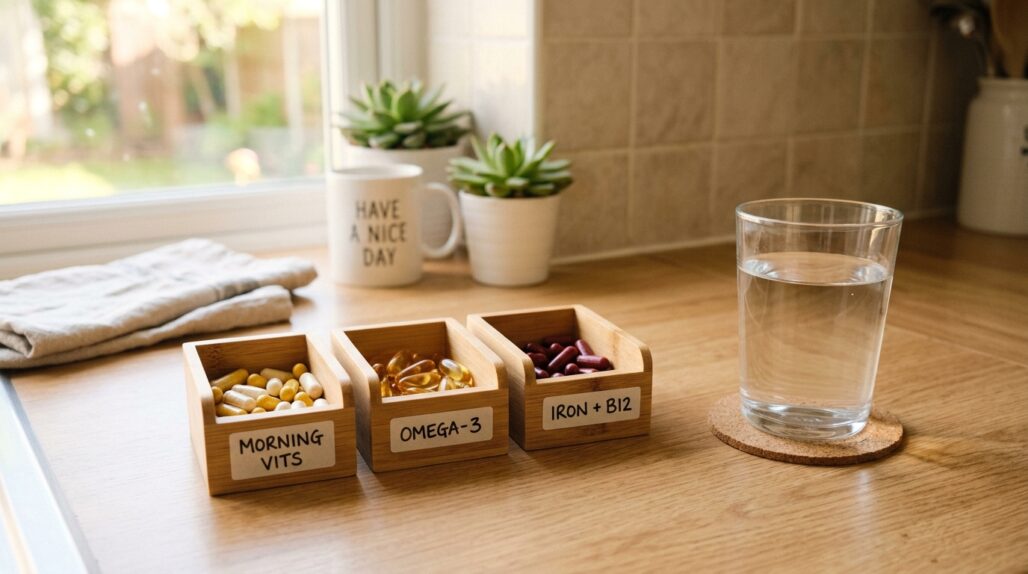
Why the order matters at all
For a lot of supplements, the honest answer is that timing barely moves the needle. A daily multivitamin taken whenever you remember it is far better than a perfectly timed one you keep skipping. So if you only take one or two things, do not overthink this.
Order starts to matter once a few specific situations are in play. Some nutrients compete for the same absorption pathway, so taking them together means you get less of both. Some are better with food, and some are blunted by it. And a few supplements gently wake you up or wind you down, which is a reason to put them at one end of the day rather than the other.
This guide gives you a plain morning, midday, and evening sequence, plus a short list of which items actually care about timing and which are happy to ride along anywhere. You do not need an app or a chart to use it. A pen and the back of an envelope will do.
The simple AM / midday / PM sequence
Here is a default order that works for most stacks. Treat it as a starting point, not a rule, and adjust to fit your meals and your day.
Morning, with or just before breakfast. This is the slot for anything that feels energizing or works alongside daytime metabolism. B vitamins and vitamin C are water-soluble and are commonly taken in the morning, partly because some people find a B-complex mildly stimulating. Iron also tends to go earlier in the day, but it has its own rules, covered below.
Midday or with your largest meal. The fat-soluble vitamins A, D, E, and K absorb better when there is some fat in the meal. The NIH Office of Dietary Supplements vitamin D fact sheet notes that vitamin D is absorbed better when taken with a meal that contains fat. So if your biggest, most balanced plate is lunch, that is a sensible home for vitamin D, fish oil, and a fat-soluble combination. If dinner is your main meal, move them there instead.
Evening, after dinner or before bed. Magnesium is the classic evening pick. Many people take it at night because it can feel calming and is easy to pair with a wind-down routine. Calcium also often lands in the evening, in part to keep it away from iron and from any morning thyroid medication.
A few examples of how this looks in practice:
- Morning: a B-complex and vitamin C with breakfast.
- Mid-morning, away from coffee: an iron supplement with a splash of orange juice.
- Lunch: vitamin D and fish oil with a meal that has some fat.
- Evening: magnesium after dinner, calcium with a snack before bed.
| Time slot | Good fit here | Why this slot |
|---|---|---|
| Morning | B-complex, vitamin C | Water-soluble and can feel mildly energizing for some people |
| Mid-morning, off coffee | Iron | Vitamin C helps it; coffee and calcium blunt it |
| Largest meal | Vitamin D, A, E, K, fish oil | Fat-soluble, so dietary fat improves uptake |
| Evening | Magnesium, calcium | Often calming; keeps calcium away from iron and thyroid meds |
The handful that genuinely care about timing
Most of your stack is flexible. These are the ones worth getting right.
Iron is the fussiest. Non-heme iron from supplements is poorly absorbed to begin with, and the polyphenols in coffee and tea bind to it and cut absorption further. The NIH iron fact sheet also lists calcium as an inhibitor of iron absorption. Vitamin C, on the other hand, helps. The practical takeaway: take iron away from your morning coffee, away from a calcium supplement, and consider pairing it with something containing vitamin C. If iron upsets your stomach on its own, that is common, and a pharmacist can suggest a gentler form or schedule. For more on the empty-stomach question, see our guide to which supplements to take on an empty stomach vs. with food.
Fat-soluble vitamins want fat. Vitamins A, D, E, and K, plus fish oil, are absorbed alongside dietary fat. Taking them with a plain glass of water on an empty stomach gets you less of them. Anchor them to the meal that actually has some olive oil, eggs, nuts, avocado, or fish.
Calcium and iron should not be roommates. Because calcium competes with iron, keep the two in different slots, which is one more reason iron drifts to the morning and calcium to the evening. If you are not sure which of your supplements clash and which actually help each other, our breakdown of which supplements to take together vs. space apart walks through the common pairings.
If you take a prescription, it drives the schedule. A levothyroxine (thyroid) tablet is the clearest example. The NCBI StatPearls reference on levothyroxine notes that it should not be taken within four hours of calcium or iron, because both bind to it and reduce how much you absorb. Levothyroxine itself is taken on an empty stomach before breakfast. So the prescription anchors the morning, and your calcium and iron move to later. This is exactly the kind of detail to confirm with your pharmacist for your specific medication, since the gaps differ by drug. Our medication and supplement timing guide goes deeper on building a stack around a prescription.
Everything else is mostly flexible. A multivitamin, vitamin C alone, zinc, a probiotic, herbal extracts: pick a slot you will remember and stick with it. Consistency beats precision here.
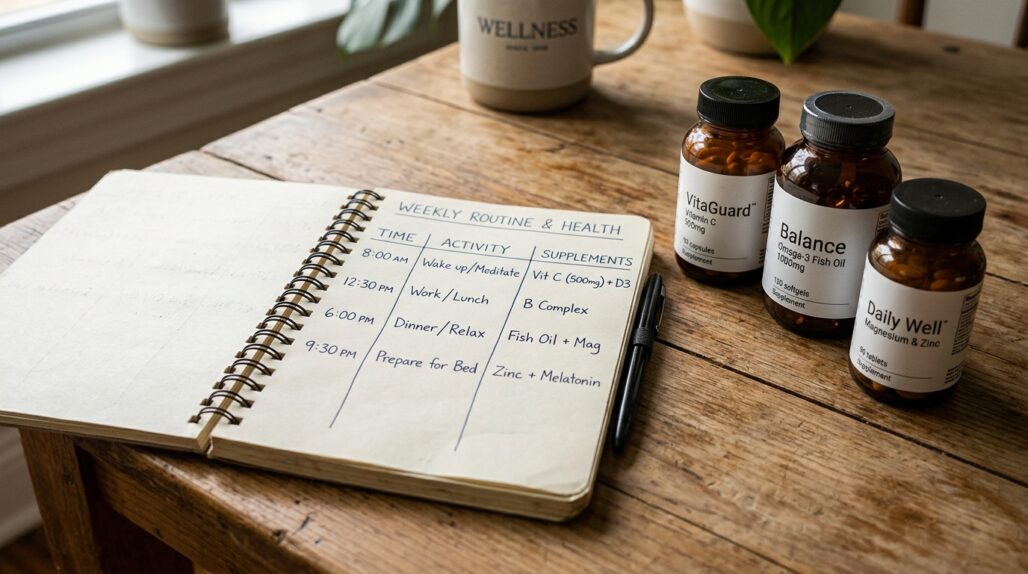
Make the sequence with a pen, no app needed
You can lock this in with a simple three-column list. Write it once and tape it inside a cupboard door where the bottles live.
- Draw three columns: Morning, Midday, Evening.
- Write each supplement under the slot from the table above. When in doubt, put it where it is easiest to remember.
- Next to each one, jot the anchor: with breakfast, with lunch, after dinner. The AHRQ My Medicines List, a free printable from the Agency for Healthcare Research and Quality, uses these same morning, noon, evening, and bedtime columns if you would rather start from a ready-made sheet.
- Flag the two or three timing-sensitive items in the margin: iron away from coffee and calcium, fat-soluble with food, and any prescription gap your pharmacist gave you.
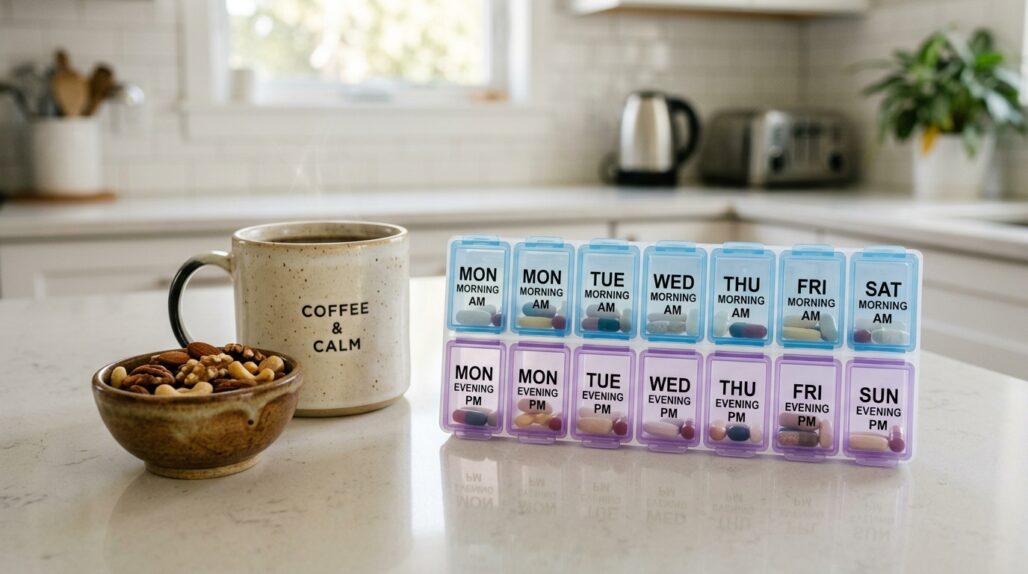
A weekly pill organizer with AM and PM rows does the same job physically, and a sticky note on the coffee maker can be the cue that gets you to the morning slot. None of this requires a screen.
Keeping the order going day after day
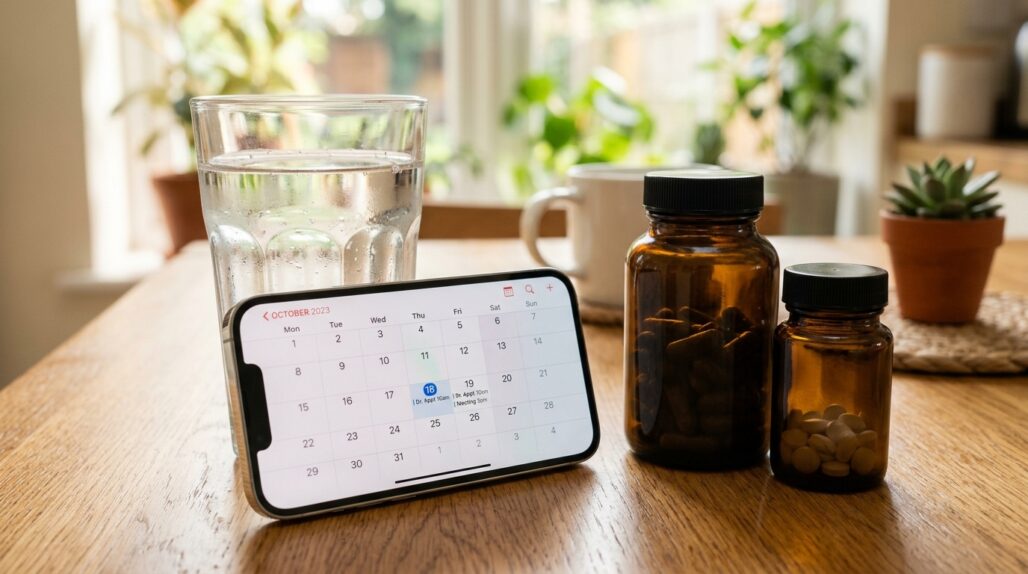
A plan only helps if you run it every day, and that is the part that quietly falls apart. The fix is to attach each slot to something you already do without thinking: coffee, lunch, brushing your teeth at night. Keep the bottles at the spot where that habit happens so the cue and the supplement are in the same place. If your real problem is losing track of whether you already took today's dose, our piece on what to do when you can't remember if you took your supplement today covers a few simple tricks.
Once you have decided your order, the hard part is actually doing it every day. A free app we make, StackMyMed (our own free app), lets you log each supplement into a morning, midday, or evening slot and nudges you when each one is due, which is one way to keep the sequence you just built. If you prefer to stay low-tech, a pill organizer plus a note on the fridge does the same job. For anything where timing touches a prescription, treat the reminder as a prompt and let your pharmacist confirm the actual spacing rather than guessing.
The point is to remove the daily decision. When the order lives somewhere outside your head, you stop relying on memory at the exact moment memory tends to fail.
FAQ
Does the order I take supplements in really change how well they work? For a few it does, mainly iron, the fat-soluble vitamins, and anything taken around a prescription. For most of your stack the bigger factor is whether you take it consistently at all.
Can I just take everything at once to keep it simple? You can for the flexible items. But lumping iron in with calcium or your morning coffee, or taking fat-soluble vitamins with no food, means you absorb less, so it is worth splitting those few out.
Why is magnesium usually suggested at night? Many people find it calming and like pairing it with a wind-down routine, and the evening keeps calcium and magnesium away from iron and morning medications. If mornings suit you better, that is generally fine for magnesium.
How long should I wait between iron and coffee? A gap of one to two hours is the common practical advice, since coffee taken with or right after iron blunts absorption the most. Ask a pharmacist if you also take a thyroid medication, which has its own separate timing.
What if I take a prescription medication too? Build your supplement order around the prescription, not the other way around. The drug sets the anchor, and your pharmacist can tell you which supplements to space and by how many hours.
Is it bad if I take a supplement at the wrong time once? A single off-schedule dose of a typical supplement is not something to worry about. Just return to your normal slot the next day rather than doubling up.
The bottom line
A workable order for most people is energizing supplements in the morning, fat-soluble vitamins with your largest meal, and calming ones like magnesium in the evening, with iron kept clear of coffee and calcium. Write it into a three-column list, anchor each slot to a meal, and the sequence mostly runs itself. The single most useful move is to put the plan somewhere you will see it instead of trying to remember it. Keeping one list of everything you take, which the FDA recommends sharing at every visit, also makes that conversation easier. And if a prescription is in the mix, let your pharmacist or doctor set the timing, since that is the part general guidance cannot tailor to you.
This article is general information, not medical advice. It does not replace guidance from your own doctor or pharmacist, and you should not start, stop, or change the timing of a prescription medication on your own. Talk to a qualified clinician about your specific medications and supplements.
StackMyMed is made by UsefulVitamins. It helps you organize your list and flag things to discuss with a pharmacist or doctor; it is not a diagnosis or treatment tool and does not replace professional medical advice.
Reviewed by the UsefulVitamins Editorial Team.
