
Why time zones quietly break a good routine
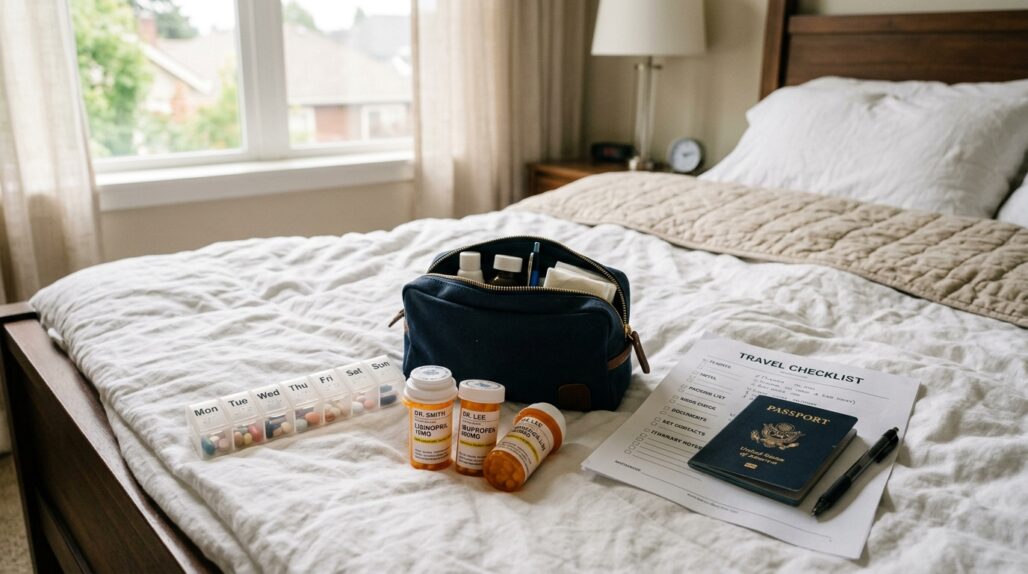
A routine that runs itself at home leans on cues you do not notice: breakfast, your alarm, the spot on the counter where the bottles live. Travel removes all of them at once. You land at what your body thinks is 3 a.m., your phone has jumped six hours, and the question "did I already take that today?" gets genuinely hard to answer.
The fix is not willpower. It is a small amount of planning before you leave and one clear rule for the road. Most people only need to sort out two things: how to pack so nothing goes missing, and how to handle the clock so doses do not bunch up or stretch too far apart.
This guide gives you a method that works on paper, with a pill box, or in your head. None of it requires an app, and none of it replaces a conversation with your pharmacist about your specific medications.
Pack so nothing can go missing
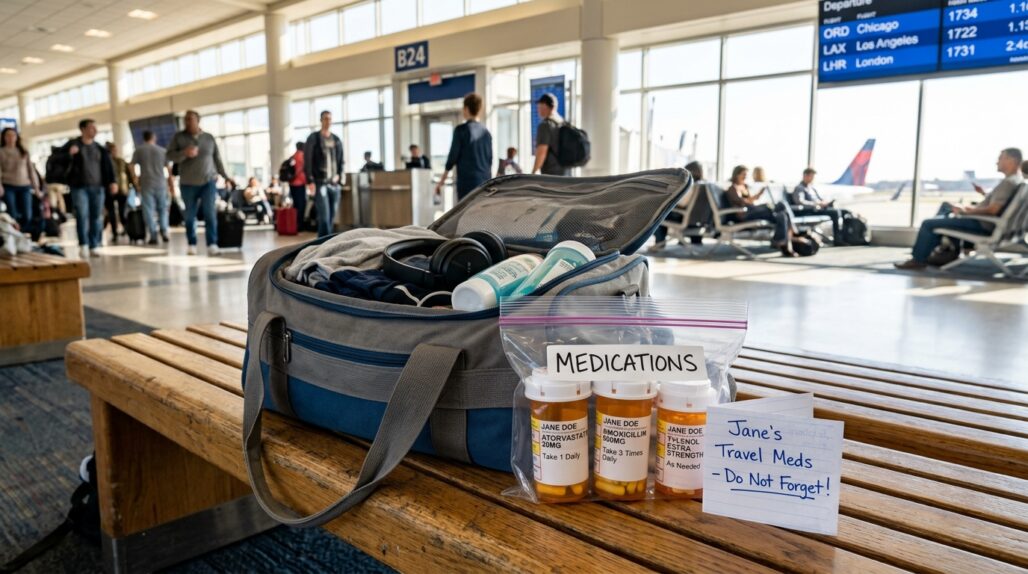
Lost luggage is the classic way a trip derails a medication routine, so the packing rules all point the same direction: keep the important things with you and keep them identifiable.
Here is the short list, drawn from CDC Travelers' Health guidance:
- Carry-on only for anything you cannot easily replace. Prescriptions ride in the bag that stays with you, never in checked luggage that can be delayed or lost.
- Keep medicines in their original, labeled containers. The label ties the pills to you and your prescriber, which matters at screening and at a border.
- Bring a few extra days' worth. Pack enough for the whole trip plus a buffer for delays, so a stuck flight does not turn into a missed dose.
- Carry a written copy of your list. Generic names included. Leave a second copy at home with someone you trust in case you need an emergency refill.
The U.S. Transportation Security Administration does not require pills to be in their prescription bottles for domestic screening, and it allows medically necessary liquids over the usual 3.4-ounce limit in your carry-on. Tell the officer about liquid medication, like insulin or a liquid suspension, before screening so it can be checked separately. Original labels are still the safer default, especially for anything you carry across a border.
Refrigerated items need their own plan. The FDA notes that insulin is normally kept between 36 and 46 degrees Fahrenheit, and can sit at room temperature below 77 to 86 degrees for a limited window depending on the product. A small insulated case with a cool pack handles a travel day. Do not let it freeze, and do not leave it in a hot car or a checked bag in the cargo hold.
A carry-on checklist you can copy
| Item | Where it goes | Why it matters |
|---|---|---|
| Prescription meds in original bottles | Carry-on, on your person | Cannot be lost with checked bags; labels confirm what they are |
| A few extra days’ supply | Carry-on | Covers delays and cancellations |
| Written copy of your full list | Carry-on plus one left at home | Speeds an emergency refill or a doctor visit abroad |
| Refrigerated meds in an insulated case | Carry-on | Avoids cargo-hold temperature swings |
| Prescriber’s note for controlled or injectable meds | Carry-on with the meds | Documents need at screening and customs |
The time-zone rule that does most of the work
There is one principle worth memorizing: count the hours since your last dose, not the local clock. Drug levels follow elapsed time, so a medication you take every 12 hours should still go in about every 12 hours, wherever the airport clock says you are.
That splits your routine into two kinds of items, and they get handled differently.
Interval-based items are the ones spaced a set number of hours apart, often more than once a day. Keep the same spacing through the travel day. If you took a dose at hour zero, the next one is due about twelve or twenty-four hours later by your watch, regardless of the new local time. Once you have arrived and settled, you can drift toward local mealtimes if the medication allows it.
Daily-timing items are the once-a-day pills tied loosely to a part of your day, like a morning supplement or an evening statin your doctor lets you take at a flexible time. For these, shift gradually after you land, moving the time by roughly one to two hours per day until you reach a slot that fits local life. For a short trip of only a few days, many people find it simpler to keep these on home time and switch nothing.
A do-it-by-hand timing worksheet
You do not need software for this. On a card or a phone note, write each medication and fill in three things before you fly.
| Medication or supplement | Home time you take it | Travel-day plan |
|---|---|---|
| Twice-daily med (example) | 8 a.m. and 8 p.m. | Keep about 12 hours apart by your watch; adjust to local times over the next 2 to 3 days |
| Once-daily flexible item (example) | 9 a.m. | Shift 1 to 2 hours per day toward the local morning |
| Strict-timing med (example) | Same time daily | Follow the written plan your pharmacist gave you |
Set a phone timer for the next dose as soon as you take one. The timer counts elapsed hours for you, which is exactly the number that matters and exactly the number that is hard to track in your head on a long flight.
The medications that need a plan before you fly
Some medications have very little room for error, and a few hours off can change how well they work. For these, the timing question is a medical one, not a guess to make at the gate.
Categories that commonly need a prescriber-approved plan include:
- Birth control. Progestin-only pills have a narrow window, often around three hours, before backup contraception is advised; combination pills have more room. The exact plan depends on your pill.
- Thyroid medication. Levothyroxine has a long half-life and is usually forgiving, but it is taken on an empty stomach, which complicates a flipped schedule.
- Heart and blood-thinning medication. Drugs like warfarin rely on steady daily timing.
- Diabetes medication and insulin. These are tied to meals and activity. Traveling east shortens the day and traveling west lengthens it, which can change how doses line up with food.
The reliable move is to ask before you go. Bring your full list to your pharmacist or doctor and ask which items can jump straight to local time, which should shift gradually, and which need a written day-by-day plan for the flight. A pharmacist can usually do this in a short visit, and it is far better than improvising at 30,000 feet. Never change a prescribed dose or stop a medication on your own to make the timing easier.

Staying consistent once you are there
Packing and the time-zone rule get you to your destination on track. Holding the routine for a week takes a couple of small anchors.
Tie each dose to something that happens anyway in the new place: the hotel breakfast, brushing your teeth, plugging in your phone at night. Borrowed cues travel better than a clock time you have to remember. A travel pill organizer filled before you leave is the lowest-tech safety net there is, because one glance shows whether today's slot is empty or full. Pair it with the original bottles in your bag so you can still confirm exactly what each pill is.
Once the manual method is set, the day-to-day job is just keeping it current and not losing count, especially with several doses at different intervals. A paper note or a filled organizer covers this for many people. If you would rather have something count the hours for you and nudge you per dose, a free app we make, StackMyMed (our own free app), holds your schedule and sends a reminder for each dose, which is handy on a travel day when jet lag scrambles your sense of time. It reminds you when to take things; it does not decide your timing. For anything time-sensitive, keep working from the plan your pharmacist gave you and raise any timing question with them rather than the app.
Whichever you use, the goal is the same: never be guessing how many hours it has been.
Crossing borders with medications and supplements
Customs is the last place a routine gets disrupted, usually because something is unlabeled or undocumented. Keep everything in original, labeled containers and carry your written list.
Rules differ by country and can be strict. The CDC Yellow Book warns that a medication ordinary at home may be restricted or banned at your destination, and that the consequences can include confiscation, denied entry, or worse. There is no single global list, so check your destination's embassy and any layover countries before you go. Many nations allow only about a 30-day supply and ask for a prescription or a doctor's note. For controlled substances or injectables such as insulin or an EpiPen, carry a note from your prescriber listing each medication by generic name, the dose, and what it is for.
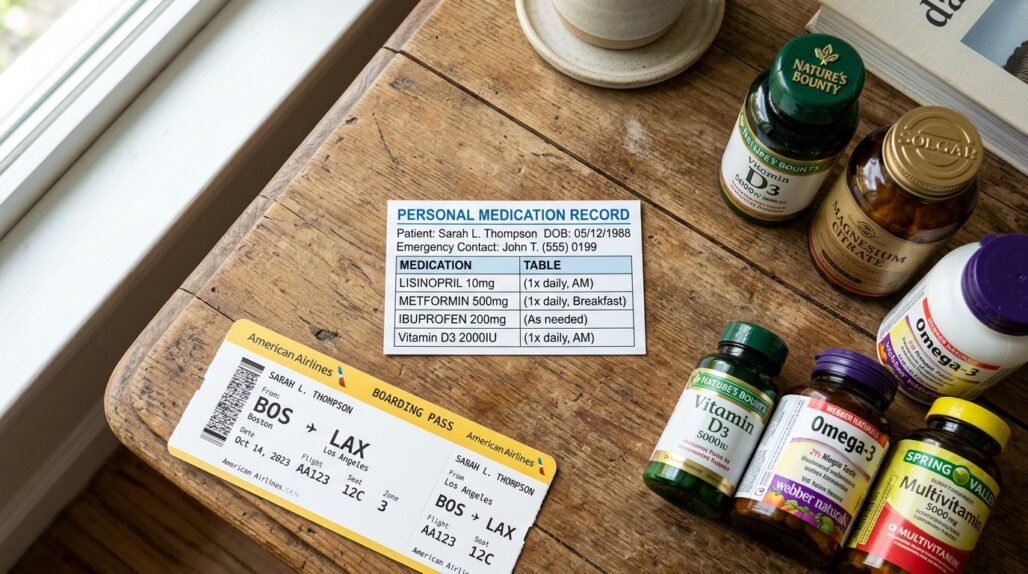
Supplements get less scrutiny but follow the same logic: keep them in their bottles, not loose in a bag, so nothing is a mystery powder at a checkpoint.
FAQ
Should I keep taking my pills on home time or switch to local time? It depends on the medication. Interval-based meds should stay on the same hourly spacing, then drift toward local time after you arrive. Once-daily flexible items can shift by an hour or two per day, or stay on home time for a short trip. Strict-timing meds follow the plan your pharmacist gives you.
Can I use a daily pill organizer instead of the original bottles when I travel? An organizer is great for staying consistent, but bring the original labeled bottles too. Customs and airport screening can struggle to identify loose pills, and the label confirms what each medication is.
What if I miss a dose because of a flight delay or sleeping through a time change? Do not double up to catch up. Many medications have specific missed-dose instructions, and the safe answer varies by drug. Ask your pharmacist before you travel what to do if you miss a dose of each time-sensitive item, and keep that note with your list.
How do I keep insulin or other refrigerated medicine safe on a long trip? Carry it in a small insulated case with a cool pack and keep it in your carry-on. The FDA notes insulin is normally stored cold and tolerates room temperature only for a limited window. Do not let it freeze or sit in a hot car or the cargo hold.
Do I need a doctor’s note to fly with my medication? Not for most routine prescriptions, though original labels help. For controlled substances and injectables, a prescriber’s note listing each medication, dose, and reason is recommended, especially crossing borders, where rules can be strict.
Are supplements treated differently from prescriptions when traveling? They draw less attention but follow the same packing logic. Keep them labeled and in their containers, and include them on your written list so your pharmacist can flag any timing or interaction questions before you go.
The bottom line
Travel does not have to scramble a routine you have worked to build. Pack your medications in your carry-on in their original labels with a buffer supply, keep interval-based doses on the same hourly spacing, and shift daily-timing items gradually after you land. The single most useful habit is counting hours since your last dose instead of trusting an unfamiliar clock, with a timer or a filled pill organizer doing the counting for you.
For anything time-sensitive, the real decision belongs to your pharmacist or doctor. Bring your full list, ask for a written plan covering the days you cross zones, and never adjust a dose or stop a prescription on your own to make the schedule easier.
For more on the everyday version of this problem, see our guides on what to do when you cannot remember if you took your supplement today and on keeping a routine through disrupted schedules like night shifts. Our medication and supplement timing guide covers spacing in more detail, and if you take prescriptions alongside supplements, our overview of drug and supplement interactions is a good place to start before your pre-travel pharmacist chat.
This article is for general information and is not medical advice. It does not replace guidance from your doctor or pharmacist, who know your medications and your situation. Do not start, stop, or change any medication or supplement based on this page alone.
StackMyMed is made by UsefulVitamins. It helps you organize your list and flag things to discuss with a pharmacist or doctor; it is not a diagnosis or treatment tool and does not replace professional medical advice.
Reviewed by the UsefulVitamins Editorial Team.
