
Affiliate disclosure: this article contains affiliate links. As an Amazon Associate, UsefulVitamins.com earns from qualifying purchases at no extra cost to you.
Why high doses upset your stomach in the first place
Plain vitamin C is ascorbic acid, and it is genuinely acidic. Its solution sits at roughly pH 2.1 to 2.6, close to the pH of stomach acid itself, so a large dose lands as a sour, irritating slug in your gut.
The second problem is osmotic. Your small intestine can only pull in so much vitamin C at once, and whatever it cannot absorb drags water into the bowel and gives you the cramps and loose stools.
Those two mechanisms point at two different fixes. Acidity is solved by changing the form. The osmotic ceiling is solved by taking less at a time. Most people who feel sick on vitamin C are fighting both at once without realizing it.
So the honest framing of this whole page: the stomach upset is mostly a dosing and form problem, not a brand problem.
The bowel-tolerance ceiling is the real "too much" signal
There is no magic number where everyone's gut gives out. The practical ceiling is personal, and clinicians have a name for it. The orthomolecular physician Robert Cathcart described titrating vitamin C up to the dose just short of the one that causes diarrhea, a level he called bowel tolerance in a 1981 paper in the Journal of Orthomolecular Medicine.
We are not endorsing the mega-gram protocols from that era. The useful idea that survives is simpler: loose stools are the body's stop sign, and the gentle dose is one notch below wherever yours appears.
This matters because the NIH Office of Dietary Supplements vitamin C fact sheet is blunt that high intakes cause diarrhea, nausea, and abdominal cramps, and that these are the most common adverse effects of too much. The symptom is not damage in most healthy people, but it is your signal to back off.
Here is the rule that keeps people out of trouble: if a dose gives you watery stools, the next dose should be smaller, not the same. Pushing through the ceiling is how people end up miserable for no extra benefit.
More is not more: what your body actually absorbs
Absorption works against you at the top end. In the classic pharmacokinetic work by Mark Levine and colleagues at the NIH, vitamin C is taken up efficiently at modest amounts, with roughly 70 to 90 percent absorbed up to about 180 to 200 mg.
Push the single dose higher and the intestinal transporters saturate. Above about 1,000 mg in one sitting, the fraction absorbed falls below 50 percent, and the rest either gets excreted in urine or stays in the gut causing the osmotic problem above.
That is the quiet argument for splitting. Two 500 mg doses are absorbed far better, and feel far gentler, than a single 1,000 mg tablet.
It is also why the NIH ODS notes that plasma levels plateau once cells are saturated around 200 mg and rise only marginally after that. The extra grams mostly do not raise your blood level, they raise your bathroom frequency.
The split-dose protocol that fixes most upset
If you want a higher daily total without the cramps, change when you take it before you change what you buy.
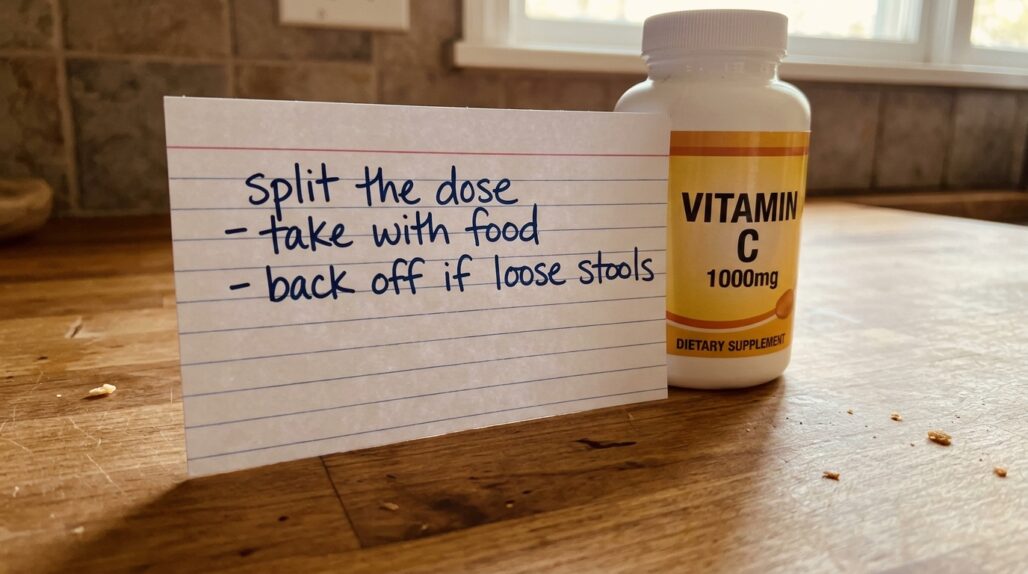
- Split the day's total into 2 or 3 doses taken with breakfast, lunch, and an evening meal rather than one large hit.
- Take it with food, not on an empty stomach, so the meal buffers the acid and slows the dump into the small intestine.
- Keep each single dose modest, generally at or under 500 mg, since that is where absorption stays efficient.
- Step up slowly over a week or two if you are increasing your intake, watching for the first sign of loose stools.
That alone clears up the majority of complaints. The form switch below is for people who still feel acidic stomach burn on plain ascorbic acid, or who are sensitive to begin with.
Want a personal daily target instead of guessing? Plug your goal into the vitamin C dose calculator and it will return a number for you, so this page can stay focused on how to take it gently rather than re-deriving the dose.

Form matters: buffered and liposomal versus plain ascorbic acid
When timing tweaks are not enough, the form is the next lever. Three categories are worth knowing.
Plain ascorbic acid is the cheapest and most common. It works, but at that pH near 2 it is the most likely to sting a sensitive stomach.
Buffered vitamin C is ascorbic acid bound to a mineral, usually sodium ascorbate or calcium ascorbate, which lifts the solution to a near-neutral pH around 7. That neutral pH is what makes buffered C noticeably gentler for most people, with similar absorption to plain ascorbic acid at everyday doses.
Liposomal vitamin C wraps the molecule in a fat membrane. In a 2024 European Journal of Nutrition crossover trial of 27 adults, a single 500 mg liposomal dose raised plasma vitamin C about 27 percent higher (Cmax) and 21 percent higher over 24 hours (AUC) than the same dose of standard ascorbic acid. Because more is absorbed, less sits in the gut, which is part of why people often find it easier on the stomach.
Form comparison at a glance
| Form | Approx. pH | Stomach gentleness | Cost | Best for |
|---|---|---|---|---|
| Plain ascorbic acid | 2.1 to 2.6 (acidic) | Lowest, can sting | Cheapest | Tough stomachs on low daily doses |
| Buffered (sodium ascorbate) | Near 7 (neutral) | Gentle | Low to moderate | Most people wanting a higher daily total |
| Buffered (calcium ascorbate) | Near 7 (neutral) | Gentlest of the buffered pair | Moderate | Sensitive stomachs, but watch added calcium |
| Liposomal | Near neutral | Gentle, less left in the gut | Most expensive | People who still react to buffered C |
One footnote on the buffered options. Calcium ascorbate carries calcium and sodium ascorbate carries sodium, so if you take a lot you are adding those minerals too. That is rarely an issue at sensible doses, but it matters if you are on a sodium-restricted diet or already taking calcium.
If you want the deeper bioavailability breakdown, our liposomal versus standard vitamin C comparison walks through the trial data in more detail.
Which form to buy
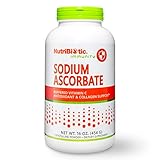
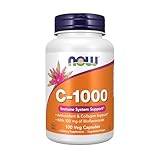
Match the product to why your stomach is reacting. If plain tablets feel acidic, a buffered sodium or calcium ascorbate is the cheapest honest upgrade. If you still react to buffered C, or you want the highest blood level per dose, liposomal is the gentler-on-the-gut splurge. A vitamin C with bioflavonoids is a reasonable middle option some people tolerate well.
We may earn a commission from links below, at no extra cost to you. We only suggest forms we would take ourselves.

As an Amazon Associate, UsefulVitamins.com earns from qualifying purchases at no extra cost to you.
Whichever you pick, check the label for the elemental vitamin C per serving and remember that the daily upper limit counts everything, including the C in your multivitamin and your food.
For the science behind the doses rather than the tolerability, our vitamin C science, benefits and dosage guide and the broader complete guide to vitamin C are the next reads.

Who needs to be more careful
Most healthy adults can experiment with form and timing on their own. A few groups should talk to a clinician first.
If you have a history of calcium-oxalate kidney stones or any kidney disease, high-dose vitamin C deserves a conversation with your doctor. Your body converts some vitamin C to oxalate, and the NIH ODS notes the clearest risk is in people with pre-existing hyperoxaluria. There are documented case reports of oxalate nephropathy after very high intakes, so this is not hypothetical at the extreme end.
People with hemochromatosis or other iron-overload conditions should be cautious too, because vitamin C boosts iron absorption. And anyone with G6PD deficiency should check before taking large amounts.
None of this is medical advice, and none of it should change a prescription on its own. Bring your actual dose and your conditions to a pharmacist or doctor and let them make the call.
FAQ
How much vitamin C is too much in one day? The tolerable upper intake level for adults is 2,000 mg a day from all sources combined, per the NIH Office of Dietary Supplements. Most people get diarrhea well before that, which is the practical ceiling for them.
Does buffered vitamin C work as well as regular ascorbic acid? At everyday doses the absorption is similar; buffering mainly changes the pH from acidic to near-neutral so it is gentler on the stomach, not weaker.
Is liposomal vitamin C worth the extra money? A 2024 trial found a single 500 mg liposomal dose raised plasma vitamin C about 27 percent more than standard C. It is the priciest form, so it is mainly worth it if you still react to cheaper buffered options.
Why do I get diarrhea from vitamin C? Whatever your intestine cannot absorb pulls water into the bowel, an osmotic effect that gets stronger as the single dose climbs above what your transporters can handle. Splitting the dose and lowering it fixes it.
Should I take vitamin C with food or on an empty stomach? With food is gentler, because the meal buffers the acid and slows how fast the dose hits your small intestine. There is no meaningful absorption penalty for taking it with a meal.
Can high-dose vitamin C cause kidney stones? The evidence is mixed for healthy people, but the risk is clearest in those with prior calcium-oxalate stones or kidney disease, since vitamin C is partly converted to oxalate. Talk to a doctor first if that is you.
The bottom line
Stomach upset on high-dose vitamin C almost always traces back to two things: an acidic form and a single dose that is too big. Fix both and the problem usually disappears.
Switch to buffered or liposomal C, split your total into 2 or 3 doses with meals, and treat loose stools as your stop sign, not a target. Keep the daily total under the 2,000 mg upper limit and remember that absorption, not ambition, sets the useful ceiling.
For your personal number, run it through the vitamin C dose calculator rather than guessing, and if you have kidney stones or a relevant condition, make that target a question for your pharmacist or doctor before you buy anything.
This article is general education, not medical advice, and it does not replace guidance from your own pharmacist or doctor about your dose, conditions, or medications.
Reviewed by the UsefulVitamins Editorial Team.
