
Affiliate disclosure: this article contains affiliate links. As an Amazon Associate, UsefulVitamins.com earns from qualifying purchases at no extra cost to you.
What B6 toxicity actually feels like
The nerve damage from too much vitamin B6 is a sensory peripheral neuropathy. It usually shows up as tingling, pins-and-needles, or numbness that starts in the feet and hands, sometimes with a wobbly, unsteady walk.
It builds slowly. People often describe the feeling spreading in a stocking-and-glove pattern, and according to the StatPearls clinical reference on vitamin B6 toxicity, it can come with hyperesthesia (skin that feels oddly raw or tender) and trouble sensing where your limbs are in space.
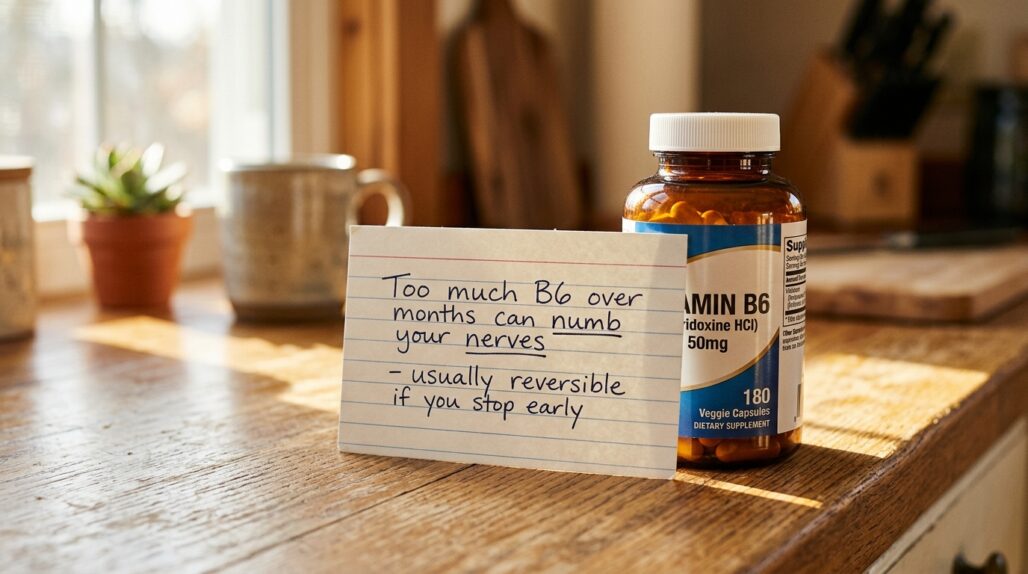
Here is the reassuring part. The motor nerves are usually spared, and the damage is generally reversible once the excess B6 stops. The unsettling part is that a handful of reported cases did not fully recover, which is exactly why catching it early matters.
The number that matters: the 100 mg/day upper limit
For adults in the US, the Tolerable Upper Intake Level (UL) for vitamin B6 is 100 mg a day from supplements, set by the Food and Nutrition Board and published by the NIH Office of Dietary Supplements.
Put that next to what your body actually needs. The RDA for most adults is about 1.3 mg a day, rising to 1.7 mg for men over 50 and 1.5 mg for women over 50. So a typical "high-potency" 100 mg B6 pill is already roughly 75 times the daily requirement while still technically sitting at the ceiling.
Food is not the problem here. The ODS is clear that dietary B6 does not cause toxicity – the reported cases come from supplements, fortified products, or medical dosing, not from eating chickpeas and salmon.
Worth knowing for context: in 2023 the European Food Safety Authority set a much lower upper limit of 12 mg/day for adults in its EFSA scientific opinion on the B6 upper level. The two bodies read the same evidence and landed far apart, which tells you the "safe ceiling" is genuinely uncertain. When experts disagree by that much, leaning conservative is reasonable.

How much, for how long, before nerves are at risk
There is no single clean threshold, and anyone who gives you one is rounding off real uncertainty. The pattern across case reports is dose times duration: a moderate excess over years can do what a large excess does over months.
Here is what the published cases tend to show.
| Daily B6 intake | Typical duration before symptoms | What the evidence suggests |
|---|---|---|
| At or under 100 mg | Years, often no clear signal | Treated as the upper limit; rare neuropathy reports exist below 500 mg but are uncommon. |
| Around 200 mg | Roughly 1 to 5 years | Some 5-year studies found no neuropathy; case reports show symptoms after about a year in others. |
| 500 mg and up | Months to about 2 years | Most classic neuropathy cases cluster here, often at 500 mg or more for two-plus years. |
| 1,000 mg and up | Weeks to months | Sensory neuropathy is well documented and tends to appear faster. |
In one case-based review of underestimated pyridoxine intake, a person taking 200 mg daily for about a year developed clear nerve symptoms and a B6 blood level nearly ten times the top of the normal range. After stopping, the symptoms resolved over the following months.
The takeaway is not a magic safe number. It is that the further above 100 mg you go, the shorter the runway before nerves complain.
The hidden-stacking trap
This is the part most people miss. B6 rarely sits in one bottle. It hides across your shelf, and the totals add up quietly.
The same review above traced toxicity to people pulling B6 from several places at once – supplements, fortified foods, and "athlete" formulas – without realizing the combined load. Check the labels on what you already take:
- B-complex tablets often carry 25 to 100 mg of B6 each.
- Energy and “stress” formulas frequently pack 50 to 100 mg to look potent.
- Magnesium-B6 blends (popular for sleep and cramps) add another dose.
- Pre-workout and electrolyte mixes sometimes slip in 50 mg or more.
- A daily multivitamin tops it all off with a few more milligrams.
Stack two or three of those and you can clear 200 mg a day without ever choosing a "high-dose B6" product. To get your real running total across products, use our B-complex stack calculator rather than guessing – it does the addition for you so the hidden overlap stops being invisible. If your shelf has crept past a sensible count, our supplement self-audit guide walks through trimming it down.
For the bigger picture on what each B vitamin does and how much you actually need, our guide to the B-complex vitamins is the place to start.

Does the form (P5P vs pyridoxine) change the risk?
You will see two forms on labels: plain pyridoxine (pyridoxine HCl) and the active coenzyme form P5P (pyridoxal-5'-phosphate). The marketing claim is that P5P is safer for nerves. The honest answer is that the evidence leans that way but is not settled.
The mechanism is interesting. As StatPearls explains, very high pyridoxine appears to competitively inhibit the active P5P form, so paradoxically the symptoms of B6 overdose can mimic B6 deficiency. Lab work has shown pyridoxine, but not other B6 forms, killing neuronal cells in a dose-dependent way, which is the basis for preferring P5P.
But two cautions keep this from being a free pass. Most real-world neuropathy reports involve pyridoxine simply because that is the cheap, common form, so the comparison is not clean. And high-dose anything is still high-dose – P5P is not a license to ignore the 100 mg ceiling.
Practically: if you only need a modest amount, the form barely matters. If a clinician has you on a higher dose for a specific reason, P5P is a defensible choice, but that is a conversation to have with them, not a reason to self-prescribe more.
Which B6 product to buy (the sensible-dose choice)
The goal here is restraint, not potency. For nearly everyone, a modest dose is the right call, and the cheapest, lowest-dose option is usually the honest recommendation.
The links below are affiliate links; UsefulVitamins may earn a commission at no extra cost to you. We only suggest sensible-dose, reputable products.

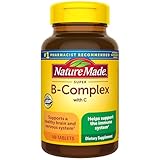

As an Amazon Associate, UsefulVitamins.com earns from qualifying purchases at no extra cost to you.
A few rules of thumb when you choose:
- Pick a low-dose B6 (around 25 mg or less) unless a clinician told you otherwise.
- If you want the active form, a P5P product is reasonable, but check the milligrams, not just the name.
- A plain B-complex with a modest B6 amount covers most people who just want general B-vitamin support.
- Read the supplement facts panel and add it to your running total before adding it to your cart.
Special case: B6 and levodopa for Parkinson's
This one deserves its own flag. Plain pyridoxine can speed up the breakdown of levodopa before it reaches the brain, which can blunt the medication's effect.
Per the Drugs.com professional monograph on the levodopa and B6 interaction, pyridoxine doses as low as 5 mg can matter when levodopa is taken without a decarboxylase inhibitor. Most modern formulas pair levodopa with carbidopa, which largely shields against this, but it is not something to navigate by yourself.
If you take any Parkinson's medication, talk to your neurologist or pharmacist before adding B6, and read our deeper explainer on the B6 and levodopa interference for the full picture. Do not start or stop a prescription on your own.
FAQ
How much vitamin B6 is too much per day? The US adult upper limit is 100 mg a day from supplements. Most neuropathy cases involve far higher doses over months to years, but staying at or under 100 mg total is the conservative, sensible target.
Is B6 nerve damage permanent? Usually not. Sensory symptoms generally improve over weeks to months after you stop the excess B6, and many cases resolve within about six months. A minority of people do not fully recover, which is why early action helps.
What are the first signs of too much B6? Typically tingling or numbness in the feet and hands, sometimes with unsteadiness or skin that feels unusually sensitive. New or spreading symptoms like these are a reason to stop and get checked.
Can I get too much B6 from food? No. Dietary vitamin B6 is not linked to toxicity, according to NIH. The risk comes from supplements, fortified products, or medical dosing, not from your meals.
Is P5P safer than pyridoxine? The evidence leans toward P5P being gentler on nerves, and the cellular mechanism supports it, but the data is not conclusive and high doses of any form warrant caution. For modest amounts, the difference is small.
Should I stop B6 before a blood test or surgery? That is a question for the clinician ordering it, not a decision to make alone, especially if a doctor prescribed the B6. Tell them everything you take so they can advise you.
The bottom line
Vitamin B6 is one of the rare water-soluble vitamins that can genuinely harm you in excess, and the harm is sensory nerve damage that builds quietly above 100 mg a day. The good news is it is usually reversible if you catch it and stop early.
The practical move is not fear, it is bookkeeping. Add up every source of B6 on your shelf, keep the total at or under the upper limit unless a clinician is steering you higher, and pick a low-dose product when you do supplement.
If you have new tingling, numbness, or balance problems, or you take levodopa, do not wait it out – see a doctor or pharmacist. They can interpret your symptoms, your blood level, and your full medication list in a way no article can.
This article is general education, not medical advice. It does not diagnose, treat, or replace care from a qualified clinician, and you should not start, stop, or change any supplement or prescription based on it without professional guidance.
Reviewed by the UsefulVitamins Editorial Team.
