
Affiliate disclosure: this article contains affiliate links. As an Amazon Associate, UsefulVitamins.com earns from qualifying purchases at no extra cost to you.
What actually separates the two forms
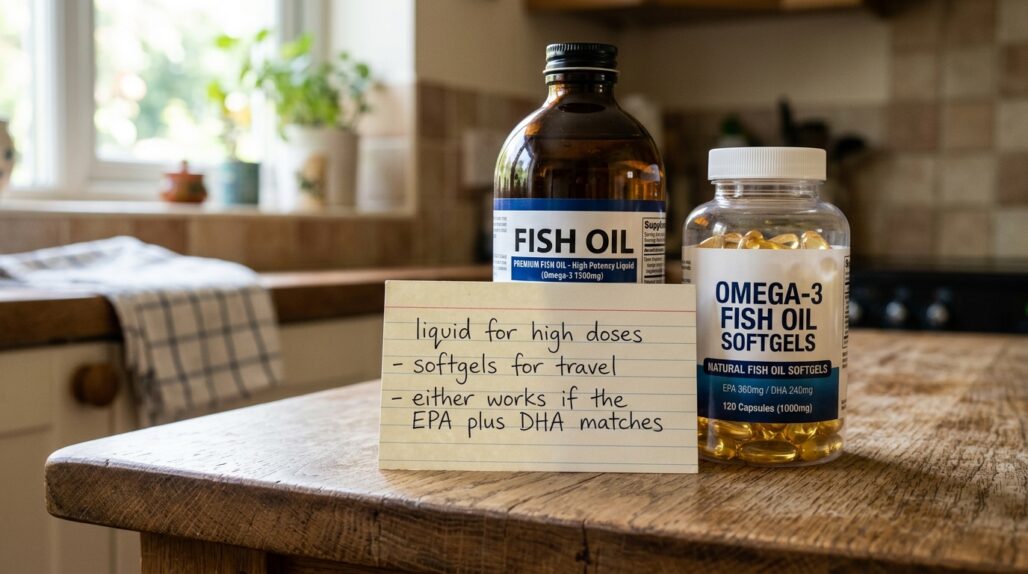
Strip away the marketing and a softgel is just liquid fish oil in a swallowable gelatin shell. The oil inside is the same class of triglyceride or ethyl-ester concentrate you would pour from a bottle.
So the real differences are not about how well the omega-3s absorb. They are about dose size, cost per gram, freshness, and whether you will actually take it.
Get those four right and the liquid-versus-softgel question mostly answers itself. The thing that moves your blood levels is how many milligrams of EPA and DHA you swallow, not the packaging around them.
Read the EPA+DHA per serving, not the "fish oil" number
A label that brags about "1,000 mg fish oil" is telling you the weight of the oil, not the active dose. The number that matters is EPA plus DHA combined, which is often only 300 mg of that 1,000 mg in a cheap softgel.
For general heart and brain upkeep, the American Heart Association points people toward two servings of fatty fish a week, which works out to roughly 250-500 mg of EPA+DHA a day for someone who does not eat fish. Our omega-3 dosage guide walks through how to land on your own target before you shop.
Higher targets exist for specific reasons. The AHA science advisory on high triglycerides found that about 4 g/day of prescription omega-3 lowers triglycerides by 20-30%, but that is a clinical dose your doctor manages, not a label you copy. The advisory is explicit that you should not try to treat high triglycerides yourself with over-the-counter fish oil.
Here is the practical split most readers fall into.
| Daily EPA+DHA goal | Who it fits | Format that fits best |
|---|---|---|
| 250-500 mg | General maintenance, no oily fish in the diet | One or two softgels – simplest |
| 1,000-2,000 mg | Higher target on a doctor’s advice | Concentrated softgels or a teaspoon of liquid |
| 2,000-3,000 mg | High-dose users working with a clinician | Liquid wins on cost and pill count |
Where liquid wins: high doses and no pill pile
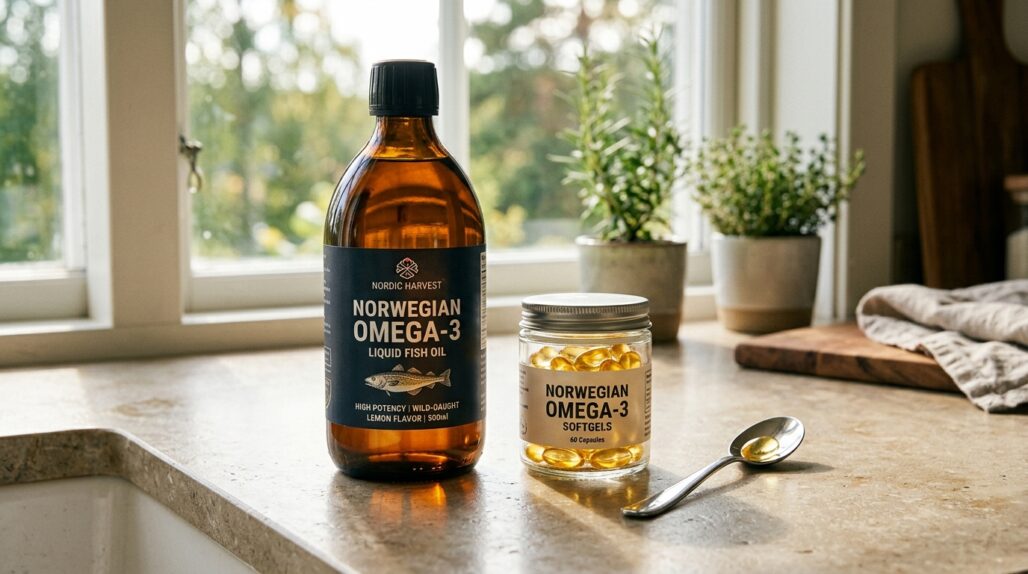
Once your target climbs past 1,500-2,000 mg EPA+DHA, softgels turn into a chore. A standard concentrated softgel might carry 300-500 mg of EPA+DHA, so a 2,000 mg goal can mean swallowing four to seven capsules a day.
A single teaspoon of a concentrated liquid can deliver that same dose in one go. That is the honest case for liquid: it is usually the cheapest way to hit a high gram-level dose, and it skips the pill pile entirely.
Liquid also suits anyone who cannot or will not swallow large capsules – some kids, some older adults, people with reflux. You can stir it into yogurt or a smoothie, and a flavored oil hides most of the fishiness.
The catch is portioning. A teaspoon is not a precise lab measure, so your dose drifts a little day to day. For maintenance that is fine; for a tight clinical target it is a reason to lean on capsules.
Where softgels win: dose control, travel, and freshness
A softgel is one fixed, repeatable dose in a sealed shell. No spoon, no guessing, no slick of oil on the counter. That precision is the whole point if you are matching a specific number.
Softgels are also the obvious travel format – tuck a few in a pill case and go. And the gelatin shell does real work: it keeps air and light off the oil, so capsules oxidize more slowly than an opened bottle of liquid.
That freshness gap is the most underrated part of this decision, and it deserves its own section.
The freshness problem nobody puts on the label
Omega-3 fats are fragile. EPA and DHA react with oxygen, heat, and light, and as they break down they form peroxides and aldehydes that taste fishy and undo some of the benefit. This is why a rancid bottle gives you worse burps, not better ones.
The industry tracks this with a freshness score called TOTOX (total oxidation), built from a peroxide value and an anisidine value. The voluntary GOED and Codex standard sets the ceilings at peroxide value 5, anisidine value 20, and TOTOX 26 for a fresh oil.
Plenty of products miss those marks. A research review on whether oxidation of fish oil supplements is a problem reported a Canadian survey where about 50% of products exceeded a voluntary oxidation limit, a US sample where 27% had more than twice the recommended peroxide level, and regions where over 80% of tested supplements were past the limits. The same review is careful to add that the health consequences of consuming oxidized fish oil are not established – the bigger losses are taste and potency.
Here is the form angle. A sealed softgel sits in a low-oxygen shell, so it ages more slowly on the shelf. An opened liquid bottle meets air every time you uncap it, so it oxidizes faster once opened.
That points to a clean storage rule for each form.
| Form | Storage once opened | Use-by after opening |
|---|---|---|
| Softgels | Cool, dark cupboard; fridge is fine but not required | Through the printed expiry if stored well |
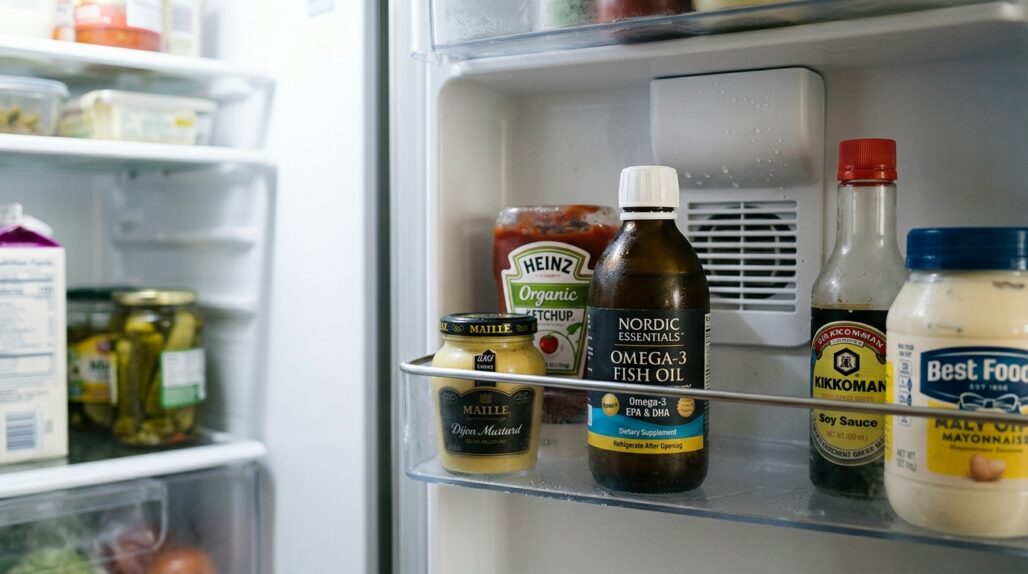
| Liquid | Refrigerate, cap tight, keep out of light | Finish within a few weeks of opening |
Whichever you buy, trust your nose. A sharp, paint-like fishy smell means the oil has turned, and a fresh fish oil should smell mild, not aggressive.
The thing that matters more than the bottle
Before you agonize over liquid versus softgel, know that a different choice usually moves absorption more: the chemical form of the oil.
Most concentrates are either triglyceride (TG/rTG) or ethyl ester (EE). The NIH Office of Dietary Supplements omega-3 fact sheet notes that triglyceride and free-fatty-acid forms have somewhat higher bioavailability than ethyl esters, though it adds that all forms raise blood EPA and DHA meaningfully, and with daily use the gap narrows. Our breakdown of triglyceride, ethyl-ester, and krill omega-3 shows how to spot which one you are buying.
Practically: a fresh triglyceride softgel can out-absorb a stale ethyl-ester liquid. So freshness and form outrank the packaging. Pick a fresh oil in a TG form, then choose liquid or softgel on cost and convenience.
Fish is not your only source either. Algae oil delivers DHA (and some EPA) without any fish, in both softgel and liquid, which matters if you are vegan or hate the burps.

Fixing the burps without quitting
The fishy repeat that drives people off omega-3 is usually a storage or timing fix, not a reason to stop. Three things help most.
- Take it with your largest meal, since dietary fat slows stomach emptying and cuts reflux.
- Keep the oil fresh – rancid fish oil burps far worse, so refrigerate liquid and finish it promptly.
- Try an enteric-coated softgel, designed to open lower in the gut so the smell does not come back up.
Our guide to getting rid of fish oil burps covers the full troubleshooting order if those three do not solve it. Freezing softgels is a common trick, though it works less reliably than coating and with-food timing.
Which form to buy
Match this to your situation rather than chasing a single "best" bottle.
- Want simple maintenance and easy dosing: a triglyceride softgel at 500-1,000 mg EPA+DHA per serving.
- Going for a high gram-level dose, or hate swallowing pills: a concentrated liquid, refrigerated and used within a few weeks.
- Want the gentlest on a sensitive stomach: an enteric-coated or fresh TG softgel taken with food.
For vetted, third-party-tested picks across all three, see our roundup of the best omega-3 fish oil supplements.
The links below may earn UsefulVitamins a commission at no cost to you. We only suggest products that fit the guidance above.


As an Amazon Associate, UsefulVitamins.com earns from qualifying purchases at no extra cost to you.
FAQ
Is liquid fish oil absorbed better than softgels? Not in a way that matters for most people. The oil is the same; what changes absorption is the chemical form (triglyceride versus ethyl ester) and freshness, not whether it came from a bottle or a capsule.
How much EPA and DHA should I take a day? General maintenance lands around 250-1,000 mg combined, in line with eating fatty fish twice a week. Higher targets exist for specific medical reasons, but the FDA suggests supplement labels not recommend more than 2 g/day of EPA and DHA, so clear higher doses with a clinician.
Does fish oil need to be refrigerated? Opened liquid should be refrigerated and used within a few weeks because it oxidizes once it meets air. Softgels are stable in a cool, dark cupboard, though the fridge does not hurt.
How do I know if my fish oil has gone rancid? Smell it. Fresh oil is mild; a sharp, paint-like, strongly fishy odor or a bitter aftertaste signals oxidation. Rancid oil also tends to cause worse burps.
Will fish oil interact with my medications? It can, especially with blood thinners and antiplatelet drugs, and at higher doses it may affect bleeding. Ask a pharmacist before combining fish oil with prescription medicine, and never adjust a prescription on your own.
Can fish oil lower my triglycerides? Prescription-strength omega-3 around 4 g/day can lower triglycerides by 20-30%, but that is a doctor-managed treatment. The American Heart Association advises against self-treating high triglycerides with over-the-counter fish oil.
The bottom line
Liquid versus softgel is a convenience-and-cost call, not an absorption call. Liquid is the cheap, pill-free route to a high EPA+DHA dose; softgels give you fixed portions, easy travel, and a sealed shell that ages more slowly.
Get the part that actually counts right first: a fresh, triglyceride-form oil with a real EPA+DHA number per serving. Then pick the format that fits how you live, store it the way that form needs, and check your target with our omega-3 dosage guide.
This article is general education, not medical advice. Talk to a pharmacist or doctor before starting fish oil if you take medication, are pregnant or nursing, or want to treat a specific condition such as high triglycerides.
Reviewed by the UsefulVitamins Editorial Team.
