
Affiliate disclosure: this article contains affiliate links. As an Amazon Associate, UsefulVitamins.com earns from qualifying purchases at no extra cost to you.
Where the saffron-for-mood claim actually came from
Most "miracle supplement" trends start with a TikTok and a cherry-picked rat study. Saffron is different, and that is worth saying plainly up front.
The interest came out of real clinical research, much of it from Iranian university psychiatry departments where saffron is cheap and culturally familiar. Starting in the early 2000s, small teams ran head-to-head trials comparing standardized saffron extract against placebo and against standard antidepressants like fluoxetine and imipramine for mild-to-moderate depression.
Then a branded extract called affron showed up with its own mood trials, and a separate extract called Satiereal got studied for appetite. Supplement brands took those papers and ran. The science is genuinely better than average here. The marketing on top of it is where things get slippery.
So the honest framing is this: the ingredient has decent human evidence for two narrow things. The "natural antidepressant that fixes everything" pitch is the part that overreaches.
What the marketing claims vs what saffron actually does
Walk through any saffron product page and you will see a familiar stack of promises. Here is how they line up against the studies.
| The claim | What the human evidence says | Honest grade |
|---|---|---|
| “Natural antidepressant” | RCTs and a meta-analysis show benefit for mild-to-moderate symptoms, non-inferior to standard drugs in those trials | Real, but narrow |
| “Reduces snacking and cravings” | One 8-week RCT at 176.5 mg/day cut snacking episodes and produced roughly 1 kg more weight change than placebo | Modest but real |
| “Powerful weight-loss aid” | Effect was small and tied to less grazing, not fat-burning; no large weight-loss trials | Overhyped |
| “Cures anxiety and stress” | Some signal on stress and anxiety scores in low-mood adults; not a treatment for an anxiety disorder | Early |
| “Works for everyone” | A 2025 trial in healthy adults with subclinical symptoms missed its primary endpoint | Not universal |
The pattern is consistent. Saffron does something for mild mood and snacking behavior, and the numbers shrink the more dramatic the claim gets.
The mood evidence, graded honestly
This is the strongest part of the saffron story, so let me be specific about the study types instead of waving at "studies show."
A meta-analysis of 11 randomized trials, published in 2019 and indexed on PubMed, pooled the data and found saffron significantly more effective than placebo and roughly non-inferior to standard antidepressants for mild-to-moderate depression. Non-inferior means "about as good in these trials," not "better."
A separate 4-week RCT in 128 adults with self-reported low mood, led by Lopresti and indexed on PubMed, found that 28 mg/day of affron beat placebo on a standard mood scale, while a lower 22 mg dose did nothing. That dose-response detail matters: it suggests the effect is real, not random.
Now the honest counterweight. A 2025 placebo-controlled trial in healthy adults with only subclinical symptoms did not hit its main combined endpoint, though it nudged self-rated mental health. And European regulators were cautious too: the European Food Safety Authority reviewed a positive-mood claim for affron and did not grant it, citing methodological limits.
So the grade is: good for mild low mood, real RCT data, but not a cure and not impressive in already-healthy people. Most of the trials are short and several involve the ingredient maker, which is a fair reason to stay measured.
The appetite and snacking evidence
The appetite claim rests mostly on one well-known trial, so it deserves its own caveat rather than being lumped in with the mood research.
In a 2010 randomized, placebo-controlled study published in Nutrition Research and indexed on ScienceDirect, 60 mildly overweight women took 176.5 mg/day of Satiereal saffron extract or placebo for 8 weeks with no calorie restriction. The saffron group recorded fewer snacking episodes and lost a little more weight, on the order of about 1 kilogram.
Read that number honestly. One kilogram over two months, in a small single study, is a nudge to grazing behavior, not a fat-loss tool. The proposed mechanism is that a mild mood lift reduces stress snacking, which fits the mood data but is not the same as boosting metabolism.
If your problem is mindless afternoon grazing, this is a plausible, low-risk lever. If you are hoping a capsule replaces a calorie deficit, it will not. For the levers that actually move the scale, our roundup on the best supplements for weight loss is the more useful read, and our look at the best greens powder for reduced appetite covers the fiber-and-satiety angle that has more consistent support.
The real scam: adulteration and underdosing
Here is where saffron earns its place on a skeptic site. The ingredient is fine. The supply chain is a minefield.
Saffron is the most expensive spice in the world, which makes it one of the most adulterated. According to food-fraud researchers, common tricks include cutting real threads with safflower, turmeric, paprika, dyed corn silk, beet fibers, and red-dyed silk. Powdered saffron is the easiest to fake because you cannot see the filler.
Two failure modes show up in supplements specifically:
- Adulteration: you pay for saffron and get partly something else, so the active compounds (crocin, safranal) are far below the studied amount.
- Underdosing or fairy-dusting: the label says "saffron" with no standardization and no milligram dose, so even if it is pure, there may not be enough to match the trials.
How to avoid both:
- Buy a standardized branded extract with a real name on the label: affron (standardized to lepticrosalides) or Satiereal. These are the materials that were actually tested.
- Match the studied dose: roughly 28 to 30 mg/day for mood, around 176.5 mg/day of Satiereal for appetite.
- Look for third-party testing (a seal, a batch certificate, or a published certificate of analysis), the same standard we apply when we flag fakes in pieces like do detox supplements actually work.
- Be skeptical of cheap "pure saffron" powders and proprietary blends that hide the dose.
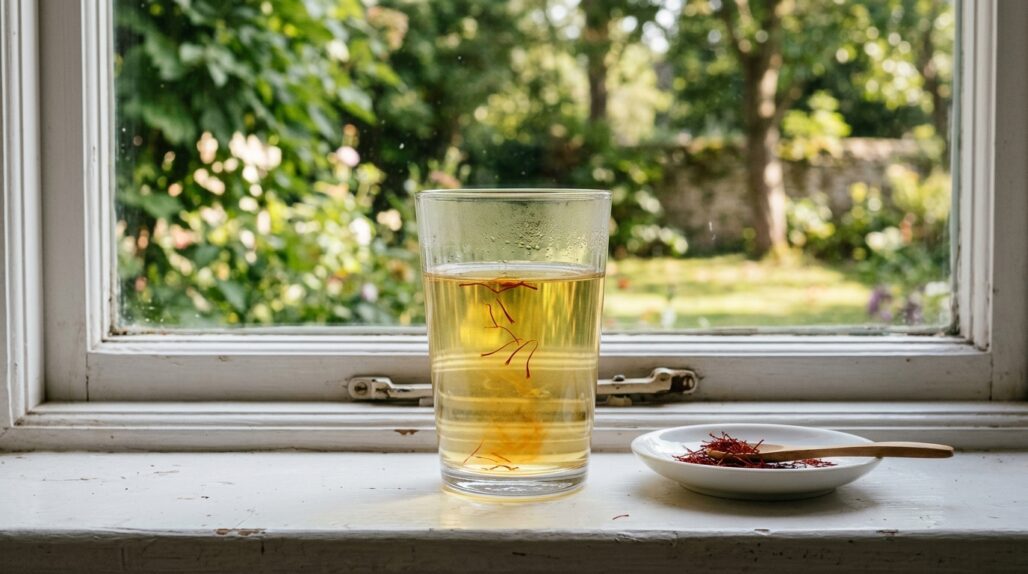
A quick kitchen tell for whole threads: real saffron releases color into warm water slowly over a minute or two and the threads keep their trumpet shape. Dye dumps color in seconds. That test does not work on capsules, which is exactly why the testing seal matters there.
Cost, value, and who should actually bother
Standardized saffron is not cheap, but you take a tiny amount. A month of a 28 mg/day affron product often runs around $20 to $40 as of writing, so check current pricing. That is a reasonable experiment if you fit the profile.
Worth a try if you have mild, situational low mood or a snacking habit you want to dial down, and you want something with actual trial data behind it.
Skip it if you have moderate-to-severe depression, you are expecting weight-loss-drug results, or you would be using it to delay seeing a clinician. Saffron is an add-on in the research, not a replacement for treatment.
If you want to try it, get a tested one
If the evidence above convinced you to test saffron, the only version worth your money is a standardized, third-party-tested extract at the studied dose. These picks point to the affron and Satiereal materials the trials actually used, not anonymous "pure saffron" powders.


As an Amazon Associate, UsefulVitamins.com earns from qualifying purchases at no extra cost to you.
UsefulVitamins may earn a commission if you buy through these links, at no extra cost to you. We only point to standardized, tested options because underdosed and adulterated saffron is the whole problem.
If you are mainly chasing calm rather than mood, our guide to the best natural supplements for anxiety compares saffron against options like magnesium and L-theanine, which is a fairer way to choose than picking by hype.
A real safety note before you start
Saffron is well tolerated at supplement doses in the trials, with low toxicity, but there is one interaction that is not optional reading.
Saffron appears to act on serotonin, which is part of why it may help mood. That also means combining it with an SSRI, SNRI, or other antidepressant raises a theoretical serotonin-related risk, as noted in a 2024 review of saffron for depression that describes saffron inhibiting the serotonin transporter much like an SSRI and flagging a possible serotonin-syndrome risk when combined with antidepressants. The risk at typical doses appears modest, but it is real.
So the rule is simple. Do not stop, start, or replace an antidepressant on your own, and do not stack saffron on top of a prescribed mood medication without asking your prescriber. Pregnancy is another reason to hold off, since high doses of saffron have a traditional reputation as a uterine stimulant. When mood is genuinely affecting your life, that is a clinician conversation, not a supplement decision.
FAQ
Does saffron really work as well as an antidepressant? In several head-to-head RCTs for mild-to-moderate depression it was about as effective as drugs like fluoxetine, which is impressive, but those trials are short and small. It is reasonable evidence for mild cases, not proof it can replace prescribed treatment for moderate or severe depression.
How much saffron extract should I take? The mood trials mostly used about 28 to 30 mg/day of a standardized extract, and the snacking trial used 176.5 mg/day of Satiereal. Match the studied dose on the label rather than guessing with raw spice.
Can I just cook with saffron instead of buying capsules? Culinary amounts are far below the studied doses and the spice is wildly expensive, so getting a trial-level dose from food is impractical. A standardized extract is the controlled way to hit the numbers used in research.
Will saffron make me lose weight? Only a little, and indirectly. The one snacking trial showed roughly a kilogram more change than placebo over eight weeks by reducing grazing, not by burning fat. Treat it as a habit nudge, not a weight-loss tool.
Is it safe to take saffron with my antidepressant? Maybe not without medical advice. Saffron is serotonergic, so combining it with SSRIs or SNRIs carries a theoretical serotonin-related risk. Ask your prescriber before adding it, and never stop a prescription on your own.
How do I know my saffron is not fake? Buy a named standardized extract (affron or Satiereal) with a milligram dose and third-party testing. Saffron is one of the most adulterated spices, so an anonymous “pure saffron” powder with no dose is the easiest thing to fake.
The bottom line
Saffron is the rare wellness trend where the human evidence mostly earns the attention. Standardized extract has real randomized-trial support for mild low mood and for cutting snacking, with effects that are genuine but modest, not the life-changing transformation the ads promise.
The thing that turns a decent ingredient into a waste of money is the supply chain: adulterated threads and underdosed, unstandardized capsules. So if you try it, the move is to buy a tested, standardized extract at the studied dose and treat it as a low-risk add-on, not a cure.
And if your mood is more than mild, or you take a mood medication, the real next step is a clinician, not a capsule.
This article is for general information and is not medical advice. Talk to a qualified healthcare professional before starting any supplement, especially if you take prescription medication, are pregnant, or are managing a diagnosed condition.
Reviewed by the UsefulVitamins Editorial Team.
