
Affiliate disclosure: this article contains affiliate links. As an Amazon Associate, UsefulVitamins.com earns from qualifying purchases at no extra cost to you.
Those fine red and blue threads behind your knees or across your thighs are not just a skin issue. They are tiny surface veins that have stretched and stayed stretched. No pill erases the ones you can already see. What the right supplement can do is firm up the vein walls, cut the leakage that makes legs ache and swell, and slow the next batch from forming. Here is the honest version, picks first.
Why spider veins show up in the first place
Spider veins, or telangiectasias, are dilated little veins sitting just under the skin, usually less than a millimeter wide. They turn visible when blood pools and stretches the vessel wall until it loses tone. As the Cleveland Clinic notes in its spider vein overview, this pooling can push vessels until they leak, which tends to feed more spider veins over time.
The wall itself is the problem. When venous tone drops and the wall gets leaky, fluid and pressure escape into surrounding tissue, which is what makes legs feel heavy and look blotchy by evening.
That is the mechanism these supplements target. Aescin from horse chestnut, the citrus flavonoids diosmin and hesperidin, and the proanthocyanidins in pine bark all act as venotonics. They raise venous tone and tighten the capillary wall so it leaks less. This is vein-wall chemistry, not the collagen-for-glowing-skin story that gets sold elsewhere. None of it dissolves an existing thread vein.
Two things worth holding onto before you spend anything. First, results are modest and they build over weeks. Second, spider veins sit at the mild end of a longer spectrum of chronic venous disease, so the same habits that help them also help the bigger varicose problem behind them.
The 3 supplements worth considering
I ranked these by how good the human evidence is, not by marketing. All three have real randomized trials. None is a cure.
UsefulVitamins may earn a commission from links below, at no extra cost to you. It does not change our picks or our evidence grades.


As an Amazon Associate, UsefulVitamins.com earns from qualifying purchases at no extra cost to you.
| Supplement | Evidence | Typical dose | Best for |
|---|---|---|---|
| Horse chestnut seed extract (aescin) | Strong for venous symptoms: Cochrane review of 17 human RCTs, short-term | 300mg twice daily, standardized 16-20% aescin (about 100mg aescin a day) | Achy, heavy, swelling-prone legs with early venous changes |
| Diosmin + hesperidin (micronized flavonoid complex) | Moderate to strong: multiple human RCTs, rated 1B in venous guidelines | 1000mg a day (about 900mg diosmin + 100mg hesperidin) | People who also get leg cramps, swelling, or who pair it with compression |
| Pycnogenol (French maritime pine bark) | Moderate: many small placebo-controlled human trials, mostly short-term | 100-150mg a day, split into one to three doses | Those who want an antioxidant-leaning option or react poorly to the others |
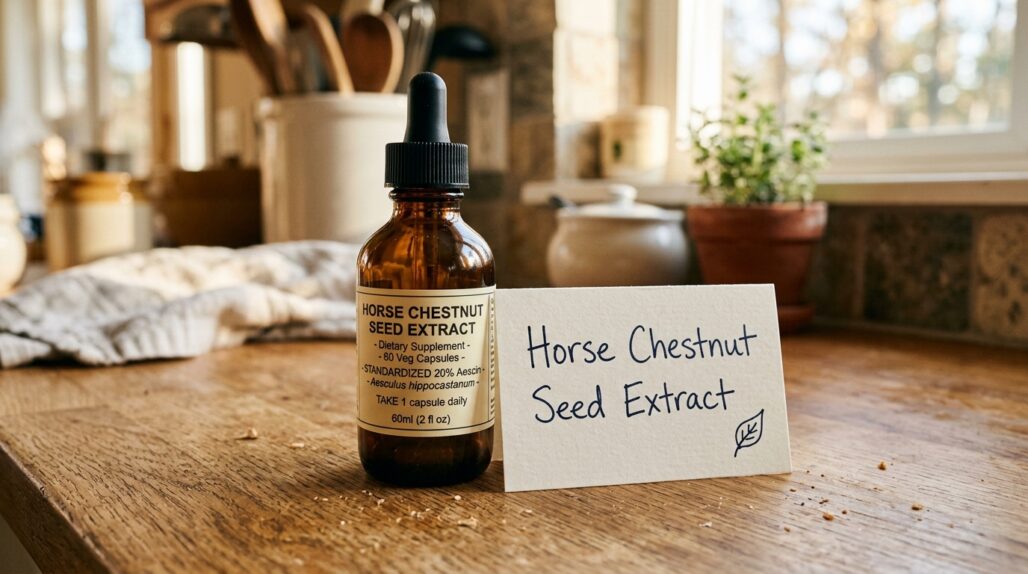
1. Horse chestnut seed extract – the top pick
Evidence grade: strong (for symptoms), human RCTs. This is the only vein supplement with a Cochrane systematic review supporting it. The review pooled 17 randomized trials, all using extract standardized to aescin (escin), the active compound. Across those trials, horse chestnut reduced leg pain and leg swelling versus placebo, and one trial found it about as good as compression stockings for cutting leg volume.
The honest caveat: the Cochrane authors called it a safe, effective short-term treatment and asked for larger trials. Most studies ran only two to sixteen weeks, and they measured aching and swelling, not whether visible threads faded. So the realistic win here is firmer, less tired legs and possibly fewer new veins, not a clearance of what you already see.
Dose: the standard is 300mg extract twice daily, standardized to 16-20% aescin, which works out to roughly 50mg aescin per dose, around 100mg a day. Take it with food. Mild stomach upset, dizziness, or headache are the usual complaints, and they are uncommon.
Who it suits: anyone whose legs feel heavy and swollen by evening alongside the spider veins. Skip it if you are pregnant, breastfeeding, or on a blood thinner (more on that below).
2. Diosmin + hesperidin – the well-studied flavonoid
Evidence grade: moderate to strong, human RCTs. This citrus-flavonoid pair, often sold as a micronized purified flavonoid fraction (MPFF), is the prescription-grade vein agent across much of Europe. A noninferiority trial of micronized diosmin 900mg plus hesperidin 100mg and a separate placebo-controlled diosmin trial both reported real drops in venous symptoms and better quality of life over one to six months. Guideline bodies rate the 1000mg micronized form 1B, meaning a strong recommendation on moderate-quality evidence.
It works by raising venous tone and reducing capillary leak, the same lever as horse chestnut, through a different molecule. Trials showed symptom intensity falling by up to about half, and the effect is strongest when it is paired with compression.
Dose: 1000mg a day, the standard micronized 90/10 split of diosmin to hesperidin. Give it a full one to three months. It is generally well tolerated, with occasional mild stomach upset.
Who it suits: people with swelling and cramping on top of the cosmetic veins, and anyone already wearing compression who wants to add something with trial data. If you want the broader picture on how flavonoids support vessel walls, see our explainer on how vitamin C and bioflavonoids work together.
3. Pycnogenol – the antioxidant option
Evidence grade: moderate, human RCTs but mostly small and short. Pycnogenol is a branded French maritime pine bark extract rich in proanthocyanidins. A 2024 manufacturer-linked review of Pycnogenol’s 39 placebo-controlled trials (about 2,009 subjects across roughly ten conditions) included just two trials in chronic venous insufficiency, where 100-150mg a day reduced edema, leg heaviness, and cramps over two weeks to six months.
The trials are real and placebo-controlled, which is why this earns a moderate grade rather than a weak one. The drawback is that many are small, short, and run by groups tied to the ingredient, so I would not rank it above the first two. Pine bark proanthocyanidins overlap with the wider flavonoid family, and if you like that mechanism you may also be reading about quercetin and related flavonoids.
Dose: 100-150mg a day, taken with food, split if your stomach prefers it.
Who it suits: people who want an antioxidant-leaning choice, or who did not get on with horse chestnut or diosmin.
The free fix that does more than you would think
If you buy nothing else, do this. The cheapest, best-evidenced thing for surface veins is moving blood out of your legs, and that costs zero.
- Walk every day. Each step fires the calf muscle pump, which squeezes blood back up and out of the pooled surface veins.
- Break up long sitting or standing. If you stand all day or sit at a desk, take a movement break every 30 to 60 minutes. A minute of calf raises or a short walk resets the pump.
- Prop your legs up in the evening. Ten to fifteen minutes with your legs above heart level drains the pooling that builds up over the day.
- Wear graduated compression hosiery. This is the one that genuinely competes with pills. Compression squeezes the veins from outside, and in the horse chestnut trials it performed about as well as the extract for leg volume. A pharmacy pair is inexpensive.
- Manage weight and stay hydrated, and avoid sitting cross-legged for hours, which kinks the return flow.
The prevention advice from the Cleveland Clinic lands in the same place: regular exercise, a healthy weight, and not smoking lower your risk of new veins. Supplements ride on top of these habits, they do not replace them.
What supplements cannot do
This is the part single-product blogs leave out. No oral supplement removes a spider vein you can already see. The threads are stretched vessels in the skin, and only an in-office procedure collapses them. Sclerotherapy, where a doctor injects a solution that seals the vein shut, is the standard cosmetic fix, with laser as an alternative for very fine veins. Often it takes more than one session.
So the realistic framing is this: supplements and habits firm the walls, ease the aching, and may slow the next crop. If your goal is making existing veins vanish, that is a dermatology or vascular clinic conversation, not a supplement aisle one.
Also skip the megadose collagen-and-biotin pitch aimed at veins. That is a skin-surface story, not a vein-wall one, and it does not target the leak that drives spider veins.

A real safety warning: blood thinners
Take this seriously. Horse chestnut, diosmin-hesperidin, and Pycnogenol can all nudge blood toward thinner. The Memorial Sloan Kettering herb monograph flags that aescin can reduce platelet aggregation and may interact with anticoagulants.
If you take warfarin, apixaban, rivaroxaban, clopidogrel, or even daily aspirin, do not stack these on top without your doctor or pharmacist signing off first. The combination can raise bleeding and bruising risk. Stop these extracts at least two weeks before any planned surgery. And do not start, stop, or change a prescription on your own.
If your cold, achy legs come more from poor circulation than vein pooling, the supplement strategy shifts. Our pages on supplements for cold hands and feet and Raynaud's support cover that circulation-first angle.
When to see a doctor
Spider veins themselves are usually cosmetic. But the leg can hide something that is not.
See a vascular doctor before self-treating if you have sudden bulging leg veins with swelling, aching, skin discoloration, or an ankle ulcer. Those can signal chronic venous insufficiency or a deep vein thrombosis (DVT), not cosmetic spider veins, and a DVT is a medical emergency.
Also get checked for one-sided leg swelling that comes on fast, a leg that is warm, red, and painful, brownish staining around the ankle, or any sore on the lower leg that will not heal. None of those should wait on a supplement trial.

FAQ
Can supplements make my existing spider veins disappear? No. They firm vein walls, cut leakage, and may slow new veins, but they do not erase visible threads. Sclerotherapy or laser does that.
How long before I notice anything? Plan on six to twelve weeks. The trials on horse chestnut and diosmin measured benefits over weeks to months, not days, so judge it after a couple of months rather than a week.
Is horse chestnut safe to take long term? The Cochrane review only confirmed safety and benefit short term, over about two to sixteen weeks. It is generally well tolerated, but there is no strong long-term safety data, so check in with your doctor for ongoing use.
Can I combine all three supplements? They overlap in how they work, so stacking all three mostly adds cost and bleeding risk rather than benefit. Pick one, give it two to three months, and add compression rather than a second pill.
Are these safe in pregnancy? Treat them as off-limits unless your clinician says otherwise. Horse chestnut, diosmin-hesperidin, and Pycnogenol are not established as safe in pregnancy or breastfeeding, and pregnancy itself is a common time for new spider veins.
Will more vitamin C help my veins? Vitamin C supports the collagen in vessel walls and pairs naturally with bioflavonoids, but it is supporting cast here, not the lead. The venotonics above have the direct vein-symptom trials.
The bottom line
If you want one supplement for spider veins, make it horse chestnut seed extract at 300mg twice daily standardized to aescin. It has the best human evidence, a Cochrane review of 17 trials, and it eases the heavy, swollen, achy legs that come with weak vein walls. Diosmin-hesperidin at 1000mg and Pycnogenol at 100-150mg are reasonable alternatives with their own trial support.
Keep the expectation realistic. These firm the wall and slow new veins. They do not erase the ones you see, and the free fix (walking, movement breaks, leg elevation, compression) does much of the heavy lifting. Clear any of them with your doctor or pharmacist first if you are on a blood thinner, and get a vascular review for sudden swelling, skin changes, or a non-healing leg sore rather than reaching for a supplement.
This article is for general information and is not medical advice. Talk to a qualified clinician before starting any supplement, especially if you are pregnant, on medication, or managing a health condition.
Reviewed by the UsefulVitamins Editorial Team.
