
Affiliate disclosure: this article contains affiliate links. As an Amazon Associate, UsefulVitamins.com earns from qualifying purchases at no extra cost to you.
You have narrowed your evening supplement to two of the most popular sleep aids on the shelf, and they do not do the same job. Ashwagandha is an adaptogenic herb that works on the stress side of poor sleep. Magnesium is a mineral that works on the physical side. Knowing which kind of bad night you actually have is most of the decision.
Stress-driven insomnia vs a tense, restless body
There are two common reasons a healthy person lies awake. One is a mind that will not switch off: you replay the day, your heart feels a little fast, and cortisol is doing its job at exactly the wrong hour. The other is bodily, with muscle tension, restless legs, or that wired-but-tired feeling that has more to do with your nervous system than your worries.
Ashwagandha aims at the first problem. Magnesium aims at the second. They overlap a little, because both touch the brain's calming GABA signaling, but their main strengths point in different directions. That is why the better question is not "which is best" but "which is best for the way I struggle to sleep."
Ashwagandha is a slow, cumulative adaptogen. You take it daily and the benefit builds. Magnesium is more of a same-night relaxant that also corrects a shortfall if you have one. Hold those two ideas and the rest of this comparison falls into place.
What ashwagandha is and how it works
Ashwagandha (Withania somnifera) is a root used in Ayurvedic medicine, sold today as a standardized extract such as KSM-66 or Sensoril. The active compounds are withanolides. Its main relevant action is dampening the stress response: it appears to lower cortisol and quiet the over-arousal that keeps a stressed brain alert at night.
Because it works on the stress axis rather than acting as a sedative, ashwagandha does not knock you out the way a sleeping pill might. It nudges your baseline stress down over time, and better sleep follows.
Evidence grade: moderate, and the best of the two for sleep specifically. A 2021 meta-analysis in PLOS ONE pooled five randomized controlled trials covering 400 adults and found a real improvement in overall sleep quality (standardized mean difference -0.59) and in how quickly people fell asleep (sleep onset latency -0.53), both graded moderate-quality. The catch is in the fine print: effects were clearest at doses of 600 mg or more per day taken for at least eight weeks. A shorter, 30-day student trial in the Journal of Medicinal Food saw a sleep-quality benefit but weaker stress effects, which fits the pattern that ashwagandha needs time.
So the honest read: decent human evidence, but it is not a tonight fix. The cortisol data are also mixed across trials, with some showing a clear drop and others not, so the mechanism is plausible rather than nailed down.

What magnesium is and how it works
Magnesium is an essential mineral involved in hundreds of enzyme reactions, including ones that govern nerve and muscle function. On the sleep side, it supports calming GABA tone and helps regulate the NMDA receptors tied to nervous-system arousal, and it relaxes muscle. If you are genuinely low in magnesium, fixing that can plausibly improve sleep on its own. According to the NIH Office of Dietary Supplements, many adults fall short of the recommended intake, so a shortfall is not rare.
The honest weakness is the sleep evidence. A 2021 meta-analysis in BMC Complementary Medicine and Therapies pooled three trials in 151 older adults and found people fell asleep about 17 minutes faster on magnesium than on placebo, a statistically real result, but total sleep time did not improve significantly, and the authors rated the whole body of evidence low to very low quality with a high risk of bias. A more recent randomized trial of magnesium bisglycinate in 155 poor sleepers found a statistically significant but small improvement in insomnia scores.
Evidence grade: weak to modest. The strongest case for magnesium is when you are actually low. If your diet is rich in greens, nuts, legumes and whole grains, supplemental magnesium may do little for your sleep.
Head-to-head: speed, evidence, dose and downside
The clearest split is timing. Magnesium can be taken nightly and may help the same evening. Ashwagandha is a multi-week commitment that you typically cycle. Here is the side-by-side.
| Factor | Ashwagandha | Magnesium |
|---|---|---|
| Best for | Stress and racing-mind insomnia; high evening cortisol | Physical tension, restlessness, or a likely magnesium shortfall |
| Evidence | Moderate; 5-RCT meta-analysis shows better sleep and faster onset | Weak to modest; small onset benefit, low-quality trials, best if deficient |
| Onset | Cumulative; meaningful effects over 6 to 8 weeks | Often same-night; can be taken every night |
| Typical dose | 300 to 600 mg standardized root extract daily, evening | About 200 to 350 mg elemental at night; supplemental upper limit is 350 mg |
| Main downside | Slow; rare liver injury; not for pregnancy, thyroid or autoimmune cases | Loose stools at higher doses; weaker sleep data; cheap forms upset the gut |
If you only read one row, read onset. That single difference decides most cases.

Who should pick which
Pick ashwagandha if your sleep problem is really a stress problem. You are not physically tense, you are mentally wired. You can take a capsule daily and you are patient enough to judge it at the six-week mark rather than the first night. For this profile it has the better sleep evidence of the two. A standardized extract like KSM-66 at 300 to 600 mg in the evening is the studied range, and our roundup of the best ashwagandha supplements walks through which standardizations are worth paying for.
Pick magnesium if the problem lives in your body, or your diet is thin on it. Restless legs, muscle twitches, a tense jaw, or a known shortfall all point here. It is cheap, you can take it every night without cycling, and the gentler forms are easy on the stomach. Glycinate is the form most people reach for at bedtime, and our pick of the best magnesium for sleep explains why the form matters more than the milligrams on the label. If you want to size a dose to your body weight and diet, the ashwagandha extract converter helps translate raw-root claims into real standardized doses so you are not comparing labels that mean different things.
Neither is a treatment for a diagnosed sleep disorder. If you have been sleeping badly for weeks, snore heavily, or wake gasping, that is a conversation for a clinician, not a supplement aisle.
Which one to buy
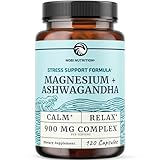
Match the product to the verdict above: ashwagandha if stress runs your nights, magnesium if your body does, and a combined evening formula if you want to cover both bases in one purchase. Note: the combo pick below uses magnesium citrate and oxide rather than glycinate, so it is the cheapest way to cover both bases but can be looser on the gut; if that bothers you, buy the glycinate and an ashwagandha separately.


As an Amazon Associate, UsefulVitamins.com earns from qualifying purchases at no extra cost to you.
Some links on this page are affiliate links, which means we may earn a commission if you buy through them, at no extra cost to you. It never changes our verdict.

Can you take both together?
Yes, and the pairing makes sense. Ashwagandha handles the stress and racing-mind side; magnesium handles the physical, relaxant side. They are not redundant, because they work through largely different routes, and there is no known direct interaction between them. A common evening setup is nightly magnesium plus a daily course of ashwagandha.
A few real cautions before you stack them:
- Additive drowsiness. Both lean calming. If you also take a sedative, sleep medication, alcohol or other relaxing herbs like valerian, the sedation can add up. Start low and do not drive after dosing until you know how you respond.
- Cycle ashwagandha, not magnesium. Magnesium is fine taken nightly within sensible limits. Ashwagandha is usually run for 6 to 12 weeks with a break, partly because long-term human safety data are thin.
- Liver signal for ashwagandha. The NIH LiverTox database lists ashwagandha as a probable, if rare, cause of liver injury, usually appearing 2 to 12 weeks in as jaundice or itching. Avoid it with existing liver disease and stop if those symptoms show up.
- Skip ashwagandha in three situations unless your doctor clears it: pregnancy or breastfeeding, an overactive or otherwise managed thyroid, and autoimmune conditions, since it can nudge the immune and thyroid systems.
- Magnesium and the gut. Too much, especially as oxide or citrate, causes loose stools. The supplemental upper limit is 350 mg of elemental magnesium per the NIH ODS.
If you take prescription medication, are pregnant, or manage a chronic condition, run the combination past a clinician first. Do not start or stop any prescription on the strength of a supplement article.
FAQ
Which works faster for sleep, ashwagandha or magnesium? Magnesium can help the same night and may shorten how long it takes to fall asleep. Ashwagandha is cumulative and is usually judged after six to eight weeks of daily use.
Does ashwagandha actually lower cortisol? Several trials show a drop and others show no significant change, so the cortisol effect is plausible but inconsistent. The sleep-quality improvement in the pooled trials is more reliable than the cortisol numbers behind it.
What magnesium form is best for sleep? Glycinate (bisglycinate) is the usual bedtime choice because it is gentle on the gut. Oxide is cheap but poorly absorbed and more likely to loosen stools. Our magnesium-for-sleep guide compares the main forms.
Can I take magnesium every night long term? Yes, within the supplemental upper limit of 350 mg of elemental magnesium for adults, assuming healthy kidneys. People with kidney disease should not supplement magnesium without medical guidance.
Is it safe to take ashwagandha and magnesium at the same time? For most healthy adults, yes, with no known interaction. The thing to watch is additive drowsiness if you combine them with other sedatives, and the usual ashwagandha cautions around the liver, pregnancy, thyroid and autoimmune conditions.
When should I just see a doctor instead? If poor sleep has lasted weeks, you snore heavily or wake gasping, or daytime tiredness is affecting your life, get evaluated. Supplements are not a fix for sleep apnea or a clinical sleep disorder.
The bottom line
For sleep specifically, ashwagandha has the stronger and more consistent human evidence, but it is a slow burn that suits stress-driven, racing-mind insomnia and needs six to eight weeks to prove itself. Magnesium has weaker sleep data on its own, yet it is the faster, cheaper, lower-risk pick for physical tension or a likely shortfall, and you can take it nightly. Pick ashwagandha if stress runs your nights, magnesium if your body does, and feel free to combine them, watching for additive sedation and keeping ashwagandha away from pregnancy, thyroid and autoimmune situations without a clinician's blessing. If you want the wider context, see our complete guide to sleep supplements.
This article is for general information and is not medical advice. Talk to a qualified healthcare professional before starting any supplement, especially if you are pregnant, take medication, or manage a health condition.
Reviewed by the UsefulVitamins Editorial Team.
