
Affiliate disclosure: this article contains affiliate links. As an Amazon Associate, UsefulVitamins.com earns from qualifying purchases at no extra cost to you.
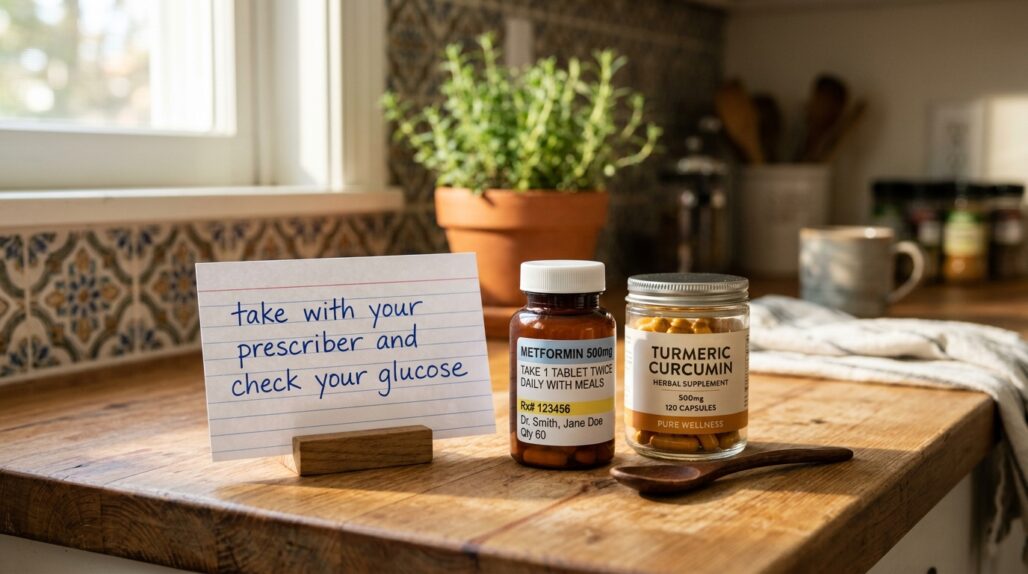
You are standing in the kitchen with the metformin in one hand and a turmeric bottle in the other, and you want a straight answer before you swallow both. Here it is, with the reasoning a careful pharmacist would give you over the counter.
Do turmeric and metformin actually interact?
Yes, but not in the way most people fear. There is no dangerous clash, no toxic reaction, no race to the emergency room for the average person. What you have is an additive effect: both lower blood sugar, so together they lower it a little more than metformin would alone.
That is usually welcome if your numbers run high. It is worth respecting rather than ignoring, because "a little more blood-sugar lowering" can tip into too much for the wrong person – mainly someone who also takes insulin or a sulfonylurea.
So this is a "caution" page, not a "yes" page and not an "avoid" page. The honest summary: generally safe, often helpful, but you should loop in your prescriber and keep an eye on your glucose rather than treat it as a casual add-on.
One thing to be clear about from the start. Turmeric is not a substitute for metformin and not a "natural alternative" to it. Nothing here is a reason to lower, skip, or stop a prescribed dose. The point is to add a supplement safely, not to swap your medication for a spice.
The mechanism: why curcumin nudges your numbers down
Turmeric's active compound is curcumin. On its own, at supplement strength, curcumin lowers blood glucose. This is well documented in people with type 2 diabetes.
The strongest source is a 2024 meta-analysis pooling randomized controlled trials (Curcumin Attenuates Hyperglycemia and Inflammation in Type 2 Diabetes Mellitus). Across 16 trials it found supplemental curcumin lowered fasting blood glucose by about 11 mg/dL (95% CI -14.26 to -8.70), and across 14 trials it lowered HbA1c by about 0.5% (95% CI -0.73 to -0.35). The reviewers graded the HbA1c finding moderate certainty and the fasting-glucose finding low certainty, so the direction is solid even if the exact size will vary person to person.
Here is the key detail for the metformin question. This is a pharmacodynamic effect – two things pushing glucose in the same direction – not a pharmacokinetic one where a supplement blocks or boosts the absorption of a pill. That distinction is the whole reason spacing your doses by a few hours does nothing. The curcumin is lowering your glucose regardless of when you take it relative to the metformin.
Metformin by itself rarely causes a low, because it does not force your pancreas to dump insulin. So with metformin alone, the added curcumin effect is mostly favorable. The hypoglycemia signal gets real when curcumin is layered onto a drug that does push insulin – a sulfonylurea (glipizide, glyburide, glimepiride) or insulin itself. A pharmacokinetic study in animals showed curcumin raised glyburide-type drug levels and prolonged glucose lowering by slowing the drug's clearance, and a related study found curcumin increased the glucose-lowering effect of gliclazide on repeated dosing. Many people on metformin are also on one of these, which is why your full med list matters.
The interaction databases agree. The Drugs.com checker grades metformin plus turmeric a moderate interaction, with additive blood-sugar lowering and advice to monitor glucose and learn the signs of a low. Evidence grade overall: the glucose-lowering of curcumin is well documented; the additive-with-metformin caution is well acknowledged but modest.
There is a second, separate caution that has nothing to do with metformin but matters to anyone starting a daily extract. The NCCIH notes that highly bioavailable curcumin formulations have been linked to rare liver injury. That is dose- and formula-dependent, and it is the reason this page does not wave you toward the strongest "ultra-absorption" mega-dose product.
The practical rule: dose, monitoring, and who is most at risk
Turmeric in your food is fine. Curry, golden milk, a turmeric latte – that amount is not going to move your glucose meaningfully. No action needed.
For a supplement-strength dose, here is how to play it. Trials typically used 500 to 1,000 mg of standardized curcumin a day (the wider studied range runs from about 80 mg up to 2,100 mg). At that level:
- Tell your prescriber and pharmacist before you start. This is a five-minute conversation, and it is the single most useful step on this page.
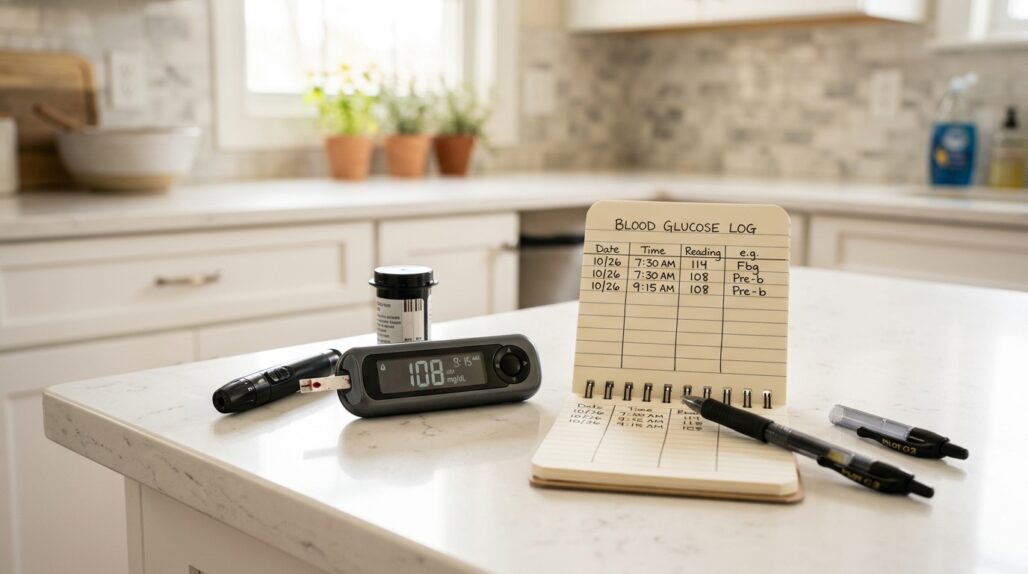
- Check your home glucose more often for the first 2 to 4 weeks. That is the window where an additive drop would show up. A reading or two extra a day is enough.
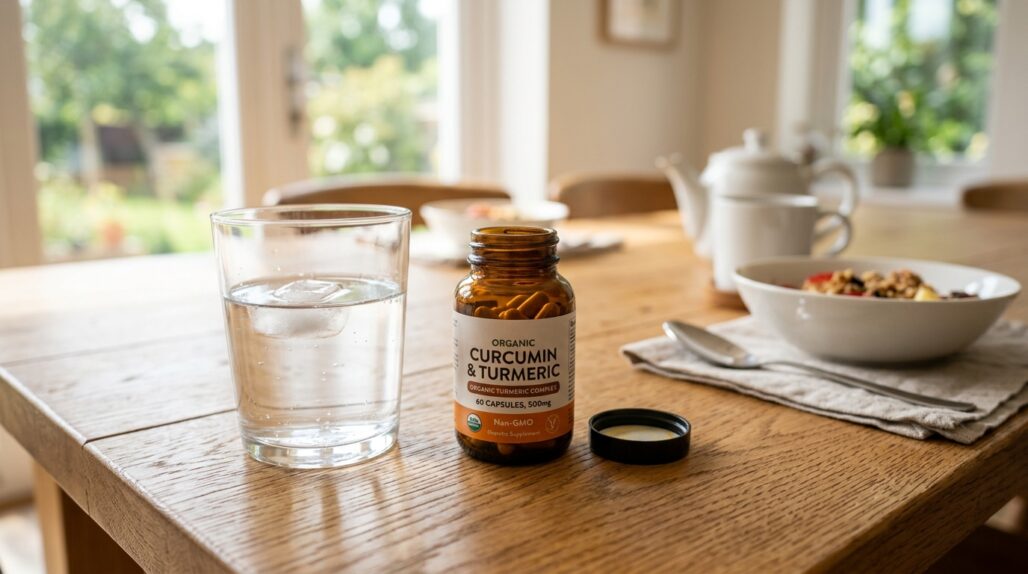
- Do not try to “space it out.” Because the effect is additive and not absorption-based, separating turmeric from your metformin by a few hours changes nothing. Take turmeric with food (a meal with some fat, or a piperine or phytosome formula, helps it absorb).
- Keep the dose modest. A 500 mg phytosome curcumin cap (which binds the curcuminoids to phospholipids for far higher absorption, so a smaller curcuminoid dose goes further) lands you in the studied range and keeps the liver-injury risk low. There is no prize for mega-dosing.
- Never adjust your metformin yourself. If your numbers drift, that is information for your prescriber, not a cue to self-titrate.
Who should clear it first, not just mention it:
- Anyone on insulin or a sulfonylurea (glipizide, glyburide, glimepiride) on top of metformin – this is where a real low can happen.
- Anyone with liver disease or who has had liver problems, because of the high-dose curcumin liver-injury signal.
- Anyone on warfarin or Eliquis – turmeric carries a separate bleeding caution unrelated to blood sugar. We cover that pairing in turmeric and Eliquis.
This is education, not a prescription change. The aim is to start a supplement knowing what to watch for, with your care team told.
What to actually do: the safe way to add turmeric
If your prescriber is comfortable with it, the safe path is simple and cheap. Pick a sensible product, set up a way to watch your numbers, and keep your routine steady.


As an Amazon Associate, UsefulVitamins.com earns from qualifying purchases at no extra cost to you.
UsefulVitamins may earn a commission from purchases made through links below, at no extra cost to you. We only suggest safe, sensibly dosed options; the products here are not a replacement for your metformin.
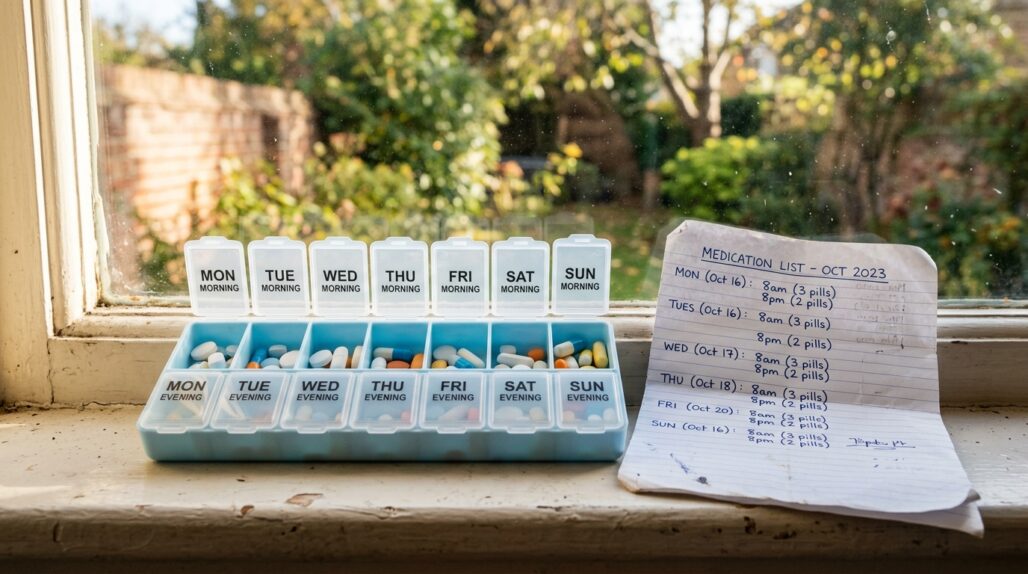
A few notes on the picks above. A 500 mg phytosome curcumin binds the curcuminoids to phospholipids for far higher absorption, so a lower curcuminoid dose keeps you in the studied range while staying well clear of the mega-dose territory tied to liver concerns. A home glucose meter with strips and lancets is the real safety tool for this combo – it turns "I think I feel low" into a number. And a 7-day AM/PM organizer keeps your metformin and your turmeric on schedule so you are not guessing what you took. If you want help choosing a form, our best turmeric and curcumin supplements roundup compares the absorbable formulas, and the curcumin bioavailability comparator lets you line up phytosome, piperine, and standard extracts side by side.
The cleanest way to avoid a surprise is to keep every prescription and every supplement in one list and have the overlaps flagged before you add anything. You can do that with pen and paper – write your full list, bring it to your pharmacist, and ask them to look for double-ups. Or you can scan your bottles into StackMyMed (our own free app), which logs your metformin and your turmeric together and flags the additive blood-sugar note so you have a concrete thing to ask your pharmacist about. It does not diagnose anything and it does not replace a clinician; it just surfaces the overlap and exports a clean med-plus-supplement list for the person who can actually advise you.
For broader pairing ideas once your prescriber has signed off, our guide to the best supplements for metformin users walks through the options that fit alongside the drug.
At a glance: turmeric and metformin
| Question | Answer |
|---|---|
| Do they interact? | Yes, mildly. Curcumin lowers blood sugar on its own, so it adds to metformin. Graded a moderate interaction, usually helpful. |
| How should I take them? | Turmeric with food, modest dose (around 500 to 1,000 mg curcumin). No spacing needed – the effect is additive, not absorption-based. Keep taking metformin exactly as prescribed. |
| Who should be careful? | People also on insulin or a sulfonylurea (real low-sugar risk), anyone with liver disease, and warfarin or Eliquis users (separate bleeding risk). |
| When do I call a doctor? | Hypoglycemia signs (shakiness, sweating, sudden hunger, dizziness, confusion, fast heartbeat, or a reading under about 70 mg/dL), or signs of liver trouble (dark urine, jaundice, persistent nausea). |
Related pairs and the wider diabetes-drug class
Turmeric behaves the same way next to other glucose-lowering routines, with one important sliding scale. Stacked on metformin alone, the additive effect is gentle and the low-sugar risk is small. Stacked on a sulfonylurea (glipizide, glyburide, glimepiride) or insulin, the risk of an actual low is higher, because those drugs already push glucose down hard. The newer agents – GLP-1 drugs like semaglutide, or SGLT2 inhibitors – have their own profiles, but the same principle holds: tell your prescriber, watch your numbers early, and do not self-adjust.
Other blood-sugar-active supplements deserve the same caution next to your diabetes meds. Berberine, for instance, is more potent than curcumin and warrants the same prescriber conversation. The better question is not "is this one supplement safe?" but "does anything I am adding push my glucose, and does my care team know?"
If you take a blood thinner alongside your diabetes meds, treat the bleeding question as its own issue. Our page on turmeric and Eliquis covers that pairing properly.
FAQ
Can turmeric replace my metformin? No. Curcumin can lower blood sugar modestly, but it is not a medication and it is not a substitute for one. Keep taking your metformin exactly as prescribed and treat turmeric as an add-on you have cleared with your prescriber.
How much turmeric is safe with metformin? Food amounts are a non-issue. For a supplement, trials mostly used 500 to 1,000 mg of standardized curcumin a day. Keep it modest, take it with food, and confirm the dose with your pharmacist – especially the highly bioavailable formulas, which carry a small liver-injury signal.
Should I take turmeric and metformin at different times? It will not change anything. The interaction is additive, not absorption-based, so spacing the doses by hours does not reduce the effect. Take turmeric with a meal for absorption and tolerability.
Will turmeric make my blood sugar drop too low? On metformin alone, that is unlikely, because metformin does not force insulin release. The real low-sugar risk shows up when you also take insulin or a sulfonylurea. Watch for shakiness, sweating, sudden hunger, dizziness, confusion, or a reading under about 70 mg/dL.
Is the liver risk from turmeric something to worry about? For most people on a sensible dose, no. The concern, per NCCIH, is with high-dose, highly bioavailable curcumin products. Stop and seek care if you notice dark urine, yellowing of the skin or eyes, or persistent nausea.
What should I tell my doctor or pharmacist? The exact product, the curcumin dose, every other medication you take (especially insulin, sulfonylureas, and blood thinners), and any liver history. Bring your bottles or a written list so they can check the whole picture at once.
The bottom line
Turmeric and metformin are usually fine together, and the curcumin may even help your numbers a little – but it is an additive blood-sugar effect, so this is a "caution," not a free yes. Tell your prescriber and pharmacist before you start, take turmeric with food at a modest dose, and check your home glucose more often for the first few weeks. There is no spacing trick, because the effect is not about absorption. Be most careful if you also take insulin or a sulfonylurea, have liver disease, or take a blood thinner. Watch for low-sugar signs – shakiness, sweating, sudden hunger, dizziness, confusion, rapid heartbeat, or a reading under about 70 mg/dL – and never adjust your metformin on your own.
This article is for general education and is not medical advice. Supplements can interact with prescriptions in ways that depend on your dose, your other medications, and your health. Always confirm with your doctor or pharmacist before combining anything with a prescription, and never start, stop, or change a medication on your own.
Reviewed by the UsefulVitamins Editorial Team.
