

Affiliate disclosure: this article contains affiliate links. As an Amazon Associate, UsefulVitamins.com earns from qualifying purchases at no extra cost to you.
Do fish oil and metformin actually interact?
Short version: no, not in any way that has been documented. Run the pair through the Drugs.com interaction checker and it returns "no interactions found." The two work on completely separate machinery. Metformin lowers how much glucose your liver pumps out and makes your tissues a little more sensitive to insulin. Fish oil delivers two omega-3 fatty acids, EPA and DHA, that mostly act on your blood fats. Two different jobs, no overlap.
That covers most of what people are actually worried about. The two questions that usually sit behind "can I take these together" are: will the fish oil mess with how my metformin works, and will it push my blood sugar somewhere it should not go. The answer to both is no at normal supplement doses.
There is one real caveat, and it is about dose, not about metformin. More on that below.
Why they do not interact – the mechanism, graded
Here is why, if you want the reasoning behind the answer.
No absorption clash. Some supplement-drug pairs fight in the gut: a mineral binds the drug and you absorb less. That is not what is happening here. Fish oil does not bind metformin or change how much of it reaches your blood. So separating the doses by hours buys you nothing.
No blood-sugar harm. The old worry was that fish oil might raise blood glucose and quietly undercut a diabetes drug. That has been looked at carefully and it does not hold up. A 2015 meta-analysis in PLOS One pooled 20 randomized trials in 1,209 people with type 2 diabetes and found no meaningful change in HbA1c or fasting glucose with omega-3. Evidence grade here is high: many trials, consistent result. The same analysis flagged a small wrinkle worth being straight about, fasting glucose ticked up slightly in Asian study populations but not in Western ones, and the size of that signal was tiny. It is a reason to keep an eye on your numbers if you start a high dose, not a reason to skip the supplement.
What fish oil actually does. Its reliable effect is on triglycerides, the blood fats that often run high in type 2 diabetes. The NIH Office of Dietary Supplements notes that the American Heart Association considers 4 g/day of prescription-strength omega-3 effective for lowering triglycerides, on its own or alongside other lipid drugs. At ordinary over-the-counter doses the triglyceride drop is more modest, but the direction is the same and it gets stronger above about 2 g/day. That is a benefit that sits comfortably next to metformin, not a conflict with it.
So the picture is straightforward: no known interaction, no glucose harm at normal doses, and a likely triglyceride benefit. That is why the answer is a plain yes, not a hedge.
| Question | Answer |
|---|---|
| Do they interact? | No known interaction. Checkers return “no interactions found,” and omega-3 does not worsen blood sugar. |
| How do I take them? | Together, with a meal. Dinner is an easy shared slot. No spacing needed. About 1 to 2 g/day of combined EPA+DHA. |
| Who should be careful? | High-dose users (2 g/day and up) should tell their prescriber; anyone on a blood thinner should clear a high dose first (a blood-thinner caution, not a metformin one). |
| When do I call a doctor? | Persistent diarrhea, severe stomach pain, or unusual bruising or bleeding. Treat fish oil as an add-on, never a replacement for metformin. |

The practical rule – dose, timing, and who should be careful
Take them together, with food. Metformin should be taken with a meal anyway, because food blunts the stomach upset it is known for, which the Mayo Clinic metformin information spells out plainly. Fish oil also goes down easier with a meal and burps back less. Dinner is the natural shared slot. No spacing rule applies, because there is no absorption competition to space around.
On dose, a common evidence-based range is about 1 to 2 g/day of combined EPA+DHA. Read the back of the bottle for the EPA and DHA numbers, not just the "fish oil 1000 mg" on the front, since a 1,000 mg softgel often contains only 300 mg of actual omega-3. If you want help translating a label into your real intake, our omega-3 EPA and DHA calculator does the math.
The one dose-related caveat: if you (or your prescriber) go to a high dose, roughly 2 g/day and up, and especially toward 4 g/day, it is reasonable to recheck fasting glucose or HbA1c a few weeks after starting. Not because trouble is likely, but because the high-dose end is the only place the data gets a little soft, and confirming your numbers is cheap. The FDA suggests not exceeding 5 g/day of EPA+DHA from supplements regardless.
Who should pause and talk to a prescriber first:
- Anyone on a blood thinner or antiplatelet – warfarin, apixaban (Eliquis), aspirin, clopidogrel. High-dose fish oil can add to bleeding risk. Important: that caution is about the blood thinner, not the metformin. The NIH ODS notes the real-world bleeding signal is smaller than once feared, with no clear excess at up to 7 g/day in one review, but it is still the conversation to have before a high dose.
- People heading into surgery – tell your surgeon you take fish oil; they may ask you to stop it beforehand.
- Anyone also taking a sulfonylurea or insulin on top of metformin. Fish oil itself does not cause lows, but if your glucose-lowering regimen is already aggressive, any change is worth a heads-up to your prescriber.
This is education, not a prescription change. Nothing here is a reason to adjust, skip, or stop your metformin. The supplement is an add-on you clear with your prescriber, never a swap for the drug.
What to actually do – the safe way to take it
Keep it simple. Buy a sensible product, take it with dinner, and stay consistent.
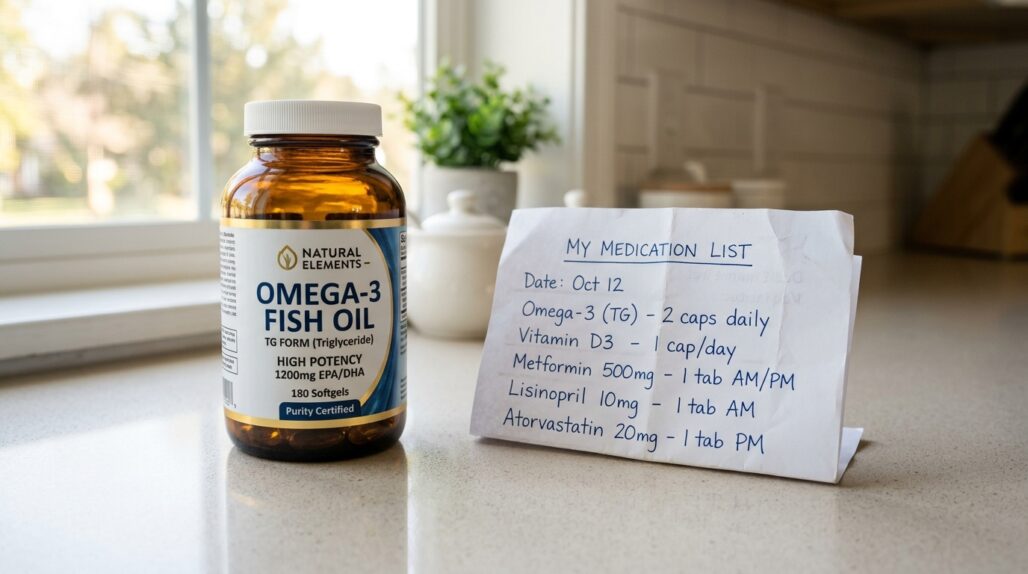
For form, the triglyceride (re-esterified) or natural-triglyceride form tends to absorb a bit better than the cheaper ethyl-ester version and burps less, which matters for actually sticking with it. Look for a labeled EPA+DHA total, not just total fish oil. If you want a vetted shortlist, see our roundup of the best omega-3 fish oil supplements.
A weekly AM/PM pill organizer is the dull little tool that makes the "with dinner, every day" habit hold. Consistency is what delivers the triglyceride effect, not the exact minute you swallow it.


As an Amazon Associate, UsefulVitamins.com earns from qualifying purchases at no extra cost to you.
Some links below are affiliate links. If you buy through them we may earn a small commission at no extra cost to you. We only card products that are safe for this pairing – never the risky combination.
One more habit that quietly prevents surprises: keep every prescription and every supplement on one list. The cleanest way to do that is to log them in one place and have overlaps flagged before you add anything new. You can do this with StackMyMed (our own free app), which lets you scan your metformin and your fish oil into a single list and surfaces things to ask your pharmacist about. It is non-diagnostic – it flags, it does not decide. If an app is not your thing, the low-tech version works just as well: write your full list, prescriptions and supplements both, and show it to your pharmacist at your next visit. Either way, the real decision lives with a person who knows your chart.

Related pairs and the wider class
A few neighbors worth knowing, since metformin and fish oil rarely come up alone.
Metformin and vitamin B12. This is the metformin issue most people miss. Long-term metformin use is linked to lower vitamin B12, now acknowledged by the ADA and the UK MHRA. In the Diabetes Prevention Program follow-up, about 1 in 5 long-term metformin users had low or borderline-low B12 (19.1 percent vs 9.5 percent on placebo at 5 years), and the risk rose by roughly 13 percent per year of use (PMC review on metformin and B12 deficiency). It has nothing to do with fish oil, but if you take metformin long term, periodic B12 checks are reasonable. See our notes on metformin and vitamin B12 depletion.
Fish oil and blood thinners. This is the fish oil pairing that actually calls for care, and the one people sometimes mix up with the metformin question. Different drug class, different rule.
Other supplements for people on metformin. If you are building a stack around a metformin routine, our guide to the best supplements for metformin users covers what is worth it and what is not.
The pattern for the whole class: separate pathways usually mean no interaction (fish oil and metformin), a shared direction of effect means watch for additive results, and a narrow-margin drug like warfarin means clear it first.
FAQ
Does fish oil raise blood sugar and cancel out metformin? No. The pooled trial evidence shows no meaningful change in HbA1c or fasting glucose with omega-3 at supplement doses, and there is no documented interaction with metformin. Its main effect is lowering triglycerides.
Do I need to space fish oil and metformin apart by a few hours? No. The two do not compete for absorption, so spacing does nothing. Take them together with a meal.
How much fish oil is reasonable with metformin? A common evidence-based range is about 1 to 2 g/day of combined EPA+DHA. Above 2 g/day, and especially near 4 g/day, recheck your glucose or HbA1c a few weeks in and keep your prescriber in the loop. The FDA suggests staying under 5 g/day from supplements.
I take metformin and a blood thinner. Is fish oil still fine? The metformin side is fine. The blood thinner is the reason to talk to your prescriber before a high dose, because omega-3 can add to bleeding risk. That caution is about the anticoagulant, not the metformin.
Should I worry about vitamin B12 on metformin? That is a metformin matter, not a fish oil one. Long-term metformin can lower B12, so periodic testing is reasonable. Ask your prescriber whether you are due for a level.
Can fish oil replace my metformin if it helps my numbers? No. Fish oil is not a substitute for a diabetes medication and should not be framed as a natural alternative. Keep taking metformin exactly as prescribed and treat fish oil as an add-on you clear with your doctor.
The bottom line
Yes, you can take fish oil with metformin. There is no known drug interaction, omega-3 does not worsen blood sugar at normal doses, and it may help your triglycerides. Take both with a meal, no spacing needed, around 1 to 2 g/day of EPA+DHA, and recheck your glucose if you go to a high dose. The two situations that call for a prescriber chat are a high fish oil dose and a blood thinner in your regimen. None of this changes how you take metformin.
This article is for education and is not medical advice or a prescription change. Talk to your doctor or pharmacist before combining any supplement with a prescription medication, and never stop or alter a prescribed medicine on your own.
Reviewed by the UsefulVitamins Editorial Team.
