
If you're searching for the immune-support mushroom with the strongest clinical backing, the honest answer is: turkey tail has a legitimate evidence base, but almost all of it comes from oncology trials, not healthy-population immune-boosting studies — and those two contexts are not interchangeable. This article breaks down what PSK and PSP actually are, what those trials found at what doses, and why the gap between the cancer-adjunct research and general "immune boost" marketing claims matters for everyday supplement buyers. You'll also get a clear look at the drug interactions that make turkey tail genuinely risky for certain populations — particularly anyone on immunosuppressant therapy — and what to look for on a supplement label before spending any money on a product that may or may not contain meaningful polysaccharide concentrations.
Affiliate disclosure: this article contains affiliate links. As an Amazon Associate, UsefulVitamins.com earns from qualifying purchases at no extra cost to you.
Summary / Quick Answer: does turkey tail support immune function?
Turkey tail's two key compounds, PSK and PSP, have more peer-reviewed clinical trial data than any other mushroom supplement — but that data is primarily in cancer patients receiving conventional treatment, not in healthy adults seeking general immune support.
- Best for: Adults who have discussed mushroom supplements with an oncologist as part of integrative oncology care; adults looking for the most evidence-backed medicinal mushroom in the category; readers who want to understand where the evidence actually sits before buying
- Not ideal for: Anyone on immunosuppressant therapy (organ transplant recipients, those on biologics, autoimmune-disease patients on DMARDs) — PSK and PSP modulate immune function in ways that can directly counter the purpose of immunosuppression; anyone expecting a supplement that straightforwardly prevents colds in healthy people (the evidence for this specific use is thin)
- What to look at before buying: Fruiting body content versus mycelium-on-grain, disclosure of polysaccharide percentage, and third-party COA — most of the clinical work on PSK used pharmaceutical-grade preparations, not retail capsules
- Decision shortcut: If an oncology-related use is relevant to you, have this conversation with your treatment team first. If you're a healthy adult shopping for immune support, the evidence is much more modest than the headline "strongest immune-support mushroom" suggests
What you'll find in this guide
- What turkey tail is and what PSK/PSP actually are
- How beta-glucans activate the immune cascade
- What the research actually shows, honestly
- Who it's for and who should skip it
- Dosing context from clinical trials
- Side effects and drug interactions
- Product picks
- Frequently asked questions
What turkey tail is and what PSK and PSP actually are {#what-turkey-tail-is}
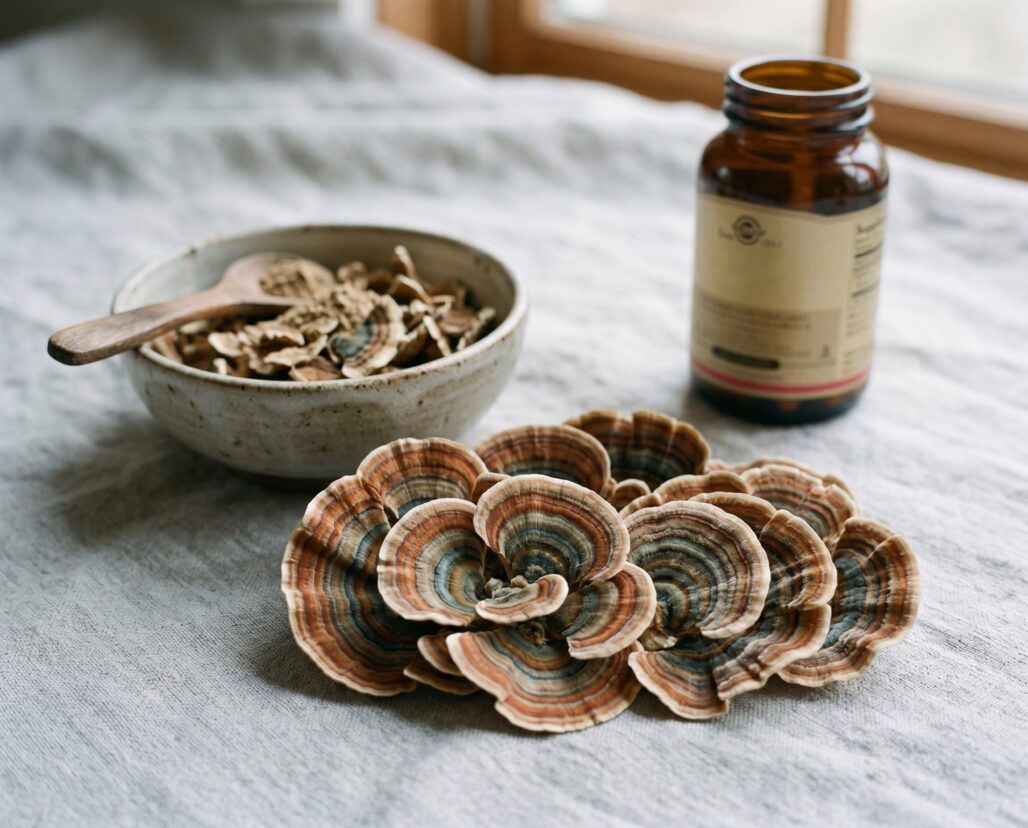
Turkey tail (Trametes versicolor, also sold under the older name Coriolus versicolor) is a bracket fungus that grows on dead hardwood trees across the Northern Hemisphere. The name comes from the concentric banded rings on its surface, which range from rust and brown to cream and grey-blue, resembling the fanned tail feathers of a wild turkey. It is not a culinary mushroom — the texture is leathery and the flavor unremarkable — so it is consumed primarily in extract or powder form.
Two polysaccharide compounds from turkey tail have been studied extensively:
PSK (polysaccharide K, also called Krestin) is a protein-bound polysaccharide derived from the CM-101 strain of Trametes versicolor. It was developed in Japan in the 1970s and has been approved as a cancer adjunct therapy in Japan since 1977. PSK is a pharmaceutical-grade compound manufactured to defined standards, and virtually all the oncology research used this specific preparation — not a retail supplement.
PSP (polysaccharide peptide) is a similar protein-bound polysaccharide from a different Coriolus versicolor strain (Cov-1), developed primarily in China. PSP research is somewhat less extensive than PSK research but points in similar immunological directions.
In traditional Chinese medicine, turkey tail (yun zhi) has been used as a tonic for centuries. Traditional use is context, not evidence — but it is worth noting that the original pharmaceutical interest in PSK grew partly from observations about traditional medicinal use, leading researchers to isolate and study the active compounds.
Actionable takeaway: When you see "turkey tail" on a supplement label, you are not buying PSK or PSP as studied in clinical trials. Those are pharmaceutical-grade preparations. You are buying an extract of Trametes versicolor that contains some quantity of beta-glucans and polysaccharides, with variable standardization depending on the manufacturer.
How beta-glucans activate the innate immune cascade {#how-beta-glucans-work}
Beta-glucans are glucose polysaccharides found in the cell walls of fungi, yeast, oats, and some other plants. The beta-glucans in turkey tail — including those that form part of PSK and PSP — bind to pattern-recognition receptors on immune cells. The primary receptor in this cascade is Toll-like receptor 2 (TLR2), along with Dectin-1, a C-type lectin receptor on macrophages, dendritic cells, and neutrophils.
When beta-glucans bind TLR2 and Dectin-1, they trigger a downstream signaling cascade that activates the innate immune system: macrophages increase phagocytosis (the engulfing of pathogens), natural killer (NK) cell activity increases, and dendritic cells are primed to present antigens to T cells. In simplified terms, beta-glucans act as a signal telling the immune system that something foreign is present and that it should get ready to respond.
This mechanism is well-characterized in cell culture and animal models. The more complicated question is whether orally consumed turkey tail supplements reach immune cells in sufficient concentrations to produce this effect in humans at retail supplement doses. PSK studies used intravenous or high-dose oral administration in clinical settings — not 500mg capsules twice a day.
Think of beta-glucan's immune effect like a fire alarm: it can trigger a response, but only if the signal reaches the right cells in the right concentration. Whether a retail turkey tail supplement delivers that signal at meaningful intensity is a different question than whether PSK administered in an oncology protocol does.

What the research actually shows — honestly {#what-research-shows}
The oncology-adjunct evidence: genuinely strong
The strongest human data for turkey tail comes from oncology settings, where PSK has been used as an adjunct to conventional cancer treatment.
A 2012 Phase I clinical trial (Torkelson et al., PMID 22782060) enrolled 11 breast cancer patients who had completed primary treatment and given them escalating doses of whole turkey tail powder (3g, 6g, or 9g daily for 6 weeks). The study measured immune outcomes including NK cell and CD8+ T cell activity. All three dose groups showed increases in NK cell activity, with the 9g dose showing the largest effect. This was a Phase I dose-escalation study — it was designed primarily to assess safety, not to establish efficacy in a powered randomized design.
Earlier PSK-specific work includes Japanese randomized trials in colorectal and gastric cancer patients from the 1980s and 1990s showing improved five-year survival rates in PSK groups versus placebo. A 2003 meta-analysis (Oba et al., PMID 14735226) pooled data from eight randomized controlled trials of PSK as adjunct to surgery and chemotherapy in colorectal cancer (total n=1,094) and found a statistically significant improvement in overall survival (hazard ratio 0.73, 95% CI 0.61-0.87) in the PSK group.
This is real evidence. It is why turkey tail has a legitimate claim to "the strongest evidence in the mushroom category." PSK has been studied in actual RCTs in actual patients for decades, not just in petri dishes.
A 2008 pilot study (Standish et al., PMID 18830257) used PSP from turkey tail in breast cancer patients and measured immune biomarkers, finding increases in CD8+ T cells and NK cells at 3g and 6g daily for 6 weeks. Again, the population was cancer patients, not healthy adults.
The general immune-support evidence: much thinner
The real question isn't whether PSK helps cancer patients in combination with chemotherapy. It's whether a turkey tail supplement helps a healthy adult resist winter infections or mount a stronger antibody response to a vaccine.
Human RCT data for turkey tail in healthy adults is limited. One 2014 randomized, placebo-controlled trial (Toth et al., PMID 24312084) gave 60 healthy adults either 500mg or 1,000mg of turkey tail mushroom biomass daily for 8 weeks, measuring a panel of immune markers. Neither dose produced statistically significant changes in the primary outcome measures. The study was small and lacked the statistical power to detect modest effects, so a negative finding does not definitively rule out benefit — but it does not support the "immune boost" claims made by most consumer brands.
An adaptogen brand can have impressive marketing and still miss third-party testing for the active marker compound. For turkey tail, the active marker compound — or at least the closest proxy — is the total polysaccharide content, and few retail products disclose this as a verified percentage from a third-party COA.
Actionable takeaway: The evidence for turkey tail is genuinely strongest in oncology-adjacent settings. For healthy adults, the immune-support claim rests on plausible mechanism, traditional use, and limited human data — not the same RCT base as the cancer adjunct work.
Who it's for and who should skip it {#who-its-for}
Strong fit:
- Adults engaged in integrative oncology care who want to discuss mushroom supplements with their treatment team (the oncology evidence is real, but decisions must involve the prescribing oncologist)
- Adults interested in the most evidence-backed medicinal mushroom supplement and willing to accept that most evidence comes from cancer studies, not general wellness trials
- Anyone using turkey tail for general immune support who has verified that they are not on immunosuppressant medication
Skip if:
- You are on immunosuppressant therapy: tacrolimus, cyclosporine, mycophenolate, biologic DMARDs (adalimumab, etanercept, ustekinumab), or high-dose corticosteroids — PSK and PSP modulate immune function in ways that directly work against the mechanism of immunosuppression, and this is not a theoretical concern
- You are undergoing cancer treatment and have not discussed mushroom supplements with your oncologist — even beneficial immunomodulatory effects can interact unpredictably with specific chemotherapy agents
- You are on anticoagulant therapy (warfarin, apixaban, rivaroxaban) without medical supervision — beta-glucan-rich supplements have a preclinical interaction signal with anticoagulant drugs
- You are pregnant or nursing — no safety data exists for turkey tail in pregnancy
Dosing context from clinical trials {#dosing-context}
Turkey tail is not a pharmaceutical compound with a defined minimum effective dose established in large Phase III trials. What clinical research provides is dose ranges tested in specific populations for specific outcomes.
In the Torkelson 2012 breast cancer Phase I trial, doses ranged from 3g to 9g of whole turkey tail powder daily for 6 weeks. In the Standish 2008 PSP trial, the doses were 3g and 6g daily for 6 weeks. In the Toth 2014 healthy-adult study, doses were 500mg and 1,000mg daily for 8 weeks — and neither dose produced significant immune changes.
This is a wide range with no validated minimum effective dose for healthy adults. The clinical work on PSK specifically used pharmaceutical PSK preparations, not retail supplements, which makes translating those doses to commercial products even less straightforward.
In the context of traditional use and available safety data, most commercial turkey tail supplements are sold at 500mg to 2g daily. The Toth healthy-adult trial found no significant immune changes at 500mg and 1,000mg daily, which is worth noting when evaluating products at this dose range.
As with any medicinal mushroom, look for fruiting body extract with disclosed polysaccharide content, not mycelium-on-grain powder of unverified composition.
Side effects and drug interactions {#side-effects-and-drug-interactions}
Reported adverse effects in clinical trials
In the published turkey tail and PSK trials, turkey tail and PSK were generally well tolerated. The Torkelson 2012 trial — the highest dose in a clinical setting at 9g/day — reported no serious adverse events at any dose level. Minor gastrointestinal symptoms (nausea, diarrhea, bloating) have been noted at higher doses in individual case reports. Darkening of the fingernails has been reported as a side effect in some PSK trials, a benign cosmetic effect.
Allergic reactions are possible, as with any fungal supplement. Anyone with known mushroom or mold allergies should proceed with caution and physician guidance.
Drug interactions
Immunosuppressants (avoid): This is not a theoretical concern. Per Memorial Sloan Kettering's integrative medicine database entry on turkey tail, PSK and PSP are immunostimulatory — they enhance NK cell and T cell activity. In transplant recipients or patients with autoimmune disease on biologics and DMARDs, this effect directly opposes the intended action of immunosuppressive therapy. There is a plausible and clinically meaningful risk of graft rejection or autoimmune flare. Do not use turkey tail supplements if you are on any immunosuppressant medication without explicit physician approval.
Anticoagulants and antiplatelet drugs (caution): Per the NCCIH overview of medicinal mushrooms, beta-glucan-rich mushroom supplements have a preclinical interaction signal with anticoagulant medications. For turkey tail specifically, no human pharmacokinetic study has confirmed this interaction, but the mechanistic basis is plausible enough that the MSK database flags it. If you use warfarin, apixaban, rivaroxaban, heparin, clopidogrel, or daily aspirin, discuss turkey tail with your prescriber before starting.
Chemotherapy drugs (consult oncologist — do not self-manage): The immunomodulatory effects of PSK and PSP are the reason they have been studied as cancer adjuncts. But the interaction between specific immunostimulants and specific chemotherapy agents is complex and agent-specific. Some combinations are being actively studied; others may interfere with treatment. This is not a drug class where general guidance applies — it requires an oncologist's input on your specific treatment regimen. Turkey tail supplements are not a substitute for cancer treatment and should never be used to replace standard oncology care.
Pregnancy and breastfeeding: No human safety data for turkey tail in pregnancy or breastfeeding. The standard caution applies: consult a physician before use.
Product picks {#product-picks}
The three products below represent commercially available turkey tail options with reasonable quality signals. Amazon product cards with current pricing and ratings are below.
As an Amazon Associate, I earn from qualifying purchases. Product recommendations are based on real reviews and independent research.
Frequently asked questions {#faq}
Is turkey tail the most evidence-backed immune mushroom supplement?
For oncology-adjacent immune support, yes — PSK has been studied in multiple RCTs as a cancer treatment adjunct since the 1970s, and a pooled analysis of eight colorectal cancer RCTs found a statistically significant survival benefit. For general healthy-adult immune support, the picture is less clear. The one published healthy-adult RCT (Toth 2014, n=60, 8 weeks) did not find significant changes in immune markers at 500mg or 1,000mg daily.
Can turkey tail help prevent cancer?
No published evidence supports using turkey tail to prevent cancer in healthy people. The clinical evidence is for PSK as an adjunct to surgery and chemotherapy in cancer patients, not for cancer prevention. Marketing language suggesting turkey tail "fights cancer" or "prevents cancer" overstates the evidence substantially.
How long does turkey tail take to work for immune support?
The clinical trials in cancer patients ran 6 weeks. The healthy-adult Toth 2014 trial ran 8 weeks. These are the only human data points on duration. There is no published evidence that shorter durations produce measurable immune changes.
Can I take turkey tail with my cancer treatment?
This is a question for your oncologist, not a supplement guide. PSK has been studied as a cancer adjunct in Japan and is a recognized part of integrative oncology in some settings, but interactions with specific chemotherapy agents are complex and drug-specific. Your oncologist needs to know about any supplements you are taking.
What is the difference between PSK and PSP?
Both are protein-bound polysaccharide compounds from Trametes versicolor (turkey tail), but they come from different strains. PSK (Krestin) was developed in Japan from the CM-101 strain; PSP was developed in China from the Cov-1 strain. Both have been studied in oncology settings. PSK has a longer research history and is approved as a cancer adjunct in Japan. PSP has a somewhat shorter but growing evidence base, primarily from Chinese clinical trials.
Should I buy turkey tail extract or whole mushroom powder?
The clinical oncology work used pharmaceutical PSK or PSP preparations that are not available as retail supplements. The one healthy-adult RCT used whole mushroom biomass powder. For retail supplements, fruiting body extract with a disclosed polysaccharide percentage is a more verifiable quality signal than whole powder of unstated composition. The real question isn't whether one form is definitively better — it's whether the product you're buying tells you what it contains.
Is turkey tail safe for daily long-term use?
The longest published clinical trials ran approximately 6 weeks in cancer patients. No long-term safety study in healthy adults exists. Turkey tail has been consumed as a tea and food ingredient in East Asia for generations without documented toxicity at food amounts. Supplement doses — especially extracts at 2g or more — lack long-term safety data. The absence of documented harm is not the same as a confirmed safety record at supplement doses.
Related reading
- Medicinal Mushrooms: The Complete Guide to Evidence-Based Supplementation
- Chaga for Immune Support: Promising Mechanisms, Limited Human Data
- Best Mushroom Coffee 2026: Which Adaptogenic Blends Are Worth It?
- Mushroom Tincture vs Powder: Which Form Delivers More Active Compounds?
Conclusion: the bottom line on turkey tail immune support
Turkey tail has the strongest evidence base of any mushroom supplement in this category — but the evidence is concentrated in oncology-adjunct use, not healthy-adult immune support. PSK, the pharmaceutical-grade compound derived from Trametes versicolor, has been used as a cancer treatment adjunct in Japan since 1977 and has multiple RCTs and a pooled analysis of over 1,000 colorectal cancer patients behind it. That is a meaningful evidence record.
For healthy adults looking to prevent winter colds or mount a stronger vaccine response, the evidence is much thinner. The one published healthy-adult RCT found no statistically significant immune changes at doses of 500mg to 1,000mg daily over 8 weeks. The mechanism — beta-glucan activation of TLR2 and the innate immune cascade — is plausible and well-characterized in cell models, but plausibility is not the same as demonstrated clinical effect in healthy people.
The gap between "strongest evidence in the mushroom category" and "proven general immune booster for healthy people" is real, and most turkey tail marketing papers over it.
Next steps:
- If you are considering turkey tail in the context of cancer care, bring this conversation to your oncologist first — the PSK research is legitimate, but drug interactions with chemotherapy require specialist oversight
- If you are on immunosuppressant medication for any reason, skip turkey tail supplements entirely
- If you are a healthy adult seeking general immune support, understand that the evidence for this specific use is limited and the best-studied preparations are not available as retail supplements
- For a broader look at the mushroom supplement category, see Medicinal Mushrooms: The Complete Guide to Evidence-Based Supplementation
This article is for informational purposes and not medical advice. Turkey tail supplements — including PSK and PSP extracts — are immunomodulatory compounds with documented interactions with immunosuppressant drugs, anticoagulants, and chemotherapy agents. Turkey tail supplements are NOT a substitute for cancer treatment and should never be used to replace or delay standard oncology care. Consult a licensed physician or oncologist before starting turkey tail if you are pregnant, nursing, taking prescription medications, managing a chronic condition, or undergoing cancer treatment.
As an Amazon Associate, I earn from qualifying purchases. Product recommendations are based on real reviews and independent research.
This article is for informational purposes and not medical advice. Herbal adaptogens, even traditional ones, can interact with thyroid medication, antidepressants, anticoagulants, immunosuppressants, blood-pressure drugs, and more. Consult a licensed physician before starting any adaptogen, particularly if you are pregnant, nursing, taking prescription medications, or managing a chronic condition.
