
If you're new to peptides and trying to figure out where to start, the honest answer is: most beginner guides skip the part where "starting" usually means choosing between three completely different categories — and only one is something you can buy yourself. The other two involve either a licensed physician or an offshore vendor with no quality controls. Treating those three as interchangeable is a common mistake that the peptide marketing world profits from. This guide is organized around the three-tier framework because that framework is the only accurate map for a beginner. Where a peptide lives on that map determines your safety profile, your legal options, and whether the thing you're reading is giving you information or selling you something.
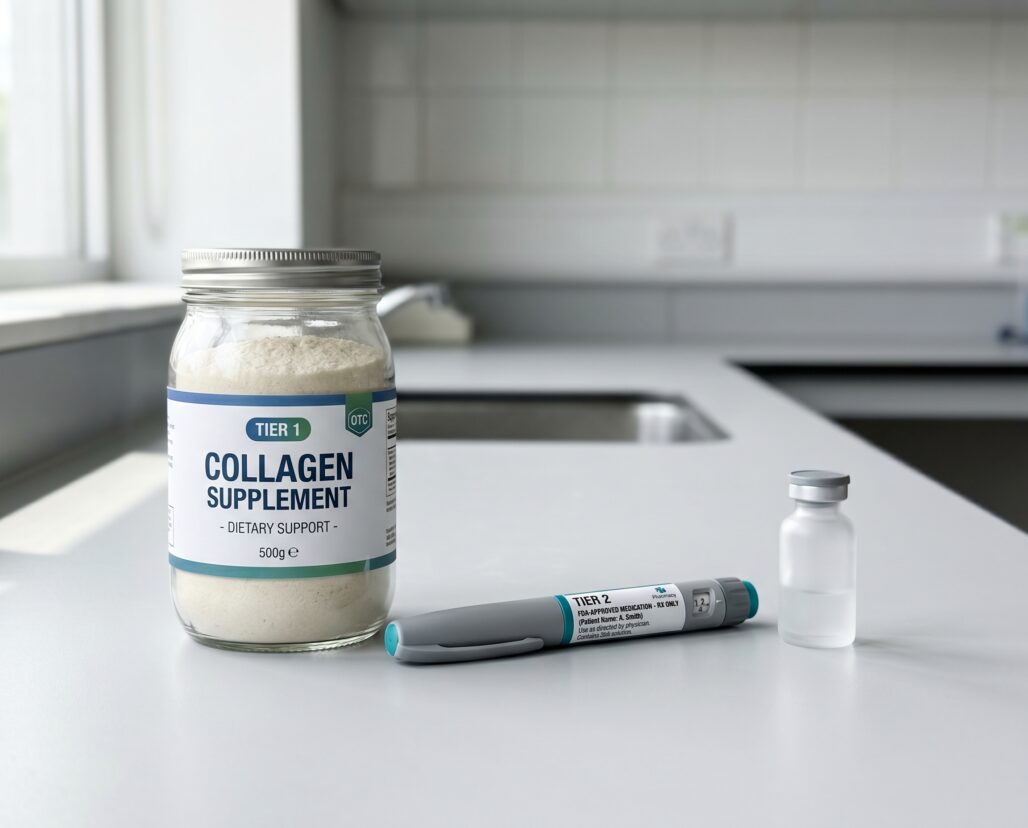
Summary: The Three-Tier Framework Every Beginner Should Understand First
Before buying, reading, or asking anyone about peptides, it helps to know that every peptide product in circulation sits in one of three tiers — and the tiers are not equally safe or equally accessible.
Tier 1 — OTC consumer products containing peptide ingredients: Collagen powders, hydrolyzed collagen capsules, and copper peptide serums available at pharmacies, grocery stores, and online retailers. These are the safest and easiest entry point. No prescription needed. Evidence for some applications (skin elasticity, joint discomfort) is moderate and growing.
Tier 2 — FDA-approved peptide drugs from licensed prescribers: Insulin, semaglutide, liraglutide, oxytocin, desmopressin, and roughly 80 additional approved therapeutic peptides. These require a prescription from a licensed physician because they carry real, documented side effects that need medical supervision. They are appropriate for specific medical indications — not lifestyle optimization.
Tier 3 — Grey-market "research peptides": Compounds sold online as "not for human use" or "research chemicals" — BPC-157, TB-500, CJC-1295, Ipamorelin, and dozens of others. These have either no human clinical trial data or very limited preliminary data. They are manufactured without pharmaceutical-grade oversight and carry unknown contamination and dosing risks. Beginners should not use Tier 3 compounds.
Decision shortcut: If you can buy it at CVS or on Amazon, you are almost certainly in Tier 1. If a physician is prescribing it and a licensed pharmacy is dispensing it, you are in Tier 2. If you found it through a bodybuilding forum and it arrived in an unlabeled vial with no lot number, you are in Tier 3.
The 3-Tier Peptide Reality Every Beginner Should Know
The word "peptide" covers an enormous range of compounds. At the smallest end, a dipeptide is two amino acids joined by a single bond — essentially a fragment of a protein your body already makes. At the larger end, insulin is a 51-amino-acid peptide that has been used medically since 1923 with a safety record accumulated across more than a century of clinical use. Somewhere in between is BPC-157, a synthetic 15-amino-acid chain popular in fitness circles that had, as of 2025, completed a handful of small pilot trials in humans with no published Phase 2 or Phase 3 data.
Putting all three of those in the same bucket called "peptides" is like putting aspirin, chemotherapy drugs, and untested herbal extracts under the label "medicine." The label is technically accurate, but it obscures a difference that matters enormously for safety.
The three-tier framework cuts through that confusion. It is not a complexity invented for this article — it reflects how regulators, physicians, and researchers actually think about these compounds.
| Tier | What it is | Examples | Where to get it | Safety profile |
|---|---|---|---|---|
| Tier 1 | OTC consumer products with peptide ingredients | Collagen powders, hydrolyzed collagen capsules, copper peptide serums | Pharmacies, grocery stores, Amazon | Moderate evidence for specific benefits; broadly well-tolerated in adults |
| Tier 2 | FDA-approved prescription peptide drugs | Insulin, semaglutide (Ozempic/Wegovy), liraglutide (Victoza), desmopressin, oxytocin, octreotide | Licensed physician + licensed pharmacy | Extensively studied; labeled side effects managed under physician supervision |
| Tier 3 | Grey-market research peptides | BPC-157, TB-500, CJC-1295, Ipamorelin, Selank | Online "research chemical" vendors | No pharmaceutical-grade manufacturing; limited or no human trial data; unknown contamination risk |
A note for anyone with a chronic disease or taking daily medications: before adding any peptide product — including Tier 1 OTC options — consult your prescriber first. Collagen peptides are generally well-tolerated, but interactions between supplements and medications are underreported in clinical literature, and your prescriber is the right person to evaluate your specific situation.
What You Can Buy at a Drugstore: Tier 1 Explained
Tier 1 covers products you can walk into a pharmacy and purchase without a prescription. This category has two main branches: ingestible collagen peptides and topical copper peptide products.
Collagen peptides and hydrolyzed collagen are short-chain amino acid fragments derived from animal sources — usually bovine hide, porcine skin, or marine sources — that have been enzymatically broken down ("hydrolyzed") to improve absorption. A systematic review published in the International Journal of Dermatology examined 11 randomized controlled trials on oral collagen supplementation and reported statistically significant improvements in skin hydration and elasticity at doses ranging from 2.5 to 10 grams daily over periods of 4 to 24 weeks. A separate review in the British Journal of Nutrition found preliminary evidence for improvements in joint discomfort and bone density markers in postmenopausal women.
The evidence is not definitive. Most studies are small, industry-funded, and conducted over short periods. The mechanism — whether absorbed collagen peptide fragments actually reach skin or joint tissue in meaningful concentrations — remains an active area of investigation. But the safety profile for healthy adults is strong. The most commonly reported adverse effects are mild GI discomfort and a taste some people find unpleasant. For people who are pregnant or nursing, the safe assumption is to consult a physician before starting any supplement, including collagen, because the evidence base for these populations is limited.
Copper peptide serums (most commonly GHK-Cu) are applied topically to skin. They work by delivering a small tripeptide molecule that appears to support wound healing, collagen synthesis, and antioxidant activity in skin cells, based on laboratory and small clinical studies. As a topical cosmetic product, copper peptide serums are regulated by the FDA as cosmetics, not drugs — meaning the FDA reviews safety and labeling but does not evaluate efficacy claims. That distinction matters when you see marketing language suggesting a serum will "regenerate" or "repair" skin at a structural level. The available evidence supports more modest effects: improved skin texture, reduced fine-line appearance, and better hydration in some users.
Actionable takeaway for Tier 1: Start with a well-labeled collagen peptide powder (look for third-party testing certification from NSF, Informed Sport, or USP) or a topical copper peptide serum from a brand that cites its research. These are reasonable entry points with manageable risk profiles. Manage expectations — neither will produce the dramatic body-composition or anti-aging results that marketing often implies.
What Requires a Physician: Tier 2 FDA-Approved Peptide Drugs
Tier 2 peptides are drugs. Not supplements, not wellness products — FDA-approved pharmaceuticals that have completed Phase 1, Phase 2, and Phase 3 clinical trials in humans, received an approved drug label, and require a prescription from a licensed physician to access legally.
There are currently more than 80 FDA-approved peptide therapeutics on the U.S. market. They cover a wide range of indications.
- Metabolic and endocrine: Insulin, semaglutide (Ozempic, Wegovy), liraglutide (Victoza, Saxenda), tirzepatide (Mounjaro, Zepbound)
- Hormonal conditions: Desmopressin, oxytocin, leuprolide (prostate cancer, endometriosis)
- Gastroenterology: Octreotide (acromegaly, carcinoid tumors)
- Cardiology: Eptifibatide (acute coronary syndrome)
Each of these carries a full prescribing label with documented adverse effects, contraindications, and monitoring requirements. The FDA-approval process is the mechanism by which those risks become known and manageable within a physician relationship. A 2019 review in the Journal of Medicinal Chemistry noted that peptide therapeutics have several pharmacological properties — limited oral bioavailability, rapid renal clearance, immunogenicity risk — that make professional administration and monitoring important for most Tier 2 compounds.
What Tier 2 is not: a menu of enhancements for generally healthy people. GLP-1 receptor agonists carry FDA-labeled warnings for acute pancreatitis and a boxed warning for thyroid C-cell tumors based on animal studies. They are not indicated for weight loss without a qualifying BMI or weight-related comorbidity. Leuprolide suppresses sex hormone production and affects bone density with long-term use. None of these risks disappear because your vendor has good intentions.
If a physician has evaluated your specific condition and determined a Tier 2 drug is appropriate, that is the right way to access it. Obtaining Tier 2 drugs through telehealth platforms that ask no qualifying questions, or through compounding pharmacies outside 503A/503B compliance, shifts you toward Tier 3 risk while paying Tier 2 prices.
Actionable takeaway for Tier 2: If you have a condition for which a peptide drug is indicated — type 2 diabetes, obesity with a qualifying BMI, a pituitary disorder — speak with a physician who can evaluate you properly and prescribe through a licensed pharmacy. Do not attempt to self-manage Tier 2 compounds based on online dosing protocols.
What to Avoid: Tier 3 Grey-Market Research Peptides
Tier 3 is not a safer or cheaper version of Tier 2. It is a different category with a different risk structure — and that risk structure is the reason to avoid it entirely as a beginner.
Research peptides are synthetic compounds sold with disclaimers stating they are "for laboratory research use only" or "not intended for human consumption." In practice, the vendors who sell them know exactly who their customers are and what they plan to do with the products. The disclaimers exist to create legal distance, not to inform a scientist.
The FDA has addressed Tier 3 peptides directly. BPC-157 appears on the FDA's list of bulk drug substances presenting significant safety risks, which means it cannot legally be included in compounded medications. This is not because BPC-157 has been proven harmful in humans — the clinical data is simply insufficient to make either determination. The reasoning is that without Phase 2 and Phase 3 human trials, no one knows the therapeutic window, the dose-response relationship, or the long-term organ effects in a heterogeneous population.
Beyond the pharmacology problem, there is a manufacturing problem. A warning letter sent by the FDA to Summit Research Peptides in December 2024 illustrates the gap between what a label says and what is in the vial. Without pharmaceutical Current Good Manufacturing Practice (cGMP) standards, there is no systematic testing for heavy-metal contamination, endotoxin levels, peptide purity, or correct identification of the compound. Multiple independent testing projects by journalists and researchers have found Tier 3 products with peptide content ranging from 60% to 120% of the stated dose, with occasional contamination from unrelated compounds.
For a beginner — someone who does not yet know what a normal physiological response to a peptide feels like — working with Tier 3 compounds makes it impossible to troubleshoot: you cannot know whether a side effect is from the compound itself, the dose, a contaminant, or an interaction with something else you are taking.
Actionable takeaway for Tier 3: Skip it entirely until there is Phase 3 human data and a legitimate pharmaceutical pathway. There is no scenario in which the potential upside for a general-health application justifies the risk profile for someone who is new to this category.
Marketing Red Flags: How to Spot Claims That Should Make You Leave the Page
The peptide marketing ecosystem runs ahead of the evidence by a wide margin. Here are the specific patterns that signal you are reading marketing copy dressed as health information.
"Same as FDA-approved but cheaper." This conflates the molecule with the product. The same amino acid sequence in an unlabeled vial from an offshore vendor is not equivalent to a pharmaceutical-grade licensed drug. The difference is everything that goes into manufacturing, purity testing, sterility assurance, and proper storage.
"Natural peptides can't hurt you." Your body makes peptides, therefore all peptides are safe — this is a naturalistic fallacy that ignores dose, route of administration, purity, and individual physiology. Oxytocin is a natural peptide. It also requires careful obstetric management when used to induce labor because the therapeutic window is narrow and the risks of misuse are serious.
Testimonials with before-and-after photos and no clinical data. The before-and-after format is a feature of supplement marketing, not clinical research. It cannot control for confounding variables like diet changes, other supplements, exercise, or photography lighting. A study cited by PMID is not the same thing as a forum post.
Vague claims about "anti-aging," "regeneration," or "healing." These phrases are not medical claims — they are marketing language calibrated to suggest drug-like effects while avoiding FDA drug-claim regulations. The more dramatic the language, the more skepticism is warranted.
No third-party testing certificate, no lot number, no return address. Legitimate supplement brands publish certificates of analysis from independent labs. Legitimate compounding pharmacies have 503A or 503B registration numbers. If neither is available, the product has no verified quality controls.

FAQ: Practical Questions Beginners Actually Ask
Can I start with collagen peptides if I'm pregnant or nursing? The evidence base for collagen supplementation during pregnancy is thin. Consult your OB-GYN or midwife before starting any supplement, including collagen. Do not rely on general wellness guides for this decision.
How do I verify a peptide drug is actually FDA-approved? Use the FDA's Drugs@FDA database. Search by drug name or active ingredient. If the drug has an approved application, you will see the New Drug Application (NDA) or Biologics License Application (BLA) number, the approved indications, and the current labeling. If a product you're considering does not appear in this database, it is not FDA-approved.
What about copper peptide serums? Do I need a prescription? No. Copper peptide serums sold as cosmetics do not require a prescription. They are Tier 1 products regulated under cosmetic law, not drug law. Cosmetic regulations require safety and accurate labeling but not efficacy proof — so the evidence bar for marketing claims is lower than it would be for a drug.
I've heard peptides "reset" the gut. Is that real? This claim almost always refers to BPC-157, which is a Tier 3 research peptide with preliminary animal data suggesting effects on gut mucosal healing. There is no Phase 2 or Phase 3 human trial data supporting the "gut reset" framing. As a beginner, this is not a safe place to experiment.
Tracking a protocol like this? Our companion app, StackMyMed, lets you log doses, schedule them, and check interactions across everything you take — alongside, never instead of, your clinician’s guidance.
Conclusion: Where to Start and What That Actually Looks Like
The three-tier framework is the honest starting map for anyone new to peptides. Tier 1 OTC products — collagen peptides and copper peptide serums — are accessible, broadly safe for healthy adults, and supported by moderate evidence for specific, modest applications. They are a reasonable place to start for most people, with the caveat that anyone on medication or managing a chronic condition should check with their prescriber first.
Tier 2 FDA-approved peptide drugs are appropriate when a physician has evaluated a specific medical condition and determined that a peptide drug is indicated. They are not lifestyle supplements. They require medical oversight because they carry real, documented side effects.
Tier 3 grey-market research peptides are the wrong starting point for anyone, but especially for beginners who have no clinical baseline and no way to verify product quality. The marketing surrounding these compounds is sophisticated and the evidence supporting their human use is thin. Skipping Tier 3 entirely is not a conservative position — it is the only evidence-consistent position.
For more on the regulatory landscape, the article on FDA-approved peptides covers approval history and labeled indications for the major therapeutic classes. If you are still building a baseline, what peptides are and the current safety evidence are the right places to start. For practical steps on accessing peptide products through legal channels, see how to buy peptides legally.
This article is for informational purposes only and does not constitute medical advice, diagnosis, or treatment. Always consult a qualified healthcare provider before starting, stopping, or changing any supplement or medication. Peptide drugs are prescription medications in the United States; using them without physician oversight and a valid prescription is not recommended. If you are pregnant, nursing, or managing a chronic health condition, speak with your healthcare provider before using any peptide product, including over-the-counter supplements.
