
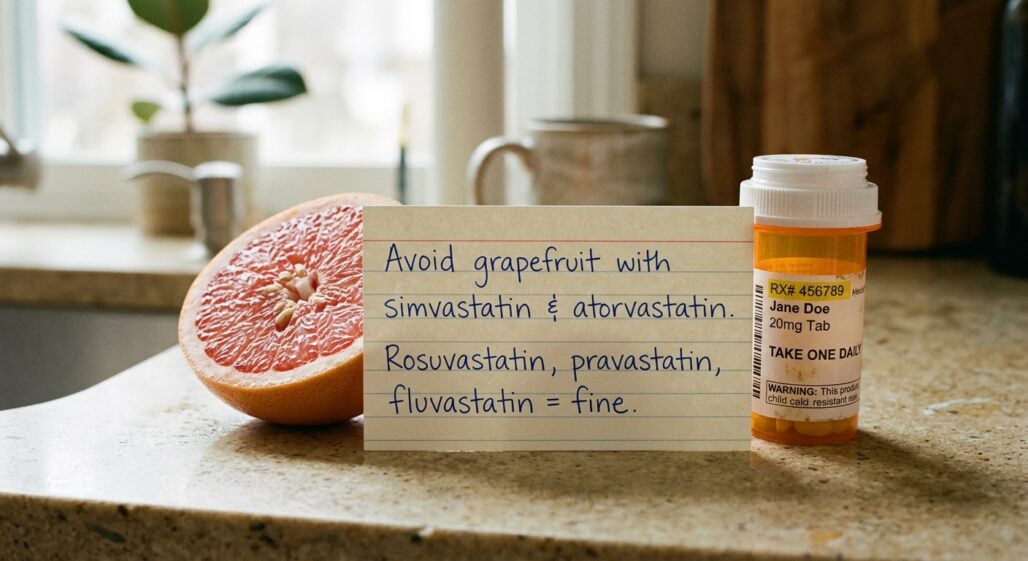
If you are looking up "grapefruit and statins," you are probably either staring at a new pill bottle that mentions grapefruit, or you love your morning grapefruit and want to know if it is actually a problem. The honest answer is: it depends entirely on which statin you take, and the difference between statins here is large, not a rounding error. This article breaks down which statins genuinely clash with grapefruit, how big the effect is in real numbers, why spacing them apart does not help, and what to do instead.
Before you decide
This is general health information, not medical advice, and it is not a substitute for the pharmacist who knows your full medication list. Do not stop, skip, or change the dose of your statin on your own based on a web article, including this one. Statins lower cardiovascular risk over years, and stopping one to "be safe" around grapefruit trades a small, manageable food question for a real, measurable increase in heart-attack and stroke risk.
The people who need to be most careful are those on simvastatin, atorvastatin, or lovastatin who eat grapefruit regularly or drink the juice daily. If that is you, the safe move is a conversation, not a guess.
Call your doctor or pharmacist promptly if you develop new or worsening muscle pain, tenderness, weakness, or dark cola-colored urine while on a statin. Those can be early signs of statin-related muscle injury, and grapefruit can make them more likely on the affected drugs. The statin itself is the standard of care for cardiovascular risk reduction; the grapefruit question is about protecting that therapy, not replacing it.
What the grapefruit-statin interaction actually is
Statins are taken by mouth, so before any dose reaches your bloodstream it has to survive a first pass through the wall of your small intestine. An enzyme called CYP3A4, concentrated in your gut lining, breaks down a large share of certain statins before they are ever absorbed. That built-in waste is normal and expected; the prescribed dose already accounts for it.
Grapefruit contains compounds called furanocoumarins. These compounds shut down gut CYP3A4, so the statin that was supposed to be broken down instead gets absorbed whole. The result is more drug in your blood from the exact same tablet. The U.S. Food and Drug Administration's consumer update on grapefruit and medicines names simvastatin and atorvastatin specifically among the cholesterol drugs affected this way.
Here is the part most people miss: the inhibition is not a temporary speed bump that wears off in an hour. Grapefruit knocks out the enzyme molecules themselves, so your gut has to manufacture brand-new enzyme to recover, which takes days, not hours. A controlled study by Greenblatt and colleagues in Clinical Pharmacology & Therapeutics measured the recovery half-life of gut CYP3A activity at roughly 23 hours after a single dose of grapefruit juice. Practically, meaningful recovery can take around three days.
Think of it like jamming a lock by snapping the key off inside it. You cannot just wait a few minutes; the whole lock has to be replaced.
How big is the effect, in real numbers
This is where the statins split sharply, so it is worth seeing the actual figures rather than a vague "interacts" warning.
For simvastatin, the effect is dramatic at high grapefruit intake. In a crossover study by Lilja and colleagues, heavy grapefruit juice consumption raised simvastatin total exposure (AUC) about 16-fold and peak levels about 9-fold. That study used double-strength juice three times a day, which is far more than most people drink.
The reassuring follow-up is that even one normal glass a day still raises simvastatin exposure several-fold, not by a trivial amount. A more realistic 2004 study in the British Journal of Clinical Pharmacology gave participants 200 mL of ordinary-strength grapefruit juice daily and still saw simvastatin AUC rise about 3.6-fold. Lovastatin behaves like simvastatin and lands in the same avoid category.
Atorvastatin sits in the middle: real, but smaller. Lilja's 1999 study found grapefruit raised atorvastatin acid exposure about 2.5-fold with heavy juice intake. At everyday volumes the signal shrinks further: a 90-day study by Reddy and colleagues using 300 mL of grapefruit juice daily found atorvastatin levels rose only 19 to 26 percent, with no muscle-enzyme or liver-enzyme changes. Atorvastatin is still officially flagged, so the conservative guidance is to avoid grapefruit, but the cliff is gentler than with simvastatin.
The standout finding is what grapefruit does NOT do. Pravastatin showed essentially no meaningful change in that same 1999 study, because pravastatin is not cleared by CYP3A4 in the first place. Rosuvastatin and fluvastatin take similar non-CYP3A4 routes, which is why they are not on the grapefruit list.
| Statin | Grapefruit verdict | Why |
|---|---|---|
| Simvastatin (Zocor) | Avoid | Heavily CYP3A4-cleared; exposure can rise several-fold to 16-fold |
| Lovastatin (Mevacor) | Avoid | Behaves like simvastatin; large CYP3A4 dependence |
| Atorvastatin (Lipitor) | Avoid / caution | Real interaction but smaller; ~2.5-fold at high intake, ~20% at a daily glass |
| Rosuvastatin (Crestor) | Not affected | Minimal CYP3A4 metabolism |
| Pravastatin (Pravachol) | Not affected | Not a CYP3A4 substrate; no meaningful change in studies |
| Fluvastatin (Lescol) | Not affected | Cleared mainly by CYP2C9, not CYP3A4 |
The practical "what to do" (and why spacing does not work)

The most common reader question is whether you can drink grapefruit at breakfast and take your statin at night to dodge the problem. The answer is no, and the science of the mechanism is exactly why. Because grapefruit destroys the enzyme rather than briefly competing with the drug, the enzyme stays knocked down for roughly a day or more after that one glass. Your nighttime statin still lands in a gut that cannot break it down.
So separating them by hours does not help. If you are on an affected statin, the realistic options are simple.
First, if you take simvastatin, atorvastatin, or lovastatin and you genuinely love grapefruit, ask your prescriber about switching to rosuvastatin, pravastatin, or fluvastatin. All three are effective statins with no grapefruit restriction, so a switch can remove the conflict entirely rather than asking you to police your fruit bowl forever. This is a prescriber decision, not a do-it-yourself swap.
Second, if you stay on your current affected statin, treat grapefruit and grapefruit juice as off the menu, and read juice blends carefully because grapefruit hides in many "citrus" and "red" juice mixes. The FDA notes the same caution extends to a few relatives.
A pill bottle and a grocery list are easy to lose track of when you take several medicines. A companion tool like StackMyMed can help you spot and space conflicts like this one across your whole stack, though it helps you flag the issue rather than replace a conversation with your pharmacist.
Who is most at risk
Not everyone on an affected statin faces the same danger if grapefruit slips in. The risk concentrates in people who already have a higher baseline chance of statin muscle injury. That includes older adults, people on higher statin doses, those with reduced kidney function, and anyone taking other CYP3A4-blocking drugs such as certain antifungals, some antibiotics, or specific calcium-channel blockers.
The feared outcome is not a stomachache. It is statin-associated muscle injury, which in its severe form (rhabdomyolysis) can damage the kidneys, and the chance of it climbs as statin blood levels climb. Pushing simvastatin levels up several-fold with daily grapefruit is exactly the kind of nudge that matters most in someone already near the edge.
If you are young, on a low dose of an unaffected statin, and otherwise healthy, the absolute risk from any of this is low. But low is not zero, and the people reading a statin label are often precisely the higher-risk group. The Bailey review in CMAJ makes the same point: the interaction is real and avoidable, and the cost of avoiding it is trivial compared with the cost of a serious muscle event.
When to see a clinician
Book a conversation rather than waiting if any of these apply to you.
You are on simvastatin, atorvastatin, or lovastatin and you regularly eat grapefruit or drink the juice, and you would rather switch statins than give it up. You have new muscle pain, cramping, tenderness, or weakness that started after a dose change or a grapefruit habit. You notice dark or tea-colored urine, which warrants prompt medical attention. Or you simply are not sure which statin you take and want it checked against your diet.
For the bigger picture on how these conflicts work beyond statins, our explainer on grapefruit and drug interactions covers the other drug classes affected, and our ultimate guide to drug and supplement interactions maps the broader landscape. You can also run your own list through our drug and supplement interaction checker before your appointment.
Frequently asked questions
Is grapefruit juice worse than eating the fruit?
Both carry the active compounds, so neither is safe with the affected statins. Juice is often consumed in larger volumes, which can make the effect bigger, but a single grapefruit segment is not a free pass.
What about other citrus, like oranges or lemons?
Standard sweet oranges, lemons, and limes do not cause this interaction. The ones to watch are grapefruit and its close relatives such as Seville (bitter) oranges, pomelos, and tangelos, which the FDA groups with grapefruit.
I already drank grapefruit juice today and I take simvastatin. What now?
Do not panic and do not stop your statin. One exposure is rarely a crisis, but call your pharmacist for tailored advice, and avoid further grapefruit going forward. Watch for muscle aches or dark urine and seek care if they appear.
Does grapefruit make my statin work better since more gets absorbed?
No. The extra drug raises side-effect risk without reliably improving cholesterol control. In the 90-day atorvastatin study, the modest rise in drug levels did not meaningfully improve the lipid results. Higher blood levels here are a hazard, not a bonus.
My friend takes a statin and eats grapefruit with no problem. Is it really an issue?
Quite possibly your friend is on rosuvastatin, pravastatin, or fluvastatin, none of which interact. The brand name on the bottle is what decides this, which is why checking the specific statin matters.
Conclusion: the bottom line on grapefruit and statins
Grapefruit and statins is one of the few interactions where the right answer is genuinely clean once you know your drug. Avoid grapefruit on simvastatin, atorvastatin, and lovastatin; ignore the warning entirely on rosuvastatin, pravastatin, and fluvastatin. The mechanism (destroyed gut enzyme, recovery measured in days) is also why the popular "just space them out" workaround does not work.
Next steps:
- Read the exact statin name on your bottle and match it to the table above.
- If you are on an affected statin and love grapefruit, ask your prescriber about switching to an unaffected one rather than living with the restriction.
- Learn how we vet this guidance on our how we review supplements page, and see more from the UsefulVitamins Editorial Team.
- If muscle aches show up, related reading on vitamin D and statin muscle pain is a useful companion, but new symptoms still warrant a call to your clinician.
This article is for informational purposes and is not medical advice. Statins and grapefruit can interact in ways that depend on your specific medication and health profile. Never start, stop, or change a prescription on your own. Consult your physician or pharmacist before making any change, particularly if you are older, on multiple medications, or managing kidney or liver conditions.
Reviewed by the UsefulVitamins Editorial Team.
