
Affiliate disclosure: this article contains affiliate links. As an Amazon Associate, UsefulVitamins.com earns from qualifying purchases at no extra cost to you.
You have two tabs open, both tubs are in the cart, and you just want a straight answer on which one to buy. Here is the fast version, then the receipts.
Before you buy
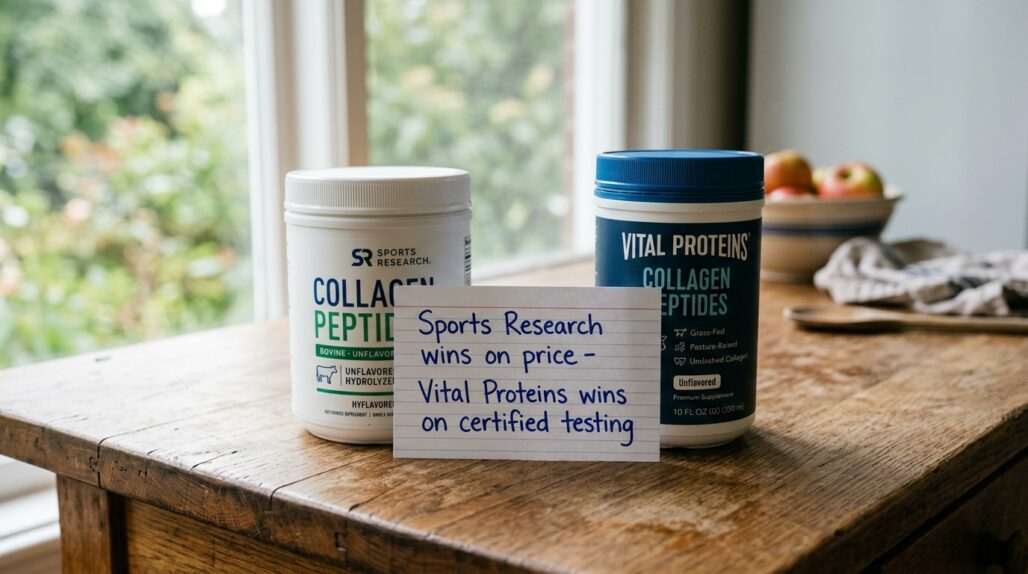
Understand what this comparison actually is. It is not a fight between two different ingredients. Vital Proteins Collagen Peptides and Sports Research Collagen Peptides are the same basic thing: hydrolyzed bovine collagen peptides, Type I and III, taken from cowhide and broken down so they dissolve in coffee or water.
If you have read our collagen peptides vs collagen protein explainer, you already know "peptides" just means the collagen has been chopped into smaller, more mixable pieces. Both brands do exactly that. Neither hides a secret form the other lacks.
So the decision narrows to four practical things:
- Grams of collagen per scoop, and the price you pay per gram.
- Testing and certifications, the one place the two genuinely split.
- Extras, where Vital Proteins' Advanced tub adds hyaluronic acid and vitamin C.
- Format and mixability, canisters versus stick packs and how cleanly each dissolves.
Get those four straight and the pick makes itself.
Grams per scoop and cost per gram
This is where most shoppers get fooled. Vital Proteins puts a bigger number on the front, so it looks stronger. It is not more potent. It is a bigger serving.
Here is what each brand puts in a serving, from their official pages:
- Vital Proteins Collagen Peptides (plain): roughly 20 g collagen, 18 g protein, about 70 calories per 2-scoop serving (one scoop is about 10 g). The 20 oz canister lists around 27 servings.
- Sports Research Collagen Peptides: about 11 g collagen, 10 g protein, 40 calories per scoop. The 16 oz canister lists around 41 servings, the 32 oz around 82.
Take two Sports Research scoops and you land near 22 g, roughly matching one Vital Proteins 2-scoop serving. The front-of-tub number is a serving-size choice, not a quality gap.
There is no magic dose to chase here. A systematic review of collagen peptide trials has not pinned down one correct collagen amount, and most skin and joint studies sit somewhere in the 2.5 g to 15 g range. Both brands clear that range comfortably with a single typical scoop.
What actually moves your wallet is cost per gram of collagen. Run the math, with prices hedged because they swing week to week (figures as of writing, check the current price):
- Vital Proteins 20 oz Advanced at roughly $43 to $50 works out to about $0.08 to $0.09 per gram.
- Sports Research 16 oz at roughly $29 to $33 lands near $0.07 per gram.
- Sports Research 32 oz at roughly $45 to $50 drops to about $0.05 per gram, the cheapest of the three.
Scoop for scoop, Sports Research is the cheaper collagen, and the big 32 oz canister is the clear value play. Vital Proteins costs more per gram partly for the name and partly for the extras it bundles in.
| Factor | Vital Proteins (Collagen Peptides, plain) | Sports Research |
|---|---|---|
| Collagen type | Bovine, hydrolyzed, Type I and III | Bovine, hydrolyzed, Type I and III |
| Collagen per serving | ~20 g | ~11 g |
| Protein per serving | ~18 g | ~10 g |
| Calories per serving | ~70 | 40 |
| Servings (main size) | ~27 (20 oz) | ~41 (16 oz), ~82 (32 oz) |
| Approx cost per gram | ~$0.08 to $0.09 | ~$0.05 to $0.07 |
| Added extras | Hyaluronic acid and vitamin C on the Advanced formula only; the plain NSF tub is single-ingredient | None, plain peptides |
| Third-party testing | NSF Certified for Sport on the plain Collagen Peptides (not the Advanced tub); confirm the seal on the exact unit | Brand-stated batch heavy-metal testing; its Informed Choice listing shows as no longer certified |
| Sourcing | Grass-fed, pasture-raised bovine hide | Grass-fed bovine |
| Formats | Canister, flavors, and stick packs | Canister in several sizes, plus stick packs |

Testing and certifications, where they split
If you remember one difference, make it this one.
Vital Proteins carries an NSF Certified for Sport mark you can confirm yourself on the NSF Certified for Sport public listing. That program verifies label accuracy and screens against hundreds of banned substances, which is what a drug-tested athlete needs.
One catch most write-ups skip: the NSF seal sits on the plain, single-ingredient Collagen Peptides (the unflavored powder and certain flavors), not on every product in the line. The hyaluronic-acid-plus-vitamin-C Advanced tub is a separate formula. Do not assume it carries the mark just because the brand does. If certification is your reason to buy, check the exact size in your cart and skip the Advanced tub.
Sports Research states its collagen is third-party tested for heavy metals (arsenic, cadmium, lead, and mercury by ICP-MS) and lists IGEN Non-GMO testing, Keto Certified, and Certified Paleo. Those are real signals.
Here is the honest part. Its Collagen Peptides product has an Informed Choice listing, and as of writing that listing shows the product as no longer certified, pointing shoppers to contact the brand. So treat Sports Research's testing as brand-stated and batch-level, not a live independent certification you can pull up the way you can with Vital Proteins.
Both are reputable mainstream brands that test. The difference is verification. Vital Proteins gives you a look-it-up seal on the right variants; Sports Research asks you to trust its stated testing. For the wider checklist on reading these signals, our supplements for skin health guide covers what "third-party tested" should mean before you pay extra for it.
Extras: hyaluronic acid and vitamin C
The Vital Proteins Advanced formula is not just collagen anymore. It adds hyaluronic acid and vitamin C, a genuine if modest difference.
Vitamin C has real mechanistic logic behind it, because your body uses it as a cofactor to build collagen, so the pairing is not marketing nonsense. The snag: if you eat a single orange, kiwi, or bell pepper, you are already covered, and the amount added here is small.
Hyaluronic acid taken by mouth has some early skin-hydration research behind it, but the science is far from settled.
Sports Research keeps it plain peptides, nothing added. For a lot of buyers that is the smarter call. You skip a premium for a sprinkle of vitamin C you likely do not need, and you can add your own.
So the extras tilt toward Vital Proteins only if you specifically want a convenient all-in-one beauty scoop. If you just want collagen, the extras are a reason not to pay more. And if your real goal is hair, temper expectations and read best supplements for hair growth first, because collagen is no guaranteed fix there.
Taste, mixability, and format
Both unflavored powders are built to vanish into hot or cold liquid, and in practice both dissolve well in coffee, smoothies, and water with a quick stir. Neither is truly tasteless. You may catch a faint savory note in plain water that disappears in coffee.
A few practical notes:
- Sports Research dissolves cleanly with minimal clumping and a very neutral profile. The 3.9 oz, 16 oz, and 32 oz sizes make it easy to try small then size up.
- Vital Proteins mixes well too; the bigger scoop is simply more powder to stir in. It also offers flavored versions and stick packs for grab-and-go.
- Both sell stick packs, which cost more per gram than the canister but win on travel.
If format decides it: want the widest size-and-price ladder, take Sports Research. Want the broadest flavor lineup and easy retail availability, take Vital Proteins.
Where to buy and the value pick
Ready to add one to cart? Here is the honest framing.
Sports Research is the value buy, especially the 32 oz canister at the lowest cost per gram. Vital Proteins earns its premium only when the NSF seal on the plain Collagen Peptides, or the hyaluronic-acid-and-vitamin-C Advanced tub, genuinely matters to you. Those two perks live on two different tubs, so pick the one that matches your reason.
Either way, verify the current price and the exact certification on the specific size before you buy. Both move.


As an Amazon Associate, UsefulVitamins.com earns from qualifying purchases at no extra cost to you.
Heads up: UsefulVitamins earns a commission from qualifying Amazon purchases at no extra cost to you. It never changes our picks or what we tell you to skip.
Want more head-to-head context? Our deeper Vital Proteins Collagen Peptides review and our roundup of the best collagen peptides cover the wider field if neither of these two is quite right.
FAQ
Is Vital Proteins or Sports Research better for skin and hair? Neither has a real edge, because both deliver the same Type I and III bovine peptides that drive those benefits. Vital Proteins’ Advanced tub adds a little vitamin C and hyaluronic acid, which may marginally help skin, but the collagen itself is equivalent. A sensible daily dose and sticking with it matter far more than the brand.
Why does Vital Proteins cost more per gram? You are paying for brand recognition, and on the Advanced formula the bundled hyaluronic acid and vitamin C. Vital Proteins also offers a verifiable NSF Certified for Sport seal, though that sits on the plain single-ingredient tub, not the Advanced one. Without those needs, Sports Research gives you the same core collagen for less, especially in the 32 oz size.
Are both collagens third-party tested for heavy metals? Both brands say they test. Vital Proteins backs its plain Collagen Peptides with an NSF Certified for Sport listing you can look up, while the Advanced tub is a separate SKU, so confirm the seal on the exact unit. Sports Research states it tests each batch, but its Informed Choice listing reads as no longer certified as of writing, so treat that testing as brand-stated rather than independently verifiable.
How many grams of collagen should I take a day? Most studies land somewhere between roughly 2.5 g and 15 g daily, and there is no single agreed-upon best number across the published trials. One Vital Proteins 2-scoop serving near 20 g, or two Sports Research scoops near 22 g, both clear that range, so a single typical scoop is plenty for most people.
Can I take either on keto or paleo? Yes. Both are essentially pure protein with no carbs or sugar. Sports Research is explicitly Keto Certified and Certified Paleo, and Vital Proteins’ peptides are keto- and paleo-friendly too. Neither affects ketosis at normal serving sizes.
Is the unflavored powder really tasteless in coffee? Close to it. Plain water may reveal a faint savory note from either brand, but in coffee, tea, or a smoothie both dissolve cleanly and read as undetectable. Sports Research is slightly more neutral in plain water if that matters to you.
The verdict
Want the cheapest reliable collagen? Buy Sports Research. The 32 oz canister wins on cost per gram, and the formula is clean plain peptides with brand-stated heavy-metal testing.
Want a testing seal you can actually look up? Buy the plain Vital Proteins Collagen Peptides and confirm the NSF Certified for Sport mark on your chosen size. Want hyaluronic acid and vitamin C in one scoop instead? That is the separate Vital Proteins Advanced formula, which is not the NSF-sealed tub, so pick the perk you truly care about.
Pick Sports Research if you want the lowest cost per gram, prefer plain peptides with nothing added, and like a small-to-large size ladder to test before committing.
Pick Vital Proteins if you need the NSF Certified for Sport seal (grab the plain Collagen Peptides), want the hyaluronic-acid-plus-vitamin-C convenience scoop (the Advanced formula), or simply prefer the wider flavor and retail availability.
What you should not do is pay extra assuming the bigger 20 g serving is more potent. It is just a bigger serving. Match the dose, then buy the cheaper grams unless certification is your reason to spend more.
This article is for general information and is not medical advice. Talk to a clinician or pharmacist before starting a supplement, especially if you are pregnant, nursing, managing a health condition, or taking medication. Prices, formulas, and certifications change, so verify current details before buying.
Reviewed by the UsefulVitamins Editorial Team.
