
Before you decide
This article is general information, not medical advice. Magnesium and acid-reflux medicines sit in millions of bathroom cabinets, so the "can I take these together" question is reasonable – and the honest answer has two parts.
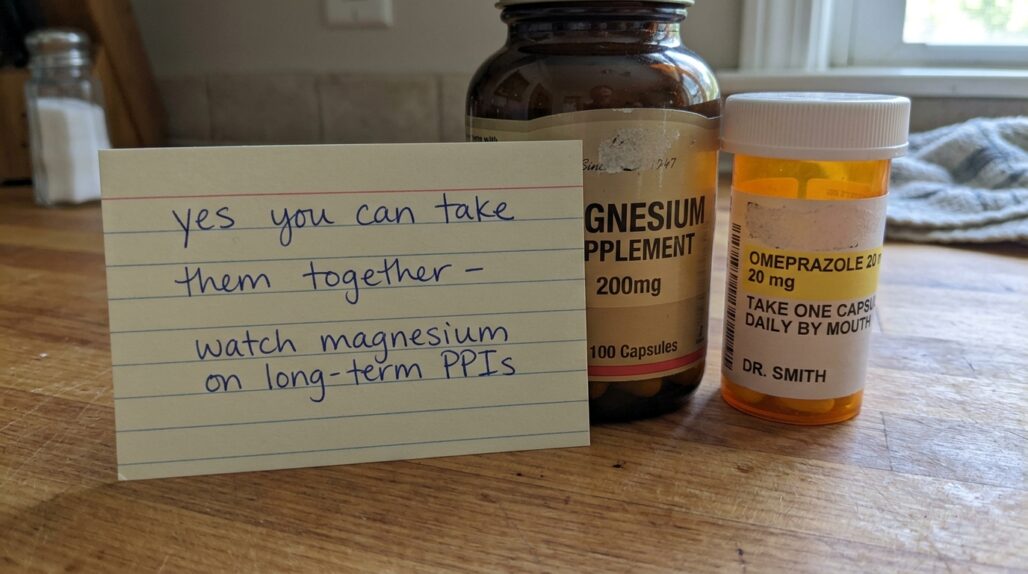
Taken at the same time, magnesium and omeprazole do not cause a dangerous reaction. The concern that actually matters builds slowly: people on long-term proton pump inhibitors (PPIs) can drift into low magnesium, and the drug itself blunts how well a magnesium supplement is absorbed.
The people most worth watching are anyone on a PPI for more than a year, older adults, and anyone also taking a diuretic or digoxin. If that is you, this is less about timing one dose and more about checking your magnesium over time.
Below is what the interaction really is, how big it gets, which form to pick, and the symptoms that mean "get labs, not guesswork."
What omeprazole actually does to your magnesium
Omeprazole is a PPI – it shuts down the stomach's acid pumps. That helps reflux and ulcers, but the same acid suppression reaches downstream into how minerals move.
Your gut absorbs magnesium two ways: a passive route across the lining and an active route through channels called TRPM6 and TRPM7. Those channels work best in a mildly acidic environment, and research suggests PPIs reduce their activity, so less magnesium crosses into the blood. A review in Gastroenterology Report describes omeprazole impairing passive intestinal magnesium absorption and altering the gut's acidity and junction proteins.
The result is a slow negative balance. Your kidneys try to hold onto magnesium, and your bones release some to compensate, which is why the drop can stay hidden for a long time before a blood test catches it.
That same review notes PPI-related low magnesium showed up after a median of about 5.5 years of use, though cases ranged from two weeks to thirteen years. So this is usually a long-haul issue, not a first-week one.

How big is the effect, really?
For most short-term omeprazole users, the magnesium effect is small and you may never notice it. The risk concentrates in long-term use and in people with a second reason to lose magnesium.
In 2011 the FDA issued a Drug Safety Communication warning that low magnesium can follow long-term PPI use. The FDA review of reported cases found most events occurred after about a year of treatment, and roughly a quarter of patients did not recover on magnesium supplements alone – they needed to stop the PPI too.
The combination that pushes risk up most is a PPI plus a diuretic. A study in Kidney International found PPI use was tied to a 54% higher odds of hypomagnesemia in people on diuretics, while non-diuretic users showed no clear drop. Diuretics flush magnesium through the kidneys, so the gut and the kidney losses stack.
Overall, clinically significant low magnesium from PPIs is uncommon – estimates hover around 1% of long-term users – but the consequences when it happens can be serious, which is why monitoring matters more than panic.
Who is most at risk
Some people should pay closer attention than a casual reflux user. You are higher-risk if you fit one of these:
- You have taken omeprazole or another PPI for more than a year.
- You also take a diuretic, digoxin, or another magnesium-lowering drug.
- You are older, eat little, or have a condition that limits intake.
- You have kidney issues, alcohol use, or chronic diarrhea that already strain magnesium balance.
- You have had unexplained cramps, palpitations, or tingling on a PPI before.
If none of these apply and you are on a short course, the practical concern is mostly about picking a good supplement form and spacing it from any thyroid medicine.
| Risk factor | Why it raises magnesium risk | What it changes for you |
|---|---|---|
| Long-term PPI (>1 year) | Steady reduction in active gut absorption over time | Ask about a serum magnesium check |
| Diuretic use | Adds kidney magnesium loss on top of gut loss | Highest-risk combination – monitor |
| Older age or low intake | Smaller dietary buffer and reduced reserves | Food sources plus a gentle supplement |
| Digoxin | Low magnesium worsens its heart-rhythm risk | Both drugs warrant closer monitoring |

Which form of magnesium to choose on a PPI
Since omeprazole already trims absorption a little, the form you pick matters. You want one that absorbs well and does not upset your stomach.
The NIH Office of Dietary Supplements notes that forms which dissolve well in liquid – citrate, lactate, chloride, and aspartate – tend to absorb better than magnesium oxide, which is poorly taken up despite its high elemental content. Oxide also tends to cause loose stools, which makes it a poor fit when you are trying to retain magnesium.
For daily repletion, two forms stand out:
- Magnesium glycinate – amino-acid chelated, well tolerated, gentle on the gut, a good default for sensitive stomachs.
- Magnesium citrate – reliably well absorbed and inexpensive, though at higher doses it can loosen stools.
If you want to compare the trade-offs in more detail, see our breakdown of magnesium forms and bioavailability, and our complete guide to magnesium for dosing context and food sources. People taking magnesium mainly for rest can also look at our notes on the best magnesium for sleep.
Skip the marketing-grade "miracle" blends. A single well-absorbed form is enough.
Timing: when to take each pill
Here is the part that confuses people. There is no required gap between magnesium and omeprazole for safety – you can take them together without harm.
But if you want the most magnesium absorbed, a few practical habits help:
- Take magnesium with food to ease the gut and improve tolerance.
- If you take a once-daily PPI before breakfast, taking magnesium with lunch or dinner is an easy, no-fuss separation.
- Split larger magnesium doses into two smaller doses across the day, since the gut absorbs modest amounts better.
The bigger timing rule has nothing to do with omeprazole. Magnesium can bind levothyroxine in the gut and block it, so keep them well apart.

The levothyroxine trap
If you take thyroid medicine, this is the timing rule that actually changes outcomes. Magnesium – like calcium and iron – can chelate levothyroxine, forming a complex your gut cannot absorb, which can raise TSH and leave your thyroid undertreated.
Standard interaction guidance and American Thyroid Association practice advise separating magnesium from levothyroxine by at least 4 hours. The simplest routine: take levothyroxine on an empty stomach in the morning, then magnesium with an evening meal.
This applies to all common magnesium forms, since they share the same binding behavior. If you recently changed your routine, ask your doctor about rechecking TSH after six to eight weeks.
Warning signs that mean "get labs"
Low magnesium can be silent until it is not. The early symptoms are vague – fatigue, loss of appetite, nausea, weakness, per the NIH consumer fact sheet – which is why people miss them.
More serious hypomagnesemia can show up as:
- Muscle cramps, twitching, or carpopedal spasm (tetany)
- Heart palpitations or irregular heartbeat (arrhythmia)
- Tingling, numbness, or tremor
- Seizures in severe cases
These are reasons to call your doctor, not to double your supplement. Get urgent care for chest tightness, fainting, a racing or irregular pulse, or a seizure. Severe low magnesium can also drag down potassium and calcium, and supplements alone may not fix it – which is exactly why the FDA flagged that some patients needed to stop the PPI.
A simple serum magnesium test settles the question. If you are on a long-term PPI, it is reasonable to ask whether your magnesium has ever been checked.
How to keep track of your stack
Most interaction trouble comes from no single person seeing the whole list – the supplements, the omeprazole, the thyroid pill, the diuretic. Writing it down is the cheapest safety step you can take.
A free app like StackMyMed lets you log everything in one place and flag combinations to raise with a pharmacist. It does not replace clinical judgment, but it makes the pharmacy conversation far more useful.
For the broader picture, our ultimate guide to drug-supplement interactions and the interaction checker are good next stops. If your main interest is the long-term nutrient drain rather than timing, read our companion piece on omeprazole and magnesium depletion, and if you are also weighing your reflux options, see our notes on the best supplements for acid reflux.
FAQ
Can I take magnesium and omeprazole at the same time? Yes. There is no dangerous same-dose reaction. Taking magnesium a few hours later mainly helps you absorb a bit more, and matters most if you also take levothyroxine.
Does omeprazole cause magnesium deficiency? It can with long-term use. The FDA links low magnesium to PPI use of about a year or more, and the risk rises if you also take a diuretic. Short courses rarely cause a problem.
What is the best magnesium to take with a PPI? Magnesium glycinate or citrate are well-absorbed and gentle. Magnesium oxide absorbs poorly and tends to loosen stools, so it is a weaker choice for repletion.
How far apart should I take magnesium and levothyroxine? At least 4 hours. Magnesium can bind levothyroxine and reduce its absorption. Take the thyroid pill on an empty stomach and magnesium later with food.
What are the symptoms of low magnesium on omeprazole? Early signs are fatigue, appetite loss, and weakness. More serious signs include muscle cramps, spasms, palpitations, tingling, and rarely seizures – all reasons to get a blood test.
Should I stop my PPI to protect my magnesium? Not on your own. Some patients with PPI-related low magnesium do need to stop the drug, but that is a decision for your prescriber alongside magnesium repletion and monitoring.
Conclusion: take them together, but watch the long game
You can take magnesium with omeprazole – the meaningful risk is not a same-dose clash but the slow possibility of low magnesium on long-term PPI therapy. Pick a well-absorbed form like glycinate or citrate, keep it at least 4 hours from levothyroxine, and stay alert to cramps, palpitations, or tingling.
If you have been on a PPI for over a year, especially with a diuretic, ask your doctor whether a serum magnesium check makes sense. Log your full stack, bring it to a pharmacist, and let the labs – not guesswork – guide any change.
This article is for general education and does not replace personalized advice from your doctor or pharmacist. Do not start, stop, or change any medication or supplement based on this page alone.
Reviewed by the UsefulVitamins Editorial Team.
