
Before you decide
This is general information about how grapefruit can change the blood levels of certain antidepressants. It is not medical advice, and it cannot tell you whether your specific prescription is affected.
The interaction is real but narrow. It only matters for antidepressants and anti-anxiety drugs that the body clears through one particular enzyme, and several of the most prescribed SSRIs do not use that route in a meaningful way.
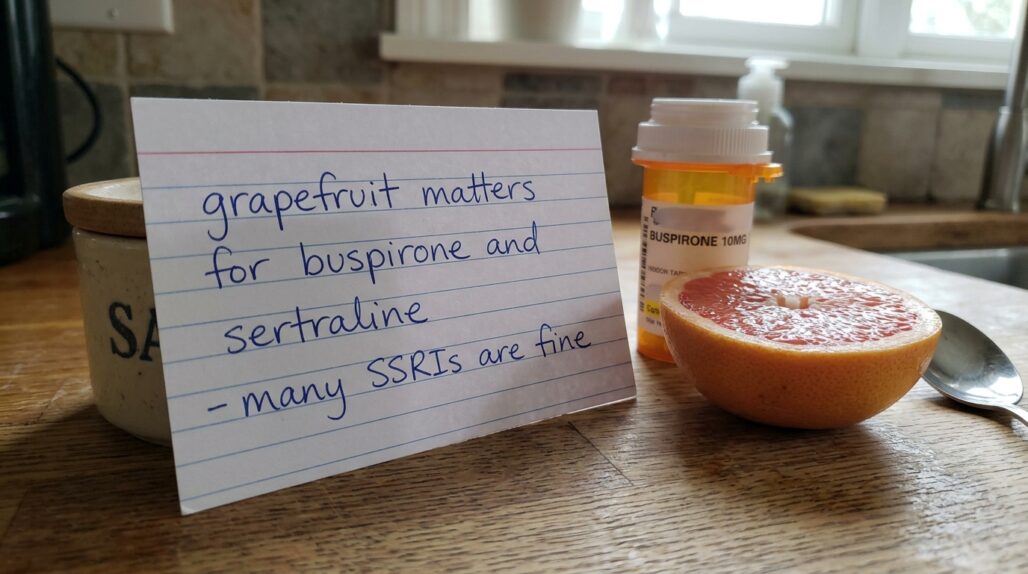
The people most likely to run into trouble are those taking buspirone for anxiety, those on sertraline at higher doses, and anyone who drinks grapefruit juice daily rather than once in a while. If that sounds like you, the rest of this article is worth a careful read, and the final answer still belongs to your prescriber or pharmacist.
What the grapefruit interaction actually is
Grapefruit does not react with the drug itself. It changes how fast your body breaks the drug down.
Your small intestine is lined with an enzyme called CYP3A4, and it acts as a first checkpoint that destroys a portion of many oral medications before they ever reach your bloodstream. Grapefruit contains compounds called furanocoumarins that shut this enzyme down. With the checkpoint disabled, more of the drug gets absorbed, so blood levels climb higher than the prescribed dose was designed to produce.
The FDA explains in its consumer update that grapefruit blocks intestinal CYP3A4 so that, instead of being metabolized, more of the drug enters the blood and stays there longer. The agency also notes that the amount of this enzyme varies a lot from person to person, which is why two people on the same dose can react very differently.
One detail trips people up. This is not about acidity, vitamin C, or sugar. It is specifically the furanocoumarins, which is why Seville oranges, pomelos, and tangelos can do the same thing while regular sweet oranges generally do not.
How big the effect is, and how long it lasts
The size of the effect depends almost entirely on which drug you take. For the antidepressant and anxiety drugs in this cluster, the spread is wide.
Buspirone is the standout. In a controlled crossover study, Lilja and colleagues found that grapefruit juice raised buspirone's blood-concentration curve about 9-fold on average, with peak levels up roughly 4-fold and individual responses ranging from a 3-fold to a 20-fold jump in total exposure. That is a large, clinically meaningful change, and the authors recommended avoiding large amounts of grapefruit juice with buspirone.
Sertraline sits much lower on the scale. In a single-dose study, grapefruit juice roughly doubled the total sertraline exposure, with peak levels rising from about 17.6 to 29.3 ng/mL. A doubling is not nothing, but it is a different order of magnitude than what happens with buspirone.
The timing of the effect surprises most people. Grapefruit's furanocoumarins inactivate CYP3A4 in a way that is partly irreversible, meaning your body has to build brand-new enzyme to recover. Research on the recovery timeline shows intestinal CYP3A4 activity comes back with a half-time of about 24 hours and is largely restored within roughly 3 days. So the effect of a single glass can linger well past the day you drank it.
| Medication | Main clearing enzyme | Grapefruit effect | Practical stance |
|---|---|---|---|
| Buspirone | CYP3A4 | Large (about 9-fold AUC) | Avoid grapefruit |
| Sertraline | CYP3A4 and others | Modest (about 2-fold) | Best to avoid or keep intake very consistent |
| Escitalopram / citalopram | Mainly CYP2C19 | Minimal in most people | Generally fine, confirm with pharmacist |
| Fluoxetine | CYP2D6 / CYP2C9 | Not flagged by FDA | Generally fine, confirm with pharmacist |
Why most SSRIs are not on the danger list
The reason so many people hear "grapefruit and antidepressants" and assume their pill is risky comes down to a misread. The interaction follows the enzyme, not the drug class.
Several of the most prescribed SSRIs are cleared mainly through CYP2C19 or CYP2D6, not CYP3A4. The CPIC pharmacogenetics guideline for SSRIs describes citalopram, escitalopram, and sertraline as substrates handled substantially by CYP2C19, with sertraline also touching CYP3A4. Because grapefruit's strongest effect is on CYP3A4 in the gut, drugs that lean on the other enzymes do not see the same surge.
The FDA's own materials reflect this. Agency information has not flagged a clinically important grapefruit problem with fluoxetine, citalopram, escitalopram, or bupropion, while the strongest signals in this space stay with buspirone and, to a smaller degree, sertraline.
One honest caveat. A 2026 human study suggested that repeated, daily grapefruit intake may also dampen CYP2C19 to some degree, not just CYP3A4. That research is newer and the clinical weight is still being worked out, so the cautious reading is simple. Occasional grapefruit with a CYP2C19 drug looks low-risk, but a daily grapefruit-juice habit is worth mentioning to your pharmacist either way.
Serotonin syndrome is a separate worry
People often blur two different concerns together, so it helps to keep them apart.
Grapefruit raises how much drug is in your blood. It does not, by itself, flood your system with serotonin. Serotonin syndrome is a distinct, potentially serious reaction that usually shows up when serotonin-active agents are stacked together, for example an SSRI combined with St. John's wort, certain migraine drugs, tramadol, or another antidepressant.
That said, a much higher drug level can increase ordinary side effects, and in rare cases higher exposure may make a serotonin reaction more likely if other triggers are present. Agitation, a racing heart, heavy sweating, shivering, muscle twitching, or confusion are warning signs that warrant urgent medical attention, regardless of the cause.
If you want the broader picture on stacking serotonin-active products, our guide to antidepressants, 5-HTP and serotonin syndrome walks through the combinations that carry the most weight, and our overview of melatonin with SSRIs and SNRIs covers a common nighttime add-on.
What to actually do
For most people the practical answer is short. If your antidepressant or anxiety drug is cleared by CYP3A4, the cleanest choice is to leave grapefruit out of the rotation rather than try to outsmart the timing.
The reason spacing does not rescue you is that CYP3A4 stays suppressed for a day or more after a single serving. You cannot reliably "wait out" the effect within a normal dosing schedule. The Mayo Clinic Proceedings review of grapefruit interactions notes that for the most sensitive CYP3A4 drugs even large gaps between the fruit and the dose offer limited protection.
A reasonable approach, to confirm with your own clinician:
- If you take buspirone, treat grapefruit, grapefruit juice, Seville oranges, and pomelos as off the menu while you are on it.
- If you take sertraline, the safest path is the same, but at minimum keep your intake very consistent so your dose is not chasing a moving target, and never start a daily grapefruit habit mid-treatment without telling your prescriber.
- If you take escitalopram, citalopram, fluoxetine, or bupropion, occasional grapefruit is generally fine, but a heavy daily juice habit is still worth a quick pharmacist check.
- Read the patient leaflet that came with your prescription, since it lists food and drink cautions specific to your exact product and dose.
Logging exactly what you take, including the juice in your fridge, makes the pharmacist conversation faster and more accurate. A free tool like StackMyMed lets you record your medications and supplements in one place and flag possible interactions to raise with a professional. It is a prompt for that conversation, not a substitute for clinical judgment.
If you want to double-check a specific combination, our drug and supplement interaction checker and the broader guide to drug-supplement interactions are good starting points before you call your pharmacy.

When to see a clinician
Reach out promptly, rather than waiting for your next routine visit, if you notice the kinds of changes that suggest your drug level has climbed.
Call your prescriber or pharmacist if, after eating grapefruit, you develop new or worse drowsiness, dizziness, lightheadedness on standing, or a pounding or fast heartbeat on a CYP3A4-metabolized antidepressant. These can reflect higher-than-intended exposure.
Seek urgent care or emergency help for severe symptoms such as fainting, chest pain, severe agitation, high fever with rigid or twitching muscles, or confusion. Do not stop a prescribed antidepressant on your own, since abrupt discontinuation carries its own risks. The right move is to keep taking your medication as prescribed and get professional guidance on the grapefruit question.
FAQ
Can I drink orange juice with my antidepressant instead? Regular sweet oranges and ordinary orange juice do not contain the furanocoumarins that block CYP3A4, so they are not part of this interaction. Be careful with marmalade made from Seville oranges, and with pomelos and tangelos, which can act like grapefruit.
How long should I wait between grapefruit and my dose? Spacing usually does not solve the problem, because grapefruit can suppress CYP3A4 for a day or more after a single serving. For sensitive drugs like buspirone the realistic answer is to avoid grapefruit altogether rather than rely on timing.
Is escitalopram (Lexapro) affected by grapefruit? Escitalopram is cleared mainly through CYP2C19 rather than CYP3A4, and the FDA has not flagged a clinically important grapefruit interaction with it. Occasional grapefruit appears low-risk, though a daily juice habit is still worth mentioning to your pharmacist.
Why is buspirone such a big deal compared with sertraline? Buspirone relies heavily on CYP3A4 and has very low natural absorption, so blocking that enzyme can raise its blood levels several-fold. Sertraline uses more than one pathway, so grapefruit roughly doubles its levels rather than multiplying them.
Does grapefruit cause serotonin syndrome? Grapefruit raises drug levels but does not directly trigger serotonin syndrome, which usually comes from combining serotonin-active agents. Very high drug levels can worsen side effects, so warning signs like agitation, fever, and muscle twitching still deserve urgent attention.
What if I already drank grapefruit juice today? A single serving is rarely an emergency, but watch for new dizziness, drowsiness, or a fast heartbeat over the next day or two. If anything feels off, call your pharmacist, and avoid making grapefruit a regular part of your routine.
Conclusion: match the fruit to the enzyme, not the drug class
Grapefruit and antidepressants is a smaller, sharper problem than the headlines suggest. The fruit blocks intestinal CYP3A4, so the drugs that depend on that enzyme are the ones to watch.
In practice that means avoid grapefruit with buspirone, be cautious and consistent with sertraline, and relax a little about escitalopram, citalopram, fluoxetine, and bupropion while still confirming with a professional. Your next step is a two-minute conversation with your pharmacist, ideally with your full medication list in hand.
This article is for general education and does not replace personalized medical advice. Do not start, stop, or change any prescription based on it. Talk with your doctor or pharmacist about your specific medications and diet.
Reviewed by the UsefulVitamins Editorial Team.
