
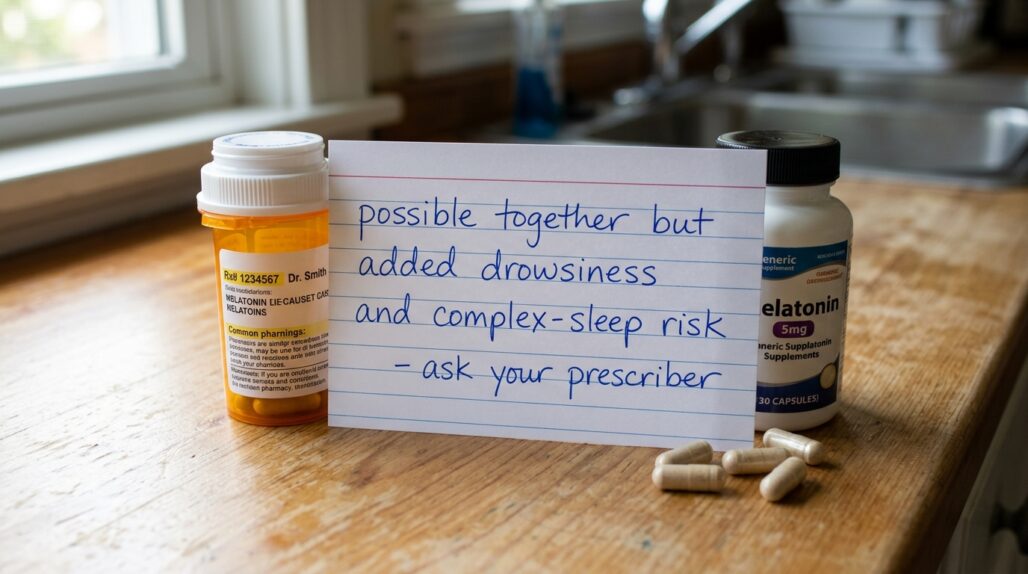
Before you decide
This article is general information, not medical advice. Zolpidem is a prescription sedative-hypnotic with a narrow safety margin, and your prescriber knows your full medication list, your age, and your other conditions in a way a web page never can.
A few people are at higher risk when these two are combined: older adults, anyone who drinks alcohol in the evening, people with sleep apnea or breathing problems, and anyone taking other sedating medicines such as opioids, gabapentin, or other sleep aids. If that describes you, the answer is rarely "just add melatonin."
The honest framing is this. Melatonin is a mild signal that nudges your body clock. Ambien is a strong drug that forces sleep. Putting a nudge on top of a forced effect does not usually make sleep dramatically better, but it can make the side effects worse.
What the two drugs actually do
Melatonin and zolpidem reach sleep by separate routes, which is the key to understanding why combining them is mostly about added sedation rather than a chemical clash.
Melatonin is a hormone your brain releases in darkness to time your circadian rhythm. As a supplement it acts mainly on the MT1 and MT2 receptors, which research links to regulating REM and non-REM sleep and shifting the body clock, as described in work on the differential roles of melatonin MT1 and MT2 receptors. It is a timing signal more than a sedative.
Zolpidem works on a completely different system. It is a positive allosteric modulator of the GABA-A receptor, the brain's main inhibitory channel, where it amplifies GABA's calming effect and pushes you into sleep. That is a much more forceful action than melatonin's.
So there is no major chemical interaction between them at usual doses. The real issue is overlap: two depressant-leaning effects on the same brain at the same time. That is why the main risk is additive drowsiness and impaired alertness, not a dangerous reaction in the bloodstream.

How much does melatonin even add?
It helps to be realistic about melatonin's effect size before stacking it on a prescription drug. The evidence says it is gentle.
A widely cited meta-analysis of melatonin for primary sleep disorders pooled 19 studies and 1,683 people. It found melatonin helped users fall asleep about 7 minutes faster and sleep roughly 8 minutes longer than placebo, with a small improvement in sleep quality.
Those are real but modest numbers. The same authors noted the effect was smaller than what prescription sleep drugs produce. In other words, if Ambien is already doing the heavy lifting, melatonin adds little extra sleep while still adding to the sedation load.
The NCCIH overview of melatonin reaches a similar place: it can help with jet lag and shifting the body clock, but the case for treating ongoing insomnia is weak. That matters here, because if melatonin is not solving your sleep problem on its own, adding it to zolpidem is unlikely to be the missing piece.
The Ambien warnings that change the math
Zolpidem is not a neutral background drug, and two FDA actions reshape how cautious you should be about anything that adds to its sedation.
First, the FDA placed its strongest warning on Ambien. The FDA Boxed Warning for prescription insomnia medicines covers complex sleep behaviors such as sleep-driving, sleepwalking, cooking, and making phone calls while not fully awake and with no memory of it afterward. The agency identified 66 cases of serious injuries, including deaths, and added a contraindication: anyone who has had one of these episodes on zolpidem should never take it again.
This is the single most important reason not to casually deepen zolpidem's sedation. Melatonin will not cause sleep-driving by itself, but anything that increases grogginess and lowers arousal sits in the same risk zone these warnings are about.
Second, the FDA lowered recommended doses because of morning hangover. The FDA next-morning impairment Q&A explains that zolpidem blood levels can stay high enough the next morning to impair driving. The agency cut the recommended dose for women to 5 mg for immediate-release and 6.25 mg for extended-release, because women clear zolpidem more slowly and reach roughly 45% higher peak blood levels than men. In FDA testing, about 15% of women versus 3% of men still had levels high enough to impair driving eight hours after a dose.
If a single dose of zolpidem can already linger into the morning, layering melatonin on top is the wrong direction. Melatonin can also leave some people drowsy, and the NCCIH overview notes it may stay active longer in older adults, deepening next-day sleepiness.

Who should be most careful
The combination is not equally risky for everyone. A few groups should treat it as off the table unless a clinician says otherwise.
| Risk factor | Why it raises concern | What to do |
|---|---|---|
| Older adults | Both drugs can linger longer; falls and confusion rise | Avoid stacking; discuss safer options with the prescriber |
| Alcohol in the evening | Alcohol multiplies sedation and complex-sleep risk | Do not drink on any zolpidem night, with or without melatonin |
| Sleep apnea or breathing problems | Sedatives can blunt breathing during sleep | Clear any new sleep aid with the clinician treating the apnea |
| Other CNS depressants | Opioids, benzodiazepines, and gabapentinoids add up | Have a pharmacist review the full stack before adding anything |
| Driving early the next day | Morning blood levels can still impair alertness | Plan around it; do not drive if you feel less than fully awake |
If more than one row applies to you, the safest move is to not combine them at all and to raise the issue at your next appointment. You can compare other sedating pairings in our guide to supplements and anxiety and our overview of the melatonin and Xanax combination, which raises the same additive-sedation theme.
What to do instead of stacking
The more useful question is usually not "can I add melatonin" but "why do I still need Ambien at all." Zolpidem is meant for short-term use, and melatonin does not fix the reason it was prescribed.
If your sleep is the problem, the strongest evidence points away from piling on supplements. The ACP clinical practice guideline recommends cognitive behavioral therapy for insomnia (CBT-I) as the first-line treatment for chronic insomnia, ahead of medication, because it works as well and lasts longer without drug side effects. The AASM 2017 guideline likewise gives only a weak recommendation against melatonin for chronic insomnia, reflecting thin evidence rather than a proven benefit.
Practical steps that do not add sedation:
- Keep a consistent wake time seven days a week, which anchors your body clock better than any pill.
- Get morning light and dim the lights at night so your own melatonin rises on schedule.
- Cut caffeine well before bedtime; our caffeine cutoff calculator can help you find your line.
- Ask your prescriber about a de-prescribing plan to taper off zolpidem rather than leaning on it indefinitely.
If you want a low-risk evening routine to discuss with a clinician, our sleep supplement protocol and our notes on magnesium for sleep lay out gentler options that do not carry zolpidem's warnings.
Keeping an accurate list of everything you take makes any of these conversations faster. A free tracker like StackMyMed lets you log your prescriptions and supplements in one place and flag a combination to raise with a pharmacist. It is an organizing aid, not a substitute for clinical judgment.

When to call a clinician
Some situations are not "wait and see." Contact your prescriber, pharmacist, or urgent care if any of the following happen.
- You learn you did something while asleep that you do not remember, such as driving, eating, or leaving the house. Stop zolpidem and call your prescriber, since this can mean it should never be used again.
- You feel confused, very groggy, or unsteady the next morning, especially before driving.
- Your breathing seems shallow or you wake gasping, which can signal sedation affecting your airway.
- You realize you cannot sleep without Ambien or are taking it most nights, which is a reason to talk about tapering.
Call 911 or emergency services for severe drowsiness that you cannot rouse from, slowed or stopped breathing, or any combination taken with alcohol or opioids that leaves someone hard to wake.
FAQ
Is it dangerous to take melatonin and Ambien together? There is no major chemical interaction at usual doses, but both lower alertness, so the combination can deepen drowsiness and next-day impairment. Because zolpidem already carries an FDA boxed warning for complex sleep behaviors, clear the combination with your prescriber rather than adding melatonin on your own.
Does melatonin make Ambien work better? Probably not in a meaningful way. Melatonin’s own effect on sleep is modest, helping people fall asleep only about 7 minutes faster in pooled studies, so adding it to a strong sleep drug tends to add side effects more than sleep.
How long should I wait between melatonin and Ambien? There is no validated spacing rule, and inventing one yourself is not a safe substitute for advice. Ask your prescriber or pharmacist whether you should take either at all and at what time, since the goal is usually to use the fewest sleep aids, not to schedule both.
Can I drive the morning after taking both? Be very cautious. The FDA lowered zolpidem doses because morning blood levels can impair driving, and melatonin can add to that grogginess, so do not drive unless you feel fully awake and alert.
Is melatonin safer than Ambien? Melatonin has a milder side-effect profile and no controlled-substance status, but “safer” does not mean it treats the same problem. It will not address the reason Ambien was prescribed, and combining the two does not make either one safer.
What should I do if I want to stop relying on Ambien? Ask your prescriber about a gradual taper paired with cognitive behavioral therapy for insomnia, which guidelines rank as first-line treatment. Do not stop abruptly or self-manage the switch with supplements.
Conclusion: a prescriber question, not a self-fix
Melatonin and Ambien can coexist, but the point is what the combination buys you. Melatonin adds little sleep on top of a drug that already forces it, while quietly adding to the drowsiness and next-day impairment that make zolpidem risky in the first place.
The better path is to treat ongoing sleep trouble at the root. Talk with your prescriber about whether you still need zolpidem, ask about CBT-I and a taper, and bring an accurate list of everything you take. For more pairings worth watching, see our drug and supplement interaction checker and the full interactions hub.
This article is for general education and does not replace personalized advice from your doctor or pharmacist. Do not start, stop, or change any medication or supplement based on this page alone.
Reviewed by the UsefulVitamins Editorial Team.
