
Affiliate disclosure: this article contains affiliate links. As an Amazon Associate, UsefulVitamins.com earns from qualifying purchases at no extra cost to you.
Before you decide
This article is general information, not medical advice. Prednisone bone loss is a well-studied problem, but your exact plan depends on your dose, how long you will be on it, your age, and your fracture history. Use this to ask better questions, not to self-prescribe.
The highest-risk groups are easy to name. If you take 7.5 mg of prednisone or more daily, or any dose expected to last three months or longer, your fracture risk climbs. The same is true if you are postmenopausal, 65 or older, or have already broken a bone as an adult.
One more point worth saying plainly: calcium and vitamin D are foundational, but on their own they are not always enough. For higher-risk patients, the guidelines add a prescription bone medication on top. That decision belongs with your doctor, not a supplement aisle.
Why prednisone is so hard on bone
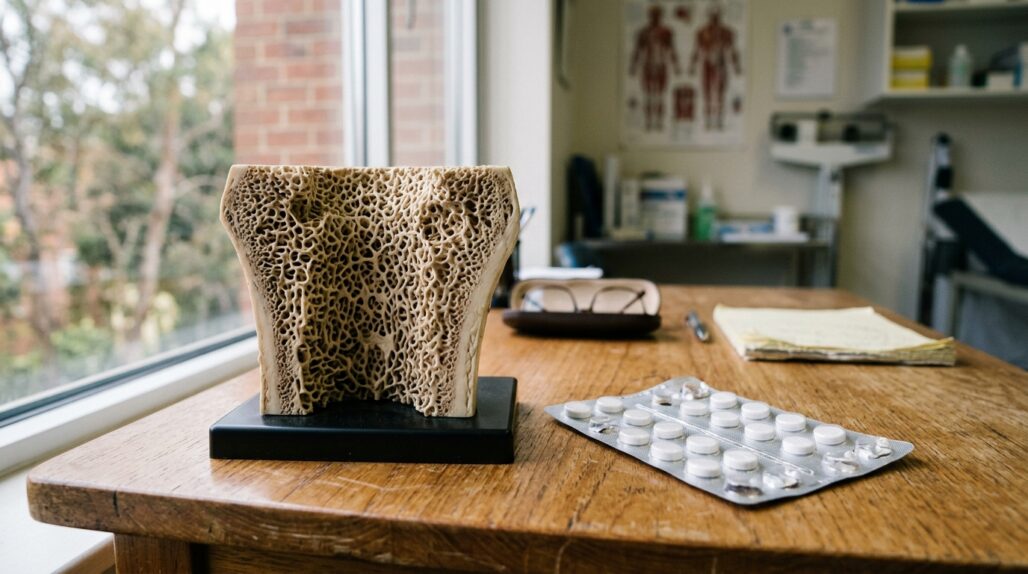
Glucocorticoids like prednisone are the most common drug cause of osteoporosis, a point made across the rheumatology literature and summarized in this review of glucocorticoid-induced osteoporosis. They damage bone through more than one route at once.
The main problem is suppressed bone formation. Steroids quiet the osteoblasts, the cells that build new bone, and shorten their working life. At the same time there is an early, transient rise in bone breakdown, so for a stretch you are losing bone faster than you make it. That combination is described in detail in a peer-reviewed review of glucocorticoid-induced osteoporosis.
Prednisone also nudges the body to absorb less calcium from the gut and lose more in the urine, which pulls on the calcium and vitamin D reserves the rest of your skeleton depends on. That is the specific reason these two nutrients sit at the front of the prevention plan.
The timing is what surprises people. The fastest losses happen early, often within the first three to six months, and fracture risk can rise in a dose-dependent way within months of starting. That is why "wait and see" is the wrong instinct here.
Calcium and vitamin D: the first-line pair
For nearly everyone starting or continuing steroids, the 2017 American College of Rheumatology guideline recommends optimizing calcium and vitamin D alongside basic lifestyle steps, regardless of fracture risk. It is the floor, applied to all glucocorticoid users.
The ACR patient page puts a number on it: patients should aim for at least 1,200 mg of calcium and 800-1,000 IU of vitamin D daily, counting food first and supplements for the gap. That lands in the same range as the general adult RDA of 1,000-1,200 mg of calcium in the NIH Office of Dietary Supplements calcium fact sheet.
Food counts toward the total. If you already get a good amount of dairy, fortified plant milk, tofu set with calcium, or leafy greens, you may need far less from a pill than the label suggests. More calcium is not better – the goal is hitting the target, not stacking past it.
On the timing question, why this matters bears repeating: research suggests bone loss is fastest in the first few months, so the protective habit should start when the prednisone does, not later.
How to take it so it actually absorbs
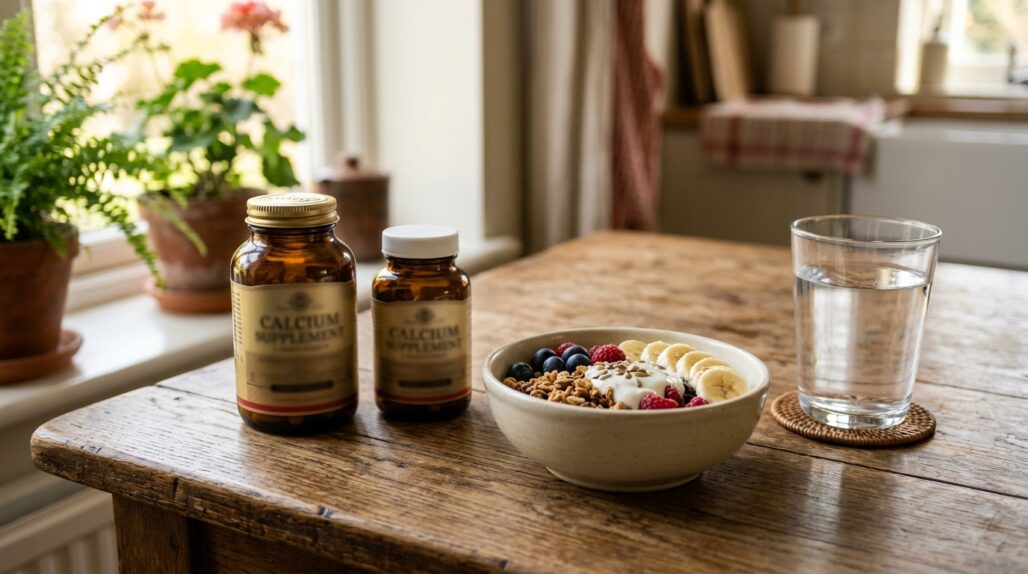
The way you take calcium changes how much your body uses. The NIH fact sheet notes the gut absorbs calcium best in doses of 500 mg or less at a time, and that fractional absorption drops as the single dose climbs.
So if you are aiming for 1,000 mg from supplements, split it – for example, one dose with breakfast and one with dinner, rather than a single large tablet. This is one of the few "tricks" with real evidence behind it.
Form matters too. The two common options behave differently:
| Form | How to take it | Best for |
|---|---|---|
| Calcium carbonate | With food; needs stomach acid to dissolve well | Most people; cheapest, highest elemental calcium per pill |
| Calcium citrate | With or without food; works on an empty stomach | Low stomach acid, older adults, or anyone on acid-reducing drugs |
A practical note: many people on long-term steroids are also on a proton pump inhibitor for stomach protection. Those reduce stomach acid, and that is exactly the situation where calcium citrate tends to be the easier choice.
For vitamin D, the NIH vitamin D fact sheet lists an adult RDA of 600-800 IU, with a common blood target of a serum 25-hydroxyvitamin D of at least 50 nmol/L (20 ng/mL) for bone health. Some people need more than the RDA to reach that level, which is one reason a blood test can be useful rather than guessing.
Heads up: the links below are to products we have reviewed, and we may earn a commission if you buy through them. It does not change what we recommend or what you pay.


As an Amazon Associate, UsefulVitamins.com earns from qualifying purchases at no extra cost to you.
If you want to see how these forms compare in practice, our deeper write-ups on the best supplements for bone health and the complete guide to vitamin D walk through dosing and testing in more detail.
When calcium and vitamin D are not enough
For higher-risk patients, the nutrients are the base layer and a prescription medication goes on top. The decision hangs on a formal fracture-risk estimate.
For adults 40 and older, the 2017 ACR guideline recommends estimating fracture risk with the FRAX tool, adjusted for glucocorticoid dose, ideally within the first six months of starting steroids. FRAX even bumps the risk estimate up for daily doses of 7.5 mg of prednisone or more, as described in the glucocorticoid osteoporosis review.
When risk is moderate to high, oral bisphosphonates are the usual first-line bone drug, mainly because they are effective and inexpensive. Other options exist for specific situations, but that is a conversation for your prescriber, not a self-serve choice.
This is the honest limit of supplements: calcium and vitamin D help prevent the slide, but they do not undo established osteoporosis or replace a fracture-prevention drug when one is indicated.
What to do this week
A short, realistic checklist beats a perfect plan you never start:
- Add up your current calcium from food and any supplement, then fill the gap toward roughly 1,000-1,200 mg/day – no more for the sake of it.
- Take vitamin D daily in the 600-800 IU or higher range, and ask for a 25(OH)D blood test if you are not sure where you stand.
- Split calcium into doses of 500 mg or less, with food if you use carbonate.
- Bring up a bone-density (DXA) scan and a FRAX assessment if you are over 40, on 7.5 mg/day or more, or expecting a course past three months.
- Keep moving – weight-bearing activity, not smoking, and limiting alcohol all support the same goal.
If you take several medications, it helps to keep one current list. A free app like StackMyMed lets you log your prednisone, calcium, and vitamin D in one place and flag the stack for a pharmacist to review. It is an organizing tool, not a substitute for clinical judgment.

FAQ
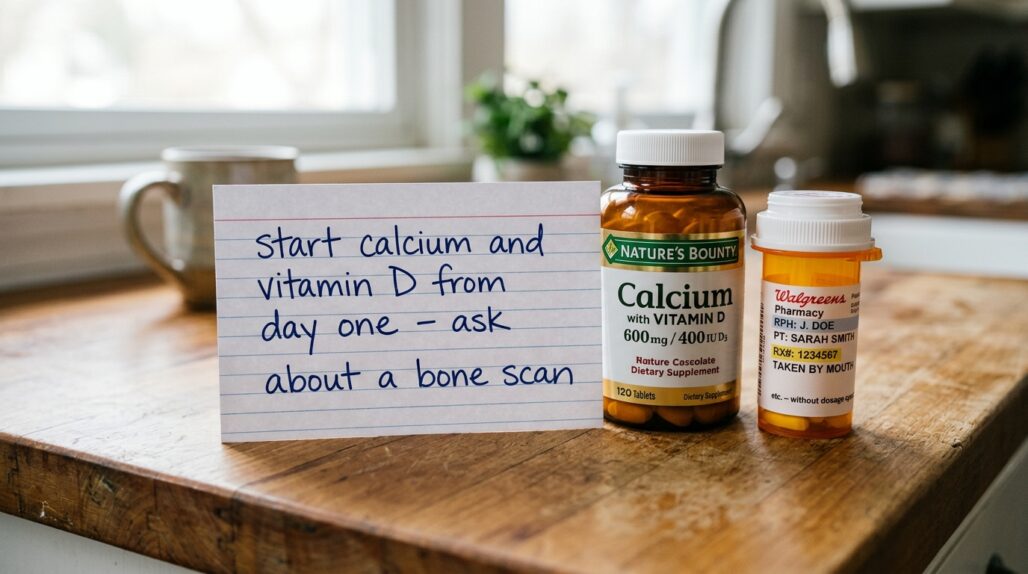
Do I really need to start calcium and vitamin D from day one? The guidelines treat them as foundational for everyone on glucocorticoids, and bone loss is fastest early, so starting with the prednisone rather than later is the safer default. Confirm the right amount for you with your prescriber.
How much calcium should I take with prednisone? Most adults aim for a total of about 1,000-1,200 mg per day from food plus supplements, not from pills alone. Going well above the target offers no extra bone benefit and may carry its own risks.
What about short prednisone courses? A single brief course is lower risk, but repeated or recurrent courses add up. If you find yourself back on steroids often, raise long-term bone protection with your doctor rather than treating each course as isolated.
Is vitamin D alone enough? Vitamin D supports calcium absorption, but the two work as a pair, and higher-risk patients often need a prescription bone medication on top. A blood test for 25(OH)D can show whether your vitamin D is actually in range.
Carbonate or citrate – which calcium is better? Carbonate is cheaper and fine for most people when taken with food, while citrate absorbs well on an empty stomach and suits those with low stomach acid or who take acid-reducing drugs. Either can work if you split the dose.
Will calcium and vitamin D reverse osteoporosis I already have? No. They help slow steroid-related bone loss, but established osteoporosis usually needs a prescription medication chosen after a fracture-risk assessment. That is a clinician decision.
Conclusion: protect bone early, then ask about a scan
Prednisone is hard on bone, and the losses come fast, so the move is to cover calcium (about 1,000-1,200 mg/day, split into 500 mg doses) and vitamin D (600-800 IU or more) from the start. That is the first-line, guideline-backed step almost every steroid patient can take.
The second step is a conversation. If you are on 7.5 mg/day or more, over 40, postmenopausal, or facing a long course, ask your doctor about a FRAX assessment, a DXA scan, and whether you need a bone medication like a bisphosphonate. For more on related steroid concerns, see our guides on supplements for osteoporosis prevention and prednisone, potassium, and magnesium depletion, and you can sanity-check any pairing with our drug-supplement interaction checker.
This article is for general education and does not replace personalized advice from your doctor or pharmacist. Do not start, stop, or change any medication or supplement based on this page alone.
Reviewed by the UsefulVitamins Editorial Team.
