
Affiliate disclosure: this article contains affiliate links. As an Amazon Associate, UsefulVitamins.com earns from qualifying purchases at no extra cost to you.
Before you buy
Magnesium glycinate is one of the few supplements where the cheap version and the expensive version are often the same molecule. The premium part is the branding, not the chemistry.
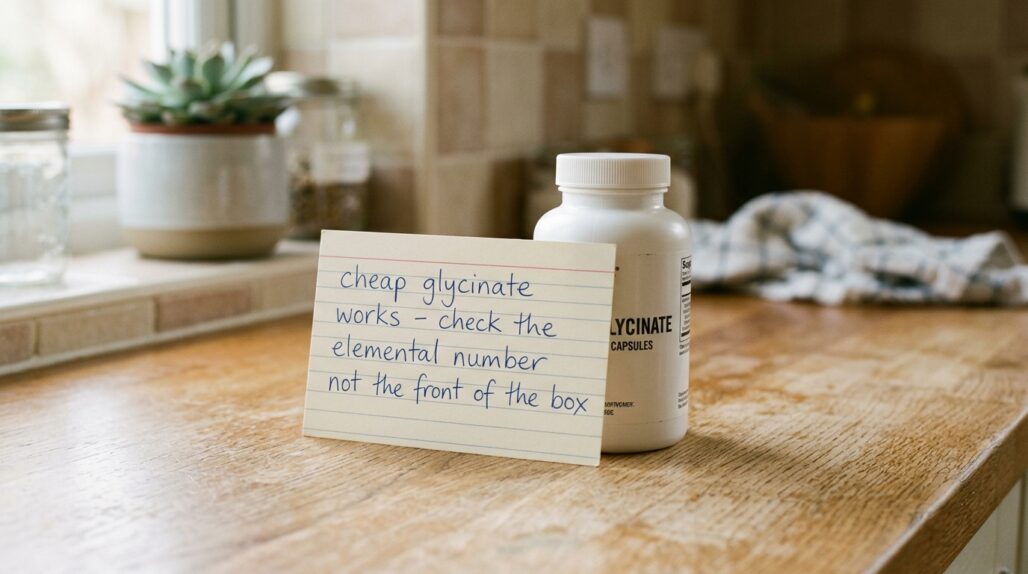
The real decision is not "which brand is best." It is "am I actually getting the elemental magnesium I paid for, in a form my gut tolerates?" That comes down to two numbers on the back of the bottle and one labeling trick to watch for.
If you take magnesium for sleep, leg cramps, or because your diet runs low, glycinate is the form most people reach for because it is gentle and absorbs well. You do not need to spend $40 to get it. You do need to read the supplement facts panel for thirty seconds, which is what this guide walks you through.
For the wider picture on what magnesium does and how much you need, see our complete guide to magnesium. This page is narrower: the best low-cost glycinate you can actually add to a cart.
Why glycinate, and the one number that matters
Magnesium glycinate (also written magnesium bisglycinate) is magnesium bound to the amino acid glycine. That chelated bond is what makes it easy on the stomach, so it rarely triggers the loose stools that cheaper magnesium oxide is famous for.
Here is the catch that trips up most shoppers. The big number on the front of the box is usually the weight of the whole compound, not the magnesium itself. Pure magnesium bisglycinate is only about 11 to 14 percent elemental magnesium by weight, so 1,000 mg of glycinate gives you roughly 100 to 140 mg of usable magnesium.
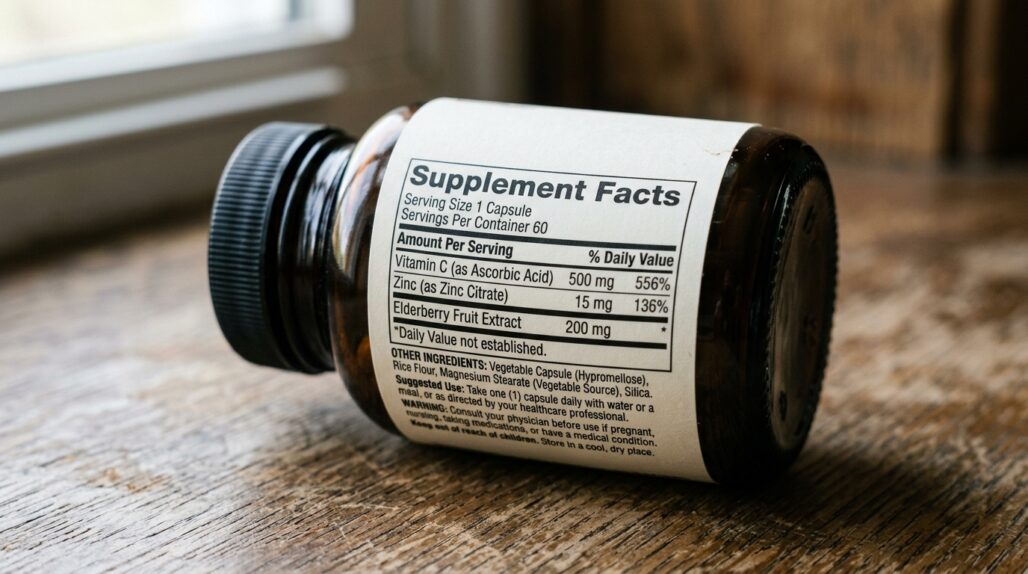
The only figure worth comparing across brands is elemental magnesium per serving – the line on the supplement facts panel that reads "Magnesium … mg" with a percent daily value next to it. Ignore the gram-sized "from X mg of magnesium glycinate" number; it is there to look impressive.
For reference, the NIH Office of Dietary Supplements puts the adult RDA at 310 to 320 mg for women and 400 to 420 mg for men (total, from food and supplements combined). The same agency sets a 350 mg upper limit on supplemental magnesium specifically – the part you swallow as pills – above which loose stools and cramping get common. Most glycinate doses land at 100 to 200 mg per serving on purpose, which keeps you comfortably under that ceiling.
The buffered-blend trap (read this before you spend)
This is where cheap goes wrong, and it has nothing to do with the price. A true chelate costs more to make than plain magnesium oxide, so some brands quietly blend the two and still print "magnesium glycinate" on the front.
The tell is simple. If the front says glycinate but the ingredient panel lists "magnesium oxide" alongside it, you are buying a buffered blend. The oxide pads the elemental number up but absorbs poorly, which partly defeats the reason you chose glycinate in the first place.
A practical rule of thumb:
- Pure chelate: elemental magnesium is roughly 10 to 14 percent of the listed glycinate weight. A clean tell.
- Buffered blend: elemental magnesium suddenly jumps to 18 to 25 percent of the listed weight. That extra came from oxide.
- The honest red flag: any panel that lists both "magnesium bisglycinate" and "magnesium oxide" in the same "from" statement.
NOW Foods has published its own analysis of glycinate brands sold on Amazon arguing that many competitors do exactly this. Treat that as the brand-sponsored argument it is, but the underlying chemistry checks out, and the labeling examples it cites are real: products like Horbaach and similar value lines openly list magnesium oxide in the panel while leading with a big "glycinate chelate" number on the front. That is not illegal, but it is not what most people think they are buying.
None of this means you must pay a premium. It means you read the panel. A true chelate from a budget brand beats a buffered blend from any brand. If you want the deeper chemistry on how the forms compare, our breakdown of magnesium forms and bioavailability covers oxide, citrate, glycinate, and the rest side by side.
The top cheap Amazon picks, compared
Three products keep showing up as the sensible-value choices, and all three list a true chelate with clear elemental numbers. Prices move, so treat these as ballpark figures as of writing and check the current price and the per-serving math before you buy.
| Product | Form | Elemental Mg / serving | Serving size | Approx. price | Third-party testing |
|---|---|---|---|---|---|
| Nature Made Magnesium Glycinate | Bisglycinate (true chelate) | 200 mg | 2 capsules | Around $20 to $24 for 180 ct | USP Verified |
| NOW Foods Magnesium Glycinate | Bisglycinate, Albion chelate | 200 mg | 2 tablets | Around $22 to $28 for 180 ct | NPA / UL GMP facility |
| Doctor’s Best High Absorption | Lysinate glycinate, Albion TRAACS | 200 mg | 2 tablets | Around $16 to $24 for 240 ct | Albion TRAACS chelate |
Nature Made Magnesium Glycinate – the safe default
Nature Made is the easiest pick to recommend because it is USP Verified, which means an independent body has checked that what is on the label is in the bottle, at the stated potency, made under controlled conditions. According to the Nature Made product page, you get 200 mg of elemental magnesium from a 2-capsule serving of true bisglycinate, with no artificial flavors or added color.
At roughly $20 to $24 for a 90-day (180-capsule) bottle, that lands near $0.11 to $0.13 per 100 mg elemental. For most people who just want a reliable glycinate without homework, this is the answer. One note: stock and exact SKUs shift, so confirm the listing is current before ordering.
NOW Foods Magnesium Glycinate – value with a clean panel
NOW uses Albion-brand chelated magnesium and delivers 200 mg elemental per 2-tablet serving, per the NOW Foods product page. NOW is not third-party seal-certified the way USP works, but it manufactures in NPA and UL-certified GMP facilities with in-house ISO-accredited testing, which is a real quality signal even without an outside stamp on the bottle.
Pricing runs about $22 to $28 for 180 tablets, so roughly $0.12 to $0.16 per 100 mg elemental. A solid, no-nonsense pick, especially if you already trust NOW for other basics.
Doctor's Best High Absorption – the flexible-dose option
Doctor's Best uses Albion TRAACS lysinate glycinate and, per the Doctor's Best product page, lists 100 mg elemental per single tablet. That smaller per-pill dose is a feature: you can take one tablet for a light 100 mg or two for 200 mg, which suits people titrating up slowly to find their gut's comfort line.
At around $16 to $24 for 240 tablets, the per-100 mg cost is among the lowest here, often near $0.08 to $0.12. The tradeoff is that it is a lysinate glycinate blend rather than straight bisglycinate, though both are legitimate chelates.
One more value option worth a look is Nutricost Magnesium Glycinate, the cheapest-per-dose pick below. Its label lists 210 mg of elemental magnesium from magnesium bisglycinate per 3-capsule serving (70 mg per capsule), with no oxide in the panel, and it is third-party tested in an NSF-certified GMP facility. Just note the serving is three capsules, so do the per-serving math the same way before you compare it to the two-pill picks above.


As an Amazon Associate, UsefulVitamins.com earns from qualifying purchases at no extra cost to you.
UsefulVitamins is reader-supported. If you buy through links on this page we may earn a small affiliate commission, at no extra cost to you. It never changes our rankings or verdicts.
Fillers and serving-size gotchas
Two things quietly change the real value of a bottle, and neither shows up in the headline price.
First, count the serving size. A bottle of "120 count" at 100 mg per tablet that calls 2 tablets a serving is really 60 servings. Compare per serving, never per pill or per bottle. The table above does this for you, but new SKUs appear constantly.
Second, fillers. Glycinate capsules and tablets usually need binders and flow agents, and that is normal. Watch for long lists with magnesium stearate, titanium dioxide, or heavy artificial coloring if you prefer a cleaner panel. None of these are dangerous at supplement doses, but if you are paying budget money you can usually find a cleaner option for the same price.
A few more practical notes:
- Capsules vs tablets: capsules tend to be slightly gentler and easier to split a dose; tablets are often cheaper per milligram.
- "High absorption" on the label means nothing on its own. It is marketing language, not a tested claim. The form and the elemental number tell the real story.
- Timing: many people take glycinate in the evening because glycine is mildly calming, but there is no rule. Take it when you will remember.
How the cheap picks compare to premium DTC
The reason this article exists is that a wave of premium direct-to-consumer magnesium products charge $35 to $50 for doses you can match for under $25 on Amazon. Some bundle several magnesium forms together and market the blend hard.
If you want to see how that pitch holds up, we put one of the most-advertised through its paces in our look at whether Magnesium Breakthrough is worth it, and we rounded up cheaper stand-ins in Magnesium Breakthrough alternatives on Amazon. The short version: a multi-form blend can be convenient, but most people taking magnesium for sleep or cramps do fine on a single well-absorbed form, and glycinate is that form.
Paying more buys you a nicer bottle, a brand story, and sometimes extra forms you may not need. It does not buy you more usable magnesium per dose. That is the whole argument for shopping cheap here.
FAQ
Is cheap magnesium glycinate as good as the expensive brands? Usually yes, as long as it lists a true chelate and clear elemental milligrams. The molecule is the same; the price gap is mostly branding and packaging, not absorption.
How do I know if a “glycinate” is secretly buffered with oxide? Check the supplement facts panel. If it lists “magnesium oxide” next to the glycinate, it is a buffered blend. A pure chelate shows elemental magnesium at roughly 10 to 14 percent of the listed glycinate weight; a blend pushes that toward 18 to 25 percent.
How much elemental magnesium should I take? Common supplement doses are 100 to 200 mg of elemental magnesium per day. The NIH sets a 350 mg upper limit on supplemental magnesium specifically, so staying at or below 200 mg from pills leaves comfortable room and lowers the chance of loose stools.
Does magnesium glycinate actually help sleep? Many people find it calming, partly because the glycine itself is mild and soothing, but the evidence is strongest for correcting a genuine shortfall rather than as a sedative. If your intake is already adequate, do not expect dramatic results.
Is USP Verified worth paying a little more for? It is a real independent check that the label matches the bottle, which is reassuring in a loosely regulated category. Among the cheap picks, Nature Made carries it, and that is a fair reason to pick it if you want certainty without a premium price.
Can I take magnesium with my other medications? Magnesium can interact with some antibiotics and certain blood pressure drugs, so spacing the doses a few hours apart often matters. Check the timing with your pharmacist if you take prescription medicine, and review the dosing notes in our complete guide to magnesium.
The verdict
You do not need a $40 bottle. A genuine magnesium glycinate that lists clear elemental milligrams and skips the oxide blend will run you under $25 on Amazon, and the value picks here all clear that bar.
If you want the simplest safe choice, Nature Made wins on the strength of its USP Verified seal at a budget price. NOW Foods is the close runner-up for a clean panel and reputable manufacturing, and Doctor's Best is the flexible-dose value play if you like to titrate. Any of the three beats a buffered blend dressed up as a premium product.
Your next step is thirty seconds long: open the listing, find the "Magnesium … mg" line on the supplement facts panel, divide the price by the number of 100 mg servings, and buy whichever true chelate comes out cheapest. That is the entire game.
This article is for general information and is not medical advice. Supplements can interact with medications and health conditions; talk to your doctor or pharmacist before starting magnesium, especially if you have kidney problems or take prescription drugs.
Reviewed by the UsefulVitamins Editorial Team.
