
Affiliate disclosure: this article contains affiliate links. As an Amazon Associate, UsefulVitamins.com earns from qualifying purchases at no extra cost to you.
Before you buy
Most people land on this comparison because two brands kept showing up in the same searches and they assumed they were rivals. They are not. One is a broad magnesium supplement; the other is a single specialized form. Buying the wrong one for your goal is the real risk here.
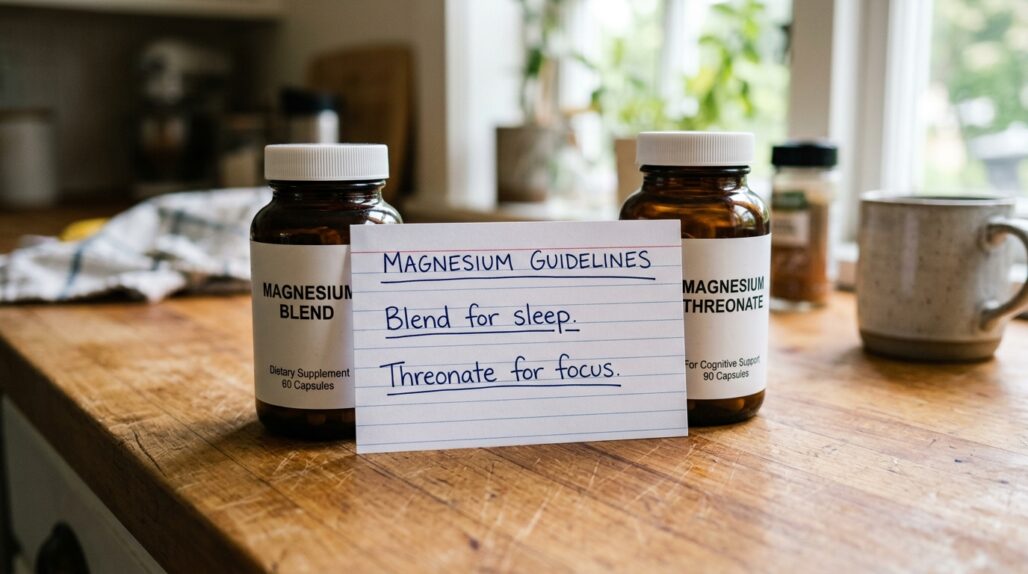
Magnesium Breakthrough, from BiOptimizers, is a blend of seven magnesium forms aimed at covering general magnesium needs – the kind tied to sleep, muscle relaxation and everyday stress. Magtein is a branded form of magnesium L-threonate, the one form studied specifically for getting magnesium into the brain.
So the question is not "which is better." It is "what are you actually trying to fix?" If you want help winding down at night, those are different aisles than if you want to test whether magnesium does anything for memory.
One more thing before you spend. Neither product is a magnesium megadose, and Magtein in particular delivers a surprisingly small amount of elemental magnesium. Keep reading before you assume the brain-targeted one is the "stronger" pick.
What each one actually is
The two products share a mineral and almost nothing else.
Magnesium Breakthrough packs seven forms into one capsule line: chelate, citrate, bisglycinate, malate, sucrosomial (as magnesium oxide), taurate and orotate. The pitch is that different forms suit different jobs, so a blend covers more bases than a single salt. Per the brand's own page, a two-capsule serving delivers about 500 mg of elemental magnesium, which is a genuinely full daily dose.
Magtein is magnesium L-threonate, developed off research out of MIT and licensed as a trademarked ingredient that several brands sell under their own labels (Sports Research is one common one). Its selling point is that L-threonate appears to raise magnesium levels in the brain better than ordinary forms. A typical four-capsule serving of 2,000 mg Magtein yields only about 144 mg of elemental magnesium, per the Sports Research label.
That gap matters. You are not buying these two products for the same amount of magnesium. Breakthrough is built to repletion-level dosing; Magtein is built to deliver a specific molecule to a specific place, and the raw mineral count comes along for the ride.
A quick reality check on forms in general: the differences between magnesium salts are real but often oversold. If you want the deeper version of this, our breakdown of magnesium forms and bioavailability goes salt by salt.

The number that surprises people: elemental magnesium
Supplement labels love big milligram figures. The number that counts is elemental magnesium – the actual mineral your body uses.
Here is the side-by-side, using each brand's published serving.
| Dimension | Magnesium Breakthrough | Magtein (L-threonate) |
|---|---|---|
| What it is | 7-form magnesium blend | Single form, L-threonate |
| Main goal | Sleep, stress, general repletion | Brain magnesium, memory, focus |
| Serving size | 2 capsules | 4 capsules (2,000 mg threonate) |
| Elemental magnesium / serving | About 500 mg | About 144 mg |
| Third-party testing | In-house heavy-metal testing; Informed Sport status withdrawn | Varies by seller; some are third-party tested |
| Approx. price | $32 to $40 / bottle | $30 to $40 / bottle |
For context, the NIH Office of Dietary Supplements sets the adult RDA at 310 to 420 mg of magnesium a day from all sources. So Breakthrough's roughly 500 mg covers a full day on its own, while Magtein's 144 mg is a fraction of your daily need.
That same NIH page notes the tolerable upper limit for supplemental magnesium is 350 mg, which applies to the form, not food. Breakthrough sits above that line, so if loose stool is a problem for you, split the dose or take it with food. This is general information, not medical advice; if you have kidney issues or take prescription medication, ask your doctor first.
What the L-threonate research actually shows
Magtein's whole reason for existing is the brain claim, so it deserves a straight answer. The evidence is real but small, and most of it traces back to the company behind the ingredient.
The early human trial that started the buzz tested a threonate formula in older adults with mild memory complaints over 12 weeks and reported better cognitive scores than placebo. It was a small study with a few dozen participants, which is a starting point, not a settled case.
More recently, a 2025 randomized controlled trial published in Frontiers in Nutrition gave 100 healthy adults 2 grams of Magtein daily for six weeks. The supplement group showed a modest edge on a composite cognition score and faster reaction time, but sleep results were mixed – subjective sleep impairment improved while objective measures did not move. Worth knowing: that trial was industry-funded, which does not void it but does mean you read it with a careful eye.
So here is the honest read. L-threonate has more direct cognition data than any other magnesium form, but the effect sizes are modest, the trials are small, and independence is limited. It is reasonable to try if memory and focus are your specific target. It is not a proven nootropic, and it will not fix a sleep problem that is really about caffeine, screens or stress.
If you want the full picture on what magnesium does and does not do across the body, our complete guide to magnesium lays out the evidence by claim.

Cost per serving, and what you are paying for
On a sticker basis the two land close, but you are buying very different things per dollar.
- Magnesium Breakthrough: around $32 to $40 a bottle as of writing. A 60-capsule bottle is 30 daily servings, so call it roughly $1.10 to $1.30 a day for a full 500 mg of elemental magnesium across seven forms.
- Magtein: around $30 to $40 depending on count and retailer. At four capsules a serving, a 90-count bottle is only about 22 servings, so the per-day cost can run higher than it looks for just 144 mg of elemental magnesium.
Put plainly: with Breakthrough you are paying for a complete daily magnesium dose, while with Magtein you are paying for the L-threonate delivery, not the milligram count. That is fine if the brain angle is what you want, but it is a bad deal if you only wanted "more magnesium."
There is also a value angle worth naming. Magtein is a licensed ingredient, so generic magnesium L-threonate from other brands is often cheaper for the same compound. We compare those directly in Magtein vs generic magnesium L-threonate, and the short version is that the molecule is the molecule.
Third-party testing and quality
Quality testing is where buyers should slow down, because the marketing can outrun the certification.
Magnesium Breakthrough publishes in-house testing for heavy metals such as lead, mercury and arsenic, plus California Proposition 65 compliance. It was once listed under the Informed Sport program, but that certification was voluntarily withdrawn, so do not assume a bottle on the shelf today carries a current batch-tested mark. If you are a drug-tested athlete, verify the specific batch on the Informed Sport site before you trust it.
Magtein is an ingredient, not a finished-product certification, so testing depends entirely on the brand that bottles it. Some sellers, including Sports Research, publish their own third-party testing; others do not. Read the specific label, not the ingredient's reputation.
Neither product carries a standout independent seal like NSF Certified for Sport on the version we reviewed, so if certified testing is a hard requirement for you, factor that in.

Who should buy which
This is the part most articles skip, so here is the plain routing.
Buy Magnesium Breakthrough if you want one general magnesium supplement, you are after better sleep or calmer stress, or you suspect you are simply low on magnesium. Its 500 mg elemental dose does the everyday job in one product.
Buy Magtein if your specific, narrow goal is memory and mental sharpness and you have read the evidence with realistic expectations. Treat it as an experiment, not a guarantee.
Buy neither, and grab a plain magnesium glycinate, if you just want cheap, gentle daily magnesium for sleep. A basic glycinate runs well under both and covers most people fine. We get into whether the premium blend earns its keep in our standalone Magnesium Breakthrough review.


As an Amazon Associate, UsefulVitamins.com earns from qualifying purchases at no extra cost to you.
UsefulVitamins is reader-supported. We may earn a commission from qualifying purchases made through the links above, at no extra cost to you. It does not change our verdicts.
FAQ
Is Magnesium Breakthrough or Magtein better for sleep? Magnesium Breakthrough is the more sensible sleep pick because it delivers a full elemental magnesium dose across calming forms like glycinate and taurate. Magtein’s sleep data is mixed, and its elemental dose is small.
Does Magtein really reach the brain? Magnesium L-threonate does appear to raise brain magnesium better than common forms in research, but the human cognition trials are small and several are industry-funded. The effect on memory and focus is modest, not dramatic.
Why is Magtein’s elemental magnesium so low? A 2,000 mg serving of Magtein yields only about 144 mg of actual magnesium because most of the molecule’s weight is the threonate carrier. You are paying for the delivery form, not a big mineral dose.
Can I take both together? Some people do, using Breakthrough for general repletion and Magtein for the brain angle, but watch your total. Combined supplemental magnesium can push past the 350 mg upper limit and cause loose stool, so split doses and check with your doctor.
Is a cheaper magnesium just as good? For everyday needs like sleep and muscle relaxation, a plain magnesium glycinate works well for most people at a fraction of the price. The blend and the threonate form are worth paying for only when their specific angle matches your goal.
Are these products third-party tested? Magnesium Breakthrough publishes in-house heavy-metal testing, but its Informed Sport certification was withdrawn, so verify the batch. Magtein testing depends on the brand bottling it, so read the specific label.
The verdict
These two products only look like rivals because they share a mineral. Magnesium Breakthrough is the better default for general use, sleep and stress, because it actually delivers a full daily magnesium dose. Magtein is a niche tool for the brain angle, backed by small and mostly industry-linked studies.
If you want one magnesium and a calmer night, get Breakthrough or an even cheaper glycinate. If you are specifically curious whether magnesium can sharpen memory and you will treat it as a trial, Magtein is a reasonable, if pricey, bet – and the generic threonate version usually costs less for the same compound.
Your next step: decide your goal in one sentence, then buy the product that matches it. Do not pay for a brain supplement when you wanted sleep, or for 144 mg of magnesium when you wanted a full dose.
This article is for general information and is not medical advice. Supplements can interact with medications and are not a substitute for care from a qualified professional. Talk to your doctor before starting any new supplement, especially if you have kidney disease, take prescription drugs, or are pregnant.
Reviewed by the UsefulVitamins Editorial Team.
