
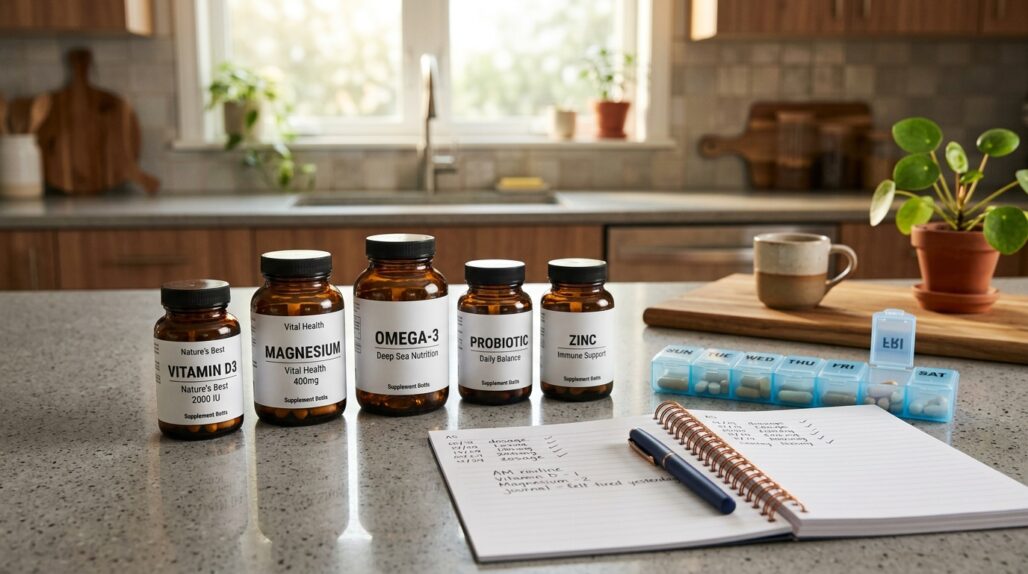
Why the stack grows so fast on a GLP-1
A GLP-1 routine rarely stays simple. You start the injection, then a friend mentions protein, a forum mentions electrolytes, your stomach gets cranky so you add magnesium and fiber, and a multivitamin feels sensible because you are eating less. Within a month the bathroom shelf looks like a small pharmacy.
There is a real reason for the pile-up. These medications slow how fast the stomach empties, which is part of why you feel full sooner and eat less. Smaller meals can leave gaps in protein and a few vitamins and minerals, and the side effects send people reaching for support. The result is a stack that grew one bottle at a time, with no one ever looking at the whole picture.
This guide is about that whole picture. The goal is not more supplements or fewer, it is a routine you can see, take, and explain to a professional. Everything here works with a pen and a piece of paper.
Start with one list (the master inventory)
Before you organize anything, get it all in one place. Take every bottle off the shelf, including the ones you forget about, and write down five things for each: the product name, the active ingredient and its amount per serving, how many you take, when you take it, and why you think you are taking it.
That last column matters more than people expect. If you cannot finish the sentence "I take this for…," that is the first item to question with your pharmacist. A reason you cannot name is a reason to revisit.
Here is a simple paper template you can copy onto a page or the back of an envelope. Fill one row per product.
| Product | Active ingredient and amount | How much I take | When | Why |
|---|---|---|---|---|
| Multivitamin | Mixed – see label | 1 tablet | AM with food | Backfill smaller meals |
| Vitamin D3 | 50 mcg (2,000 IU) | 1 softgel | AM with food | Low blood level last test |
| Magnesium | 200 mg glycinate | 1 capsule | PM | Constipation, sleep |
| Electrolyte mix | Sodium, potassium, magnesium | 1 packet | Midday in water | Low energy, low intake |
| Protein powder | 25 g protein per scoop | 1 scoop | AM shake | Preserve muscle |
Notice that two of those rows already carry magnesium – the standalone capsule and the electrolyte mix. That is the kind of thing a single list makes obvious. We will come back to it.

Group the stack into three buckets
Once everything is on one page, sort each item into one of three groups. This is the part that turns a random shelf into a routine you understand.
- Baseline nutrition. The things meant to cover gaps from eating less – a multivitamin, vitamin D if your level was low, sometimes B12 or iron if a clinician flagged it. These fill in what smaller meals may miss.
- Muscle support. Protein is the anchor here. Weight loss on these medications includes some loss of lean mass alongside fat, and most reviews point to adequate protein and resistance training as the practical way to protect muscle during treatment, as summarized in this overview of muscle health during incretin therapy. The general adult protein reference is about 0.8 g per kg of body weight, and several reviews suggest many adults, especially older ones, do better toward the higher end while losing weight, a point laid out in this review of protein needs in older adults. Your exact target is a conversation for your provider, not a number to chase alone.
- Side-effect support. Magnesium and fiber for constipation, ginger for nausea, electrolytes for the flat, low-energy days. These exist because the medication slows the gut. The slowing is the same mechanism behind early fullness, and it can reduce fiber and fluid intake enough to cause constipation, as described in this review of GLP-1 effects on gastric emptying.
When you write each product into a bucket, look for items that do not fit any of them. Those are usually candidates to trim, especially anything sold as a "natural" version of the drug you are already taking. If the prescription is doing the job, a redundant blood-sugar herb on top may simply be clutter worth raising with your pharmacist. For a deeper look at whether your total stack has crept too high, our supplement self-audit walkthrough takes you through it product by product.
Trim the duplicates before they add up
Grouping exposes overlap, and overlap is where a tidy stack quietly becomes a risky one. The danger is not the headline dose on any single bottle; it is the same nutrient appearing in three products at once. A multivitamin, a standalone capsule, and a fortified shake can all carry magnesium or zinc, and the totals add together inside you.
A few nutrients have published ceilings worth knowing. For supplemental magnesium, the NIH Office of Dietary Supplements lists a tolerable upper intake level of 350 mg from supplements for adults, with diarrhea being the effect that sets that limit – which is awkward when you are already taking magnesium to fix the opposite problem. Iron has an adult upper limit of 45 mg per day per the ODS iron fact sheet, and vitamin D sits at 100 mcg (4,000 IU) per day for adults per the ODS vitamin D fact sheet. Fat-soluble vitamins like A, D, E, and K are worth extra care because the body stores rather than flushes them.
To check yourself, total each nutrient across every product, not bottle by bottle. If a single nutrient lands near or over its limit once you add the sources together, do not start cutting prescriptions on your own. Pick the redundant over-the-counter product to drop, or bring the math to your pharmacist and let them sort it. We keep a fuller, gentle walkthrough of finding these hidden overlaps in our guide on spotting duplicate ingredients across supplements, and a plain-English explainer in the complete guide to magnesium if that is the nutrient stacking up in your routine.
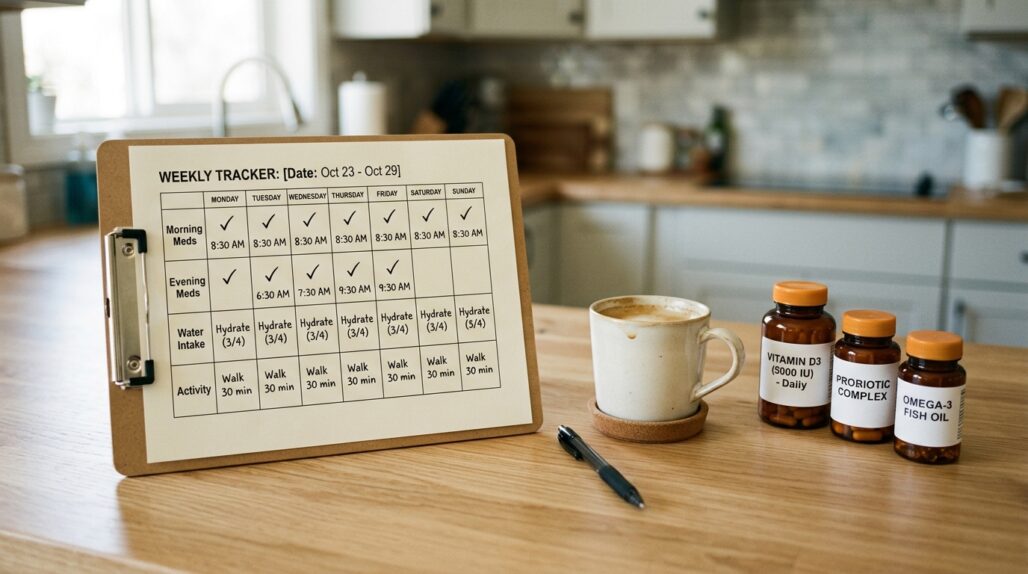
A simple AM/PM placement that fits smaller meals
With the stack grouped and trimmed, give it a shape. Smaller meals change the old "take it with a big breakfast" advice, so anchor doses to the meals you do eat and to your injection day rather than guessing.
| Time | What goes here | Why this slot |
|---|---|---|
| Morning, with first food | Multivitamin, vitamin D, protein shake | Fat-soluble vitamins absorb better with food; protein early helps you actually hit the daily target |
| Midday | Electrolytes, fiber with plenty of water | Spreads fluids out and supports the slower gut without crowding a small meal |
| Evening | Magnesium, anything that bothers your stomach on an empty one | Many people tolerate magnesium better at night, and it doubles as a constipation and sleep cue |
A weekly pill organizer fills this in nicely: load Sunday night, eyeball the week, refill when it runs low. For timing questions specific to the injection itself, our GLP-1 timing schedule around meals and injection covers the details, and if you want a sense of which supports tend to pair well with the medication, the page on supplements people take alongside their GLP-1 is a useful starting point to discuss.
Keep the list current (this is the part people skip)
The list you just built is only as good as how current it stays. Doses change, products run out, a clinician adds or removes something, and within a few weeks the page on your shelf no longer matches the bottles. The fix is a small habit: once a week, glance at the organizer and update the page when anything changes. A pill box plus a single sheet you actually keep up to date beats the most detailed plan you wrote once and forgot.
If you would rather not maintain it on paper, this is the one place a phone can help. Since a GLP-1 routine can mean a multivitamin, vitamin D, magnesium, electrolytes, and protein all at once, StackMyMed (our own free app) keeps the whole stack in one place so nothing gets quietly forgotten or doubled up, and it can flag where two products share a nutrient so you can raise that overlap with your pharmacist. Either way – a notes app, a paper sheet, or the app – the point is one current list, not three slightly different ones. The app organizes the list and surfaces overlaps; your pharmacist decides whether a combination is fine.

FAQ
How many supplements is too many on a GLP-1? There is no magic number. The better question is whether each item has a clear purpose and stays under safe limits when you total nutrients across products. If you cannot say what something is for, that is the one to review with a pharmacist.
Do I really need protein powder, or is that just marketing? Food first is fine if you can hit your protein target with smaller meals, which is hard for many people. Protein matters during this kind of weight loss because some of the loss is muscle, but powder is just a convenient source, not a requirement. Your provider can help set a realistic target.
Can I take magnesium for constipation and also use an electrolyte mix that contains magnesium? You can, but you have to add up the magnesium from both, because the supplemental ceiling for adults is 350 mg and diarrhea is the limiting side effect. Tally the total first, then ask your pharmacist if it looks high.
Should I stop my “natural Ozempic” supplements now that I am on the real medication? Possibly, since they may be redundant, but do not stop anything prescribed on your own. Bring those products to your pharmacist or prescriber and let them decide what still earns a place.
When should I take everything – all at once? Spreading doses across morning, midday, and evening usually sits better with smaller meals and slower digestion. Fat-soluble vitamins and protein fit the morning meal; magnesium often suits the evening.
What if organizing the stack does not fix my side effects? Persistent or severe nausea, constipation, or fatigue can mean the dose needs adjusting, which is a prescriber conversation rather than a supplement fix. Organizing helps you take what you have correctly; it does not replace a medical review.
The bottom line
A crowded GLP-1 shelf is normal, and it is fixable in an afternoon. Put everything on one list, sort it into baseline nutrition, muscle support, and side-effect support, then cut the duplicates and the items you cannot justify. Place what remains around the meals you actually eat, and keep the list current with a weekly glance.
The single most useful move is the first one: one master list you keep up to date. It makes overlaps obvious, it makes your routine easier to follow, and it gives your pharmacist or prescriber something real to work from. Bring that list to your next visit and ask the questions the list surfaces – they make the medical calls, your job is to hand them an accurate picture.
This article is for general education and is not medical advice. It is not a substitute for guidance from your own pharmacist or doctor, who know your health history and the rest of your routine. Do not start, stop, or change any medication or supplement based on this page alone.
StackMyMed is made by UsefulVitamins. It helps you organize your list and flag things to discuss with a pharmacist or doctor; it is not a diagnosis or treatment tool and does not replace professional medical advice.
Reviewed by the UsefulVitamins Editorial Team.
