
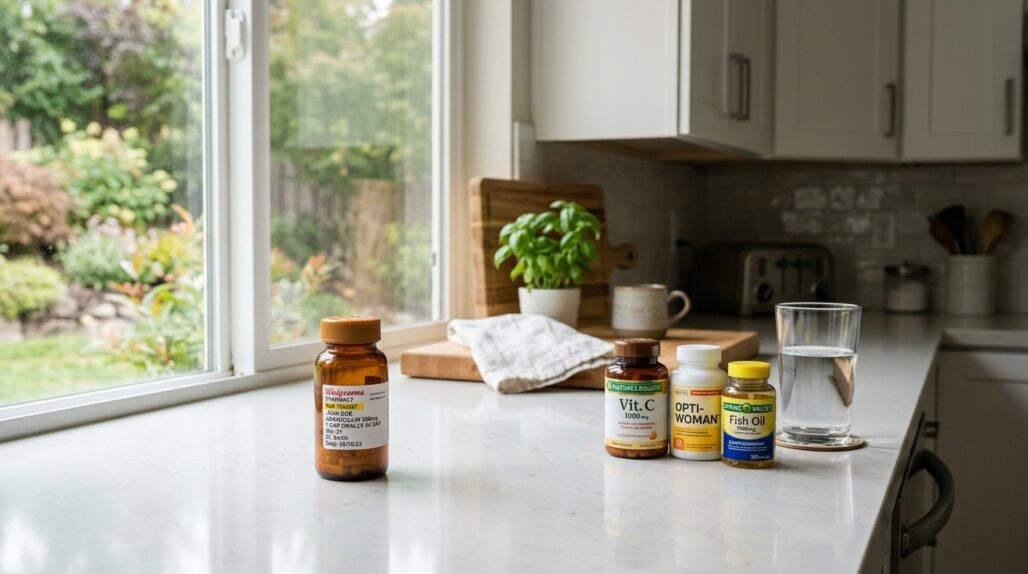
Why a new antibiotic can change your supplement timing
You picked up a prescription, and the label says little beyond "take twice daily." What it rarely tells you is that a handful of antibiotics behave differently when a supplement is sitting in your stomach at the same time. The two do not cancel each other out in a dramatic way, but the antibiotic can be absorbed far less than intended, which is the part that matters when you are trying to clear an infection.
The good news is that this is a timing problem, not a "give everything up" problem. For most people the fix is to keep taking what you already take and simply move the supplement a few hours from the antibiotic dose. The trick is knowing which antibiotics this applies to and how big a gap to leave.
This page walks through the antibiotics most likely to interact, the supplements most likely to cause it, and a simple way to build the spacing into a normal day. None of it replaces the conversation with your pharmacist, who can confirm your exact drug. Think of this as what to sort out before your first dose.
Which antibiotics actually interact with minerals
Most antibiotics do not have this problem at all. Common ones like amoxicillin and azithromycin are generally not affected by mineral supplements in this way. The interaction shows up mainly in two drug families.
The first is the tetracyclines, which include doxycycline, minocycline, and tetracycline itself. The second is the fluoroquinolones, which include ciprofloxacin, levofloxacin, and moxifloxacin. Both families share a chemistry quirk: their molecules grab onto metal ions and form a clump the gut cannot absorb well. Pharmacists call this chelation, and according to the tetracycline overview in StatPearls, it is why these drugs lose potency when taken with aluminum, calcium, iron, magnesium, and zinc.
The size of the effect is not small. A study of patients taking these antibiotics noted that ciprofloxacin absorption can fall by up to 42 percent when taken with calcium and by up to 64 percent with iron. That same study found nearly three out of four patients were swallowing the two at the same time anyway, which tells you how easy this is to miss.
If your antibiotic is not on this list, you may not need to change anything. But the only way to be sure is to read the label and confirm with the pharmacist, because brand names and combination products can hide the drug family.
The supplements and foods most likely to cause it
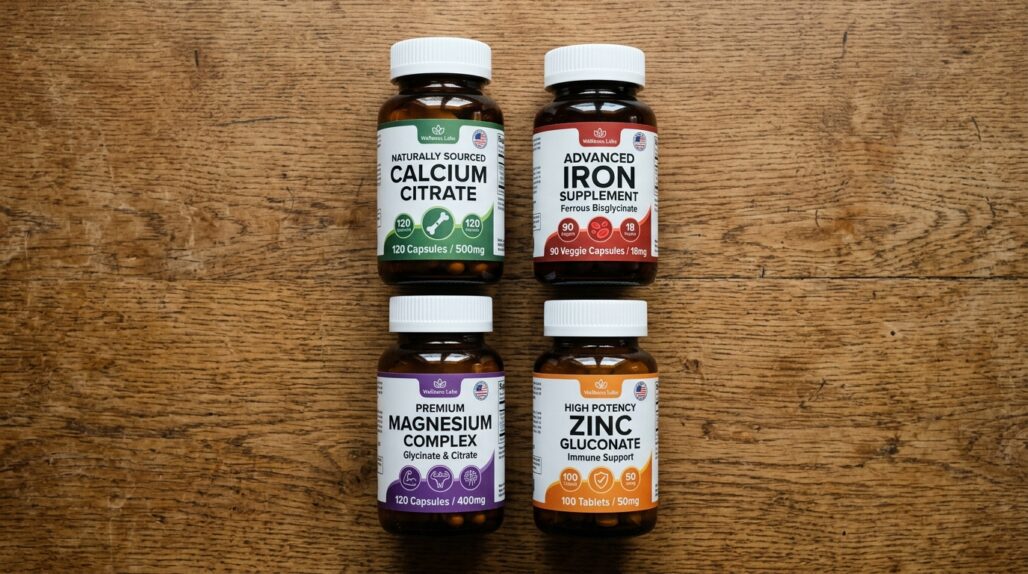
The culprits are the minerals that carry a strong positive charge, plus a few everyday items that contain them. Here is what to look at on your shelf.
| Item | Why it interferes | What to do |
|---|---|---|
| Iron supplements | Binds strongly to tetracyclines and fluoroquinolones | Space the most, often the antibiotic first then iron hours later |
| Calcium supplements | Binds and can cut absorption noticeably | Separate by several hours from the antibiotic |
| Magnesium and zinc | Both chelate; zinc is common in immune blends | Move away from the antibiotic dose |
| Multivitamins with minerals | Often contain iron, calcium, magnesium, and zinc together | Treat the whole pill as something to space |
| Antacids and acid reducers | Many contain aluminum, calcium, or magnesium | Check the label and space them too |
| Dairy and milk-based foods | High in calcium; matters most for older tetracyclines | Keep the antibiotic away from a glass of milk or yogurt |
One nuance worth knowing: doxycycline is somewhat more forgiving than plain tetracycline when it comes to a regular meal. A review of food effects on tetracycline-class drugs notes that food or milk can cut older tetracycline absorption by half or more, while doxycycline is affected less. Even so, a calcium supplement or a tall glass of milk is concentrated enough to matter, so the spacing advice still stands. When in doubt, a small non-dairy snack with water is the safer companion for a dose that upsets your stomach.
How many hours to leave between doses
This is where people want one tidy number, and there is not one, because it depends on the drug and the mineral. The figures below come from published interaction data and are useful as a starting picture, but your pharmacist confirms the exact gap for your prescription.
| Antibiotic | General spacing from minerals |
|---|---|
| Doxycycline | Take 1 to 2 hours before aluminum, calcium, or magnesium; for iron, take doxycycline well before or about 2 hours after |
| Ciprofloxacin | Take the antibiotic 2 hours before, or 6 hours after, the mineral |
| Levofloxacin | Leave at least 2 hours on either side of the mineral |
| Moxifloxacin | Take it about 4 hours before, or 8 hours after, the mineral |
A few patterns make these easier to remember. Take the antibiotic first whenever you can, since most labels give a shorter "before" window than "after." Iron usually needs the widest gap of the common minerals. And the review of fluoroquinolone and cation interactions makes the point that these gaps exist to keep the drug working at full strength, which protects both your recovery and, over the long run, the drug's usefulness against resistant bacteria.
If the math feels fiddly, that is normal. The next section turns it into a plan you can write on paper.
A simple plan you can build by hand
You do not need anything fancy to get the spacing right. Here is a method that works with a pen and a piece of paper.
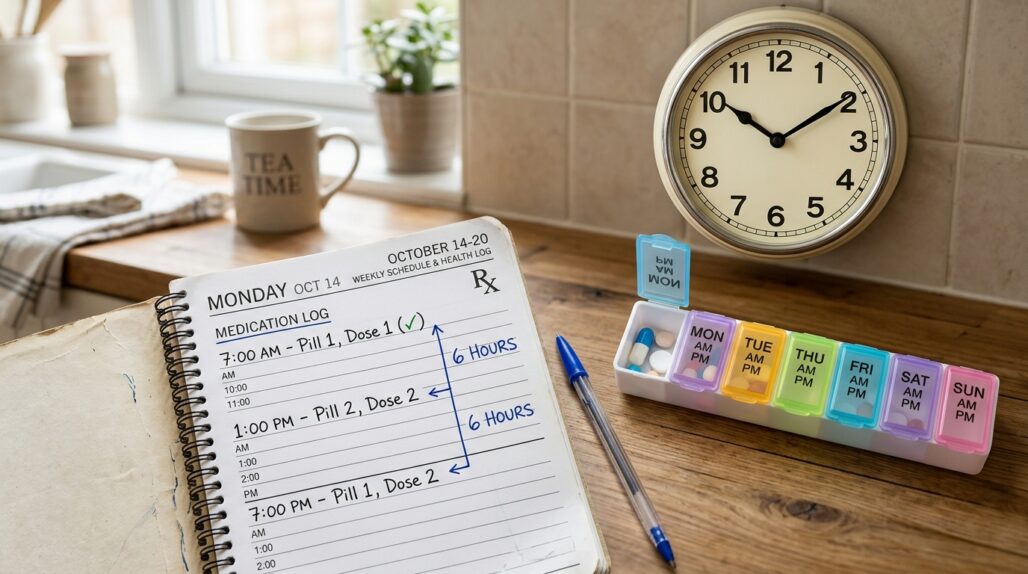
- Write down your antibiotic schedule first. Note each dose time, for example 8 a.m. and 8 p.m. for a twice-daily drug. The antibiotic is the anchor; everything else moves around it.
- List your mineral-containing supplements separately. Iron, calcium, magnesium, zinc, your multivitamin, and any antacid go on this list. Everything else, like fish oil or a probiotic, can usually stay where it is, with the probiotic note below.
- Park the minerals in the open gaps. If you take doxycycline at 8 a.m. and 8 p.m., your minerals and any milk could sit around midday and at bedtime, well clear of both doses.
- Make a one-week grid. Draw seven columns for the days and rows for morning, midday, and evening. Mark the antibiotic in one color and the minerals in another so a clash is easy to spot.
- Keep the antibiotic with water, not milk. A full glass of water and an empty-ish stomach (or a light non-dairy snack if it upsets you) is the simplest default.
Here is a worked example for a twice-daily antibiotic so the shape is clear:
| Time | What you take |
|---|---|
| 8 a.m. | Antibiotic with water, no dairy or minerals nearby |
| 12 p.m. | Multivitamin, calcium, or your usual minerals |
| 3 p.m. | Iron, if you take it, with a little vitamin C |
| 8 p.m. | Antibiotic with water |
| Bedtime | Magnesium or zinc, clear of the evening dose |
That grid is the whole system. Once it is on paper and taped to a cabinet, you mostly just follow it. The harder part is keeping it accurate when a dose moves or a new bottle joins the shelf, and that is the next step.
Keep the plan current as the week goes on
A schedule only helps if it stays right when life nudges it. A dose runs late, you add a magnesium at bedtime, or you forget whether the antibiotic and the multivitamin actually drifted close together. The low-tech fix is to keep the paper grid by your pills and check off each dose as you take it, so a glance tells you what is left and what is too close to what.
If you would rather not babysit a sheet of paper, this is the one spot an app earns its place. Because some antibiotics bind to iron, calcium, magnesium, or zinc, it helps to see your whole stack in one view before your first dose, and a free app we make, StackMyMed (our own free app), flags possible supplement interactions for you to confirm with your pharmacist rather than deciding anything for you. It does the same job as the paper grid plus a second set of eyes on what is sitting near what; the pill box or notebook works fine if you prefer to stay offline, and either way the safety call stays with your pharmacist.
On probiotics, since people ask: many take one during a course to ease antibiotic-related stomach upset. Bacterial probiotics are generally spaced about 2 to 3 hours from the antibiotic so the drug does not knock them out, while the yeast-based Saccharomyces boulardii is not killed by antibiotics and can usually be taken closer together. Evidence here is mixed and strain-specific, so treat it as worth raising with the pharmacist, not a settled rule.
FAQ
Do I need to stop my supplements while I am on an antibiotic? Usually no. For most people the issue is timing, not stopping. You keep taking your supplements and simply move the mineral-containing ones a few hours from the antibiotic dose. Confirm with your pharmacist whether any need a wider gap.
Should I ever skip an antibiotic dose to fit a supplement in? No. The CDC advises taking antibiotics exactly as prescribed and finishing the full course, even once you feel better. The antibiotic schedule comes first; the supplement moves around it, not the other way around.
Which supplements are the main ones to watch? The minerals iron, calcium, magnesium, and zinc, plus any multivitamin or antacid that contains them, and calcium-rich dairy. These are the items that bind tetracyclines and fluoroquinolones and can cut how much antibiotic you absorb.
Does this apply to every antibiotic? No. Common ones like amoxicillin and azithromycin generally are not affected this way. The mineral-binding problem mainly involves tetracyclines, such as doxycycline, and fluoroquinolones, such as ciprofloxacin and levofloxacin. Check your specific drug with the pharmacist.
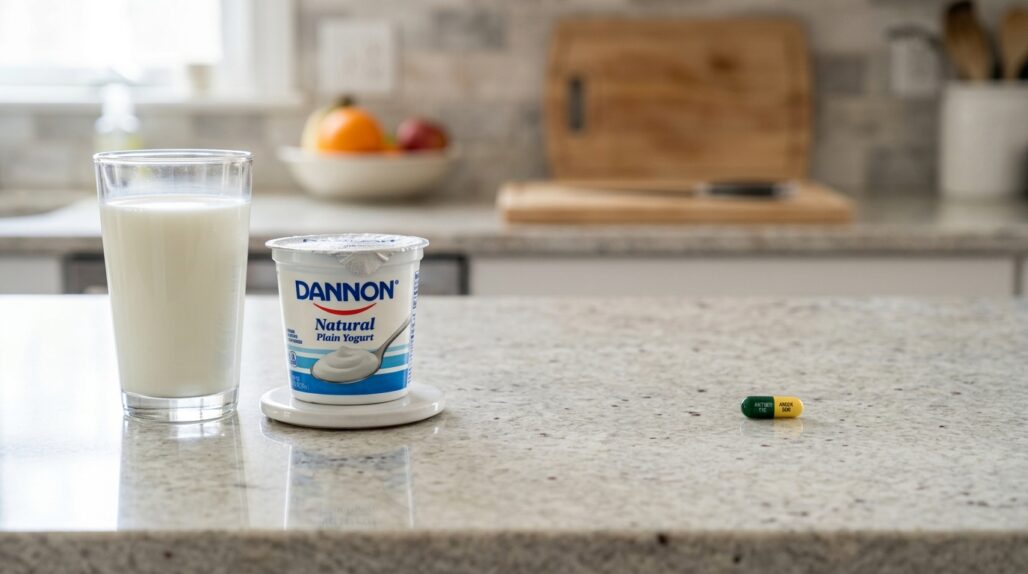
Can I take my antibiotic with milk or yogurt? It is safer not to. Dairy is high in calcium, which can bind these antibiotics. The effect is larger for older tetracyclines and smaller for doxycycline, but keeping the dose clear of a glass of milk or a yogurt is the simple call.
What about probiotics during the course? Many people take one to ease stomach upset. Bacterial probiotics are usually spaced a couple of hours from the antibiotic, while the yeast Saccharomyces boulardii is not killed by antibiotics and can be taken closer. The evidence varies by product, so ask your pharmacist what fits your situation.
The bottom line
A new antibiotic does not mean clearing your supplement shelf. For the drugs that interact, mainly tetracyclines like doxycycline and fluoroquinolones like ciprofloxacin, the answer is to take the antibiotic first and slide your iron, calcium, magnesium, zinc, multivitamin, and dairy a few hours away. The single most useful move is to write your antibiotic times on paper, then fill the gaps with everything else.
Two things never change: do not skip antibiotic doses to make room for a supplement, and confirm your exact drug and spacing with the pharmacist, because not every antibiotic behaves the same way. Bring your full list, prescriptions and supplements together, so they can check it as one picture.
For more on the timing side, see our guides on how far apart to space supplements and medications and the deeper doxycycline and supplements breakdown. If you want to sanity-check a specific pairing, the drug and supplement interaction checker and our full interactions reference are the place to start before you call the pharmacy.
This article is general information, not medical advice. It is not a substitute for guidance from your doctor or pharmacist, who know your health history and your exact medications. Do not start, stop, or change the timing of a prescription on your own.
StackMyMed is made by UsefulVitamins. It helps you organize your list and flag things to discuss with a pharmacist or doctor; it is not a diagnosis or treatment tool and does not replace professional medical advice.
Reviewed by the UsefulVitamins Editorial Team.
