
Why injection day can feel different
Most people on a weekly GLP-1 settle into a rhythm: the shot, then a stretch where appetite is low and the stomach feels touchy, then a calmer back half of the week. The FDA-approved label for semaglutide lists nausea, vomiting, diarrhea, and constipation among the most common reactions, and many people notice those feelings cluster around the dose rather than spreading evenly across all seven days.
That timing matters for supplements. A multivitamin or a fish-oil capsule that goes down fine on a good day can sit heavy when your stomach is already unsettled. None of this means your supplements are the problem. It just means the same routine can land differently depending on where you are in the week.
So the question this page answers is narrow and practical. You are not changing what you take or how much. You are deciding whether a few items are better moved to a gentler slot on the one or two days your stomach is most sensitive.
First, sort your list into two columns
Before you touch any timing, split everything you take into two groups. This five-minute sort tells you what is fixed and what has some give.
Column one: keep steady, no matter the day. This is anything prescribed and anything that works on a fixed interval or a fixed time. Your GLP-1 itself, blood pressure medication, thyroid medication, a blood thinner, birth control, diabetes medication, a statin, an antidepressant. These stay exactly where they are. Injection-day queasiness is not a reason to move or skip a prescription on your own.
Column two: some flexibility. This is most over-the-counter supplements with no strict timing rule: a general multivitamin, vitamin D, fish oil, a probiotic, magnesium taken for sleep, collagen. For these, "with food" usually means "with a meal," and which meal is up to you.
Write it out. A scrap of paper works. The point is to see, at a glance, which line items you are even allowed to move.
| Item type | Move on injection day? | Why |
|---|---|---|
| Prescription medications | No, keep the usual time | Skipping or shifting a prescription on your own can be risky; that decision belongs with your prescriber |
| Time- or interval-locked items | No | Thyroid medication, the pill, and similar items depend on consistent timing to work |
| General “with food” supplements | Often yes | A multivitamin, fish oil, or magnesium can go with whichever meal you tolerate best |
| Stomach-heavy supplements | Yes, to your easiest meal | Iron, large oils, and big capsules are the usual culprits when queasiness is already high |

What to keep exactly where it is
Start with the rule that does not bend. Do not skip, delay, or double a prescribed dose to dodge a rough stomach. If injection-day nausea is making a medication hard to take, that is a conversation with your pharmacist or doctor, not a solo adjustment.
A few categories deserve special care because their timing is the whole point:
- Thyroid medication. Levothyroxine is usually taken on an empty stomach at a consistent time, and a systematic review on the NCBI/PMC archive describes keeping it well separated from calcium and iron, commonly by about four hours. If your shot day tempts you to bunch everything together, that gap still has to hold.
- Birth control and other time-sensitive prescriptions. These stay on their schedule.
- Any interval-based item your clinician set up a specific way. Steady is the goal.
There is a reassuring footnote here. The semaglutide label notes that the drug delays stomach emptying and so has "the potential to impact the absorption of concomitantly administered oral medications," yet in the manufacturer's own trials it "did not affect the absorption of orally administered medications to any clinically relevant degree," per the FDA-approved labeling on DailyMed. For most people, the worry is comfort on a queasy day, not a medication failing to absorb. Still, if you take a narrow-margin drug, ask your pharmacist before you assume nothing changes.
What you can adjust, gently
Now the flexible column. The goal on injection day is to take the same things you always take, just at the kindest moment.
- Pair stomach-heavy supplements with your best meal. Whatever meal sits easiest on the day after your shot, that is when to take iron, fish oil, or any large capsule. If lunch is your steadiest meal that week, move them to lunch.
- Spread items out instead of stacking them. Five capsules at once on a touchy stomach is harder than two in the morning and three later. Same total, gentler delivery.
- Shift to the calmer end of the day if mornings are rough. Many people feel worst in the first day or so after the dose. If yours is a morning shot and the queasiness peaks then, a flexible "with food" supplement can ride along with an evening meal instead.
- Skip nothing important to make room. Adjusting timing is not the same as dropping an item. If something genuinely cannot go down on the worst day, note it and ask your pharmacist whether moving it to the next day is reasonable, rather than guessing.
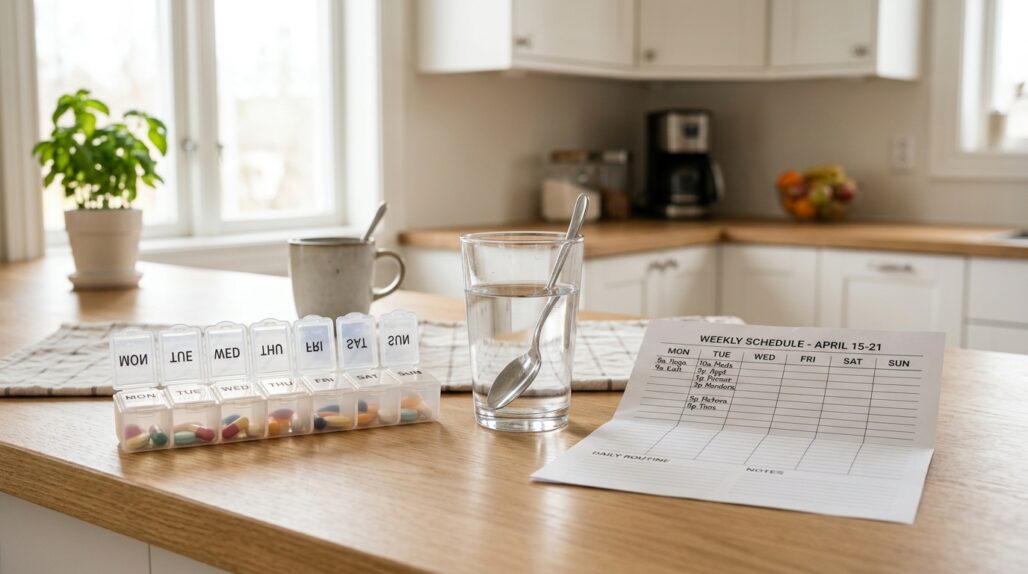
A printable method, so this works with zero apps: take a sheet of paper and make seven columns, one per weekday, and circle your injection day. Under it, write your flexible supplements next to the meal you plan to pair them with on that day only. The other six columns stay on your normal schedule. Tape it inside a cabinet door. That single page is a complete injection-day timing plan.
Hydration and electrolytes on the roughest day
The day your stomach is most unsettled is also the day fluids slip. That is worth attention on its own. The semaglutide label points to dehydration as a thread running through its more serious gastrointestinal reports and advises taking precautions to avoid fluid depletion, and StatPearls on adult dehydration describes how quickly low fluid intake can turn from a nuisance into a real problem.
Practical, low-drama steps:
- Sip steadily rather than gulping. Small, frequent sips of water tend to sit better than a large glass when you are queasy.
- Add electrolytes if you have lost fluids. If you have had vomiting or diarrhea, plain water alone may not be enough; an electrolyte drink can help replace what was lost.
- Keep a general target in mind. The CDC's guidance on water and healthier drinks is a sensible anchor for ordinary days, and your needs rise when you are losing fluids.
If you cannot keep liquids down, that is past the "tweak your timing" stage. Vomiting that blocks fluids, or signs of dehydration, is a call to your clinician, not a supplement question.
Once you have a plan you like, the only hard part is remembering that injection day runs on different rules than the rest of the week. A pill box you load on Sunday handles your fixed items, and a sticky note on the fridge can carry the "move these to lunch on shot day" reminder. If you would rather not rely on paper, and your routine genuinely shifts on shot day versus the rest of the week, a free app we make, StackMyMed (our own free app), lets you set day-specific reminders for the reminders piece so injection-day timing does not get forgotten or doubled up, and for anything that touches a possible interaction it simply flags it to raise with your pharmacist rather than clearing it for you. Either way, the system, not your memory, should carry the difference.
FAQ
Should I take my supplements on injection day at all? Usually yes. The aim is to keep taking what you normally take, just paired with the meal you tolerate best. Stopping a supplement you rely on is a separate decision worth running by your pharmacist.
Can I skip my GLP-1 shot if I feel too nauseated? Do not change a prescribed dose on your own. If injection-day nausea is hard to manage, your prescriber can talk through timing, anti-nausea options, or titration. That call is theirs to make with you.
Does the GLP-1 stop my supplements from absorbing? The semaglutide label notes it can slow stomach emptying, but the manufacturer’s trials found no clinically relevant effect on the absorption of the oral medications tested. If you take a narrow-margin drug, ask your pharmacist to be sure for your situation.
What if I take iron or a multivitamin and it makes the nausea worse? Move it to your easiest meal of the day, or take it on a fuller stomach. If it still seems to drive the queasiness, mention it to your pharmacist before dropping it entirely.
Do I need electrolytes every injection day? Not automatically. Plain water is fine for an ordinary day. Reach for electrolytes mainly when you have actually lost fluids through vomiting or diarrhea, and seek care if you cannot keep liquids down.
How long should injection-day nausea last? For many people it eases within a day or two as the week goes on. Nausea that lingers, worsens, or comes with severe stomach pain is worth a prompt message to your clinician.

The bottom line
Injection day does not need a new supplement plan. It needs a small, deliberate shift: prescriptions and time-locked items stay exactly where they are, and your flexible "with food" supplements move to whichever meal sits easiest on the day or two after your shot. Add steady sips of fluid, electrolytes if you have lost any, and a written note so the change is automatic instead of something you have to recall while queasy.
The single most useful habit is keeping one clear, current picture of what you take and when. And for anything that feels like more than timing, persistent nausea, a dose you want to move, a supplement that might clash with a medication, route it to your pharmacist or doctor. They can see the whole stack and make the calls that timing tweaks cannot.
For more on the weekly picture, see how to schedule supplements around meals and your shot, how to steady your routine through nausea and constipation, and a simple way to organize a GLP-1 stack when the bottles pile up. If you are figuring out what belongs in the stack at all, our overview of supplements people pair with Ozempic is a useful next read.
This article is for general information and is not medical advice. It does not replace guidance from your own pharmacist, doctor, or care team, who know your medications and history. Do not start, stop, or change any prescription based on what you read here.
StackMyMed is made by UsefulVitamins. It helps you organize your list and flag things to discuss with a pharmacist or doctor; it is not a diagnosis or treatment tool and does not replace professional medical advice.
Reviewed by the UsefulVitamins Editorial Team.
