
Affiliate disclosure: this article contains affiliate links. As an Amazon Associate, UsefulVitamins.com earns from qualifying purchases at no extra cost to you.
What collagen actually does in your body
Collagen powder is just hydrolyzed protein. The manufacturer breaks animal collagen into short chains called peptides, so it dissolves and digests easily, and your body treats it as a source of amino acids like glycine and proline.
That matters for the safety question. You are not taking a drug or a strong botanical with a low tolerance threshold. You are adding a few grams of food-grade protein to your day.
The U.S. Food and Drug Administration has treated collagen peptides as Generally Recognized As Safe for decades, and both the European Food Safety Authority and the World Health Organization regard hydrolyzed collagen as safe for human consumption. That is the backdrop for everything below: the realistic risks are mild and manageable, not dramatic.
The side effects people actually report
Real-world complaints exist, but they are usually minor and short-lived. Here is what shows up most often.
- Bloating or a full, heavy feeling in the stomach, especially in the first week.
- Mild gas or a change in bowel habits as your gut adjusts to the extra protein.
- An aftertaste or mild nausea, more common with unflavored marine powders.
- Rarely, a headache or feeling of fullness that fades once you lower the dose.
The reassuring part is what the controlled data shows. In one 8-week study of healthy women taking 20 grams of collagen peptides a day (well above a typical dose), researchers recorded no adverse events, and digestive scores actually improved over the trial, with bloating dropping about 31 percent on average. You can read the full write-up in the collagen and digestive symptoms study on PubMed Central.
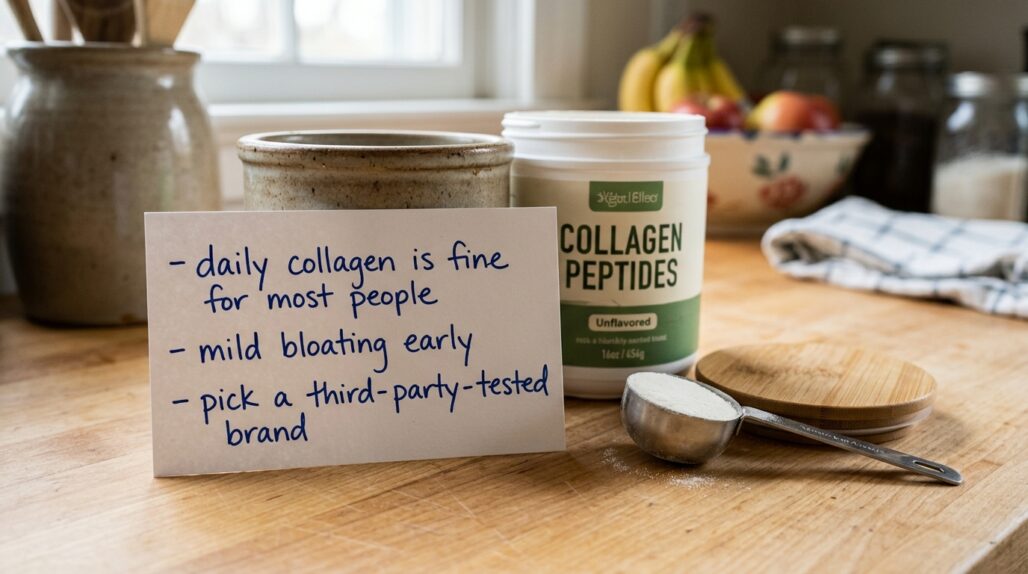
So if you feel a little puffy in week one, that is common and usually temporary. If it does not settle, the fix is almost always mechanical: smaller dose, with food, in a larger volume of liquid.
How to take it without the bloating
Most early GI complaints respond to three simple changes.
First, split the dose. If you were taking two scoops at once, take one in the morning and one later. Second, mix it into a real drink or meal rather than a tiny splash of water, so it dilutes. Third, build up slowly over a week or two instead of jumping to a full serving on day one.
If you want to dial in the exact amount that matches your goal, use our collagen dose calculator rather than guessing. This article is the tolerability and safety map around that number, not a replacement for it.

The quality problem that matters more than the side effects
Here is the honest part. For a healthy person, the biggest real-world risk with daily collagen is not the protein itself. It is what else is in the tub.
Collagen is an animal-derived ingredient, and animal tissue can accumulate environmental contaminants. Independent testing has repeatedly found measurable heavy metals in some collagen products. In a 2020 Clean Label Project study that tested 28 of the top-selling collagen peptide products specifically, detectable arsenic showed up in a majority of samples (about 64 percent) and lead in roughly a third (about 37 percent), with smaller numbers showing mercury (about 34 percent) or cadmium (about 17 percent). You can see those collagen-specific results in the 2020 Clean Label Project collagen testing write-up.
A fair caveat: industry groups criticized that report for using very sensitive detection thresholds, and a trace finding is not the same as a dangerous dose. But the practical takeaway holds. Because you take collagen every day, for months or years, you want a product that publishes its contaminant testing.
So the single most useful safety move is to choose a third-party-tested brand. Independent labs such as ConsumerLab buy products off the shelf and run lead, cadmium, arsenic and mercury analysis by mass spectrometry; you can see how that works in the ConsumerLab collagen testing method. Look for an NSF, USP, or Informed-Choice mark, or a published certificate of analysis on the brand's site.
Marine vs bovine, allergies, and the calcium angle
The two common sources are bovine (cow hide and bone) and marine (fish skin and scales). For skin outcomes the research does not crown a clear winner, so the choice often comes down to sourcing, taste, and your own allergy profile.
Allergies are where this gets specific. Marine collagen comes from finned fish, not shrimp, crab, or other shellfish. A shellfish allergy and a fish allergy are different things, so a shellfish allergy alone does not automatically rule out marine collagen.
That said, two cautions are worth respecting. If you have a true fish allergy, marine collagen is not for you, since trace fish protein can remain even after hydrolysis. And if your fish or seafood allergy is severe, the cross-contamination risk during manufacturing is reason enough to pick bovine instead. For a deeper comparison aimed at skin goals, see our guide to the best marine collagen powder for skin.
One more detail people miss: some marine collagen products are formulated with added calcium (from sources like fish bone or hydroxyapatite). On its own that is fine, but if you also take a calcium supplement and a calcium-fortified collagen daily, your total can creep up. The NIH Office of Dietary Supplements calcium fact sheet sets an adult upper limit of around 2,000 to 2,500 mg a day, and chronically overshooting it is linked to hypercalcemia. Check the label and count your real total.
A realistic timeline of what to expect
This table tracks the typical experience of starting daily collagen at a sensible dose. Individual results vary; this is the common pattern, not a promise.
| Stage | What you may notice | What to do |
|---|---|---|
| Days 1 to 7 | Mild bloating, gas, or a full feeling as your gut adjusts | Start with half a scoop, take it with food, drink more water |
| Weeks 2 to 4 | GI effects usually settle; no obvious skin or joint change yet | Move to your full studied dose; keep it consistent and daily |
| Weeks 8 to 12 | Early skin hydration or comfort changes reported in trials | Reassess whether it is worth continuing for your goal |
| Months and beyond | Generally well tolerated long-term in healthy adults | Stay with a tested brand; recheck total calcium if relevant |
If you are mainly chasing skin results and want to know how patient to be, our breakdown of how long collagen takes to work for skin sets honest expectations.

Who should check with a clinician first
Daily collagen is low-risk for most people, but a few groups should get personalized advice before making it a habit.
- Kidney disease. Collagen is protein, and people with reduced kidney function are often advised to manage protein intake. This is a doctor conversation, not a do-it-yourself call.
- A calcium-oxalate kidney stone history. Collagen contains hydroxyproline, which can modestly raise urinary oxalate. If you form stones, ask before adding a daily dose.
- Fish or shellfish allergy. Covered above; favor bovine or clear it with an allergist.
- Pregnancy or breastfeeding. Safety data is thin, so default to a clinician's input rather than assumptions.
A general note that applies to everyone: a supplement like collagen supports a goal, it does not treat or cure a disease, and nothing here should override advice from your own doctor or pharmacist. If you are weighing whether collagen earns a place in your routine at all, our honest take on whether collagen is really worth taking is a good gut check before you spend.
Which collagen to buy if you want the low-risk option
If you have read this far, the buying decision is simple. You want a product that is third-party tested, lists its source clearly (bovine or marine), and provides a serving in the studied 2.5 to 15 g range without a stack of unnecessary extras.
A plain, tested bovine peptide is the easy default for most people. Choose marine only if you specifically prefer fish sourcing and have no fish allergy. A clean grass-fed value tub is fine if the testing is published, since the molecule is the same; you are paying for purity verification, not a fancier form.
The picks below are options we think fit a safety-first daily routine. UsefulVitamins may earn a commission from purchases made through these links, at no extra cost to you. Prices and formulas change, so check the current label and test status.


As an Amazon Associate, UsefulVitamins.com earns from qualifying purchases at no extra cost to you.
Whichever you pick, the rule is the same: the form barely matters, the testing and the dose do.

FAQ
Is it safe to take collagen every single day? For most healthy adults, yes. Trials run daily dosing for months without consistent adverse effects, and regulators treat hydrolyzed collagen as a safe food ingredient. The main caveats are quality (pick a tested brand) and a few medical exceptions.
Why do I feel bloated after taking collagen? Early bloating or fullness is the most common complaint and usually passes within a week or two. Splitting the dose, taking it with food, and mixing it into more liquid almost always helps.
Does collagen damage your kidneys or liver? In healthy people, the available evidence does not show liver or kidney harm at normal supplemental doses. People with existing kidney disease or a calcium-oxalate stone history should ask a doctor first, because collagen is protein and contains hydroxyproline.
Can I take marine collagen if I have a shellfish allergy? Often yes, because marine collagen is made from finned fish, not shellfish, and the two allergies are different. But avoid it if you have a fish allergy, and consider bovine if any seafood allergy is severe because of cross-contamination risk.
How much collagen should I take a day? Studies commonly use 2.5 to 15 grams daily depending on the goal. More is not clearly better, so use our collagen dose calculator to match your intake to your goal rather than maxing out the scoop.
What is the most important thing to look for when buying collagen? Third-party testing for heavy metals. Because you take it daily over a long stretch, a published lead, cadmium, arsenic, and mercury test matters more than the source animal or the brand name.
The bottom line
Daily collagen is one of the lower-risk supplements you can take. Most people get nothing worse than a week of mild bloating, and the controlled data on healthy adults is reassuring.
The real homework is on the shelf, not in your gut. Pick a third-party-tested product, take a sensible dose in the studied range, and reassess after a couple of months to see if it is doing anything for you. Match the marine-or-bovine choice to your allergy profile, and watch your total calcium if your collagen is fortified.
If you have kidney disease, a stone history, a fish allergy, or you are pregnant, make this a conversation with your pharmacist or doctor before it becomes a daily habit.
This article is general education, not medical advice. It is not a substitute for guidance from your own healthcare professional, who can account for your medications and conditions.
Reviewed by the UsefulVitamins Editorial Team.
