

Affiliate disclosure: this article contains affiliate links. As an Amazon Associate, UsefulVitamins.com earns from qualifying purchases at no extra cost to you.
People line these two up as if they were rivals on the same shelf, but they are answering different questions. One is built to feed muscle. The other is built to feed the scaffolding around muscle. Get that distinction right and the choice gets simple.
What "muscle and recovery" actually means here
"Recovery" is a slippery word. After a hard session you are repairing two separate things: the contractile muscle fibers that produce force, and the connective tissue (tendons, ligaments, cartilage, fascia) that transmits and absorbs it. Those two tissues are made of different proteins and respond to different amino acids.
Whey is aimed squarely at the first. It is the gold-standard tool for muscle protein synthesis (MPS), the process that rebuilds and grows muscle fibers. Collagen is aimed at the second. It supplies the raw material your body uses to remodel tendon and skin matrix. Calling them competitors is like comparing rebar to drywall. You need both in a building, but for very different reasons.
So the honest framing is not "which protein is better," it is "which job are you trying to do." Below is the mechanism and the real evidence grade for each, then the head-to-head and the combine answer.
Whey: the leucine engine for muscle
Whey is a complete protein, meaning it contains all nine essential amino acids in the ratios humans need. More to the point, it is the most leucine-dense practical protein around, roughly 10 to 12 percent leucine by weight. Leucine is the amino acid that flips the MPS switch.
There is a well-replicated idea here called the leucine threshold: you need roughly 2.5 grams of leucine in a single feeding (closer to 3 grams for older adults) to near-maximally turn on muscle protein synthesis. That works out to about 20 to 25 grams of whey per serving for most younger adults. The response is step-like. Below the threshold you get a weak signal, at and above it you get close to the full effect. The dose-response work behind this, summarized in a systematic review on the leucine trigger hypothesis, is the reason whey is so reliable: it clears that threshold easily and digests fast.
Evidence grade: strong (human RCTs and meta-analysis). A large meta-analysis of 49 trials in 1,863 people by Morton and colleagues found that protein supplementation on top of resistance training added meaningful strength (about a 2.5 kg gain in one-rep max) and extra lean mass. Two honest caveats from that same paper. First, training did most of the heavy lifting; the supplement was the add-on. Second, benefits plateaued once total daily protein reached about 1.6 g/kg, with the authors landing on roughly 1.6 to 2.2 g/kg/day as the useful range. Whey is a convenient way to reach that number, not a magic shortcut past it.

Collagen: raw material for the scaffolding
Collagen peptides are hydrolyzed (pre-broken-down) collagen, usually type 1 and type 3, rich in three amino acids that are scarce in whey: glycine, proline and hydroxyproline. Those are exactly the building blocks of tendon, ligament, cartilage and skin matrix. The leading theory is that a dose of collagen peptides briefly floods the blood with these specific peptides, and the pre-exercise mechanical load on a tendon directs them into local repair.
That is also why collagen is a poor muscle-building protein. It is an incomplete protein: very low in leucine and missing one essential amino acid (tryptophan) almost entirely. It never reliably clears the leucine threshold, so it cannot drive MPS the way whey does.
Evidence grade: moderate and improving for connective tissue, weak for muscle mass. The landmark mechanism study is Shaw and colleagues, 2017, in the American Journal of Clinical Nutrition. Subjects who took 15 g of vitamin C-enriched gelatin one hour before a short jumping protocol doubled a blood marker of collagen synthesis versus placebo, with 5 g doing little. The vitamin C matters because it is a required cofactor for the enzyme that hydroxylates proline during collagen formation. Newer trials and a systematic review of collagen plus long-term training point toward improvements in tendon structure and morphology (with mixed or non-significant findings for tendon stiffness) at 15 to 30 g/day. For muscle mass specifically, the same body of work shows only small effects at low certainty, which lines up with the mechanism: collagen is not built to grow muscle.
Head-to-head: where each one actually wins
The short version: whey owns muscle, collagen owns connective tissue, and trying to swap one for the other wastes the dose.
| Factor | Whey protein | Collagen peptides |
|---|---|---|
| Best for | Muscle growth, strength, preserving muscle with age, hitting daily protein | Tendon, ligament, joint and skin recovery; nagging tendinopathy support |
| Evidence | Strong: large human RCTs and meta-analysis for hypertrophy and strength | Moderate and improving for connective tissue; weak and low-certainty for muscle mass |
| Onset | MPS spikes within hours of a dose; visible muscle change over weeks of training | Synthesis marker rises within an hour; tendon and skin changes over weeks to months |
| Typical dose | 20 to 40 g per serving (about 2.5 g leucine), inside 1.6 to 2.2 g/kg/day total protein | 15 g (tendons, with vitamin C) up to 30 g/day; take 30 to 60 min pre-load |
| Main downside | Dairy or lactose issues for some; does nothing special for tendons or skin | Incomplete protein, low leucine, will not build muscle if used as your main protein |
The most common mistake is treating collagen as a protein shake replacement. People see "20 g protein" on the tub and assume it counts the same toward muscle. It does not. If collagen is your main protein source, you are eating low-quality protein and shortchanging your muscle. Use whey for the protein job and let collagen do the tendon job. To compare brands once you have decided, our best whey protein powder roundup and best collagen supplements guide break down formulas, sourcing and value.

Who should pick which
Pick whey if you lift, you are chasing size or strength, you are trying to protect muscle through a fat-loss phase, or you are over 50 and fighting age-related muscle loss. Older adults show some anabolic resistance, so they may need a slightly larger per-meal dose to hit the same MPS response, which makes a fast, leucine-rich protein even more useful. If your only question is "what should I drink after lifting," it is whey, and you can size your servings with our protein powder for muscle gain guide.
Pick collagen if your bottleneck is connective tissue: a cranky Achilles or patellar tendon, achy joints, recovery from a ligament strain, or skin and nail goals. Endurance and field athletes who pound their tendons often see the clearest case for it. To dial in grams by bodyweight and goal, use the collagen dose calculator.
If you are not sure which tissue is limiting you, ask what hurts and what you want to change. Sore, weak or shrinking muscle points to whey. Stiff, painful tendons and joints point to collagen.
Can you take both together?
Yes, and for most training people it is the better setup, not a luxury. They do not compete for the same job, so stacking is genuinely complementary rather than redundant. The clean routine looks like this:
- Collagen: 15 g (with about 50 mg vitamin C, or just take it with fruit) roughly 30 to 60 minutes before load-bearing training, so the peptides are circulating when the tendon is loaded.
- Whey: 20 to 40 g after training or whenever it helps you reach your daily protein target.
- The non-negotiable: neither one replaces total daily protein. Build the day around 1.6 to 2.2 g/kg, then let collagen handle connective tissue on top.
If you would rather buy one product, a blended whey-plus-collagen powder exists, though the timing logic gets muddier since the ideal collagen window is pre-workout and whey is flexible.
Safety note. Both are generally well tolerated foods, not drugs. The realistic cautions: whey can trigger GI upset in people with lactose intolerance (an isolate or a non-dairy protein helps), and very high total protein deserves a conversation with a clinician if you have kidney disease. Collagen is usually sourced from bovine, marine or porcine tissue, so check the source for allergies and dietary needs. None of this treats a diagnosed tendon injury or muscle-wasting condition. If you are managing real pain, an injury, pregnancy or a medical condition, talk to a clinician or registered dietitian before adding either, and the NIH Office of Dietary Supplements is a sober place to check baseline protein and amino-acid guidance. Never start or stop a prescribed medication based on a supplement.
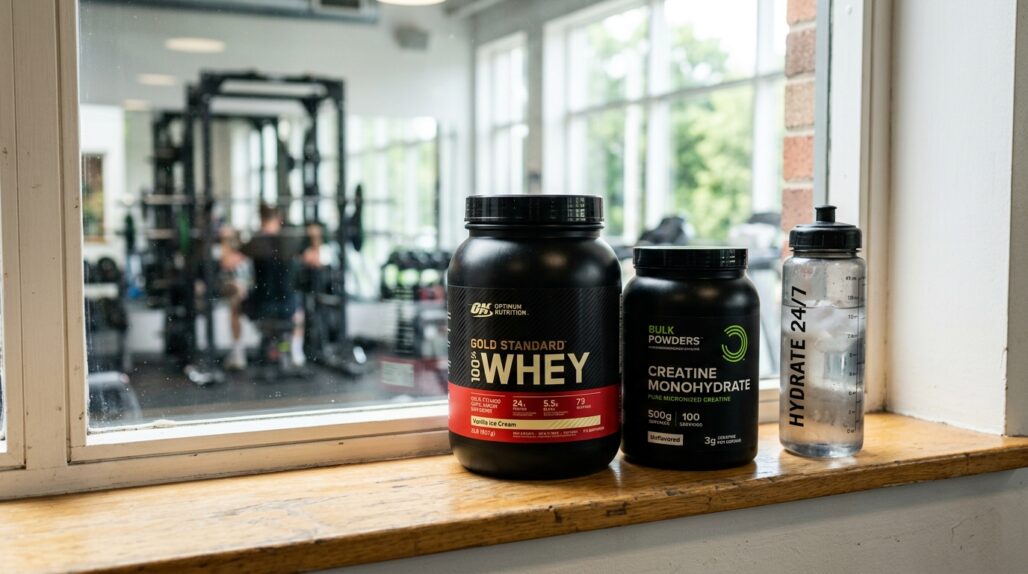
Which one to buy


As an Amazon Associate, UsefulVitamins.com earns from qualifying purchases at no extra cost to you.
We may earn a commission if you buy through links on this page, at no extra cost to you. It does not change our verdict.
If muscle is the goal, the whey pick is where your money does the most work. If tendons, joints or skin are the issue, the collagen pick is the right buy. And if you train hard enough to care about both tissues, the combo option lets you cover muscle and scaffolding without juggling two checkouts.
FAQ
Is collagen a complete protein for building muscle? No. Collagen is incomplete, very low in leucine and nearly missing tryptophan, so it cannot reliably trigger muscle protein synthesis. Use it for tendons, joints and skin, not as your muscle protein.
Does whey help tendons and joints the way collagen does? Not directly. Whey supports muscle and overall protein needs, but it lacks the high glycine, proline and hydroxyproline content that feeds connective-tissue repair. That is collagen’s lane.
How much of each should I take? Aim for about 20 to 40 g of whey per serving inside a total of 1.6 to 2.2 g/kg/day. For tendons, 15 g of collagen with vitamin C taken 30 to 60 minutes before training is the studied pattern, up to 30 g/day for broader goals.
Should I take collagen before or after exercise? Before. The pre-load timing, with vitamin C, is what the research used to raise collagen synthesis. Whey timing is more flexible and works fine after a session.
Can I just buy a whey-collagen blend? You can, and it is convenient. The trade-off is timing: collagen seems to want a pre-workout window while whey is flexible, so a blend is a compromise rather than the optimal split.
Will collagen alone meet my protein needs? No. Because it is low quality, leaning on collagen for daily protein leaves you short on the amino acids muscle actually needs. Treat collagen as an add-on, not a base protein.
The bottom line
For muscle growth and recovery of muscle tissue, whey wins on strong human evidence, full stop. Collagen is not a weaker muscle protein, it is a different tool that earns its keep on tendons, ligaments, joints and skin where whey does little. Pick whey if your goal is size, strength or protecting muscle. Pick collagen if connective tissue is your limiter. And if you train seriously, take both, with collagen plus vitamin C before load-bearing work and whey to round out your daily protein, remembering that neither replaces hitting your total intake.
This article is for general education and is not medical advice. Talk to a clinician or registered dietitian about your own situation, especially with an injury, a medical condition or pregnancy.
Reviewed by the UsefulVitamins Editorial Team.
