
If you've searched for holy basil as a stress remedy, the short answer is: the evidence is real but modest, and the risks are specific enough to matter before you buy. Three placebo-controlled trials in humans show meaningful stress and anxiety improvements over 6 to 8 weeks. But holy basil also lowers blood sugar, may suppress thyroid hormone levels, carries a reproductive warning from animal data, and interacts with anticoagulants. This guide breaks down the botanical context, the active compounds, the clinical trial record, and the drug interactions that a lot of adaptogen articles gloss over. You'll also get clear dosing ranges derived from the trials themselves, and honest product guidance on what to look for when choosing a tulsi supplement.
Affiliate disclosure: this article contains affiliate links. As an Amazon Associate, UsefulVitamins.com earns from qualifying purchases at no extra cost to you.
Summary / Quick Answer: does holy basil actually work for stress?
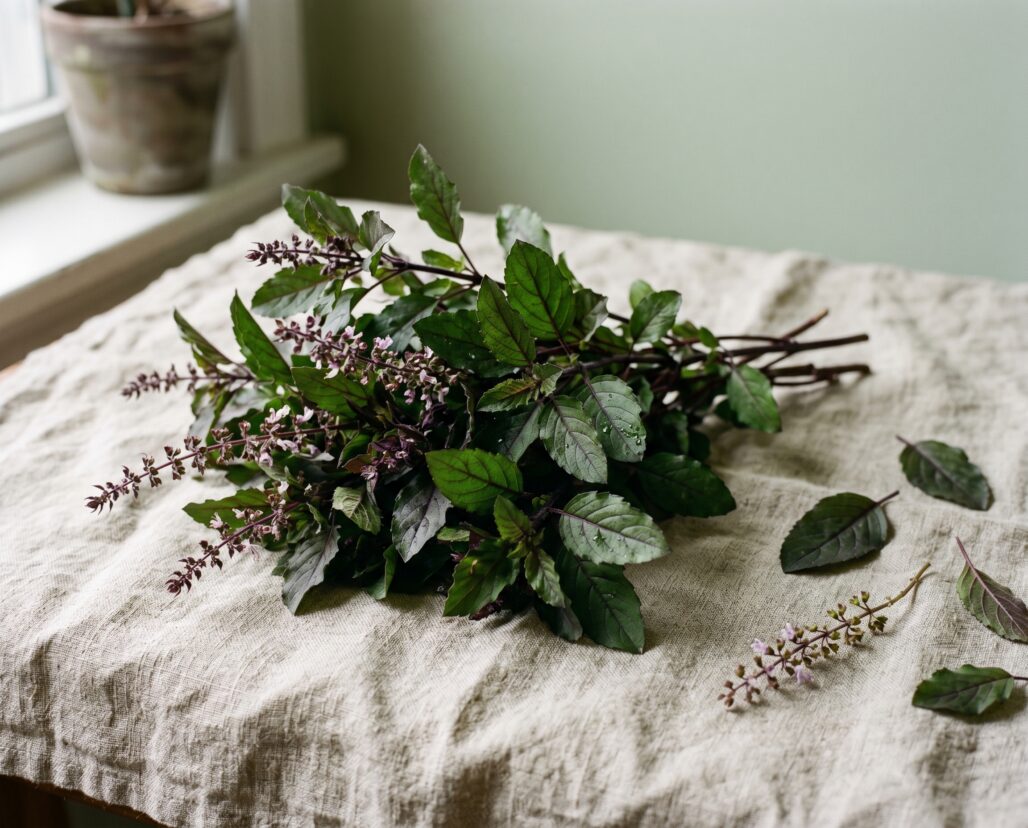
Holy basil (Ocimum sanctum, also called tulsi) has demonstrated statistically significant reductions in stress, anxiety, and related symptoms in three human placebo-controlled trials. The effect sizes are meaningful but the trials are small to moderate in size, and standardized extracts matter more than raw leaf powder. It is not a substitute for clinical treatment of anxiety disorders.
Best for: Adults with chronic occupational or lifestyle stress, mild anxiety symptoms, and no concurrent thyroid, anticoagulant, or blood-sugar medication. Six to eight weeks is the minimum window to expect any signal.
Not ideal for: Anyone taking warfarin, a sulfonylurea or insulin, levothyroxine or other thyroid hormone replacements, or anyone pregnant or actively trying to conceive. The interaction profile for these groups is documented and not trivial.
What to look at before buying: Standardized ethanolic or supercritical extracts over plain leaf powder. Look for disclosure of eugenol content or standardized actives. Avoid capsules that list only "tulsi leaf 500mg" without any standardization statement.
Decision shortcut: If you want a stress adaptogen with the cleanest interaction profile, ashwagandha's KSM-66 extract has more RCT weight behind it. If you're drawn to tulsi specifically, the 2012 Saxena OciBest trial (PMID 21977056) is the best evidence available, and its dose was 1200mg actives per day for six weeks.
What you'll find in this guide
- What holy basil actually is: botanical context and active compounds
- What the research actually shows: stress, anxiety, blood sugar, and cognition
- Who it's for and who should skip it
- Dosing ranges from clinical trials
- Side effects and drug interactions
- Product picks: what to look for
- Frequently asked questions
What holy basil actually is: botanical context and active compounds {#what-holy-basil-is}
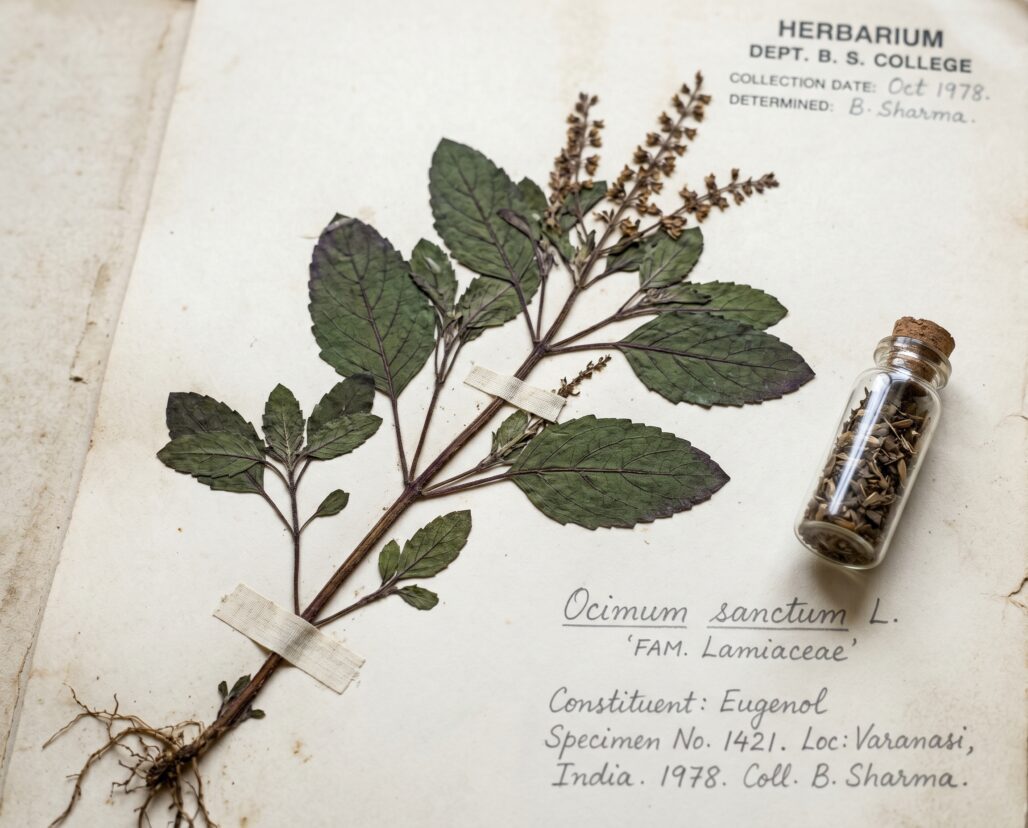
Holy basil, Ocimum sanctum (also taxonomically listed as Ocimum tenuiflorum), is a short-lived perennial herb in the mint family (Lamiaceae), native to the Indian subcontinent and widely naturalized across Southeast Asia. It is not the culinary sweet basil used in Italian cooking; the flavor and phytochemistry differ substantially.
Three main varieties are cultivated and discussed in the research literature:
- Krishna tulsi (purple-stemmed, more pungent, high eugenol content)
- Rama tulsi (green-stemmed, milder flavor, most common in commercial supplements)
- Vana tulsi (wild-forest variety, higher camphor content)
Most supplement products and clinical trials use Rama or Krishna leaf material, or a standardized extract of Ocimum tenuiflorum, which is the same species. When you see "tulsi leaf extract" on a supplement label, it is almost certainly one of these varieties.
The active compounds that drive the pharmacology
A 2013 review (Baliga et al., PMID 23682780) cataloged the key phytochemicals. The two most pharmacologically discussed are eugenol and ursolic acid, though the plant also contains rosmarinic acid, apigenin, luteolin, beta-sitosterol, and carnosic acid.
Eugenol is a phenylpropanoid that also appears in cloves. In lab settings, it has demonstrated anti-inflammatory, analgesic, and mild antiplatelet activity. That antiplatelet effect is directly relevant to the bleeding-risk interaction discussed in Section 8. At concentrations achievable with supplement doses, eugenol may also inhibit CYP2C9, the liver enzyme primarily responsible for metabolizing warfarin. This enzyme inhibition pathway is one mechanism behind the anticoagulant interaction.
Ursolic acid is a pentacyclic triterpenoid with demonstrated activity against cortisol-driven stress pathways in animal models. Its adaptogenic properties, including modulation of the HPA axis stress response, form part of the mechanistic rationale for tulsi's anti-stress effects. But traditional use in Ayurveda as a rasayana, a category of rejuvenating tonic, is background context. It is not clinical evidence.
Think of holy basil's pharmacology like a narrow-spectrum tool. Eugenol and ursolic acid have real mechanisms, the way caffeine's xanthine structure explains its effects. But knowing the mechanism exists is not the same as knowing the human dose proves out at supplement concentrations. That is what the trials are for.
Actionable takeaway: When reading a tulsi supplement label, a product standardized to a specific percentage of actives or eugenol content is more meaningful than a non-standardized leaf powder. The clinical trials used extracts, not raw leaf powder.
What the research actually shows {#what-the-research-shows}
Stress and anxiety: the best human evidence
The strongest human evidence for holy basil's effects on psychological stress comes from three placebo-controlled trials, each using different extracts and doses.
The earliest is a 2008 controlled clinical trial by Bhattacharyya et al. (n=35, PMID 19253862) in participants with generalized anxiety disorder. Participants received 500mg Ocimum sanctum leaf extract twice daily for 60 days. The study reported statistically significant attenuation of anxiety, stress, and depression (p < 0.001), along with improvements in attention and willingness-to-adjust scores on Hamilton's brief psychiatric rating scale. The sample size was small and the study was not described as double-blind in its design, which limits its weight.
The larger and better-controlled trial is the 2012 Saxena study (Saxena et al., n=150, PMID 21977056). Participants received OciBest, a standardized Ocimum tenuiflorum extract delivering 1200mg of actives per day, for six weeks in a randomized, double-blind, placebo-controlled design. The OciBest group showed 39% more improvement in controlling general stress symptoms compared to placebo (p 0.05), including significant reductions in forgetfulness, sexual problems, exhaustion, and sleep disturbances. No adverse events were reported.
The most recent trial, Lopresti et al. 2022 (n=100, PMID 36185698), used HolixerTM, a standardized O. tenuiflorum extract at 125mg twice daily for eight weeks in stressed adults. Compared to placebo, the HolixerTM group showed greater improvements on the Perceived Stress Scale and Athens Insomnia Scale, and hair cortisol concentrations were significantly lower at week 8. After acute stress testing, supplemented participants also showed reduced salivary cortisol and lower blood pressure responses. No major adverse effects were reported.
A 2017 systematic review by Jamshidi and Cohen (PMID 28400848) synthesized 24 human studies on tulsi and found favorable clinical outcomes across stress, metabolic disorders, cognition, and immunity domains. The authors noted that further large RCTs are needed to clarify mechanisms, optimal dose forms, and which populations benefit most.
But traditional use is not the same as RCT evidence. Tulsi has been central to Ayurvedic medicine for centuries. That historical use is the reason researchers ran the trials. It is not, by itself, evidence that a commercial extract at a given dose will produce a measurable effect in your situation.
Blood glucose and metabolic effects
The blood-glucose signal from tulsi is real and clinically relevant, which is precisely why it matters for anyone on diabetes medication.
A 1996 randomized crossover trial (Agrawal et al., PMID 8880292) in patients with non-insulin-dependent diabetes mellitus found that holy basil leaf supplementation reduced fasting blood glucose by 17.6% (p < 0.001) and postprandial blood glucose by 7.3% (p < 0.02) compared to a placebo-leaf control period.
A 2017 pilot RCT (Satapathy et al., n=30, PMID 28811698) in overweight and obese adults without diabetes tested O. sanctum 250mg twice daily for eight weeks. The intervention group showed statistically significant improvements in serum triglycerides, LDL, HDL, VLDL, plasma insulin, and insulin resistance scores. These are promising metabolic findings from a small pilot, but they come from a non-blinded open-label study, so effect inflation is possible.
The lipid-lowering data for tulsi in healthy humans is still primarily from animal studies. The metabolic effects described above are real signals, not yet definitive conclusions for large populations.
Cognition
A 2015 double-blind placebo-controlled study (Sampath et al., PMID 26571987) gave healthy adults 300mg ethanolic O. sanctum extract daily for 30 days and found significant improvements in reaction time, error rate, and attention scores on the Sternberg and Stroop cognitive tests. This is a short-duration single-trial result; the mechanism is not established, but the HPA-axis and cortisol reduction observed in stress trials may indirectly support working memory.
The real question isn't whether holy basil works in small controlled trials, it's whether the available evidence is robust enough to confidently predict effects across diverse real-world users. With sample sizes ranging from 30 to 150, and without replication of every specific finding, honest confidence sits at "preliminary" to "moderate" depending on the outcome.
Actionable takeaway: The stress and anxiety signal is the best-supported indication for tulsi in humans. Metabolic effects are a secondary signal worth knowing about, especially if you are also managing blood sugar.
Who it's for and who should skip it {#who-its-for}
Strong fit
Adults with chronic occupational or lifestyle stress lasting three months or longer, no thyroid or blood-sugar medication, and normal clotting function. The participants in the Saxena 2012 and Lopresti 2022 trials represent this profile well: stressed but otherwise healthy adults.
Who should skip it or consult a prescriber first
| Who | Reason |
|---|---|
| Anyone on warfarin, heparin, or antiplatelet drugs | Eugenol's antiplatelet activity and potential CYP2C9 inhibition may affect INR and bleeding risk |
| Anyone on sulfonylureas, insulin, or GLP-1 agonists | Tulsi's demonstrated blood-glucose-lowering effect creates additive hypoglycemia risk |
| Anyone on levothyroxine or other thyroid hormone replacements | MSD Manual data indicate holy basil may decrease thyroxine levels, potentially worsening hypothyroidism |
| Pregnant women, or those trying to conceive | Animal studies show large doses of O. sanctum may interfere with implantation and early pregnancy; no safety data in humans exist |
| Those who are breastfeeding | Safety not studied |
| Surgery within two weeks | Platelet inhibition increases surgical bleeding risk; most practitioners advise stopping herbal anticoagulants 14 days before elective procedures |
Dosing ranges from clinical trials {#dosing}
Important framing: What follows is a description of doses used in the trials listed above. This is not a prescription or recommendation.
In the 2008 Bhattacharyya trial, participants received 500mg Ocimum sanctum leaf extract twice daily (1000mg total) for 60 days. In the 2012 Saxena OciBest trial, the dose was standardized to deliver 1200mg of actives per day for six weeks. In the 2022 Lopresti HolixerTM trial, 125mg twice daily (250mg total) of a standardized supercritical extract was used for eight weeks. The 2015 cognitive study used 300mg ethanolic extract once daily for 30 days.
The wide range, from 250mg to 1200mg of actives per day, reflects different extraction methods and standardization levels. A supercritical extract at 125mg per dose may deliver comparable bioactive content to a much larger dose of a less-concentrated leaf extract. This is why "standardized actives" disclosure matters. An 1800mg capsule of raw tulsi leaf powder may deliver far less eugenol or ursolic acid than a 125mg standardized supercritical extract.
Most trials saw measurable effects between four and eight weeks. Longer-term safety beyond eight weeks is not well characterized in the current human trial record.
Actionable takeaway: Look for products where the standardization level is stated, and check trial dose descriptions for context, not marketing claims.
Side effects and drug interactions {#side-effects-and-drug-interactions}
Reported adverse effects from trials
Across all three major human RCTs cited above, no serious adverse events were reported. Mild gastrointestinal symptoms, such as nausea or loose stools, are the most commonly noted in case reports and observational data.
Drug interactions (specific and named)
Anticoagulants and antiplatelet drugs. Holy basil's eugenol content inhibits platelet aggregation and may alter CYP2C9 enzyme activity. CYP2C9 is the primary metabolic pathway for warfarin. Taking holy basil alongside warfarin, heparin, clopidogrel, aspirin (therapeutic dose), or other anticoagulants may increase bleeding risk. Per the MSD Manual's holy basil monograph, "the effect of holy basil to slow down blood clotting may increase the risk of bleeding in people taking antiplatelet or anticoagulation medications." If you take warfarin and your INR is already therapeutic, adding tulsi could push it into bleeding-risk territory. This is not a theoretical concern.
Blood-sugar medications (additive hypoglycemia risk). The 1996 Agrawal RCT demonstrated a 17.6% reduction in fasting glucose in diabetic patients. Combined use with sulfonylureas (e.g., glibenclamide, glipizide), insulin, or GLP-1 agonists could lower blood sugar below safe thresholds. One study noted that combining tulsi with glibenclamide showed slightly improved glucose control, which sounds positive but means additive effect. If you are on blood-sugar medication and want to add tulsi, your prescriber needs to monitor glucose more closely and potentially adjust dosing.
Thyroid medications. Per the MSD Manual, holy basil may decrease thyroxine levels in the blood. For someone who is already hypothyroid and on levothyroxine or similar thyroid hormone replacement, this interaction could reduce the effectiveness of their medication and worsen hypothyroid symptoms including fatigue and weight gain. The thyroid interaction warning is listed explicitly for holy basil (alongside ashwagandha and eleuthero) as a documented concern.
Fertility and pregnancy. This interaction sits in a different category because it is not a medication interaction, but it is important enough to name directly. Animal studies using large doses of O. sanctum benzene extract showed reduction in sperm parameters and anti-implantation effects, meaning fertilized eggs were less likely to implant. Human studies confirming this effect do not exist, but the precautionary recommendation from multiple clinical reference sources is to avoid holy basil when trying to conceive, whether you are the egg-bearing or sperm-bearing partner. Pregnant women should not take holy basil. No human breastfeeding safety data exist.
Barbiturates and CNS depressants. Animal data suggest holy basil may potentiate sedation from barbiturates. The clinical relevance at supplement doses is unclear, but the interaction is noted in pharmacological references.
Actionable takeaway: If you take any of these medication classes, discuss holy basil with your prescriber before starting. The fact that it is an "herbal supplement" does not make these interactions less real.
Product picks: what to look for {#product-picks}
An adaptogen brand can have impressive marketing and still miss third-party testing for the active marker compound. For tulsi supplements specifically, the key markers are: whether the extract is standardized, what the standardized actives are, and whether the product discloses extraction method.
The clinical trials used ethanolic extracts (Bhattacharyya 2008, Sampath 2015), a proprietary standardized extract (OciBest, Saxena 2012), and a standardized supercritical extract (HolixerTM, Lopresti 2022). Plain leaf powder products not standardized to any active marker are the lowest-evidence option.
What to look for:
- Standardized extract with disclosed eugenol or total actives percentage
- Ethanolic, supercritical CO2, or proprietary standardized extract (not plain leaf powder)
- Third-party certificate of analysis (COA) available on request
- No proprietary blends that obscure the per-serving dose
Skip if: The label says only "tulsi leaf 400mg" with no standardization statement and no third-party testing disclosed.
As an Amazon Associate, I earn from qualifying purchases. Product recommendations are based on real reviews and independent research.
Frequently asked questions {#faq}
Is holy basil the same as regular basil?
No. Holy basil (Ocimum sanctum / Ocimum tenuiflorum) is a different species from culinary sweet basil (Ocimum basilicum). The flavor, phytochemistry, and traditional use are different. Holy basil has a more pungent, clove-like taste from its higher eugenol content. Do not substitute one for the other in a supplement context.
How long does it take for holy basil to work?
The trials showing measurable stress effects ran for six to eight weeks. The Saxena 2012 trial measured improvements at weeks two and four, suggesting some effect within the first month, but statistically significant group differences were maintained through six weeks. If you observe no effect after eight weeks of a standardized extract at an evidence-matching dose, it likely will not work for you.
Can I take holy basil every day?
Most trials used daily dosing for six to eight weeks without reporting adverse events. Longer-term safety in humans beyond eight weeks is not well-characterized in the published literature. Some practitioners recommend cycling (five to six weeks on, two weeks off), though no human RCT has tested cycling versus continuous use directly.
Does holy basil lower cortisol?
The Lopresti 2022 RCT (PMID 36185698) found significantly lower hair cortisol at week eight and reduced salivary cortisol response to acute stress in the supplement group versus placebo. This is the strongest human cortisol data to date. The effect is real in that trial context; whether it replicates reliably across diverse populations awaits larger studies.
Is holy basil safe during pregnancy?
No. Animal studies have shown anti-implantation effects with large doses of Ocimum sanctum extract. Pregnant women and women actively trying to conceive should avoid holy basil supplements. This recommendation appears in multiple clinical reference sources including the MSD Manual.
Can I take holy basil if I have thyroid disease?
If you have hypothyroidism and are on thyroid hormone replacement (levothyroxine, liothyronine, or similar), holy basil may decrease thyroxine levels and reduce medication effectiveness. Consult your endocrinologist before adding any herbal supplement to your regimen. This thyroid interaction is specific and documented, not a generic precautionary statement.
Does holy basil help with sleep?
The Lopresti 2022 RCT found significant improvements in Athens Insomnia Scale scores compared to placebo after eight weeks, and Fitbit-monitored sleep quality also showed improvement. The Saxena 2012 trial found sleep disturbances among the stress symptoms significantly improved. Sleep is a secondary outcome in these trials, not a primary indication with dedicated study. But the signal is consistent with the general stress-reduction effect.
Related reading
- What Are Adaptogens? The Complete Guide to How They Work — the upstream overview of adaptogen science, evidence standards, and how to evaluate any claim in this category.
- Best Adaptogens for Stress: A Practical Ranking — where holy basil sits in the broader stress-adaptogen landscape compared to ashwagandha, rhodiola, and others.
- Ashwagandha Complete Guide: Evidence, Dosing, and Who Should Skip It — the closest comparison point; similar interaction profile with thyroid meds, stronger RCT evidence base.
- Eleuthero (Siberian Ginseng): Honest Guide to the Evidence — another adaptogen with a thyroid-interaction warning; useful to read if you are considering multiple adaptogens simultaneously.
Adding this to a few other supplements? Our companion app, StackMyMed, scans the label, tracks your real daily intake, and schedules the best time to take it around everything else in your routine.
Conclusion: the bottom line on holy basil
Holy basil is one of the few adaptogens with multiple placebo-controlled human trials showing real stress and anxiety signal. The Saxena 2012 trial (n=150) and the Lopresti 2022 trial (n=100) are the most credible entries, and they point in the same direction: standardized tulsi extract over six to eight weeks significantly reduces perceived stress and improves sleep-related symptoms. The blood-glucose-lowering data adds a meaningful metabolic dimension.
But the drug-interaction profile demands attention that most tulsi marketing skips entirely. Anticoagulants, blood-sugar medications, thyroid hormone replacements, and pregnancy are all specific, named concerns, not generic "consult your doctor" boilerplate. If you have none of those overlaps, tulsi is a reasonably well-evidenced option in the adaptogen category. If any of those overlaps apply, the interaction risk is real enough to require a conversation with your prescriber before starting.
Next steps:
- If you are currently on any medication listed in Section 8, bring this article's interaction summary to your next appointment before purchasing anything.
- If you want to compare tulsi to the better-studied ashwagandha, the Ashwagandha Complete Guide walks through the same framework side-by-side.
- If you decide to try tulsi, prioritize a standardized extract product (not plain leaf powder), start with the lower dose range from the trials (250-500mg standardized extract per dose), and give it a minimum of six weeks before evaluating results.
This article is for informational purposes and not medical advice. Herbal adaptogens — even traditional ones — can interact with thyroid medication, antidepressants, anticoagulants, immunosuppressants, blood-pressure drugs, and more. Consult a licensed physician before starting any adaptogen, particularly if you are pregnant, nursing, taking prescription medications, or managing a chronic condition.
As an Amazon Associate, I earn from qualifying purchases. Product recommendations are based on real reviews and independent research.
