
If you're comparing KSM-66 and Sensoril to figure out which ashwagandha extract is actually worth buying, the short answer is: both have legitimate human trial data, but they target slightly different outcomes and dose ranges. KSM-66 has a larger volume of RCT evidence, particularly for stress and cortisol. Sensoril uses a combined root-and-leaf extract with a higher withanolide glycoside content, which makes it relevant for certain strength and recovery contexts at a lower daily dose. This article breaks down the standardization chemistry, the specific trials behind each extract, and the practical decision points for choosing between them. You'll also get a clear look at the interaction profile that applies to both, since the same drug-interaction risks that apply to generic ashwagandha apply to any standardized extract.
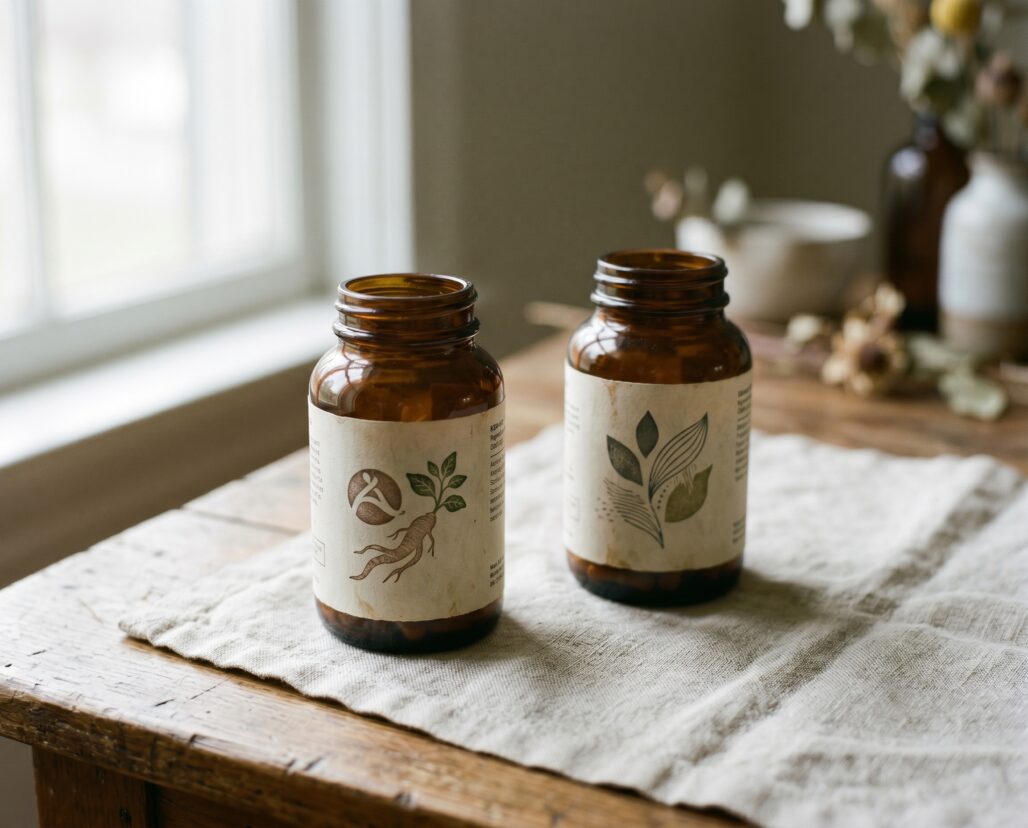
Summary / Quick Answer: KSM-66 vs Sensoril
Both extracts are standardized ashwagandha with more human trial evidence than generic root powder. The difference is in which part of the plant, which marker compound, and which outcomes those trials tested.
Best for stress and cortisol reduction: KSM-66. The Chandrasekhar 2012 and Salve 2019 RCTs both used KSM-66 and both showed statistically significant cortisol reduction in chronically stressed adults.
Best for lower-dose convenience or muscle recovery context: Sensoril. The 2018 STAR Trial used Sensoril at 500mg/day and found meaningful strength gains; the Auddy 2008 trial used doses as low as 125mg twice daily and still found cortisol and DHEA changes.
Not ideal for either extract: Anyone on thyroid medication, immunosuppressants, or sedatives. The interaction profile applies regardless of which branded extract you take.
Decision shortcut: If you want the deepest stress-and-cortisol evidence base, choose KSM-66 standardized to 5%+ withanolides. If you want a leaf-and-root combination with flexible dosing and some strength data, Sensoril is a reasonable second choice.
What you'll find in this guide
- What KSM-66 and Sensoril actually are
- How standardization markers differ
- Side-by-side comparison table
- What the research actually shows for each extract
- Who each extract is for
- Dosing ranges from clinical trials
- Side effects and drug interactions
- Product picks
- Frequently asked questions
What KSM-66 and Sensoril are {#what-ksm-66-and-sensoril-are}
Both KSM-66 and Sensoril are proprietary, trademarked extracts of Withania somnifera, the plant commonly called ashwagandha. They are not interchangeable with generic ashwagandha root powder. The trademark matters because it signals a defined extraction process, a defined marker compound at a defined minimum percentage, and a funded body of human trial research. That combination is rarer in the herbal supplement space than it should be.
KSM-66 is manufactured by Ixoreal Biomed (based in Hyderabad, India). It uses an aqueous extraction process from the root only, without any use of alcohol or chemical solvents. The extract is standardized to a minimum of 5% withanolides by HPLC assay. "Full-spectrum" is a term Ixoreal uses to describe the preservation of the natural withanolide ratio from the root, though this descriptor is not independently regulated. KSM-66 is one of the most extensively studied branded ashwagandha extracts in peer-reviewed literature.
Sensoril is manufactured by Natreon Inc. It uses a water and ethanol extraction from both roots and leaves of the plant. Because ashwagandha leaves contain higher concentrations of withaferin A than the root, the leaf-inclusive extraction produces a different withanolide profile. Sensoril is standardized to a minimum of 10% withanolide glycosides (not total withanolides), plus 32% oligosaccharides. The higher glycoside percentage at a lower recommended dose is the central marketing distinction.
The real question is not which has a more impressive specification sheet. It's which extract's evidence base matches your specific reason for taking ashwagandha.
How standardization markers differ {#how-standardization-markers-differ}
Standardization is how a manufacturer specifies what is actually in the extract. An unstandardized ashwagandha capsule labeled "500mg ashwagandha root powder" tells you the weight of the powder. It tells you nothing about active compound content.
KSM-66 standardization: 5% total withanolides. Withanolides are the steroidal lactone family of compounds believed to be responsible for most of ashwagandha's biological activity, including effects on the HPA axis and cortisol regulation. A 600mg capsule of KSM-66 provides approximately 30mg of withanolides.
Sensoril standardization: 10% withanolide glycosides (a subset of the withanolide family) plus 32% oligosaccharides. A 125mg capsule of Sensoril provides approximately 12.5mg of withanolide glycosides. Because the leaf also contributes withaferin A, a cytotoxic withanolide associated with adverse effects at high concentrations, the lower recommended dose with Sensoril is partly a safety design choice.
Standardized to X% withanolides is meaningful. "Ashwagandha root powder" alone tells you nothing. But the two extracts are not directly comparable on a per-milligram basis because KSM-66 reports total withanolides while Sensoril reports withanolide glycosides. These are not the same denominator.
Think of it like comparing two olive oils where one reports total polyphenols and the other reports oleocanthal specifically. Both are informative, but you cannot directly compare the numbers as if they are the same unit.
Side-by-side comparison {#side-by-side-comparison}
| Characteristic | KSM-66 | Sensoril |
|---|---|---|
| Manufacturer | Ixoreal Biomed | Natreon Inc. |
| Plant parts used | Root only | Root + leaf |
| Extraction method | Aqueous (water) | Water + ethanol |
| Standardization marker | 5% total withanolides | 10% withanolide glycosides + 32% oligosaccharides |
| Typical capsule dose in trials | 300mg twice daily (600mg/day) | 125-250mg twice daily (250-500mg/day) |
| Primary outcomes with RCT evidence | Perceived stress, cortisol, sleep, muscle strength, cognition | Muscle strength and recovery, stress hormones (lower dose) |
| Number of peer-reviewed human RCTs | Multiple (4+ independently published) | Multiple (fewer indexed on PubMed) |
| Withaferin A content | Lower (root-only) | Higher (leaf inclusion) |

What the research actually shows {#what-the-research-shows}
KSM-66 human trial evidence
The strongest stress-and-cortisol evidence for any ashwagandha extract comes from KSM-66 trials. In a 2012 placebo-controlled RCT (Chandrasekhar et al., n=64), participants with chronic stress took 300mg KSM-66 twice daily for 60 days. Serum cortisol was substantially reduced in the treatment group versus placebo (P=0.0006), and scores on standardized stress assessment scales showed significant improvement (P<0.0001).
A 2019 RCT (Salve et al., n=60) compared two dose levels of KSM-66 root extract against placebo over 8 weeks. Both the 250mg/day and 600mg/day groups showed statistically significant reductions in Perceived Stress Scale scores and serum cortisol, with the higher dose producing stronger effects (P<0.001 versus P<0.05 at the lower dose). Sleep quality also improved significantly in both active arms.
A 2017 pilot RCT (Choudhary et al., n=50) used KSM-66 at 300mg twice daily for 8 weeks in adults with mild cognitive impairment. Both immediate and general memory subscores on the Wechsler Memory Scale improved significantly versus placebo, along with executive function and information-processing measures. This was a pilot study, and the sample size limits how far the conclusions can be extended.
In a 2015 RCT (Wankhede et al., n=57), recreationally active males taking 300mg KSM-66 twice daily for 8 weeks showed meaningfully greater gains in bench press strength (+46.0 kg versus +26.4 kg in placebo, P=0.001) and leg extension strength. Testosterone increased by 96.2 ng/dL in the treatment group versus 18.0 ng/dL in placebo (P=0.004).
Actionable takeaway: KSM-66 has the broadest cluster of independently published human RCTs across multiple outcomes. If you want an evidence trail for stress and cortisol specifically, KSM-66 is the more defensible choice.
Sensoril human trial evidence
Sensoril's evidence is real but somewhat narrower on PubMed. The most rigorous independently published trial is the STAR Trial (Ziegenfuss et al., n=38, PMID 30463324), a 12-week double-blind RCT in recreationally active men. Participants took 500mg Sensoril per day while following a structured resistance-training program. The Sensoril group gained significantly more squat strength (+19.1 kg versus +10.0 kg in placebo, P=0.009) and bench press strength (+12.8 kg versus +8.0 kg, P=0.048), with favorable changes in body composition.
An earlier study by Auddy et al. (2008), published in the Journal of the American Nutraceutical Association (not indexed on PubMed), used Sensoril in a randomized, placebo-controlled design with 130 chronically stressed adults at three dose levels (125mg once daily, 125mg twice daily, and 250mg twice daily for 60 days). All active doses showed statistically significant cortisol and Hamilton Anxiety Scale reductions, with dose-dependent effects. This trial is frequently cited in supplement literature but carries the limitation of being published in an industry-adjacent journal; industry-adjacent publications are not the same as independently peer-reviewed trials. Sensoril has a reasonable evidence base, but less PubMed-indexed diversity than KSM-66 across multiple health outcomes.
Actionable takeaway: If your primary interest is muscle recovery and strength in a training context, Sensoril's STAR Trial is directly relevant. For stress and cortisol, KSM-66 has more published replication.
Who each extract is for {#who-each-extract-is-for}
KSM-66 fits best when your primary goal is stress and cortisol reduction with the deepest published evidence trail. The Chandrasekhar 2012 cohort (chronically stressed adults, 60 days) is the closest real-world match. Root-only extraction also means lower withaferin A exposure than Sensoril.
Sensoril fits best when you want a lower single-dose option (some products are dosed at 125mg twice daily) or your focus is strength and body composition alongside stress management. The STAR Trial profile (active adults, 12-week resistance program) is the relevant reference population.
Skip both extracts if:
- You are on levothyroxine or any thyroid hormone replacement.
- You take immunosuppressants (tacrolimus, cyclosporine, biologics).
- You are pregnant or actively trying to conceive.
- You are scheduled for surgery within 2 weeks.
Dosing ranges from clinical trials {#dosing-ranges-from-clinical-trials}
Both extracts are not prescriptions. The dose ranges below are derived from RCT protocols, not from clinical guidelines.
KSM-66 in published trials:
- In Chandrasekhar 2012, the dose was 300mg twice daily (600mg/day) for 60 days.
- In Salve 2019, two dose levels were tested: 125mg twice daily (250mg/day) and 300mg twice daily (600mg/day). Both were statistically significant, with the higher dose producing larger effects.
- In Wankhede 2015 and Choudhary 2017, the dose was 300mg twice daily for 8 weeks.
Sensoril in published trials:
- In the STAR Trial (Ziegenfuss 2018), the dose was 500mg once daily for 12 weeks.
- In Auddy 2008, doses ranged from 125mg once daily to 250mg twice daily for 60 days.
Most trials across both extracts saw measurable effects at 4 to 8 weeks. The cognitive and strength outcomes in Choudhary 2017 and Wankhede 2015 both used an 8-week duration. The real question about timing expectations is not which extract works faster; it's whether you are giving either extract a full 8-week window before evaluating.
Actionable takeaway: In clinical trials the effective dose for KSM-66 was 300mg twice daily for 8 weeks. For Sensoril the effective dose in the strength trial was 500mg once daily for 12 weeks. Neither extract has been tested for effect at doses higher than these, and more herb is not always more useful.
Side effects and drug interactions {#side-effects-and-drug-interactions}
The adverse-effect profile for KSM-66 and Sensoril mirrors what is documented for ashwagandha extracts in general. The plant part and extraction method affect withanolide profile, but both extracts share the core interaction risks.
Reported side effects from clinical trials
In the Chandrasekhar 2012 trial, adverse effects in the KSM-66 group were mild and comparable to placebo. Common effects reported across ashwagandha trials include drowsiness, gastrointestinal upset (loose stool, nausea), and headache. The NCCIH ashwagandha fact sheet notes that rare cases of liver injury have been associated with ashwagandha use, though causality has not been firmly established.
Because Sensoril includes leaf extract, it contains more withaferin A than KSM-66. Withaferin A has shown cytotoxic effects in vitro at high concentrations. This is part of the rationale for Sensoril's lower recommended dose. Whether the clinical doses used in trials produce meaningful withaferin A exposure is unclear from published data.
Drug interactions (required disclosure)
Per Memorial Sloan Kettering's integrative herbs database, withanolides may interact with thyroid hormone replacement. Ashwagandha has been shown to increase thyroxine levels in some patients, with case reports of thyrotoxicosis. This applies to both extracts.
Specific interactions to know:
- Thyroid medications (levothyroxine, liothyronine): Ashwagandha can stimulate thyroid hormone production. Combined use has been linked to elevated T3/T4 and TSH suppression. Anyone on thyroid replacement should avoid both extracts without prescriber consultation.
- Immunosuppressants (tacrolimus, cyclosporine, mycophenolate, biologics): Withanolides can modulate immune function. This may counteract immunosuppressive regimens used in transplant patients or autoimmune disease management.
- Sedative medications (benzodiazepines, anticonvulsants, barbiturates): Ashwagandha has GABAergic properties and may potentiate sedation when combined with CNS depressants.
- Antidiabetic medications: Ashwagandha has shown blood-glucose-lowering activity in some trials. Combined use with insulin or oral hypoglycemics may produce additive effects and increase hypoglycemia risk.
- CYP enzyme interactions: Per the MSK database, ashwagandha may act as a moderate inducer of CYP3A4 and inhibitor of CYP2B6, potentially affecting plasma levels of drugs metabolized by these pathways.
Pregnancy and breastfeeding
Neither KSM-66 nor Sensoril has been tested in pregnant women. The NCCIH ashwagandha fact sheet states that ashwagandha should not be used during pregnancy, as it may cause uterine contractions. Breastfeeding safety data is absent. Avoid both extracts if pregnant, nursing, or actively trying to conceive.
Product picks {#product-picks}
Frequently asked questions {#frequently-asked-questions}
Is KSM-66 better than Sensoril for stress?
KSM-66 has more PubMed-indexed RCTs targeting stress and cortisol. Chandrasekhar 2012 and Salve 2019 both used KSM-66 and found statistically significant cortisol reduction. Sensoril has cortisol data from Auddy 2008, but that study appeared in an industry-adjacent journal. For stress, KSM-66 has the stronger published evidence trail.
How much withanolide do I get per dose of each?
A 600mg KSM-66 dose provides approximately 30mg of total withanolides at the 5% minimum. A 500mg Sensoril dose provides approximately 50mg of withanolide glycosides at the 10% minimum. These figures are not comparable because total withanolides and withanolide glycosides are different fractions.
Which extract is better for sleep?
The Salve 2019 RCT used KSM-66 at 250mg/day and 600mg/day and found significant sleep quality improvement in both groups versus placebo. Sensoril has no published RCT with sleep as a primary endpoint. KSM-66 has the more direct evidence. The ashwagandha for sleep article covers those trials in detail.
How long before KSM-66 or Sensoril works?
Most trials measured primary outcomes at 8 to 12 weeks. The Chandrasekhar 2012 trial found significant cortisol effects at 60 days. Some participants reported subjective improvement by week 4. If you see no effect at 8 weeks of consistent use at a trial-comparable dose, the evidence does not support continuing indefinitely.
Conclusion: the bottom line on KSM-66 vs Sensoril
KSM-66 and Sensoril are both legitimate, standardized ashwagandha extracts with human trial data behind them. Neither is a generic root powder. The choice comes down to what the evidence actually covers for your situation. KSM-66 has more PubMed-indexed RCTs across stress, cortisol, sleep, and cognitive outcomes, making it the more defensible pick for anyone whose primary interest is chronic-stress management. Sensoril has a compelling strength and recovery trial in the STAR RCT and dose flexibility that KSM-66 trials did not explore as thoroughly.
What neither extract changes is the interaction profile. Thyroid medication, immunosuppressants, sedatives, and antidiabetic drugs are all documented concerns for ashwagandha in any form. Start with your medication list before you start with a marketing claim.
Next steps:
- For a full breakdown of how ashwagandha compares to other adaptogens for stress, see Ashwagandha: The Complete Evidence Guide for Stress, Sleep, and Hormones
- To find a verified KSM-66 or Sensoril product, see Best Ashwagandha Supplement: How to Pick a Product That Actually Has What It Claims
- If sleep is your primary concern, see Ashwagandha for Sleep: What Two RCTs Actually Found
Related reading
- Ashwagandha: The Complete Evidence Guide for Stress, Sleep, and Hormones
- Best Ashwagandha Supplement: How to Pick a Product That Actually Has What It Claims
- Ashwagandha for Sleep: What Two RCTs Actually Found
As an Amazon Associate, I earn from qualifying purchases. Product recommendations are based on real reviews and independent research.
This article is for informational purposes and not medical advice. Herbal adaptogens, even traditional ones, can interact with thyroid medication, antidepressants, anticoagulants, immunosuppressants, blood-pressure drugs, and more. Consult a licensed physician before starting any adaptogen, particularly if you are pregnant, nursing, taking prescription medications, or managing a chronic condition.
As an Amazon Associate, I earn from qualifying purchases. Product recommendations are based on real reviews and independent research.
