
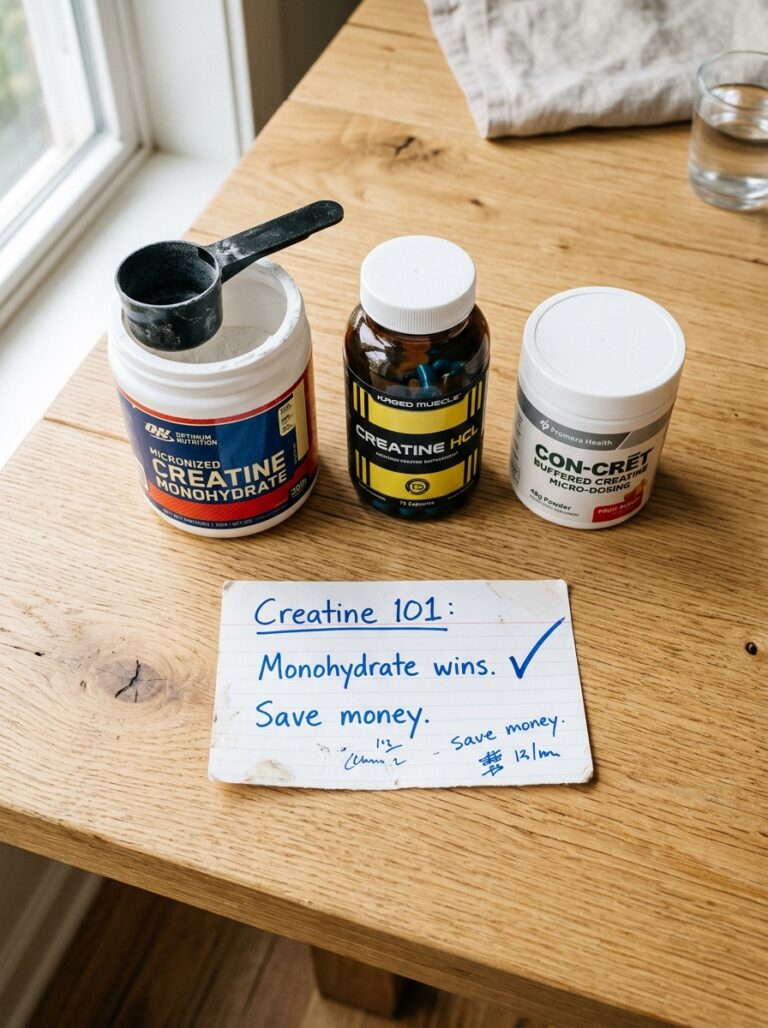
Search "creatine monohydrate vs HCl" and you'll find a wall of confident claims: HCl is 38 times more absorbable, buffered creatine skips the bloat, ethyl ester gets into muscle faster. Most of those lines trace back to a single solubility experiment or a marketing page, not to a head-to-head trial in actual people.
This guide lines up the four forms you'll see on the shelf against what the randomized trials measured, so you can tell which premium is buying you real biology and which is buying you a nicer label. The three creatine products we land on at the bottom are the ones we'd actually keep in our own family's cabinet, so it's worth the scroll.
Affiliate disclosure: this article contains affiliate links. As an Amazon Associate, UsefulVitamins.com earns from qualifying purchases at no extra cost to you.
Before you decide
Creatine is one of the most studied supplements in sports nutrition, but it isn't a free pass for everyone. If you have kidney disease, reduced kidney function, or a single kidney, talk to your physician before starting any form, because creatine raises serum creatinine in a way that can muddy the lab markers your doctor uses to track kidney health. The same caution applies if you take medications that affect the kidneys, are pregnant or breastfeeding, or are under 18, where the evidence base is thinner.
None of this is a reason for a healthy adult to be afraid of creatine; the International Society of Sports Nutrition position stand reviewed decades of data and found monohydrate well tolerated at standard doses. It's a reason to clear it first if you have a condition that touches the kidneys, and to ask your doctor about a baseline kidney panel if you're unsure. You can see how I weigh evidence and marketing claims on the how we review supplements page.
Here's the absorption reality the form debate usually skips. Creatine is a small molecule that's absorbed efficiently from the gut whichever salt or ester it's attached to. Once dissolved, it's taken up by a sodium-dependent transporter into muscle, and that transporter, not how fast the powder dissolved in your glass, is the rate-limiting step.
The proxy that actually matters in trials is intramuscular creatine content measured by muscle biopsy, sometimes alongside serum creatine. A form that dissolves beautifully but doesn't raise muscle creatine any more than monohydrate has won a chemistry contest, not a biology one. If you want the full primer on what creatine does and how to dose it, start with the complete guide to creatine.
The forms compared
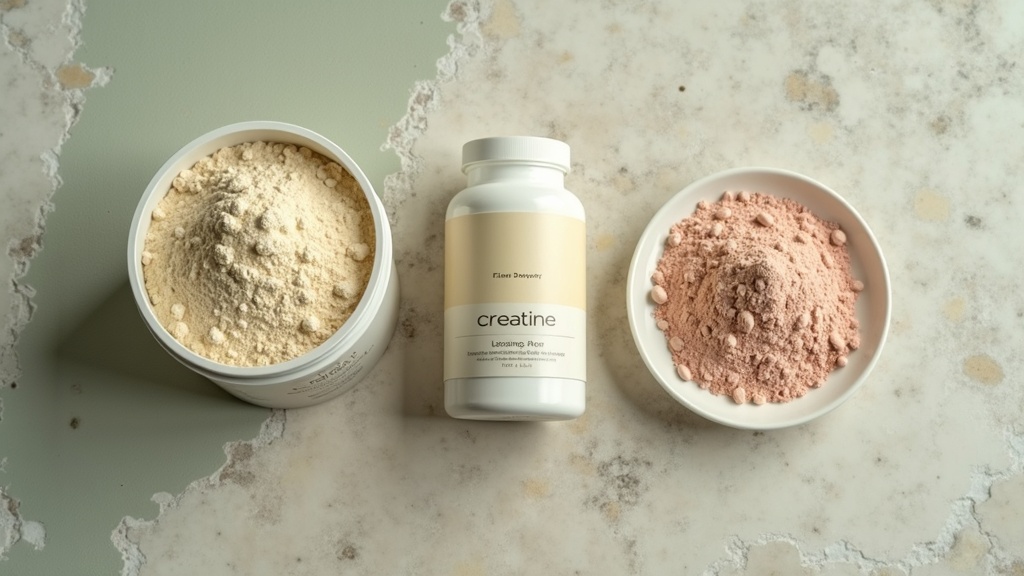
Creatine monohydrate is creatine bound to a single water molecule. It is the form used in the overwhelming majority of published trials, which is exactly why it's the reference point. The ISSN position stand calls monohydrate the most effective ergogenic supplement available for increasing high-intensity exercise capacity and lean mass, and notes that no other form has been shown to be superior to it. Its one real limitation is modest water solubility, which is the seed every other form's marketing grows from.
Creatine hydrochloride (HCl) is creatine bound to hydrochloric acid, which makes it dramatically more soluble. A physicochemical study of creatine salts found HCl roughly 38 times more soluble in water than monohydrate. That number is true and it's where the "38 times more absorbable" claim comes from, but the same study found no meaningful difference in how the salts crossed an intestinal cell model, and solubility in a glass is not absorption in a body.
The honest summary is that HCl dissolves better and may let you take a smaller, less gritty dose, but there's no human trial showing it puts more creatine into muscle.
Buffered creatine (Kre-Alkalyn) is monohydrate processed with an alkaline agent to raise its pH, on the theory that this protects creatine from converting to creatinine in the stomach and allows a much smaller dose. This is one of the few alternative forms with a direct head-to-head RCT, and the buffered claim did not hold up, as covered below.
Creatine ethyl ester (CEE) attaches an ethyl group to creatine to make it more fat-soluble and supposedly more cell-permeable. The chemistry backfires: the ester is unstable and degrades to creatinine, a waste product, before it reaches muscle. It's the one form with trial evidence of being worse than monohydrate.
| Form | What it is | Solubility / claim | Human RCT vs monohydrate | Relative cost per gram |
|---|---|---|---|---|
| Monohydrate | Creatine + one water molecule | Modest solubility; the studied reference | Reference standard, most evidence | Lowest (1x) |
| Hydrochloride (HCl) | Creatine bound to hydrochloric acid | ~38x more soluble; “more absorbable” | Equal, not superior (PMID 12291177) | High (often 3 to 5x) |
| Buffered (Kre-Alkalyn) | Monohydrate raised to alkaline pH | “pH-stable, lower dose, less bloat” | No advantage (PMID 23146213) | High (2 to 4x) |
| Ethyl ester (CEE) | Creatine with an ethyl group added | “More cell-permeable” | Inferior; degrades to creatinine (PMID 19228401) | High (2 to 4x) |
What the head-to-head trials actually found
This is where most of the form debate quietly collapses, because for once there are real comparative trials and they point the same direction.
On HCl versus monohydrate, a 2025 placebo-controlled randomized trial gave elite team-sport athletes 5 grams per day of either monohydrate, HCl, or placebo for eight weeks. Both creatine forms improved jump performance with similar effect sizes and both supported gains in fat-free mass, with no signal that HCl outperformed monohydrate. The authors stated plainly that claims of HCl superiority are unfounded and misleading and that the form does not beat monohydrate even at the low doses HCl is usually sold at.
That matters because the entire HCl pitch is "you need less and it works better," and the trial designed to test that found parity, not superiority.
On buffered creatine versus monohydrate, the Jagim double-blind trial studied 36 resistance-trained adults, comparing monohydrate at a standard load (20 g/day for 7 days, then 5 g/day) against Kre-Alkalyn at both the manufacturer's low dose of 1.5 g/day and an equivalent higher dose, all over 28 days. They measured muscle creatine content directly.
There were no significant differences between groups in intramuscular creatine, body composition, strength, or anaerobic capacity, and the study specifically tested the "fewer side effects" claim and found no meaningful difference. The pH-buffering premise simply didn't produce more creatine in muscle.
On ethyl ester versus monohydrate, Spillane and colleagues compared CEE to monohydrate and placebo over 47 days of resistance training. Monohydrate produced significantly higher serum creatine than CEE despite the CEE group taking a generous dose, and the CEE group's serum creatinine roughly tripled after loading, the chemical fingerprint of the ester degrading to waste rather than delivering creatine. CEE is the rare case where a form is not just no better but measurably worse.
The 2021 ISSN review of common creatine questions ties this together: across forms studied to date, none has been shown to be more effective than monohydrate, and monohydrate remains the recommended default.
The cost-versus-form math

This is where a dietitian's habit of pricing the active ingredient earns its keep. A typical maintenance dose is 3 to 5 grams of creatine per day. Monohydrate routinely sells for well under 10 cents per 5-gram dose in bulk powder, which works out to a few dollars a month.
HCl and buffered formulas, sold in capsules or smaller scoops at a premium per gram, frequently land at three to five times that cost per active gram, sometimes more once you account for capsule fill weight.
So the real question isn't "which form is best in a lab," it's "what am I paying the premium for?" With HCl you're paying for better solubility and a smaller, less gritty dose, which is a genuine convenience and nothing more. With buffered creatine you're paying for a pH claim the head-to-head trial didn't support. With CEE you're paying more for a form that underperforms.
There's a difference between the dose that closes a real gap and the dose that just costs more for the same effect, and across the creatine forms the effect is the same. For nearly everyone, the monohydrate premium is zero and the result is identical.
How to choose the right form for your goal
If you're a healthy adult who just wants the proven effect, choose creatine monohydrate. It has the deepest evidence base, the lowest cost per gram, and nothing has beaten it head to head. Look for products carrying the Creapure label, the German-made monohydrate used in many trials and verified for purity, which is widely available as a plain bulk powder for a few dollars a month.
If monohydrate upsets your stomach or leaves grit at the bottom of the glass, HCl is a reasonable convenience buy. The 2025 trial showed it works as well as monohydrate, just not better, so you're paying for solubility and a smaller dose, not for more muscle creatine. Dissolve monohydrate in warm water or take it with a meal first before assuming you need the upgrade.
If you're chasing the "no bloat" or "no loading" promise of buffered creatine, know that the water-weight gain from creatine is intracellular, lives inside muscle, and isn't avoided by buffering. The Jagim trial found no difference in side effects, so there's little reason to pay the premium for Kre-Alkalyn over monohydrate taken without a loading phase.
If you're considering creatine ethyl ester, skip it. It's the one form with trial evidence of being worse than monohydrate, and the elevated creatinine it produces can also distort kidney lab readings.
Across all of these, dose and timing matter more than form. If you want to know whether to load, when to take it, and how much, I lay it out in creatine timing and loading.
FAQ
Is creatine HCl a scam?
No, it's a legitimate, well-absorbed form, it's just not superior to monohydrate. You're paying a premium for better solubility and a smaller dose, not for more creatine reaching muscle.
Does buffered creatine really reduce bloating?
The trial that tested it found no difference in side effects versus monohydrate. Creatine's water gain is inside muscle cells, and buffering the pH doesn't change that.
Why does the HCl label dose look so much smaller than monohydrate's 5 grams?
Marketing, mostly. Smaller "clinical doses" are a selling point, but the comparative trial that worked used 5 grams of each, and that's the dose with evidence behind it.
Can I take creatine with food or coffee?
Yes. Creatine is stable in your stomach long enough to be absorbed, and caffeine doesn't block its uptake at normal intakes. Take whichever form with a meal if it sits better.
Will any form hurt my kidneys?
In healthy adults at standard doses, the evidence says no, though creatine raises serum creatinine, so tell your doctor you take it before a kidney panel and clear it first if you have kidney disease.
The bottom line on creatine forms
The form debate is loud because the alternatives need a reason for their higher price, but the trials keep landing in the same place: creatine monohydrate is the form worth buying for almost everyone. HCl matches it without beating it, buffered creatine matched it in a direct trial that also debunked the side-effect claim, and ethyl ester actually underperformed while spiking the lab marker your doctor uses to read your kidneys.
If you eat broadly and train, plain monohydrate at 3 to 5 grams a day closes the gap that supplementation is meant to close, at a fraction of the cost of any premium form.
Pay for a different form only when it buys you something real and specific: HCl if monohydrate genuinely upsets your stomach or you want a smaller, fully dissolved dose. Otherwise the premium is buying a nicer label, not a better result.
If you're starting out, get the dosing and timing right first, ask your doctor about a baseline kidney panel if you have any reason for concern, and put the money you saved toward food.
Recommended Products


As an Amazon Associate, UsefulVitamins.com earns from qualifying purchases at no extra cost to you. We only recommend products supported by published research or third-party testing.
Reviewed by Sarah Thompson, Registered Dietitian, focused on vitamin and mineral nutrition. See more from Sarah Thompson. This article is educational and is not a substitute for individualized medical advice; talk to your doctor before starting a supplement, especially if you have kidney disease, are pregnant, or are managing a diagnosed condition.
