
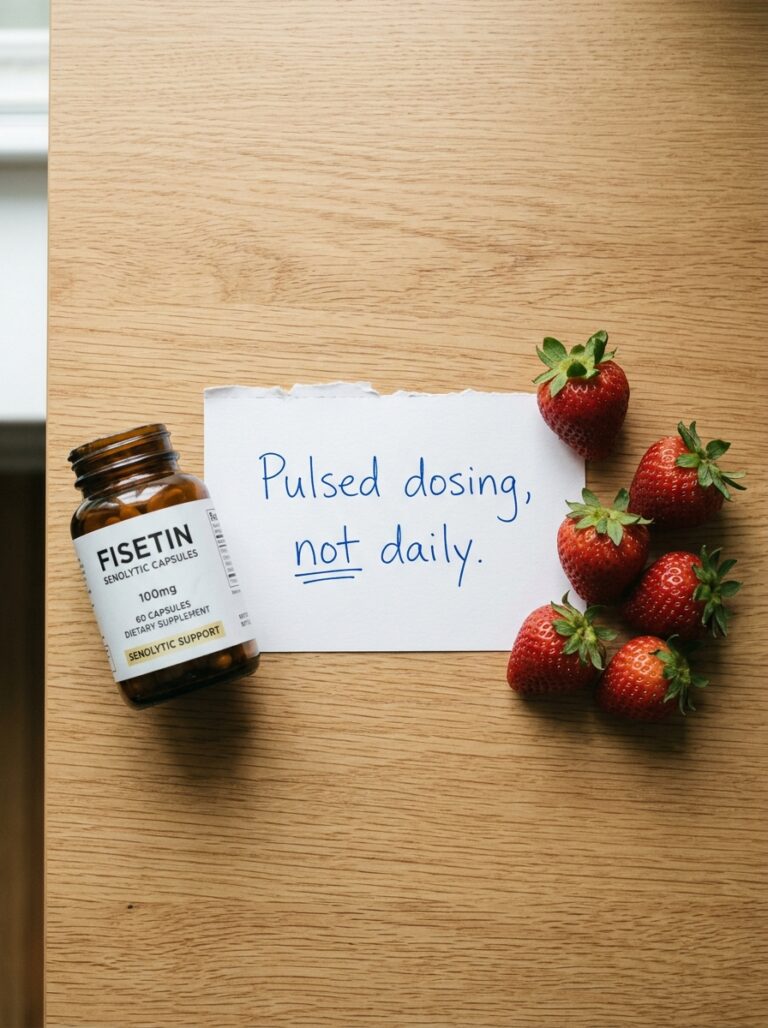
Fisetin is the flavonoid the longevity internet decided is a daily anti-aging pill. The lab that put it on the map never used it that way. The most-cited fisetin study dosed mice in short bursts, then stopped, on the logic that you only need to hit senescent cells hard enough to kill them, not babysit them forever. That gap between how it was studied and how it's sold is the whole story.
I read this literature for a living, and the honest version is less exciting than the marketing: strong mouse data, genuinely thin human data, and a smart-but-unproven protocol. The three picks at the bottom are the bottles I'd actually keep in my own family's cabinet if I were running a cautious pulsed course, and I'll tell you exactly why pulsed beats daily before you scroll there.
Affiliate disclosure: this article contains affiliate links. As an Amazon Associate, UsefulVitamins.com earns from qualifying purchases at no extra cost to you.
Before you decide
Fisetin is not a supplement to start casually if you take other medications or have a serious condition. It is being studied as a drug-like senolytic at high doses, and the people most interested in it are often older or managing chronic disease, exactly the group with the most to lose from an interaction.
If you take a blood thinner, a chemotherapy agent, an immunosuppressant, or anything metabolized by the liver's CYP enzymes, clear a fisetin course with your physician or pharmacist first. This is not a routine vitamin.
It is also worth being honest about what fisetin cannot do. No supplement has been shown to slow human aging or treat an age-related disease, and fisetin is not an exception. The lifespan extension that made it famous happened in mice; the human trials measure narrow markers like frailty and inflammation, and they have not yet returned the kind of result that would justify a health claim.
If your real goal is broad healthspan, fisetin is one experimental lever among many. I lay out the bigger picture in the complete guide to longevity supplements, and you can see how I weigh evidence and conflicts of interest on the how we review supplements page.
What fisetin actually does
Your body accumulates senescent cells as you age. These are cells that have stopped dividing but refuse to die, and they leak inflammatory signals that quietly damage the tissue around them. Researchers call that signal the senescence-associated secretory phenotype, or SASP, and it is one of the leading mechanistic suspects in age-related decline.
A senolytic is a compound that selectively pushes these zombie cells into apoptosis, the programmed cell death they have been resisting. Fisetin appears to do this by knocking out the pro-survival pathways, including PI3K/AKT and certain BCL-2 family proteins, that senescent cells lean on to stay alive. Healthy cells do not depend on those pathways the same way, which is the proposed basis for selectivity.
The key biological fact for dosing is that senescent cells take weeks to reaccumulate after you clear them. That slow rebound is exactly why you do not need fisetin in your bloodstream every day to keep the burden down, and it is the mechanistic argument for pulsing rather than daily use.
Fisetin is a plant flavonoid, most famously concentrated in strawberries. The amount in food is far below any studied dose, so you cannot eat your way to a senolytic effect, which is the entire reason supplements exist for this molecule.
What the research shows
Here is where I have to be the buzzkill. The headline result is real but it is a mouse result. The 2018 Mayo Clinic and Scripps study screened ten flavonoids and found fisetin the most potent senolytic of the group, and intermittent dosing extended both median and maximum lifespan in aged mice. That is a striking finding, and it is why fisetin is taken seriously at all.
The detail that matters is when they started dosing. The mice were already old, fed fisetin-supplemented chow only from roughly 85 weeks of age onward, and still gained about a 20% increase in median lifespan along with reduced senescence markers across multiple tissues. A benefit that shows up from a late-life start is the version most relevant to a human who is already middle-aged, which is part of why this paper carries so much weight.
A 2025 follow-up reinforced the pattern. Mice given fisetin on a one-week-on, two-weeks-off schedule showed reduced frailty and better grip strength, with effects comparable to genetically deleting senescent cells outright (Aging Cell 2025). Note the schedule again: pulsed, not daily.
The human side is thinner than most roundups admit, and the design of the flagship trial is worth seeing in full. Mayo Clinic's AFFIRM-LITE trial is a 40-participant, placebo-controlled Phase 2 study in adults aged 70 and up, dosing oral fisetin at 20 mg/kg/day for two consecutive days and tracking frailty, inflammation, insulin resistance, and bone-resorption markers. It is enrolling by invitation with completion estimated in 2027, which means the result everyone is waiting on simply does not exist yet. Treating an unfinished pilot as a verdict is the most common mistake I see in fisetin write-ups.
The closest human proof-of-concept comes from a different senolytic. A trial of dasatinib plus quercetin in people with diabetic kidney disease showed senescent cells genuinely decreased in human fat and skin after just three days of dosing, and a separate Phase I trial in pulmonary fibrosis found the same intermittent approach was feasible and tolerable. Fisetin was also fast-tracked into a multicenter COVID-19 trial in nursing-home residents on the same senolytic rationale. Quercetin is the flavonoid in that combination, and if you are curious about its standalone profile my best quercetin supplements guide covers how it is dosed and absorbed.
So the honest synthesis: the mechanism is plausible, the mouse data is strong, one human trial proves senescent cells can be cleared with a related drug, and fisetin's own human efficacy is still unproven. That is a reason for cautious interest, not a reason to take it daily forever.
What to look for when buying

The first problem with most fisetin bottles is one you cannot see on the label: plain fisetin is barely absorbed. It is poorly water-soluble, rapidly metabolized, and has a very short half-life, so a large fraction of a standard capsule never reaches your bloodstream in active form.
This is not a minor footnote. A liposomal formulation increased fisetin's relative bioavailability roughly 47-fold over the free compound in published work. When a form difference is two orders of magnitude, the form is the most important thing on the shelf.
The encouraging part is that this gap has now been tested in people, not just animals. A randomized crossover study in 15 healthy volunteers compared a hybrid-hydrogel fisetin against unformulated powder and measured a 26.9-fold higher AUC and a 23.9-fold higher peak blood level for the enhanced form. Plain fisetin barely registered in plasma; the formulated version actually showed up. That is the difference between swallowing a number and absorbing a dose.
The reason plain fisetin fails is mechanical. It is poorly water-soluble, gets chewed up by phase-II metabolism into sulfates and glucuronides, and is pumped back out of the gut by P-glycoprotein efflux, so a free-powder capsule has a half-life measured in minutes after it leaves the stomach. Liposomes, phospholipid complexes, and fiber-scaffold hydrogels all exist to outrun those three problems.
The second issue is dose. The mouse and human trials use weight-based doses around 20 mg/kg per dosing day. For an 80 kg adult that is about 1,600 mg on each dosing day, so a 100 mg "daily" capsule delivers roughly one-sixteenth of a trial dose on the wrong schedule entirely. Do the per-kilogram math for your own body weight before you judge whether a bottle is even in the right ballpark.
It also clarifies what a pulsed course looks like in practice. The pattern people borrow from the trials is two consecutive dosing days back-to-back, then nothing for several weeks, often quarterly or monthly at most, because senescent cells rebound slowly enough that there is nothing to maintain in between. A bottle sized for daily nibbling is built for a protocol the evidence never tested.
The table below is how I'd triage what's on the market. Treat it as a buying filter, not a ranking.
| What you see on the label | What it actually tells you | Worth paying for? |
|---|---|---|
| Liposomal or phospholipid-complex form | Addresses the core absorption problem; far more active fisetin reaches blood | Yes, this is the main lever |
| High per-capsule dose (500 mg+) | Lets you reach a trial-scale dose without swallowing a handful of pills | Yes, for a pulsed course |
| Third-party tested / COA available | Independent check on identity and purity of the flavonoid | Yes, a useful signal |
| “Take one daily” 100 mg capsule | Under-dosed and on the wrong schedule for the senolytic model | No, mismatched to the evidence |
| “Anti-aging” or “reverse aging” claims | Marketing ahead of the human data | Ignore the claim, judge the form and dose |
If you are comparing fisetin against the other flavonoid senolytic people pair it with, my best spermidine supplements guide covers a different longevity mechanism worth knowing about, autophagy rather than senescent-cell clearance.
Recommended Products


As an Amazon Associate, UsefulVitamins.com earns from qualifying purchases at no extra cost to you. We only recommend products supported by published research or third-party testing.
FAQ
Should I take fisetin every day?
The evidence does not support daily use, and the research model is the opposite of daily. The studied "hit-and-run" approach is a short burst of 2 to 3 consecutive days, then weeks off, because senescent cells reaccumulate slowly. Daily dosing has no efficacy data behind it and just raises exposure with no proven upside.
How much fisetin did the trials use?
The human frailty trial uses about 20 mg/kg per dosing day, which for many adults is in the low-thousands of milligrams across those days. That is far above the 100 mg in typical "daily" capsules, which is one reason per-capsule dose matters when you buy.
Is liposomal fisetin worth the extra money?
For most people, yes. Plain fisetin is poorly absorbed, and a liposomal form raised relative bioavailability dramatically in published work. Paying for absorption is more rational than paying for a bigger number on a poorly-absorbed plain powder.
Will fisetin make me live longer?
That has only been shown in mice. The human trials measure frailty and inflammation markers, not lifespan, and they have not yet proven a meaningful clinical benefit. Treat fisetin as experimental, not as a proven longevity intervention.
Can I just eat strawberries instead?
No. Food levels of fisetin are a tiny fraction of any studied dose, so dietary strawberries are great nutrition but not a senolytic strategy. The whole reason supplements exist for this molecule is the gap between food content and trial doses.
Has the bioavailability problem actually been fixed in humans?
Partly, and that is the genuinely good news here. A human crossover study found an enhanced fisetin formulation reached a 26.9-fold higher blood AUC than plain powder, and a liposomal version did roughly 47-fold better in earlier work. The chemistry exists to make fisetin absorbable; what is still missing is proof that the absorbed dose produces a clinical benefit in people.
How many days in a row, and how often, is a pulsed course?
The trials and the mouse studies point the same way. The studied pattern is two consecutive dosing days, then weeks off, repeated infrequently rather than monthly micro-dosing. AFFIRM-LITE uses two consecutive days, and the lifespan mouse work used short intermittent bursts; nobody in the serious literature is dosing fisetin daily, which is exactly the schedule most retail bottles are built around.
The bottom line on fisetin
Fisetin earns its reputation as the senolytic the data likes best, but "best" here means best-of-the-flavonoids in mice, not proven in people. The mechanism is sound, the animal data is genuinely strong, and the human evidence is still early and small. Anyone selling it as a settled daily anti-aging pill is ahead of the science.
If you decide to try it, the defensible move is to mirror the research: a bioavailable form, a trial-scale dose, taken as a short pulsed course of a couple of days with long gaps, not a capsule you swallow every morning forever. Pulsed, not daily, is the single most important thing on this page.
And because fisetin is being studied at drug-like doses in exactly the population most likely to be on other medications, run a course past your physician or pharmacist before you start. This is an experiment worth doing carefully, or not at all.
Reviewed by Maria Rodriguez, MS Nutrition Science, focused on cognitive and mood biochemistry. See more from Maria Rodriguez. This article is educational and is not a substitute for individualized medical advice; talk to your doctor before starting a supplement, especially if you take other medications, are managing a chronic condition, or are pregnant. As an Amazon Associate we earn from qualifying purchases.
