
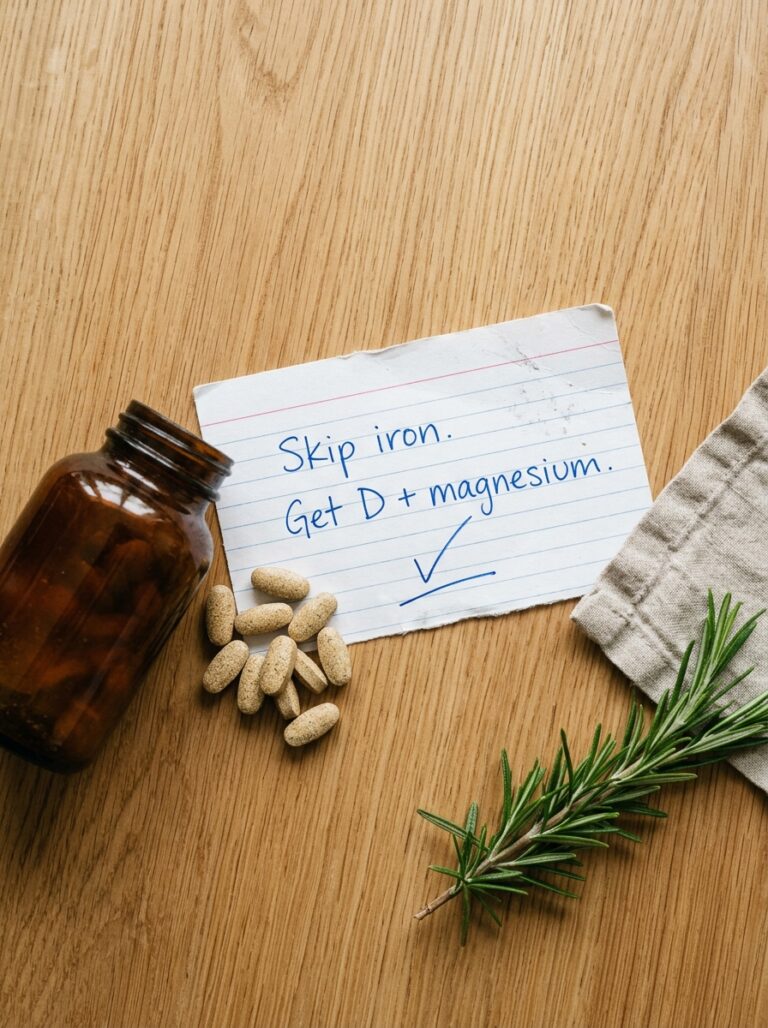
If you're shopping for the best multivitamin for men, the labels are loud about "vitality," "energy," and "testosterone support," and almost silent about the one ingredient most men should actually avoid. The honest version of this guide is short: skip the iron, prioritize a couple of nutrients men genuinely tend to miss, and don't pay for a long list of trace minerals you already eat enough of. These are the picks I'd keep in my own family's cabinet, so it's worth scrolling to the recommendations at the end.
This isn't anti-multivitamin. It's anti-marketing, in service of the few things that move the needle.
Affiliate disclosure: this article contains affiliate links. As an Amazon Associate, UsefulVitamins.com earns from qualifying purchases at no extra cost to you.
Before you decide

A multivitamin is insurance against gaps, not a treatment for a symptom. If you're tired, low, or "off," a daily multi is unlikely to fix it, and reaching for one can delay finding the actual cause. Persistent fatigue, in particular, deserves a conversation with your doctor rather than a supplement aisle.
Ask your doctor about a blood test before you assume you're low on anything. A ferritin and a vitamin D level cost little and answer the two questions that matter most for men: do you have too little iron (rare) or too little vitamin D (common)? Guessing in either direction is how people end up either wasting money or, worse, taking iron they don't need.
A multivitamin also can't out-supplement a thin diet. If your plate is built on refined carbs and very few plants, that's the lever, not a capsule. You can see how I weigh evidence and conflicts of interest on the how we review supplements page, and if you want the broader logic of who needs a multi at all, start with the complete guide to multivitamins.
What a man's multi should (and shouldn't) contain

Strip away the marketing and a "men's" multivitamin is mostly a regular multivitamin with the iron removed and the dose of a few B vitamins nudged up. The genuinely useful difference between a men's formula and a generic one is usually just that the men's version leaves out iron — which, as you'll see, is the point.
The nutrients worth caring about fall into two buckets: gaps men actually have, and "everything else" that a varied diet already covers.
The gaps that repeatedly show up in US intake data are vitamin D and magnesium, and to a lesser degree they're the reason a multi earns its place at all. Most of the rest — vitamin C, the B vitamins, zinc, copper — you're likely getting in adequate amounts if you eat a normal mixed diet, so a modest top-up is harmless but not transformative.
The table below sorts a typical men's label into what's worth having and what's mostly filler.
| Nutrient | Why it’s in there | Does a man usually need the supplement? |
|---|---|---|
| Vitamin D | Common dietary and sunlight gap | Often yes — the strongest reason to take a multi |
| Magnesium | Roughly half of adults fall short of the requirement | Frequently yes, though doses in multis are small |
| B12 and folate | Energy metabolism, methylation | Sometimes — older men and low-meat eaters benefit |
| Iron | Legacy “complete” formula habit | No for most men — see the next section |
| “Vitality” herb blends | Marketing | No — unverifiable doses, little evidence |
Notice what's doing the real work: two nutrients, not twenty. A 30-ingredient label isn't 30 times better than a clean formula that nails vitamin D, magnesium, and B12.
Why skip the iron
Here's the inversion that most "men's vitality" marketing gets backwards. Iron is the nutrient women of childbearing age frequently need more of and adult men almost never do. The NIH Office of Dietary Supplements sets the RDA at 8 mg/day for adult men versus 18 mg/day for premenopausal women, and most men already take in roughly 16 to 18 mg a day from food alone.
The reason is plumbing, not effort. Men have no monthly route to lose iron, so once stores are full, the body simply down-regulates absorption and the rest sits there. Women who menstruate lose iron on a schedule; men don't.
That changes which direction the risk runs. According to StatPearls on dietary iron, iron deficiency clusters in toddlers, young girls, and women of childbearing age, while iron toxicity occurs with excess supplement consumption and in genetic conditions causing overload such as hemochromatosis. For a man with full stores, supplemental iron is a downside with no matching upside.
Hereditary hemochromatosis is the sharp end of this. It's one of the most common genetic disorders in people of Northern European descent — homozygosity for the C282Y variant reaches a prevalence of roughly one in 200 in that population — and it presents earlier and more severely in men. In the landmark study of iron-overload-related disease in HFE hemochromatosis, clinically significant iron overload developed in about 28% of male C282Y homozygotes versus only 1% of females, a gap driven almost entirely by the fact that women bleed off the excess for decades and men don't.
The mechanism matters because it explains why a daily pill is the wrong delivery system here. In hemochromatosis the body's normal "stop absorbing" signal is broken, so iron keeps loading regardless of how full the stores already are. A man who carries the gene and unknowingly takes an iron-loaded "complete" multi for years is steadily topping up the exact tank his body can no longer drain — and the early symptoms (fatigue, joint aches, low libido) read like the vague "low energy" the multi was supposed to fix. The standard advice in the dietary management of iron overload is unambiguous: avoid iron supplements and iron-fortified products entirely.
You don't need a genetic diagnosis for this to apply to you. Most men with full stores get no benefit from supplemental iron and only carry the downside, whether or not they have a named condition. The handful of men who genuinely need iron — those with a documented deficiency, GI blood loss, or a doctor's instruction — get it as a targeted, monitored dose, not as a passenger riding along in a multivitamin.
So the rule is simple. Unless a blood test shows low ferritin or your doctor has specifically told you to supplement iron, choose an iron-free men's formula. If you do have a documented deficiency, that's a targeted, monitored fix — not a reason to take a multi that happens to contain iron.
What to look for when buying

Once you've ruled out iron, three things separate a worthwhile multi from a shelf-filler: the right active forms, real doses of the nutrients that matter, and an independent quality check.
Favor active, well-absorbed forms over the cheapest ones. For vitamin D, that means D3 (cholecalciferol) rather than D2. For magnesium, glycinate or citrate is gentler on the gut than oxide, though most multis use small amounts of whatever's cheapest, which is one reason a multi rarely covers magnesium on its own.
The same logic extends to the B vitamins, where the "active form" debate is loudest. Folate and B12 each come in a synthetic version that your body has to convert and a pre-converted version it can use directly. For folate, that's methylfolate (5-MTHF) rather than plain folic acid; for B12, methylcobalamin rather than cyanocobalamin. The honest position is that for most healthy men with normal genetics this difference is minor — your body handles the conversion fine. It earns more weight in two cases: men who carry common variants in the MTHFR enzyme that slow folic-acid conversion, and older men, whose B12 absorption is the real bottleneck.
That older-man caveat is worth a sentence on its own. As the classic review of B12 deficiency in the elderly describes, absorption of the crystalline B12 used in supplements holds up with age, but the body's ability to pull B12 out of food declines because of atrophic gastritis and lower stomach acid. The practical upshot: an older man often gets more reliable B12 from a supplement than from his dinner, which is one of the cleaner reasons for that group to keep a multi in the routine regardless of the form on the label.
On vitamin D, the gap is real and worth closing. Pooled NHANES data in a 2022 analysis of US vitamin D status found about a quarter of US adults were moderately-to-severely deficient and roughly two-thirds were either deficient or insufficient. The NIH RDA is 600 IU for men up to 70 and 800 IU after, and a multi delivering D3 in that range is doing genuinely useful work.
Magnesium is the other widespread shortfall. The NIH Office of Dietary Supplements notes that roughly 48% of Americans take in less magnesium than the estimated requirement, with young adult men among the most likely to fall short, against an RDA of 400 to 420 mg for adult men. Because a multi usually carries only a fraction of that, men with a known gap often pair the multi with a dedicated magnesium supplement rather than expecting one pill to do both.
There's a reason these two gaps belong together. Magnesium isn't just a parallel deficiency — it's a cofactor for the enzymes that activate vitamin D in the first place. The 2018 review on the role of magnesium in vitamin D activation notes that all of the enzymes metabolizing vitamin D in the liver and kidney appear to require magnesium. In plain terms, vitamin D you swallow has to be converted twice before your body can use it, and both steps lean on magnesium — so a man who is short on magnesium can take vitamin D faithfully and still leave some of it stuck in storage. Closing the magnesium gap is partly how you get full value from the vitamin D you're already paying for, which is the practical argument for treating them as a pair rather than two unrelated line items.
Most of what you're paying extra for on a "men's vitality" label is the part worth ignoring. The proprietary "energy," "performance," or "testosterone support" blends typically bundle a few herbs and amino acids at undisclosed doses, and the headline pitch — that they raise testosterone — mostly doesn't survive contact with the trials. Across the evidence on vitamin D and testosterone, the pattern is consistent: correcting a real deficiency can nudge levels in men who were low, but topping up a man who's already in range does little. Nutrients like vitamin D and zinc support testosterone production when you're deficient; they don't push a normal man above baseline. The same goes for the "vitality" botanicals — saw palmetto, tribulus, and similar — which carry far more marketing than evidence at the doses a multivitamin can fit.
So treat the vitality blend as noise. If a formula's main selling point is a proprietary blend rather than honest doses of vitamin D, magnesium, and B12, you're paying for the label, not the contents — and a proprietary blend by definition hides how much of each ingredient you're actually getting, which is the opposite of what you want from a supplement.
The last filter is trust, because supplements are loosely regulated and what's on the label isn't guaranteed to be in the bottle. Look for an independent third-party seal — a USP Verified mark or NSF certification means an outside lab confirmed identity, potency, and that the product is free of undisclosed contaminants. It's the closest thing to a quality guarantee this category offers.
| Label feature | What it tells you | Worth paying for? |
|---|---|---|
| Iron-free formula | No overload risk for men with full stores | Yes — the default for most men |
| Vitamin D as D3 | Closes the most common real gap | Yes, essential |
| Magnesium (glycinate or citrate) | Gentler form; dose usually still small | Yes, but check the amount |
| USP or NSF third-party seal | Independent check on what’s in the bottle | Yes, a strong signal |
| “Proprietary vitality blend” | Unverifiable doses, marketing-led | No, skip it |
Recommended Products


As an Amazon Associate, UsefulVitamins.com earns from qualifying purchases at no extra cost to you. We only recommend products supported by published research or third-party testing.
FAQ
Do men actually need a multivitamin at all?
Not if you eat a varied, plant-rich diet and have no documented gaps. A multi is reasonable low-cost insurance, especially for vitamin D, but it's optional. The clearest case for one is an older man, a low-variety eater, or someone whose bloodwork shows a shortfall.
Why do "men's" multivitamins leave out iron?
Because adult men rarely need supplemental iron and absorb less when stores are full. The men's-versus-women's difference is mostly just the iron, and leaving it out is the safer default for men, since overload — not deficiency — is the real risk in this group.
Should I take iron if I feel tired?
Not on your own. Fatigue has many causes, and iron only helps if you're actually deficient, which a simple ferritin test can confirm. Taking iron you don't need adds risk without benefit, so ask your doctor to check before supplementing.
Is a 30-ingredient "complete" multi better than a simple one?
No. A longer label mostly adds nutrients a normal diet already covers. The two gaps that consistently show up in US data are vitamin D and magnesium, so a clean formula that nails those plus B12 beats a kitchen-sink blend.
Do "men's vitality" or testosterone-support blends actually work?
Mostly no, at least not the way the label implies. Vitamin D and zinc support testosterone only when you're deficient; they don't lift a man who's already in normal range, and the proprietary herb blends carry far more marketing than evidence at the small doses a multi can hold. If your testosterone is a genuine concern, that's a blood test and a doctor's conversation, not a capsule with "vitality" on the front.
Should I take the "active" methylfolate and methylcobalamin forms?
For most healthy men it's a nice-to-have, not a must. Your body converts the standard forms fine unless you carry the slower MTHFR variants or you're older with reduced B12 absorption — and in those cases the active forms, or simply a reliable supplemental source, are reasonable. Don't pay a big premium for "methylated" on the label if the rest of the formula is weak; doses of the nutrients that matter come first.
Does third-party testing really matter?
Yes. Supplements aren't pre-approved for content accuracy, so a USP or NSF seal is your best assurance that what's on the label is in the bottle and free of undisclosed contaminants. It's worth a small premium.
The bottom line on men's multivitamins
The question isn't which brand wears the flashiest "men's vitality" label. It's whether a multi closes the gaps you actually have — and for most men those gaps are vitamin D and magnesium, not iron.
So the playbook is short. Skip the iron unless a blood test or your doctor directs otherwise, since men don't lose iron and overload is the genuine risk. Prioritize vitamin D as D3 and a real dose of magnesium, accepting you may need a separate magnesium supplement. And buy a formula an independent lab has verified.
If you do all of that, the multivitamin earns its small place in your routine. If you're over 50 and the priorities shift a little, I cover that separately in the best multivitamin for men over 50 guide.
Reviewed by Sarah Thompson, Registered Dietitian, focused on vitamin and mineral nutrition. See more from Sarah Thompson. This article is educational and is not a substitute for individualized medical advice; talk to your doctor before starting a supplement, especially if you have a diagnosed condition or a family history of iron overload.
