
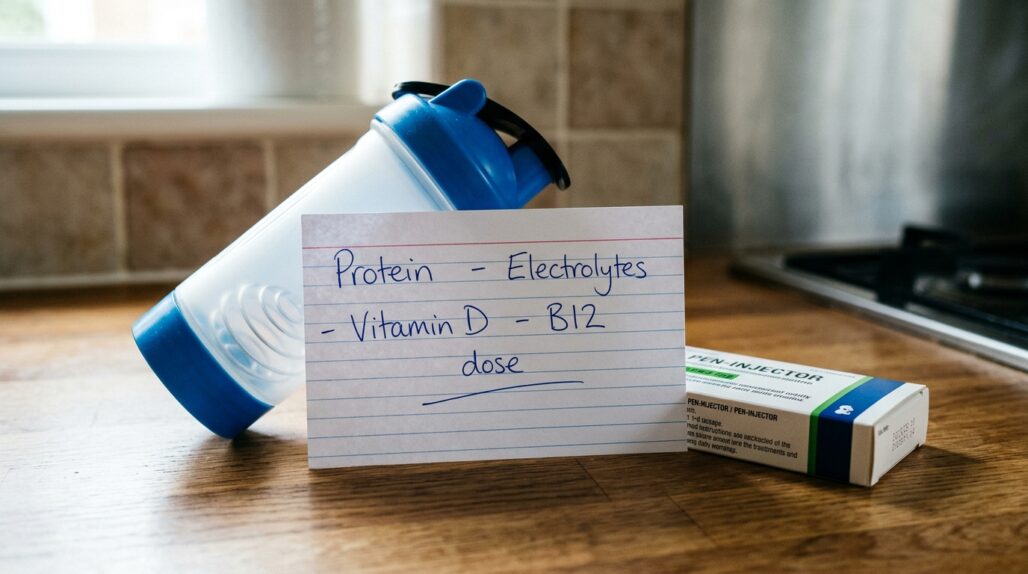
Affiliate disclosure: this article contains affiliate links. As an Amazon Associate, UsefulVitamins.com earns from qualifying purchases at no extra cost to you.
Before you decide
This is general information, not medical advice. GLP-1 medications – semaglutide (Ozempic, Wegovy) and tirzepatide (Mounjaro, Zepbound) – are prescription drugs, and your prescriber and pharmacist should sign off on anything you add to the routine.
The honest framing matters here. No supplement boosts a GLP-1 drug, and you do not need one to lose weight while taking it. The reason to supplement is defensive: when appetite drops sharply, total intake of protein, fluids, and several vitamins and minerals can fall below what your body needs.
The people at highest risk are those losing weight fastest, anyone eating very small portions, older adults, and people who also had bariatric surgery. A 2025 review noted that structured nutrient monitoring exists for bariatric patients but not yet for GLP-1 users, which leaves many people guessing. This guide is about closing that gap sensibly, not chasing faster results.
What changes in your body on a GLP-1 drug
These medications slow gastric emptying and blunt appetite signaling in the brain. You feel full sooner, stay full longer, and often eat a fraction of what you used to. That is the point of the drug, and it works.
The side effect of eating less is that nutrient intake drops alongside calories. The FDA prescribing information for Ozempic lists nausea, vomiting, diarrhea, and constipation as common, and warns these can lead to dehydration and, in some reported cases, acute kidney injury. That is the safety backdrop for why fluids and electrolytes come first.
A second issue is muscle. Some of the weight you lose is not fat. In the STEP 1 body-composition analysis, total lean body mass dropped about 9.7% on semaglutide, though the proportion of lean mass relative to total weight actually improved because fat fell faster. Translation: you can lose real muscle if you do nothing, even while your body composition trends in a good direction.

Protein comes first
Protein is the single most useful thing to get right. It is what protects the lean mass you would otherwise shed during fast weight loss, and it is also the macronutrient most likely to fall short when portions shrink.
A 2025 practical guide on preserving musculoskeletal health during weight loss recommends 1.2 to 1.6 g of protein per kg of body weight per day when exercise is part of the plan, with little added benefit above 1.6 g/kg. For many adults that lands around 20 to 30 g of protein at each main meal.
Pair the protein with movement. The same guide calls progressive resistance training the most effective way to maintain muscle during weight loss, suggesting two to three sessions a week. A protein shake without strength work does far less than the two together.
- Whole food first: eggs, Greek yogurt, fish, poultry, tofu, and legumes count toward the target.
- Powder as backup: a protein supplement is useful only when you cannot hit the number through food, which is common when appetite is low.
- Spread it out: the body uses protein better across several meals than in one large dose.
For more on muscle protection specifically, see our guide to supplements for GLP-1 muscle loss.
Electrolytes and fluids when GI side effects hit
The first weeks and any dose increase are when nausea, vomiting, and diarrhea are most likely. Those symptoms move fluid and electrolytes out of the body, and the FDA label specifically advises taking precautions to avoid fluid depletion and watching kidney function during dose escalation.
Plain water is the foundation, with electrolytes added when you have symptoms or low appetite. An electrolyte powder that supplies sodium, potassium, and magnesium can help on days you are eating and drinking very little. You do not need anything fancy or sugar-loaded.
Constipation is the other common complaint, and it is partly the slowed gut at work. Gentle, gradual fiber from food, adequate fluids, and movement usually help more than a heavy fiber supplement, which can sit poorly in an already slow stomach. We compare options in our best electrolyte powder for GLP-1 roundup. And if food sources alone do not get things moving, our breakdown of which fiber supplements work best for GLP-1 users explains how to add gentle soluble fiber without compounding the slow-stomach feeling.
The micronutrients most likely to run low
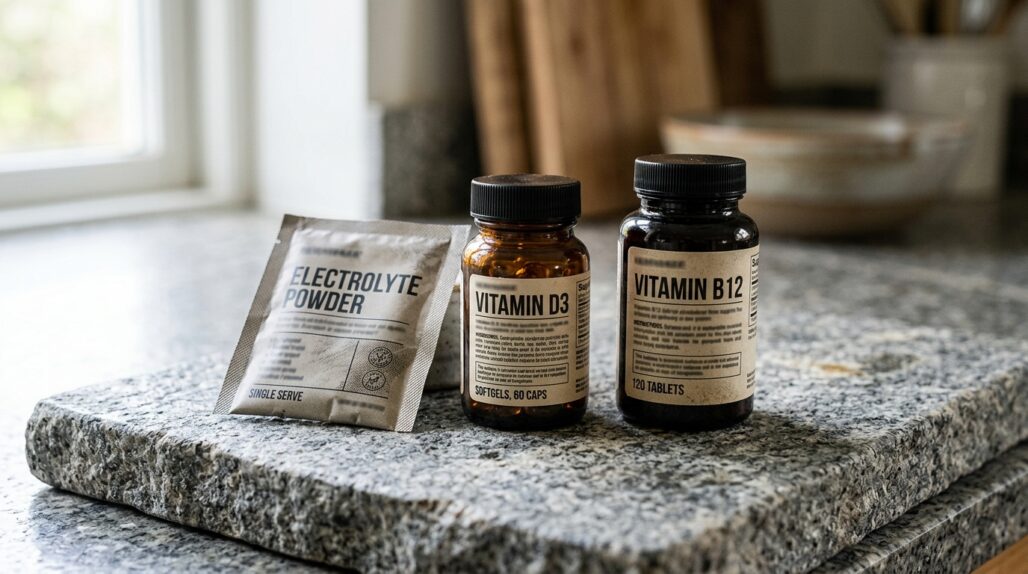
When intake drops for months, certain nutrients show up short before others. A 2025 narrative review on GLP-1 users flagged vitamin D as the most common deficiency in one cohort, rising over the first year of treatment, with B12, iron, folate, and zinc also worth watching in higher-risk people.
Vitamin D and B12 are the two most reasonable to check and consider supplementing, ideally with a blood test rather than a guess. Magnesium often tracks with low food intake and GI losses, which is one more reason electrolyte support overlaps with the micronutrient picture.
The table below shows what tends to slip and why, so you can have a focused conversation with your clinician rather than buying everything on the shelf.
| Nutrient | Why it can run low on a GLP-1 drug | Reasonable first step |
|---|---|---|
| Protein | Small portions make 1.2-1.6 g/kg hard to reach | Protein at every meal, powder only as backup |
| Electrolytes | Vomiting, diarrhea, and low fluid intake | Water plus an electrolyte mix on symptom days |
| Vitamin D | Common deficiency that rises over the first year | Ask for a blood level before dosing |
| Vitamin B12 | Low intake of animal foods; relevant if also on metformin | Check level, repletion if low |
B12 deserves a note if you also take metformin, since that drug interferes with its absorption. We cover that in detail in our best vitamin B12 supplements guide.
What to take, and how to time it
Here is the practical stack, kept deliberately short. Protein, an electrolyte source for symptom days, and vitamin D and B12 if your labs support them cover the real needs of most people on a GLP-1 drug. Anything beyond that is usually filling a gap your diet already covers.


As an Amazon Associate, UsefulVitamins.com earns from qualifying purchases at no extra cost to you.
UsefulVitamins may earn a commission from purchases made through links on this page. This never changes our research-based recommendations or what we choose to include.
Timing is simple but worth getting right because the drug slows your stomach:
- Take protein with meals, spread across the day, not all at once.
- Separate large fiber or mineral doses from your meals so they do not compound the full, slow-gut feeling.
- Hydrate steadily through the day, and lean on electrolytes when you are nauseated or eating little.
- Keep one routine so your clinician can interpret labs against a consistent pattern.
One tool from our team: StackMyMed (an app we build) lets you log your full medication and supplement list and flag possible interactions to raise with a pharmacist. It is a way to organize the conversation, not a substitute for clinical judgment.

What to skip – and the berberine trap
The biggest mistake is treating supplements as a way to boost the drug. They do not, and stacking blood-sugar-lowering products on top of a GLP-1 medication can backfire.
Berberine, marketed as "nature's Ozempic," is the clearest example to avoid stacking. UCLA Health notes that berberine works through a different pathway (AMPK) than GLP-1 drugs, that the evidence base is thin, and that it can add to the effect of diabetes medications and cause its own nausea, bloating, and diarrhea. Adding it to a real GLP-1 drug risks compounding both the glucose-lowering and the GI effects, with no proven upside.
That caution matters most if you also take insulin or a sulfonylurea, where extra glucose-lowering can push blood sugar too low. Heavy fiber laxatives and other supplements sold for "blood sugar support" carry the same logic. When in doubt, the safe default is to give your prescriber the full list. We go deeper in our pillar on drug-supplement interactions, and you can screen your own combination with our drug-supplement interaction checker.
When to call a clinician
Most of this is routine, but some symptoms are not. Persistent vomiting, signs of dehydration, severe abdominal pain, or reduced urination warrant prompt medical attention, because the FDA label ties severe GI reactions to dehydration and rare kidney injury.
Get labs rather than guess on the supplement side. Ask about checking vitamin D, B12, and iron if you have been on the drug for months, are losing weight quickly, or feel persistently tired or weak. And never stop or change the prescription on your own to "fix" a side effect – that is a clinician's call.
FAQ
Do I need supplements to lose weight on Ozempic? No. The drug drives the weight loss on its own. Supplements protect muscle and fill nutrient gaps caused by eating less, not the loss itself.
How much protein should I aim for? Research on preserving lean mass during weight loss points to about 1.2 to 1.6 g per kg of body weight per day when paired with resistance training. Your clinician or dietitian can set a target for your situation.
Should I take a multivitamin? A basic multivitamin is reasonable insurance when intake is low, but it does not replace checking vitamin D and B12 by blood test if you have been on a GLP-1 drug for several months.
Can I take berberine with Ozempic? It is best avoided without medical sign-off. Berberine can add to glucose-lowering and GI side effects, and there is no evidence it improves how the drug works.
What helps with the nausea and constipation? Steady fluids, electrolytes on symptom days, gentle fiber from food, and movement tend to help. Talk to your prescriber if symptoms are severe or persistent, since dose adjustments may be needed.
Is creatine safe to add for muscle? Creatine monohydrate is the best-evidenced supplement for muscle, and many GLP-1 users add it alongside protein and strength training. Confirm with your clinician, especially if you have kidney concerns.
Conclusion: cover the gaps, do not chase the drug
The smart supplement plan on a GLP-1 medication is small and defensive. Hit your protein target, replace fluids and electrolytes when GI side effects strike, and check vitamin D and B12 with your clinician rather than guessing. Skip anything marketed as a natural version of the drug, and keep your full list visible to your pharmacist.
If you want a single next step, check your full medication and supplement stack and bring the result to your next appointment. For side-effect management specifically, our guide to the best supplements for Ozempic side effects goes further.
This article is for general education and does not replace personalized medical advice. Dosing and lab testing should be guided by your physician or pharmacist, who knows your full history and medications.
Reviewed by the UsefulVitamins Editorial Team.
