
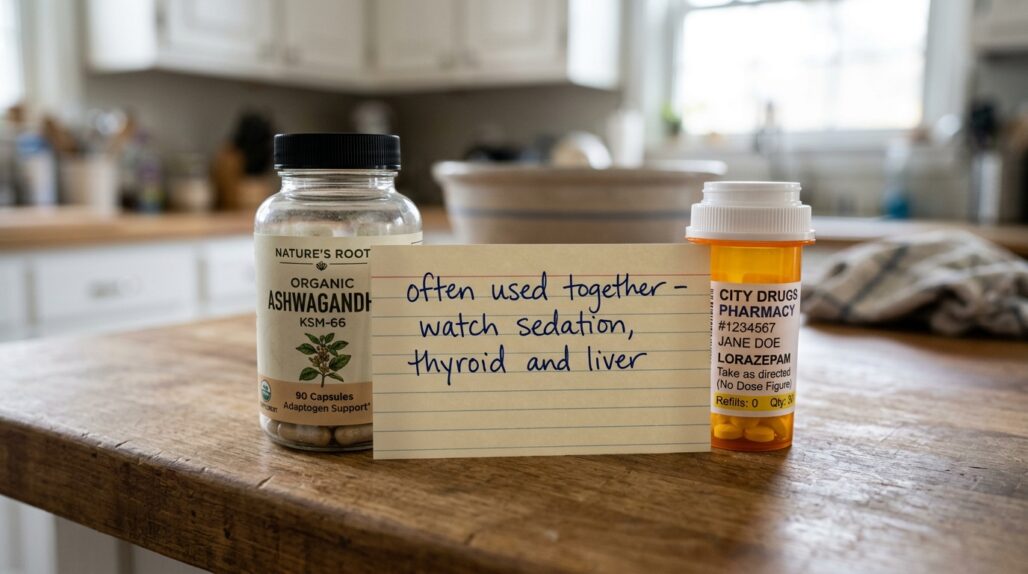
Before you decide
This article is general information, not medical advice for your situation. Ashwagandha and SSRIs are both common, and combining them is a reasonable question to bring to a clinician rather than settle alone online.
The short version: there is limited direct interaction evidence, and what evidence exists points to manageable cautions rather than a dangerous clash. That is a different message from the tryptophan or St. John's wort articles, where the serotonin risk is the headline.
The people who should be most careful are those on thyroid medication, anyone with a history of liver problems, people taking other sedating drugs, and anyone who is pregnant or trying to conceive. The NCCIH summary on ashwagandha lists thyroid disorders, pregnancy, and upcoming surgery among the reasons to avoid it.
One rule sits above all the detail below: do not stop a prescribed SSRI to try an adaptogen. Sertraline is a treatment; ashwagandha is a supplement with thinner evidence.
Does ashwagandha interact with sertraline?
No strong pharmacokinetic interaction between ashwagandha and SSRIs has been documented. The NIH Office of Dietary Supplements fact sheet flags interactions with antidiabetes drugs, blood pressure medication, immunosuppressants, sedatives, and thyroid hormones – SSRIs are not on that list.
The mechanism explains why. SSRIs like sertraline work by blocking serotonin reuptake, which raises serotonin in the synapse, as the StatPearls review of serotonin physiology describes. Serotonin syndrome happens when too many serotonin-raising agents stack on top of each other.
Ashwagandha is not a potent serotonergic. Its calming effect is tied largely to GABA signaling and the stress (HPA) axis, not to flooding serotonin. So the classic serotonin-syndrome scenario that applies to 5-HTP or L-tryptophan does not map cleanly onto ashwagandha.
That said, "no documented interaction" is not the same as "studied and proven safe together." The honest position is that the combination is low-concern on paper but under-researched, which is exactly why a prescriber should know about it.
The sedation caution comes first
Drowsiness is the most practical issue. NCCIH lists drowsiness among ashwagandha's common side effects, and the ODS fact sheet notes a plausible interaction with sedatives and CNS depressants.
Sertraline itself is not strongly sedating for most people, but other SSRIs and many co-prescribed medications (sleep aids, some antihistamines, certain anxiety drugs) are. Adding ashwagandha on top can produce more grogginess than expected.
Two simple moves reduce the problem:
- Take ashwagandha in the evening rather than the morning if it makes you sleepy.
- Do not combine it with alcohol or other sedating supplements the same night while you learn how it affects you.
If you feel unusually foggy, slow, or unsteady, lower the dose or stop and tell your clinician. This is a tolerability issue, not an emergency, but it is the effect people actually notice.
Thyroid effects: the reason to be careful on levothyroxine
This is the most concrete interaction. Ashwagandha can raise thyroid hormone levels, which matters a lot if your thyroid is already being managed with medication.
In a double-blind, placebo-controlled trial in subclinical hypothyroidism, 600 mg of ashwagandha root extract daily for eight weeks lowered TSH and raised T3 and T4 significantly versus placebo. T3 rose by roughly 41% at week 8 in that study. For untreated subclinical hypothyroidism the researchers framed this as a benefit.
For someone already taking levothyroxine, the same effect is a complication. Ashwagandha pushing thyroid hormone up while a fixed levothyroxine dose is also working can tip a person toward overtreatment (jitteriness, palpitations, heat intolerance, trouble sleeping).
People with hyperthyroidism or an overactive thyroid have the clearest reason to avoid it. NCCIH groups thyroid disorders among the conditions where ashwagandha is not recommended without medical guidance.
| Thyroid status | What ashwagandha may do | Reasonable next step |
|---|---|---|
| Healthy thyroid, no medication | Small hormone shifts, usually unremarkable | Mention it; routine monitoring if used long term |
| On levothyroxine | May add to thyroid hormone and risk overtreatment | Ask before starting; recheck TSH if you proceed |
| Hyperthyroid or overactive | May worsen excess thyroid activity | Generally avoid unless a clinician approves |
If you want the deeper picture on this, our ashwagandha and thyroid guide walks through the hormone data in more detail.
Rare liver injury – and why duloxetine raises the stakes
Ashwagandha has been linked to uncommon but real liver injury. It is rare, but the cases are well enough documented that the NIH maintains an entry on it.
In a case series published in Liver International, researchers described five patients from Iceland and the US Drug-Induced Liver Injury Network who developed jaundice, nausea, and itching after 2 to 12 weeks of ashwagandha use. Liver tests normalized within 1 to 5 months after stopping, and none of those five progressed to liver failure.
The broader LiverTox entry assigns ashwagandha a causality likelihood score of B (a likely cause of clinically apparent liver injury). The pattern is usually cholestatic or mixed, recovery typically comes within 1 to 4 months of stopping, and rare fatal or transplant cases have been reported in the wider literature. Importantly, rechallenge should be avoided once injury occurs.
Why mention an antidepressant here? Most people pairing an adaptogen with their SSRI are fine on this front, but a few antidepressants carry their own liver caution. Duloxetine (Cymbalta), an SNRI rather than an SSRI, has a documented hepatotoxicity signal. Layering a supplement with a known liver caution on top of a drug with a liver caution is the kind of stacking worth flagging to a pharmacist.
Watch for yellowing of the skin or eyes, dark urine, persistent itching, or right-sided abdominal pain. If those appear, stop ashwagandha and seek medical care promptly rather than waiting it out.
What to actually do if you want to try it
Practical steps matter more than alarm. If you and your clinician decide ashwagandha is worth trying alongside an SSRI, a few habits keep it sensible.
- Tell your prescriber and pharmacist first, especially the brand and dose, since products vary widely.
- Start low and use one product at a time so you can attribute any effect.
- Keep your SSRI exactly as prescribed – the supplement is an addition, never a swap.
- If you take thyroid medication, ask about rechecking TSH after a few weeks.
- Note your baseline so you would notice new jaundice, dark urine, or unusual sedation.
Logging everything in one place helps the conversation. A free tool like StackMyMed lets you record your full stack and flag possible interactions to raise with a pharmacist; it organizes the discussion but does not replace clinical judgment.
For the bigger map of which combinations matter, see our ultimate guide to drug and supplement interactions and run your own list through the drug-supplement interaction checker. If anxiety is the reason you are reaching for ashwagandha, our roundup of natural supplements for anxiety covers the evidence-backed options.

When to call a clinician
Get medical advice before adding ashwagandha if you take levothyroxine, have liver disease, are pregnant or breastfeeding, or have a surgery scheduled.
Contact a clinician promptly if you notice yellow skin or eyes, dark urine, severe fatigue, or stubborn nausea, since these can signal liver trouble. Seek urgent care for signs that look like overactive thyroid plus agitation, or any rapid, alarming change after starting a new product.
And to be clear about the rare serious syndrome: true serotonin syndrome (high fever, muscle twitching or clonus, severe agitation, fast heart rate) is not the expected risk from ashwagandha plus an SSRI, but it is a medical emergency from over-stacking serotonergic agents and warrants immediate care.
FAQ
Can I take ashwagandha with sertraline (Zoloft)? Often, yes, with a clinician’s awareness. There is no strong documented interaction, but watch for extra drowsiness, and be cautious if you also take thyroid or liver-sensitive medication.
Will ashwagandha cause serotonin syndrome with an SSRI? It is unlikely on its own, because ashwagandha works mainly through GABA pathways rather than raising serotonin. The bigger serotonin-syndrome concerns are 5-HTP, L-tryptophan, and St. John’s wort.
Does ashwagandha affect thyroid medication? It may. Research suggests ashwagandha can raise T3 and T4 and lower TSH, which could lead to overtreatment if you already take levothyroxine. Ask about rechecking your TSH.
Can ashwagandha hurt my liver? Rarely. Documented cases describe jaundice and itching after several weeks, usually resolving within a few months of stopping. Watch for yellow skin or eyes and dark urine, and stop if they appear.
Should I stop my antidepressant to take ashwagandha instead? No. Do not replace a prescribed SSRI with a supplement. If you want to make a change, that is a conversation for your prescriber.
When is the best time to take ashwagandha if it makes me sleepy? The evening tends to work better for people who feel drowsy, and avoid pairing it with alcohol or other sedating products while you learn how it affects you.
Conclusion: a manageable combination, with eyes open
Ashwagandha and sertraline are not a dangerous mix on current evidence, and many people use them together. The risks that actually deserve attention are additive sedation, a possible rise in thyroid hormones, and rare liver injury – not serotonin syndrome.
So treat it as a "tell your prescriber" decision, not a quiet experiment. Keep your SSRI as prescribed, start low, watch for drowsiness and any sign of liver trouble, and recheck thyroid labs if you take levothyroxine. Bring your full list to a pharmacist before you begin.
This article is for general education and does not replace personalized medical advice. Supplement and medication decisions should be made with a qualified clinician or pharmacist who knows your history.
Reviewed by the UsefulVitamins Editorial Team.
