
The first weeks are loud, so make one thing quiet
A new diagnosis rarely arrives alone. Often it comes with two or three new prescriptions, a referral to a specialist, a follow-up appointment, and a stack of printouts you half-read in the parking lot. The volume is the hard part. You are learning a condition and a routine at the same time, and the routine keeps changing as doses get adjusted in the first month or two.
So pick one job and do it well: keep an accurate, current list of everything you take. Not a better diet, not the perfect pill schedule, not a research deep-dive. Just one list. Everything else gets easier once that exists, and almost everything gets harder when it does not.
This is the single habit that protects you across every appointment, every pharmacy, and every "remind me what you're on?" Build it in the first 90 days while the routine is still forming, and you will not have to reconstruct it later from memory and a drawer full of bottles.
Why a new diagnosis trips so many people up
The problem is not that any one medicine is complicated. It is that the information arrives from different places and never lands in one spot. Your cardiologist starts one drug, your primary doctor adjusts another, the pharmacy substitutes a generic, and a friend suggests a supplement. Nobody is holding the whole picture except you.
That gap is measurable. Research on medication reconciliation has found unintended differences between a patient's records and what they actually take in a large share of cases, and people managed by several specialist teams often need information pulled from three or more sources just to assemble an accurate history. The FDA notes that a current medication list helps your care team minimize errors and harmful interactions, and that it can matter most in an emergency, when you may not be able to explain your regimen yourself.
There is a second trap. The CDC has reported that about one in five new prescriptions is never filled, and among those that are filled, roughly half are taken incorrectly. A new diagnosis is exactly the moment that slip happens, because the routine is brand new and nothing is automatic yet. A list will not take the pills for you, but it makes the gaps visible.

Step 1: Build the master list this week
Do this before you change anything else. You are not deciding whether a medicine is right – you are just writing down what is true today.
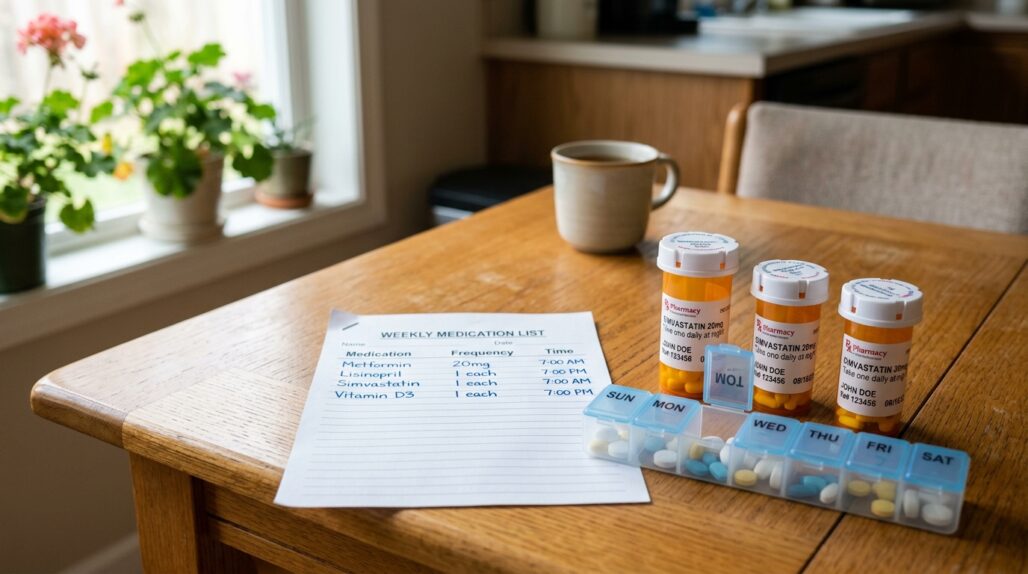
Gather every bottle, box, inhaler, patch, and supplement jar into one spot on the table. Include anything you take only occasionally, like a pain reliever or an allergy pill, because the FDA recommends listing prescriptions, over-the-counter drugs, vitamins, and supplements together. Then write a single row for each item.
Here is the template. Copy these columns onto paper, into a phone note, or into a document – the format matters more than the tool.
| Name (brand + generic) | Dose and form | When and how to take | What it is for | Prescriber / pharmacy |
|---|---|---|---|---|
| Example: Lisinopril | 10 mg tablet | Once daily, morning | Blood pressure | Dr. Reyes / Main St Pharmacy |
| Example: Vitamin D3 | 2,000 IU softgel | Once daily, with breakfast | Low vitamin D | Self / Main St Pharmacy |
| Your row | __________ | __________ | __________ | __________ |
Add two lines at the top of the page that travel with the list everywhere: your allergies and bad reactions, and the name and number of one pharmacy you want to use as your home base. Both the FDA and AHRQ point to free printable templates if you would rather start from theirs – the AHRQ "My Medicines List" wallet card is built for exactly this.
One more rule for week one: write down what each item is for, not just its name. Six weeks from now you will not remember which white tablet does what, and a list that explains itself is the one you will actually keep using.
Step 2: Add each new prescription the day it starts
This is where most lists die. You build a beautiful version on Sunday, the cardiologist changes a dose on Thursday, and by the next refill the document is fiction.
The fix is a habit, not a heroics project. Every time something changes – a new prescription, a dose adjustment, a medicine stopped – update the list that same day. The FDA's guidance is to review and update your list whenever something changes, and the first 90 days are when it changes most. Treat the moment you pick up a bag from the pharmacy as the cue to open the list before the bottle goes in the cabinet.
When you start something new, note the start date next to it. If a side effect shows up two weeks later, that date tells you and your pharmacist which change to look at first.
Step 3: Set up timing and refills so the routine holds
Now make the routine sustainable. Adherence falls as a regimen gets more complicated – the CDC has highlighted that simplifying schedules and using reminders are among the strategies that reliably help. A few low-tech moves do most of the work:
- Anchor doses to things you already do. Morning coffee, brushing your teeth, dinner. A reliable existing cue beats a brand-new one.
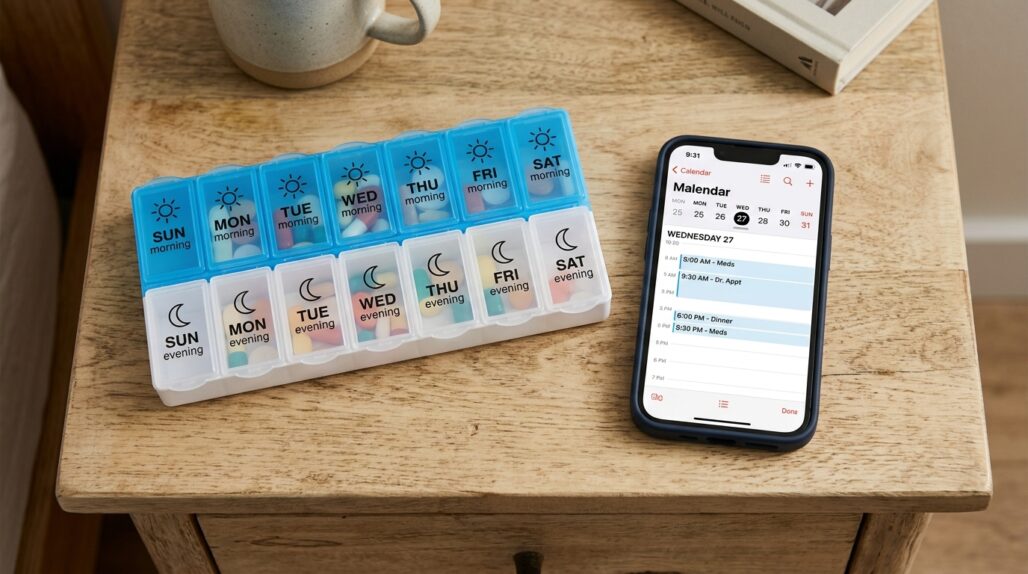
- Use a weekly pill organizer with morning and evening slots. Filling it once a week turns "did I take it?" from a daily worry into a glance at a box.
- Pick one pharmacy and sync refills. Ask whether your regular medicines can be set to refill on the same day, and whether 90-day fills make sense for the stable ones.
- Set a low-supply nudge a week out so you reorder before a bottle runs empty, especially for any medicine that should not be interrupted.
- Ask if anything can be simplified. A once-daily version or a combined pill is a question worth raising with your prescriber, not a change to make on your own.
If you are managing several medicines at once, ask the pharmacist about blister or "bubble" packaging, where each dose time is pre-sorted into a sealed pocket. For some people it removes the daily sorting step entirely.
Once the manual list exists and you have a timing plan, the only ongoing task is keeping it current as new prescriptions land. In the first weeks after a diagnosis the new prescriptions pile up fast, so the single best habit is one always-current list. You can keep that on paper or in a phone note, or if you would rather not retype every label, StackMyMed (our own free app) lets you scan each new medicine and supplement so they sit in one place as they are added – the same master-list job described above, just kept current with less typing. It organizes your stack; it does not decide what is safe to combine, so take any interaction question to your pharmacist.
Step 4: Get a pharmacist to look at the whole list
A new diagnosis is the right moment for a second set of eyes, and your pharmacist is the most accessible one. Bring the complete list – prescriptions, OTCs, and supplements – and ask three things: is anything here a duplicate, do any of these interact, and is the timing right.
Supplements belong in that conversation, not on the sidelines. The NIH Office of Dietary Supplements advises telling all your providers about every supplement you take, because supplements can interact with medicines or raise risks around certain conditions. The classic example is vitamin K and the blood thinner warfarin, where the supplement can blunt the drug. The NCCIH adds that some supplements can increase bleeding risk or affect anesthesia, so they are worth flagging well before any planned surgery. "Natural" is not the same as "safe with your new medicines," and only a professional looking at the full picture can sort that out.
Keep the list in your bag or on your phone for every appointment in these first months. When a specialist asks what you are taking, you hand over one accurate page instead of guessing. You organize the information; let your care team make the medical calls – what to start, stop, or change is theirs to decide with you.
FAQ
How fast do I really need to build the list? Within the first week if you can. Doses and prescriptions change most in the early weeks, so the sooner you start capturing them, the less you have to reconstruct from memory later.
Should supplements go on the same list as my prescriptions? Yes. The FDA and NIH both recommend keeping prescriptions, over-the-counter drugs, and supplements in one place, because anything missing from the list is invisible to the person checking for interactions.
Can I stop a medicine that seems to be causing a side effect? Do not stop a prescription on your own. Note the side effect and the start date on your list and call your pharmacist or prescriber. Some medicines need to be tapered, and stopping suddenly can cause its own problems.
What if two of my doctors gave conflicting instructions? This is common when several specialists are involved and exactly why one list helps. Bring the full list to your pharmacist or primary doctor and ask them to reconcile it; do not try to split the difference yourself.
Do I need an app to do this? No. A paper card or a phone note works completely. An app can save retyping if you take many items, but the list itself – kept accurate and carried with you – is what does the work.
How often should I update the list after the first 90 days? Update it any time something changes, and review the whole thing at least once a year, ideally with a pharmacist or at your annual check-up.
The bottom line
In the first 90 days after a diagnosis, the win is not optimization – it is one accurate, current list of everything you take, supplements included, that you keep with you. Build it this week, add each new prescription the day it starts, and set up simple timing and refills so the routine holds. Then ask a pharmacist to review the whole list for duplicates and interactions. You keep the picture organized; your prescriber and pharmacist make the medical decisions.
For more on the systems and tools mentioned here, see our guides on building a medication and supplement system, keeping a master list across multiple doctors, our drug and supplement interaction checker, and how to tell whether a loved one's supplements are safe alongside their prescriptions.
This article is for general information and is not medical advice. It does not replace a conversation with your doctor or pharmacist, who know your history and your full medication list. Do not start, stop, or change any prescription on your own.
StackMyMed is made by UsefulVitamins. It helps you organize your list and flag things to discuss with a pharmacist or doctor; it is not a diagnosis or treatment tool and does not replace professional medical advice.
Reviewed by the UsefulVitamins Editorial Team.
