
Affiliate disclosure: this article contains affiliate links. As an Amazon Associate, UsefulVitamins.com earns from qualifying purchases at no extra cost to you.
What "liposomal" actually fixes
Your gut does not absorb vitamin C in a straight line. It uses transporters that get saturated, so the more you swallow at once, the smaller the fraction that crosses into your blood.
According to the Linus Pauling Institute at Oregon State University, absorption is essentially 100% efficient at doses up to about 200 mg at a time, then drops as the dose climbs. By the time you take 1,000 mg in one sitting, roughly half of it is absorbed, and above 3 grams the absorbed fraction falls below 20%. The rest passes through and can pull water into your bowel, which is why big doses cause loose stools.
A liposome wraps the vitamin C in a tiny bubble of phospholipid (the same fatty material your cell membranes are made of). The idea is to sneak the vitamin past those saturable transporters and into the bloodstream through a different door. So the whole point of liposomal is to beat the saturation ceiling – which means it only matters when you are trying to push a lot of vitamin C in.
The honest verdict on the dose question
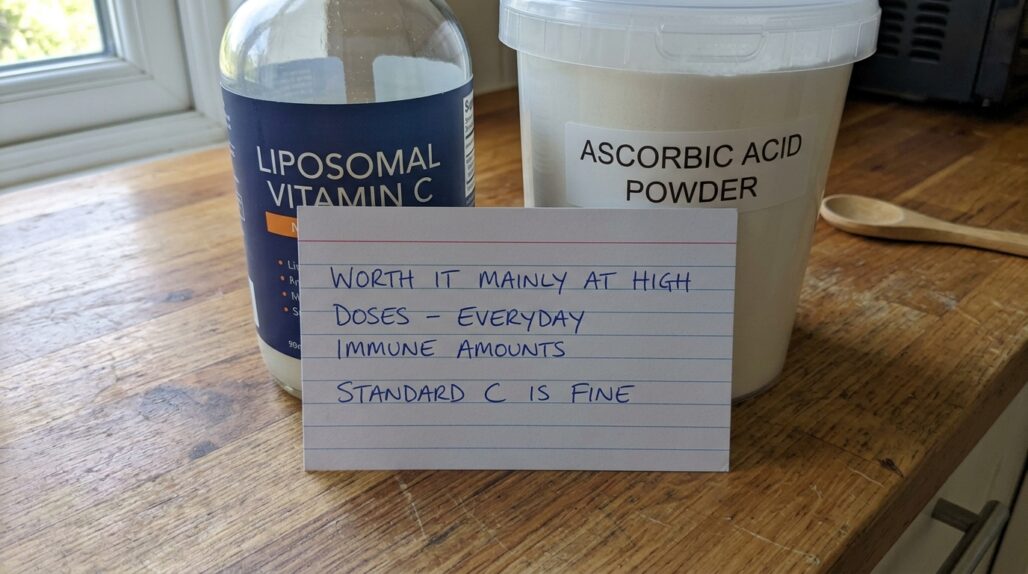
Here is the part the marketing leaves out: at the doses most people actually take, your plain ascorbic acid is already nearly fully absorbed, so there is little headroom for a fancy delivery system to improve on.
If you take 250 to 500 mg a day for general immune support, a standard tablet is already doing the job. Paying three to ten times more for liposomal to nudge an already-high absorption fraction is mostly spent on the phospholipids and the manufacturing, not on extra vitamin C reaching your cells.
The picture changes at gram-level doses. There the saturation problem is real, and that is exactly the territory where liposomal delivery has shown a measurable edge. For a side-by-side of the lab numbers behind both forms, see our deeper breakdown of how liposomal and standard vitamin C compare on bioavailability.
What the trials actually show
The cleanest recent human evidence is a randomized, double-blind, placebo-controlled crossover study published on PubMed Central. Twenty-seven adults took a 500 mg dose as either liposomal or standard vitamin C.
The liposomal version raised the peak plasma level (Cmax) by 27% and the 24-hour exposure (AUC) by about 21%, with a 20% higher peak inside white blood cells. That is a real, repeatable difference, not a rounding error.
But read those numbers carefully. A 27% bump on a 500 mg dose is a modest gain on an amount your gut already handles well. Earlier studies that showed dramatic liposomal advantages used 4 to 36 grams – doses far beyond what a daily supplement user would ever take. The benefit scales with how much you are trying to absorb, and it is largest exactly where standard C struggles most.
So liposomal is not magic. It is a tool that earns its keep when the saturation ceiling is the thing standing between you and your target blood level.
When the premium is justified
Liposomal C is worth the extra money in a few specific situations. Outside of those, the cheaper bottle is the smarter buy.
- You are deliberately taking high doses. If your plan calls for 2 grams or more a day, liposomal absorbs a larger fraction of each dose and is gentler on your gut than the same amount of plain ascorbic acid.
- Standard C upsets your stomach. Because more of a liposomal dose is taken up rather than passing into the bowel, GI-sensitive people often tolerate it better. A with-food schedule and buffered C can solve the same problem more cheaply, which we walk through in our guide to taking high-dose vitamin C without stomach upset.
- You want sustained levels. Liposomal tends to hold plasma vitamin C elevated longer rather than spiking and crashing, which some high-dose users prefer.
If none of those describe you, the plain or buffered bottle wins on value every time. Spending more does not buy more health when your absorption is already near the ceiling.

The cost-per-gram reality check
Vitamin C is one of the cheapest nutrients on the shelf, so the form you choose drives the price far more than the amount of actual vitamin C.
Plain ascorbic acid runs at pennies per gram. Liposomal typically costs three to ten times more per gram of vitamin C because you are paying for the phospholipid coating and a more involved manufacturing process. A rough real-world snapshot makes it concrete: a large bottle of standard 500 mg tablets often sells for under $10, while a much smaller bottle of 500 mg liposomal capsules can run close to $30.
Run your own target dose through our vitamin C dose calculator to see how many milligrams you actually need before you decide which form to pay for. If your number is a few hundred milligrams, the premium form is hard to justify.
| Daily target | Absorption picture | Best-value form | Is liposomal worth it? |
|---|---|---|---|
| Up to ~200 mg | Near 100% absorbed already | Standard or buffered C | No – no real upside |
| ~500 mg | Still high; modest ~27% edge in trials | Standard or buffered C | Usually not worth the cost |
| 1,000-2,000 mg | Standard absorption drops to roughly half | Liposomal or buffered C | Maybe, especially if GI-sensitive |
| Above 2,000 mg | Standard absorption falls below 20% | Liposomal (and talk to a clinician) | Yes, but this exceeds the UL |
Which form to buy
For most readers the right answer is the cheaper one. The case for trading up is narrow and dose-driven, so pick by how much vitamin C you actually plan to take rather than by the label promises.
We may earn a commission from links on this page at no extra cost to you. We only point to forms we would buy ourselves.


As an Amazon Associate, UsefulVitamins.com earns from qualifying purchases at no extra cost to you.
A quick way to choose: if your daily target sits under about 500 mg, reach for standard 1,000 mg tablets (and split them if you like) or buffered sodium ascorbate if plain C bothers your stomach. Keep the liposomal bottle for genuine high-dose use or for the days your gut refuses everything else. The form matters more than the brand here, and a deeper background sits in our complete guide to vitamin C.

Safety: the ceiling does not move
A better delivery system does not raise the amount of vitamin C your body can safely take. The NIH Office of Dietary Supplements sets the Tolerable Upper Intake Level at 2,000 mg a day for adults, based on the diarrhea and gut upset that high intakes cause. That limit applies to liposomal exactly as it does to plain C.
Two cautions matter more at gram-level doses. First, supplemental vitamin C raises urinary oxalate, and NIH advises that people prone to kidney stones consider avoiding high-dose (1 gram or more per day) vitamin C. Second, vitamin C increases iron absorption, which can be a problem if you have an iron-overload condition.
None of this is a reason to fear normal doses. It is a reason to talk to a pharmacist or doctor before living above 1 gram a day, especially with a stone history, kidney disease, or an iron disorder. Do not start, stop, or change any prescribed treatment on your own.
FAQ
Is liposomal vitamin C better absorbed than regular vitamin C? In a controlled trial it raised peak plasma vitamin C by about 27% at a 500 mg dose, so yes, modestly. The gap grows at higher doses where standard C absorption falls off, which is where the format pays off.
At what dose does liposomal vitamin C actually make sense? The benefit is largest above roughly 1 gram a day, when standard C absorption drops to about half. Under 500 mg a day, plain or buffered C is already near-fully absorbed and far cheaper.
How much more does liposomal vitamin C cost? Expect to pay roughly three to ten times more per gram of vitamin C than for plain ascorbic acid, because you are paying for the phospholipid coating and the manufacturing behind it.
Is liposomal vitamin C easier on the stomach? Often yes, because more of the dose is absorbed rather than passing into the bowel. Buffered sodium ascorbate and taking C with food can ease the same problem at a lower price.
Can I take more vitamin C because liposomal absorbs better? No. The 2,000 mg daily upper limit for adults is about safety, not absorption, and it applies to every form. Higher intakes need a clinician’s input.
Does everyone need more than the RDA? No. The RDA is 90 mg for men and 75 mg for women, and a typical diet plus a modest supplement covers most people without any premium format.
The bottom line
Liposomal vitamin C is a real technology that solves a real problem, but only the problem of squeezing high doses past your gut's absorption ceiling. At everyday immune-support amounts, your absorption is already near-complete, so the premium buys you very little.
If your target is a few hundred milligrams a day, buy plain or buffered C and pocket the difference. If you are deliberately running grams a day or your stomach rebels against standard C, liposomal is a reasonable upgrade – just respect the 2,000 mg upper limit and check with a pharmacist or doctor before going higher, especially with a kidney stone history. Run your number through the vitamin C dose calculator first, then pick the cheapest form that hits it.
This article is general education, not medical advice. Talk to a pharmacist or your doctor about your own dose, conditions, and medications before making changes.
Reviewed by the UsefulVitamins Editorial Team.
