
If you've been searching "cordyceps for energy," the direct answer is: it can modestly improve aerobic exercise tolerance after several weeks of use, but the evidence rests on one small RCT and the effect size is not comparable to creatine or even strong caffeine. This article walks through exactly what the Hirsch 2017 trial found, why the militaris-versus-sinensis distinction matters for every product you'll encounter at retail, and how cordyceps sits relative to other energy-adjacent supplements you may already be using. You'll also get a full drug-interaction picture and honest product guidance, because most cordyceps labels undercut themselves before you open the bottle.
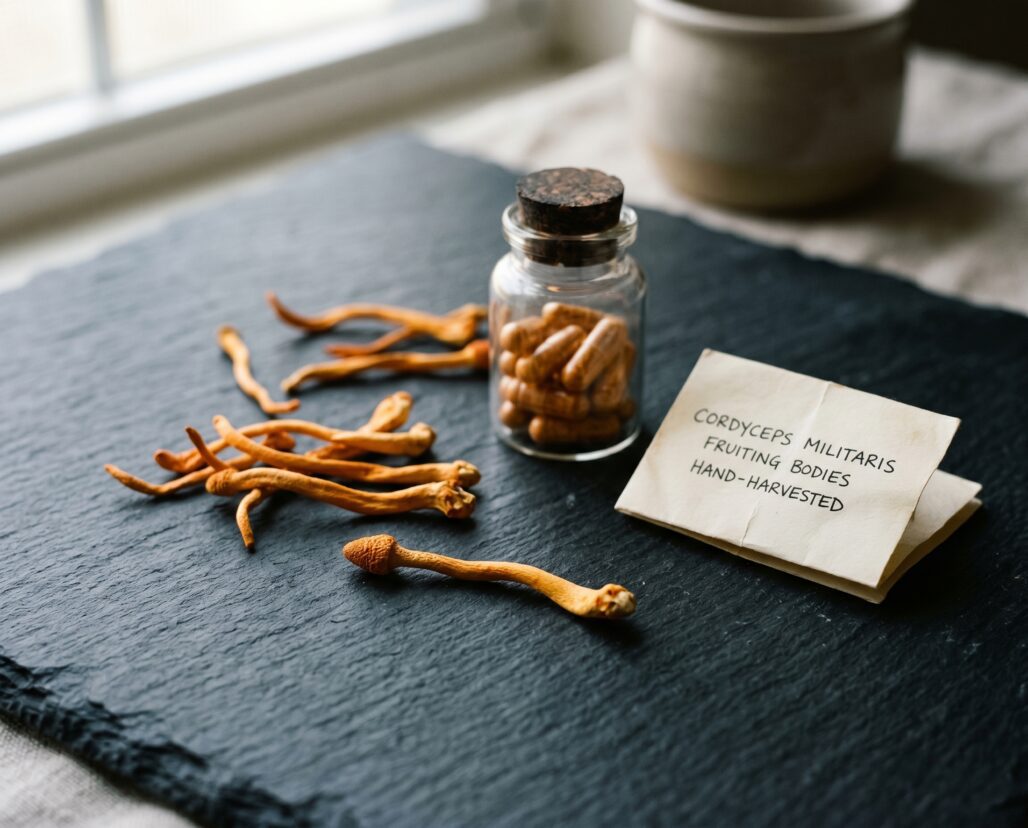
Summary: quick answer on cordyceps for energy
Cordyceps militaris supplementation at 4g/day for three weeks was associated with a statistically significant improvement in VO2max (+4.8 ml/kg/min, p=0.042) in one small double-blind RCT — but the sample completing the full protocol was ten participants, no replication trial exists, and the effect is unlikely to be meaningful to anyone not training aerobically.
Best for: Trained adults whose primary goal is aerobic endurance and who are willing to commit four weeks or more with realistic expectations. People who want a caffeine-free pre-workout adjunct with at least some human data behind it.
Not ideal for: Anyone seeking an acute energy boost. Cordyceps is not a stimulant. Effects, if present, build over weeks — not hours. Also not the right pick if your energy problem is sleep-deprivation-driven or iron-deficiency-driven.
What to check before buying: Fruiting body source (not mycelium-on-grain substrate), species confirmed as Cordyceps militaris (not a generic "cordyceps" blend), and third-party verification of cordycepin content. "Cordyceps extract" on a label tells you almost nothing.
Decision shortcut: If you are a recreational or competitive endurance athlete looking for a caffeine-free complement to your stack, the Hirsch 2017 data offers a narrow rationale. If you want to combat daily tiredness or mental fatigue, the evidence base is not there.
What you'll find in this guide
- What cordyceps actually is and which species matters
- The mechanism: cordycepin and oxygen utilization
- What the Hirsch 2017 trial actually showed
- How cordyceps compares to caffeine, creatine, and beetroot juice
- Who may benefit and who should skip it
- Dosing: what the trials used
- Side effects and drug interactions
- Product picks
- Frequently asked questions
What cordyceps is and why species matters
Cordyceps is a genus of parasitic fungi. Two species matter for supplements: Cordyceps sinensis and Cordyceps militaris, and they are genuinely different in chemistry, sourcing, and evidence profile.
Cordyceps sinensis is wild-harvested from the Tibetan plateau, where the fungus parasitizes ghost moth caterpillars. High-grade wild material commands extraordinary prices — sometimes exceeding $20,000 per kilogram. Older clinical research used CS-4, a fermented C. sinensis mycelium extract developed to sidestep those supply constraints.
Cordyceps militaris is what almost every consumer product actually contains. It grows readily in controlled laboratory conditions. Critically, C. militaris fruiting bodies contain cordycepin (3'-deoxyadenosine) at reliably measurable concentrations, while cordycepin is present in much lower quantities or absent in many CS-4 preparations. The Hirsch 2017 trial — the only well-documented exercise-focused human RCT — used a C. militaris blend, not CS-4.
A simple way to judge this: "Cordyceps sinensis CS-4" on a label means fermented mycelium extract. "Cordyceps militaris fruiting body" means lab-grown species with measurable cordycepin. "Cordyceps extract" alone tells you nothing.
In Tibetan and Chinese traditional medicine, the caterpillar fungus has been used for centuries as a fatigue and kidney tonic. But traditional use is not the same as RCT evidence, and the commercial species are not interchangeable with the wild fungi described in historical texts.
The mechanism: cordycepin and cellular energy
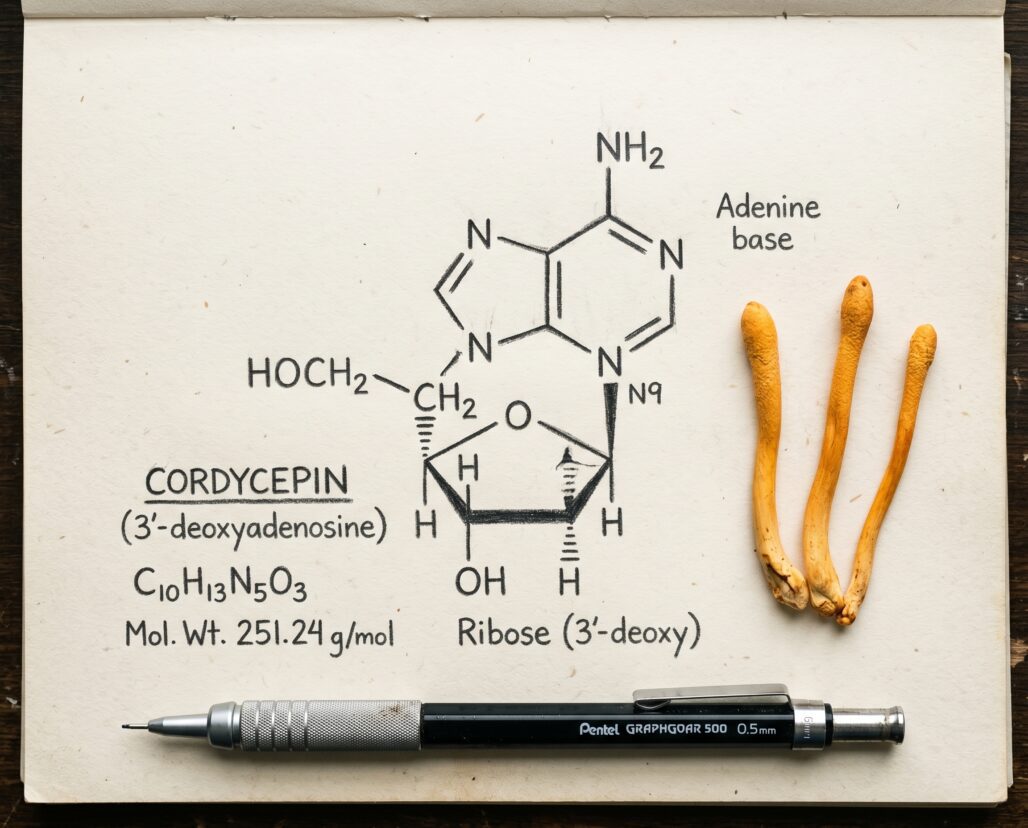
The primary active compound in Cordyceps militaris is cordycepin (3'-deoxyadenosine), a structural analog of adenosine. In cell culture and animal studies, it inhibits adenosine deaminase and influences adenosine receptor signaling. The proposed downstream effect is modulation of ATP production and oxygen utilization — cordycepin may interact with adenosine receptors involved in vasodilation, mitochondrial biogenesis, and the energy-sensing enzyme AMPK. More efficient oxygen extraction per unit of cardiac output would, in principle, raise VO2max and ventilatory threshold.
That chain is plausible but documented primarily in vitro and in animal models. The Hirsch 2017 data are consistent with the hypothesis; they are not proof of it. Oral bioavailability of cordycepin is also incompletely characterized in humans, so the dose-response relationship between a capsule and circulating levels is not as clean as the model implies.
Actionable takeaway: The mechanism is biologically coherent. It is not the kind of well-replicated human-pharmacology story that creatine or caffeine enjoys. Mechanism is the beginning of an evidence case, not its conclusion.
What the Hirsch 2017 trial actually showed
The most important human data on cordyceps and exercise comes from a 2017 randomized, double-blind, placebo-controlled trial (Hirsch et al., n=28) published in the Journal of Dietary Supplements. This is the study most cordyceps energy claims ultimately trace back to, and its design details matter considerably.
Twenty-eight recreational cyclists and runners were randomized to receive either 4 grams per day of a Cordyceps militaris mushroom blend or a maltodextrin placebo. Participants were tested at baseline, after one week of supplementation, and after three weeks. The primary outcomes were VO2max, time to exhaustion (TTE), ventilatory threshold (VT), and peak power output on a graded cycle ergometer protocol.
After one week of supplementation, no statistically significant differences were observed between groups on any primary outcome (interaction p values ranged from 0.364 to 0.823). After three weeks, the mushroom group showed a statistically significant increase in VO2max compared to the placebo group (+4.8 ml/kg/min versus +0.9 ml/kg/min, p=0.042). Time to exhaustion improved by 69.8 seconds at three weeks in the treatment group versus a smaller change in placebo.
What the trial cannot tell you
Only ten of the original 28 participants completed the full three-week phase. The critical VO2max result comes from n=10. That is a small number from which to draw confident conclusions, and no independent replication study has since been published. The mushroom blend used was not a standardized fruiting body extract with disclosed cordycepin content.
The real question isn't whether cordyceps works in a small cohort of recreational athletes — it's whether the effect replicates in larger, better-powered trials. As of 2026, that replication has not arrived.
Actionable takeaway: Hirsch 2017 is peer-reviewed, properly controlled, and worth taking seriously. It is also small and preliminary. Hold it to that standard.
How cordyceps compares to other energy options
Caffeine works via adenosine receptor antagonism — opposite to cordyceps' proposed modulation pathway. The effect is acute, onset within 30-60 minutes, and the evidence base is among the strongest in sports nutrition. The trade-off: tolerance builds and withdrawal is real. Cordyceps produces no acute stimulant effect and carries no withdrawal liability. Different tools for different problems.
Creatine monohydrate has a far stronger evidence base for muscle endurance and repeated high-intensity effort. Multiple meta-analyses confirm 2-5% improvements in maximal strength and short-duration power output. If your goal is muscular endurance or HIIT performance, creatine is simply the better-evidenced choice.
Beetroot juice (dietary nitrate) drives aerobic benefit via nitric oxide production from nitrate converted by oral bacteria, improving muscle oxygen efficiency. Several well-powered RCTs support a modest aerobic effect, particularly at sub-maximal intensities. The mechanism is similar in concept to cordyceps' proposed oxygen-utilization effect but is better documented in humans, and beetroot juice costs significantly less per dose.
Cordyceps sits below both creatine and beetroot juice in evidence quality for performance. Its argument is a caffeine-free aerobic adjunct with a distinct mechanism and a preliminary human RCT behind it.
Who may benefit and who should skip it
Reasonable fit: Recreational or competitive endurance athletes whose primary goal is aerobic capacity, who have addressed sleep and dietary deficiencies, and who are willing to commit three-plus weeks. The Hirsch 2017 cohort profile is the closest approximation of who has actual human data behind them.
Skip if: Your energy problem is driven by poor sleep, iron deficiency, or B12 deficiency — none of which cordyceps addresses. Skip if you are on anticoagulants, diabetes medications, or immunosuppressants without physician clearance. Skip if you need an effect today.
Note on elite athletes: The Hirsch 2017 cohort was recreational exercisers. The closer someone is to their aerobic ceiling, the smaller the headroom for any supplement to move the needle.
| Who it may suit | Who should hold off |
|---|---|
| Recreational endurance athletes, ≥3 weeks commitment | People with acute fatigue from poor sleep or deficiency |
| People seeking caffeine-free aerobic support | Athletes on anticoagulants or immunosuppressants |
| Adults comfortable with preliminary evidence | Anyone expecting a stimulant or same-day effect |
| Stacking with creatine or beetroot juice | Pregnant or nursing individuals (no safety data) |
Dosing: what the clinical trials used
In the Hirsch 2017 RCT, participants consumed 4 grams per day of a Cordyceps militaris mushroom blend (Hirsch et al., 2017). Effect emerged at three weeks, not one. That suggests a minimum three-week commitment is required before any exercise benefit might appear.
Older CS-4 (Cordyceps sinensis mycelium) trials in elderly Chinese adults, referenced by Memorial Sloan Kettering's integrative medicine program, used 3 to 6 grams per day. CS-4 and C. militaris differ in active compound composition; dose equivalence between them cannot be assumed.
The 4g/day figure from Hirsch 2017 is the only human reference point for C. militaris and exercise. No dose-response study has established a minimum effective dose. Most trial participants took cordyceps once or twice daily with food. No human trial has established superiority of pre-workout versus general daily timing.
Side effects and drug interactions
Cordyceps is generally well tolerated in clinical trials, with no major adverse events in the Hirsch 2017 protocol. Mild gastrointestinal discomfort has been noted at higher doses. One case report documented excessive post-extraction bleeding in a patient taking cordyceps.
Drug interactions
The following draws from Memorial Sloan Kettering's integrative herbs database:
Anticoagulants (warfarin, heparin, direct oral anticoagulants): Cordyceps may increase bleeding risk. Anyone on blood thinners should not add cordyceps without physician clearance.
Diabetes medications (insulin, metformin, sulfonylureas): Cordyceps has demonstrated blood glucose-lowering effects. Adding it to an existing glucose-lowering regimen may increase hypoglycemia risk.
Immunosuppressants (tacrolimus, cyclosporine, mycophenolate): Cordyceps has demonstrated immune-modulating activity in preclinical studies. Clinical implications for transplant patients are not characterized; the risk is unquantified.
Fungal allergies: Isolated case reports describe asthma-like symptoms in individuals with fungal sensitivities. People with known mold or fungal allergy should exercise caution.
Pregnancy and breastfeeding: No adequate human safety data exists. Use during pregnancy should be deferred until data are available.
Actionable takeaway: Healthy adults with no current medications face a limited interaction profile. The interaction risk is meaningful for anyone on anticoagulants, glucose-lowering drugs, or immunosuppressants. Flag it with your prescriber.
Product picks
Cordyceps products vary significantly in what they actually deliver. Two brands consistently cited in third-party quality reviews stand above the generic market:
{{AMAZON_CARD: Real Mushrooms Cordyceps}}
Real Mushrooms Cordyceps is among the more transparent entries in the consumer market. The product uses Cordyceps militaris fruiting body (not mycelium-on-grain), discloses beta-glucan content, and publishes third-party certificate-of-analysis data. The brand's ethos of "fruiting body only" is directly relevant given the militaris-vs-sinensis and fruiting-body-vs-mycelium distinctions above. Skip if you want a very low per-dose cost; this sits at the premium tier.
{{AMAZON_CARD: Host Defense Cordyceps}}
Host Defense Cordyceps by Paul Stamets uses Cordyceps militaris mycelium grown on organic brown rice. The brand is among the most widely reviewed in independent testing. The mycelium-on-grain format means the product contains some grain substrate alongside the fungal material; the ratio is not disclosed per dose. For consumers prioritizing brand reputation and accessibility over pure fruiting-body standardization, it remains a credible option.
Frequently asked questions
Does cordyceps actually give you energy?
Not in the way caffeine does. Cordyceps is not a stimulant and produces no acute effect. In the Hirsch 2017 RCT, improvements in VO2max were observed after three weeks of daily supplementation, not after a single dose. If you are looking for an energy effect within hours of taking a pill, cordyceps is the wrong tool.
What is the difference between Cordyceps militaris and Cordyceps sinensis?
Cordyceps sinensis is the wild Tibetan species historically used in TCM. It is extremely expensive and commercially impractical; most research used a fermented mycelium extract called CS-4, which is not the same as the wild fungus. Cordyceps militaris is the lab-grown species in virtually all current consumer products. It contains measurable cordycepin, the proposed active compound for energy effects. They share a genus but differ in chemistry, sourcing, and evidence profile. Most products labeled simply "cordyceps" or "cordyceps sinensis" at mainstream retail prices are likely C. militaris, regardless of what the label implies.
Is cordyceps safe to take every day?
In clinical trials, daily use for one to three weeks was well tolerated in healthy adults. Longer-term safety data in humans is limited. The more important safety question is not duration in a healthy adult but whether you are on medications that interact with cordyceps — anticoagulants, diabetes medications, or immunosuppressants specifically.
How long before cordyceps works for exercise?
Based on Hirsch 2017, one week produced no statistically significant improvement; three weeks was the threshold at which VO2max effect emerged. A minimum three-to-four-week trial is warranted before concluding whether cordyceps is producing a benefit for aerobic performance.
Does cordyceps help with mental energy or focus?
No human RCT as of 2026 has tested cordyceps specifically for cognitive performance, mental energy, or focus. The Hirsch 2017 trial was strictly an aerobic exercise trial. Any claims about cordyceps improving mental clarity rest on anecdote or animal models, not human clinical evidence.
As an Amazon Associate, I earn from qualifying purchases. Product recommendations are based on real reviews and independent research.
Related reading
- Medicinal Mushrooms: the Complete Guide to Lion's Mane, Reishi, Cordyceps, and More — the parent guide to this cluster, covering all major medicinal mushrooms and how to evaluate evidence across the category.
- Rhodiola for Energy: How the Adaptogen Performs Against Caffeine and B-Vitamins — direct comparison for energy-seeking readers: rhodiola's SHR-5 data versus cordyceps' Hirsch 2017 findings.
- Reishi for Sleep: What the Human Trials Actually Show — if rest quality is the underlying driver of your fatigue, the reishi sleep evidence is worth reading before defaulting to an energizer.
Conclusion: the bottom line on cordyceps for energy
One properly designed, double-blind human RCT — Hirsch 2017 — found that three weeks of Cordyceps militaris at 4g/day produced a statistically significant improvement in VO2max in recreational exercisers. The effect size was meaningful in relative terms (+4.8 ml/kg/min). The study limitation is significant: n=10 completed the chronic phase, and no independent replication exists.
Buying mushroom supplements without verifying species, plant part, and cordycepin content is like buying olive oil labeled "Mediterranean blend" — the label tells you everything except what is inside. Cordyceps militaris fruiting body from a brand that publishes third-party testing is a different product from a generic "cordyceps 500mg" capsule of unknown origin.
The energy use case for cordyceps is narrower than the marketing suggests: aerobic endurance support, caffeine-free, over weeks rather than hours, with preliminary evidence and an acceptable safety profile in healthy adults. It is not a fatigue cure, not a stimulant, and not remotely comparable to creatine or even dietary nitrate for magnitude of effect.
Next steps:
- If aerobic performance is your primary goal, read the Medicinal Mushrooms: the Complete Guide for broader context on where cordyceps fits relative to other mushroom supplements.
- If your fatigue is stress-driven rather than exercise-driven, Rhodiola for Energy covers the adaptogen with the strongest fatigue-specific RCT data.
- Before buying, confirm the label says Cordyceps militaris, fruiting body, with disclosed beta-glucan or cordycepin content. Anything less is guessing.
This article is for informational purposes and not medical advice. Herbal adaptogens — even traditional ones — can interact with thyroid medication, antidepressants, anticoagulants, immunosuppressants, blood-pressure drugs, and more. Consult a licensed physician before starting any adaptogen, particularly if you are pregnant, nursing, taking prescription medications, or managing a chronic condition.
As an Amazon Associate, I earn from qualifying purchases. Product recommendations are based on real reviews and independent research.
