
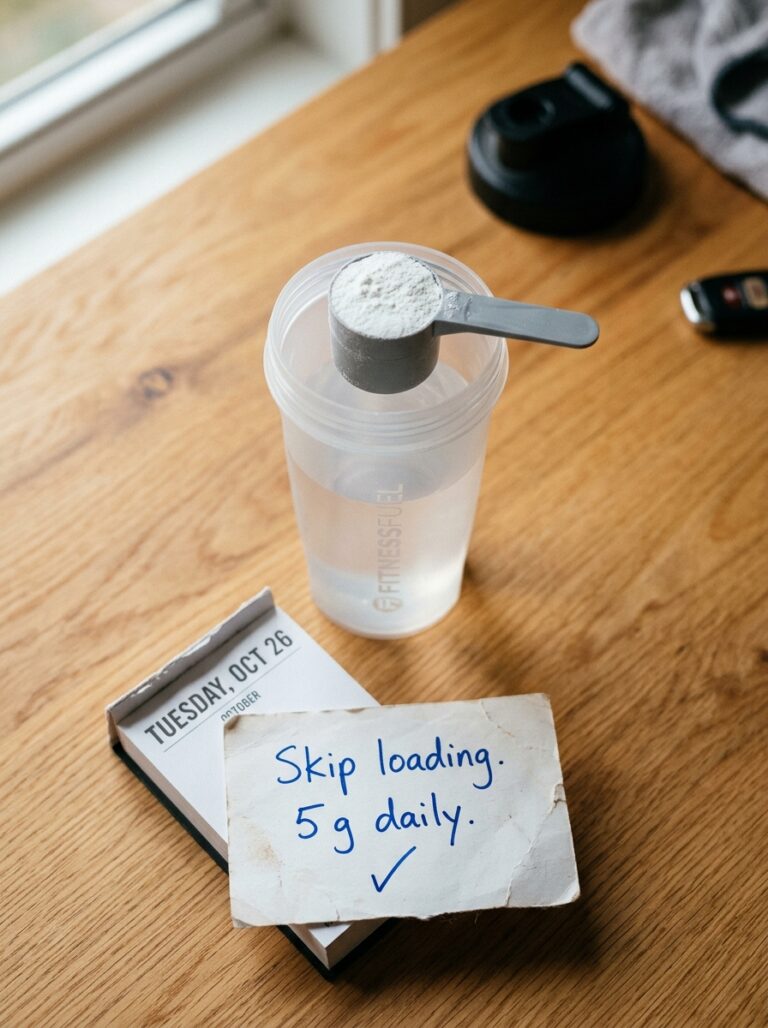
Almost every creatine label still prescribes a ritual: take 20 grams a day for the first week, split into four doses, then drop to a maintenance scoop. That loading phase has been on tubs for decades, and a lot of people assume it's the only way the supplement "works." It isn't.
The loading phase is a speed setting, not a requirement, and for most people the slower route gets you to the exact same place with less bloating and less fuss. This guide walks through what loading actually does, when it's worth it, and which timing details matter once you've decided.
Before you decide

A few people should clear creatine with a clinician before starting. If you have chronic kidney disease, reduced kidney function, or a single kidney, talk to your doctor first; creatine raises serum creatinine as a normal byproduct of its metabolism, which can muddy the standard blood marker used to monitor kidney health, so your physician should know you're taking it before reading those labs.
The same caution applies if you take medications that affect the kidneys, are pregnant or breastfeeding, or are managing a diagnosed medical condition. Creatine is one of the most studied sports supplements there is and has a strong safety record in healthy people, but none of that replaces individualized medical advice. You can see how I weigh evidence and conflicts of interest on the how we review supplements page.
If none of that applies, the decision in front of you is narrow. It is not "should I take creatine" but "how fast do I want my muscle stores full, and am I willing to trade a week of higher doses for that speed." Understanding that trade requires a quick look at what's actually happening inside the muscle.
What loading is actually doing

Your muscles store creatine as a mix of free creatine and phosphocreatine, the latter being the rapid-recharge fuel for short, hard efforts. In an unsupplemented person eating a typical mixed diet, those stores sit somewhere below their ceiling.
Dietary creatine comes mostly from meat and fish, so omnivores arrive with fuller stores than vegetarians, who tend to have more headroom and often respond more noticeably. The point of any creatine protocol, loading or not, is the same: top those stores up to their saturation ceiling and keep them there.
The foundational study on this is Hultman and colleagues, published in the Journal of Applied Physiology in 1996. They compared a rapid loading protocol of 20 g/day for six days against a slow protocol of 3 g/day for 28 days.
Both raised total muscle creatine by roughly the same amount, about 20 percent. The fast protocol just got there in under a week instead of a month. They also showed that once stores were filled by loading, a small maintenance dose of around 2 g/day was enough to hold them there.
That single study explains the whole loading debate. Loading is not more effective; it is faster. The muscle reaches the same plateau either way, because there's a ceiling and you can't push creatine past it. Once you understand that the destination is fixed, the only real question is your timeline.
Loading versus no-loading: the honest comparison
Here is the trade laid out directly. Both columns end at full saturation. They differ in how long that takes, how much powder you use up front, and how your gut feels during the first week.
| Factor | Loading phase | No loading (daily 5 g) |
|---|---|---|
| Protocol | ~20 g/day (0.3 g/kg) split into 4 doses for 5 to 7 days, then 3 to 5 g/day | 5 g/day, every day, from the start |
| Time to full saturation | About 5 to 7 days | About 28 days |
| Final muscle creatine level | Same ceiling | Same ceiling |
| GI side effects | More likely (bloating, loose stools) from large single doses | Uncommon at 5 g |
| Powder used in month 1 | Higher (front-loaded) | Lower and even |
| Best for | A near-term event where you want stores full within a week | Almost everyone else |
The International Society of Sports Nutrition lays out both as legitimate options in its 2017 position stand on creatine, and is explicit that the faster way to saturate is the loading protocol while a lower daily dose reaches the same point over about three to four weeks.
A more recent expert review put it even more plainly: you do not have to load, and 3 to 5 g/day is effective for raising intramuscular creatine and supporting training adaptations.
So who should actually load? The honest answer is a small group: someone with a meaningful event four to seven days out who wants stores topped up immediately, or someone who simply doesn't want to wait a month to feel the effect.
For everyone else, including most people starting creatine to support a long-term training habit, the daily 5 g approach is simpler, gentler on the gut, and arrives at the identical result. As a dietitian, my default recommendation is the unglamorous one: skip the loading theater and just take 5 g a day.
Why 5 g a day is the maintenance number

The 3 to 5 g/day figure isn't arbitrary. Your body turns over roughly 1 to 2 percent of its creatine pool daily, converting it to creatinine that you excrete in urine, and dietary intake from meat and fish replaces only part of that.
A 5 g daily dose comfortably covers the turnover and keeps a saturated muscle topped off, which is why the NIH Office of Dietary Supplements describes a common maintenance dose in the 3 to 5 g/day range. For a smaller person, the lower end is fine; the dose scales loosely with body mass at about 0.1 g/kg.
There's a nutritional reality worth naming here. A typical omnivorous diet supplies only about 1 to 2 g of creatine a day from animal foods, and cooking degrades some of it, so you can't realistically eat your way to a supplemented level without large quantities of meat.
That gap is exactly the case where a supplement earns its place: it closes a requirement the diet doesn't cover, rather than stacking on top of an intake that's already met. Vegetarians and vegans, who get almost no dietary creatine, tend to start with lower stores and often notice the supplement more.
A note on the maintenance dose after loading: Hultman's data showed that 2 g/day was enough to sustain stores once they were full, but most current guidance rounds maintenance to 3 to 5 g/day for everyone, loaded or not, because the slightly higher number provides a buffer and keeps the routine simple. There's no benefit to taking more than 5 g once you're saturated; the excess is simply excreted.
Timing: pre-workout, post-workout, or with carbs
Once you've decided on a dose, the timing questions tend to follow. The reassuring answer is that for daily saturation, the time of day barely matters.
Creatine works by accumulating in muscle over days and weeks, not by an acute pre-workout spike, so the single most important habit is taking it every day. A dose you take consistently at breakfast beats a perfectly timed pre-workout dose you forget half the time.
That said, two timing details have some evidence behind them and are worth a brief look.
Pre versus post workout. A 2013 study by Antonio and Ciccone gave recreational bodybuilders 5 g of creatine either before or after training for four weeks and found a modest edge for the post-workout group in fat-free mass and bench-press strength.
It's a small, short study, so I wouldn't overweight it, but if you're going to take creatine around training anyway, taking it after your session is a reasonable, low-cost default. The larger point from the position stand literature is that total daily intake and consistency drive the result far more than the exact clock time.
With carbohydrate. This one has clearer mechanistic support. Green and colleagues showed in 1996 that ingesting creatine alongside a substantial dose of carbohydrate increased muscle creatine accumulation by roughly 60 percent more than creatine alone, an effect that appears to be insulin-mediated.
The practical caveat is dose: that study paired each 5 g of creatine with around 90 g of carbohydrate four times a day, which is a lot of sugar. In real life, simply taking your creatine with a normal carb-containing meal is enough to benefit from the same mechanism without the sugar load, and it matters most during a loading phase when uptake speed is the goal. At steady maintenance, a saturated muscle is saturated regardless.
What happens when you stop (washout)
Creatine isn't permanent. If you stop taking it, muscle stores gradually fall back toward your natural baseline as daily turnover continues unreplaced. In Hultman's washout data, total muscle creatine had returned to pre-supplementation levels about 30 days after stopping, with urinary creatinine excretion rising as the stores cleared.
That slow decline is why there's no need to "cycle" creatine with deliberate on-and-off periods; the ISSN position stand finds no requirement for cycling in healthy users. If you take a break, you simply drift down over a month, and when you resume you saturate again. There's no rebound penalty and no withdrawal.
FAQ
Do I have to load creatine for it to work?
No. Loading only saturates your muscle faster. A daily 5 g dose reaches the same full saturation in about four weeks, which is fine for almost everyone who isn't racing a deadline.
Will I lose my progress if I skip a day?
A single missed day is negligible. Because turnover is only 1 to 2 percent a day, stores stay essentially full as long as you're consistent over the week. It takes about a month off entirely to fully wash out.
Is it better to take creatine before or after a workout?
The difference is small. One study favored post-workout for fat-free mass and strength, but total daily intake and consistency matter far more than timing. Take it whenever you'll remember.
Should I take creatine with carbs or protein?
Taking it with a normal carb-containing meal can modestly improve uptake through an insulin effect, which is most useful during loading. At maintenance it isn't necessary, so don't add sugar just for this.
Does creatine need to be cycled on and off?
No. There's no evidence cycling is necessary or beneficial in healthy users. If you stop, stores decline over about a month; if you continue, you stay saturated.
The bottom line on creatine timing
The loading phase printed on the tub is a holdover, not a rule. It does one thing, which is fill your muscle stores in a week instead of a month, and it comes with more powder used up front and a higher chance of gut complaints.
For the overwhelming majority of people, taking 5 g of creatine monohydrate every single day is the simpler and equally effective choice; you reach the same saturation ceiling, just a few weeks later. Reserve loading for the genuine edge case of a near-term event.
On timing, the honest message is to relax about it. Consistency is the lever that matters, taking it with a meal helps uptake a little, and post-workout is a fine default if you want one.
If you're choosing a product, creatine monohydrate is the form with the deepest evidence base, and I compare it to the pricier alternatives in creatine monohydrate vs HCl vs buffered. For the full picture on what creatine does, who benefits, and how to evaluate it, start with the complete guide to creatine.
Reviewed by Sarah Thompson, Registered Dietitian, focused on vitamin and mineral nutrition. See more from Sarah Thompson. This article is educational and is not a substitute for individualized medical advice; talk to your doctor before starting a supplement, especially if you have kidney concerns, are pregnant, or are managing a diagnosed condition.
