

Why perimenopause routines fall apart
Perimenopause throws a lot at you at once. Sleep gets choppy, moods swing, hot flashes show up at odd hours, and energy dips. It is tempting to answer all of it with a cabinet full of bottles, and that is usually where the trouble starts.
Two things break most routines. The first is consistency: a supplement you take only when you remember will not give you a clean read on whether it works. The second is guesswork: when you start three things at once, you have no way to know which one (if any) earned its place.
This guide walks through building a small, steady routine and tracking it well enough that you can actually answer the question you care about, which is "is this helping me." None of it requires an app, a subscription, or buying anything. A notebook and a pen will do.
One honest note before you spend money. Major health bodies are cautious here. The National Center for Complementary and Integrative Health says dietary supplements have not been clearly shown to relieve menopause symptoms, and a Harvard Health review notes that for hot flashes, many supplements perform no better than a placebo. That does not mean nothing helps you personally. It means the evidence is mixed, so tracking your own response matters more than the marketing on the label. If you want to know how we weigh that evidence, our review approach lays it out.
Start with the symptom, not the shelf
Do not start by asking "which supplements should I take for perimenopause." Start by naming the one or two symptoms that bother you most this month. A routine aimed at a target beats a pile of bottles aimed at "menopause" in general.
The common perimenopause targets people try to support are sleep, mood, hot flashes, bone health, and energy. The evidence behind individual supplements varies a lot from one target to the next, so treat each as something to test for yourself rather than a sure thing.
- Sleep and muscle relaxation: Magnesium is a common pick. Our complete guide to magnesium covers forms, amounts, and what the research does and does not support.
- Hot flashes: Black cohosh comes up often. NCCIH describes the evidence as inconsistent and flags rare reports of liver injury, so it is worth a conversation with a clinician first (more on that below).
- Mood and overall bother: Mind-body approaches tend to have a better safety record than supplements. NCCIH notes that yoga, mindfulness, and hypnotherapy showed some benefit for how bothersome symptoms felt, with fewer risks.
Pick one target. Choose at most one supplement to try for it. You can always add later, deliberately, once you know what the first one did.
For a fuller framework on resisting the urge to keep adding, the supplement self-audit is a good companion to this page.
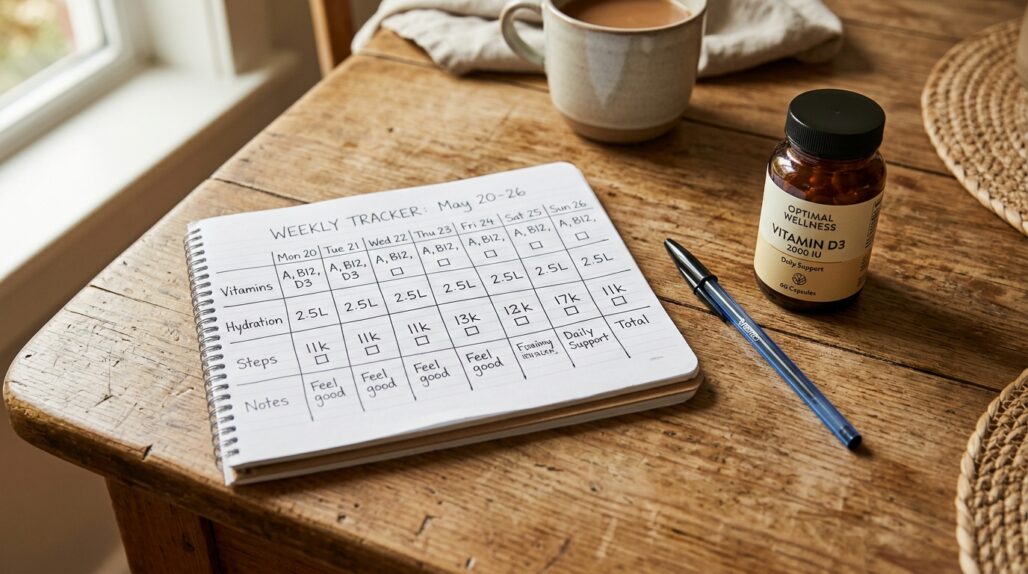
The one-variable rule (and a printable you can copy)
Here is the core idea: if you start several things at once and feel better, you will never know which one did it, or whether you would have improved anyway. So you change one thing at a time and give it a fair trial before judging.
A fair trial usually means weeks, not days. Many people use a 4 to 12 week window, depending on the symptom. Sleep changes may show up sooner; mood and hot-flash patterns often need longer because they swing on their own.
You do not need an app to do this. Copy this template into a notebook or onto a single sheet taped inside a cabinet door. Fill in one row a day.
| Date | What I am testing | Sleep (1-5) | Hot flashes (count) | Mood (1-5) | Notes |
|---|---|---|---|---|---|
| Apr 1 | Magnesium, fixed 9pm | 2 | 4 | 3 | Baseline, before starting |
| Apr 8 | Magnesium, fixed 9pm | 3 | 4 | 3 | Falling asleep a little faster |
| Apr 22 | Magnesium, fixed 9pm | 4 | 3 | 4 | Sleep steadier this week |
Three pointers make this far more useful:
- Take a baseline first. Score yourself for a few days before you start anything. Without a "before," there is nothing to compare the "after" to.
- Score the same way every time. Pick a simple 1-to-5 scale for sleep and mood, and a plain count for hot flashes. Consistency in how you measure matters as much as the number itself.
- Write the start date down. Knowing exactly when you added something lets you line up any change with the right item later.
If after a fair trial nothing has moved, the useful move is to stop that supplement rather than stack a second one on top of it. Our walkthrough on telling whether a supplement is working before you add another goes deeper on reading your own results.
One caveat worth keeping in mind: some effects are quiet. Correcting a genuine deficiency, for example, may not feel like anything day to day. For those, bloodwork ordered by your doctor is the real read, not your symptom diary.
Make consistency the easy part
A routine only tells you anything if you actually follow it. This is the make-or-break, and it is also the most fixable.
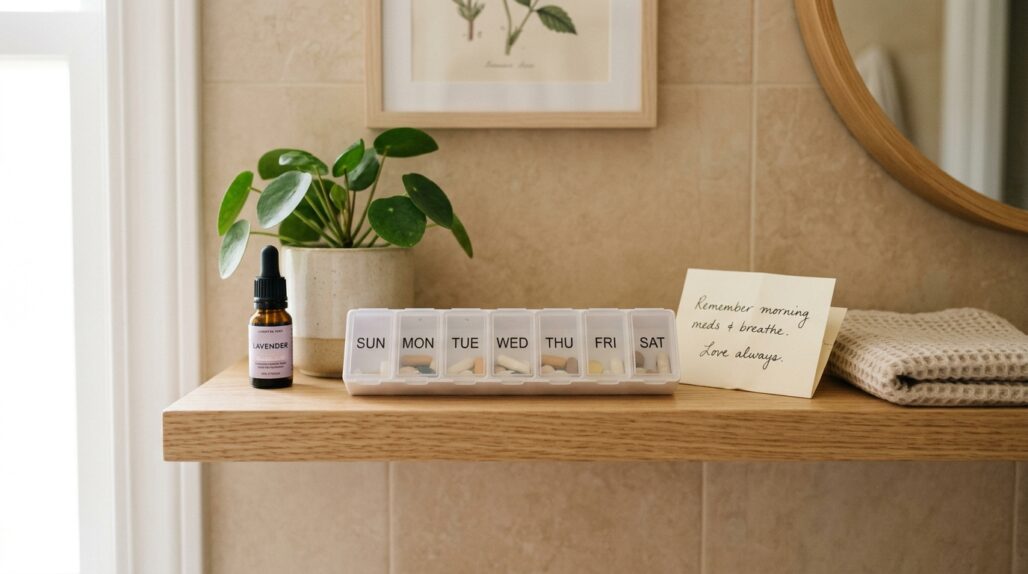
Tie the supplement to something you already do at the same time every day. Brushing your teeth, the first coffee, switching off the bedside lamp. A fixed slot beats willpower. A weekly pill organizer filled on Sunday turns "did I take it" into a glance, and a low-tech backup like a sticky note on the bathroom mirror covers the days your brain is elsewhere.
Once your manual method is running and you want a daily nudge that timestamps each addition, you can keep it on paper or, if you would rather have it on your phone, log it in StackMyMed (our own free app); it sends a daily reminder and records the date you added each item, so when a symptom shifts you can match it to the supplement you started, and you can bring that same list to a pharmacist to flag anything worth checking against your medications. A phone alarm plus the paper chart above does the same job if you prefer to skip the app entirely. Either way, the point is the same: take it at the same time, and write down when you started.
Safety: the part to run by a professional
This is the section to slow down on, because perimenopause often overlaps with new or existing prescriptions.
Two interaction patterns come up constantly:
- Mineral spacing. Calcium, iron, and magnesium can bind certain medications in the gut and reduce how much you absorb. With levothyroxine for the thyroid, the NIH Office of Dietary Supplements and standard pharmacy guidance recommend separating these minerals from the medication by about 4 hours. The fix is timing, not stopping either one.
- St. John's wort. Sometimes tried for low mood, it speeds up how the body clears many drugs and can reduce the effectiveness of hormonal contraception and other medications. This is a clear "ask first" item.
A few more ground rules:
- Black cohosh and your liver: NCCIH notes rare reports of liver injury. Watch for dark urine, unusual fatigue, or yellowing skin, and contact a clinician if they appear. It is also not advised in pregnancy or for some hormone-sensitive conditions.
- Supplements are not pre-tested for safety: The FDA does not approve dietary supplements before they are sold; the company is responsible for safety and labeling. "Natural" does not mean "harmless," and it does not mean "no interactions."
Your pharmacist is the most accessible expert here, and the visit is usually free. Bring your full list, supplements included. Some perimenopause symptoms also have medical options well beyond supplements, including non-hormonal prescriptions and hormone therapy, which is a conversation for your doctor. Never stop or change a prescription on your own to make room for a supplement.
FAQ
How long before I know if a perimenopause supplement is working? Give it a fair trial, often 4 to 12 weeks, and compare against the baseline you recorded before starting. Sleep effects may appear sooner; mood and hot-flash patterns usually need longer because they fluctuate on their own.
Can I just start two or three supplements together to save time? You can, but you lose the ability to tell which one helped, or whether any did. Adding one at a time is slower and far more informative. If you feel better, you will know what to credit.
Is magnesium safe to take during perimenopause? Many people use it, commonly for sleep. The main practical issue is spacing it away from medications it can bind, such as thyroid medication, by about 4 hours. Confirm the right amount and timing for you with a pharmacist, especially if you take other medicines.
Does anything actually work for hot flashes? The supplement evidence is mixed, and several options perform no better than placebo in studies. That is exactly why personal tracking helps. If hot flashes are disrupting your life, ask your doctor, since there are medical options beyond supplements.
What if a supplement does nothing after a fair trial? Stop it rather than adding a second one on top. A routine that keeps growing is harder to follow and harder to read, and you may be paying for things that are not doing anything.
Do I need to tell my doctor about supplements if they are not prescriptions? Yes. Supplements can interact with medications and affect how some are absorbed. Keep one current list of everything and bring it to every appointment so your care team sees the whole picture.

The bottom line
A perimenopause supplement routine works when it is small, steady, and tracked. Name your top symptom, try one thing at a time against a written baseline, and take it at the same time every day so the result means something. If something does not help after a fair window, drop it instead of stacking another bottle on top.
The single most important step is the simplest one: keep one current list of everything you take, supplements and medications together, and review it with your pharmacist or doctor. They can flag interactions, tell you whether a supplement is worth your money, and point you toward medical options when a symptom needs more than a supplement.
This article is for general information and is not medical advice. It does not replace a conversation with your own doctor or pharmacist, who know your health history and medications. Do not start, stop, or change any medication or supplement based on this page alone.
StackMyMed is made by UsefulVitamins. It helps you organize your list and flag things to discuss with a pharmacist or doctor; it is not a diagnosis or treatment tool and does not replace professional medical advice.
Reviewed by the UsefulVitamins Editorial Team.
