
Affiliate disclosure: this article contains affiliate links. As an Amazon Associate, UsefulVitamins.com earns from qualifying purchases at no extra cost to you.
What the omega-3 index actually measures
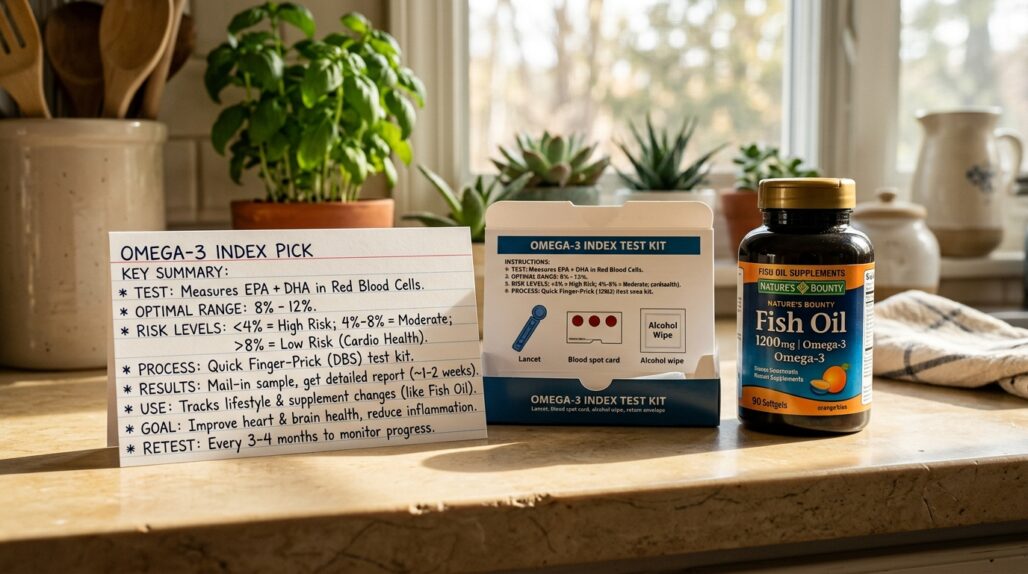
The omega-3 index is the combined amount of two long-chain omega-3 fats, EPA and DHA, expressed as a percentage of all the fatty acids in your red blood cell membranes. Because red cells turn over slowly, the number reflects roughly the last three to four months of intake rather than what you ate yesterday. That makes it a steadier marker than a single fasting blood draw of plasma omega-3.
The widely cited target comes from the research group behind the original test. They sort results into three bands: a desirable range of 8 to 12 percent, an intermediate range of 4 to 8 percent, and an undesirable range below 4 percent, per OmegaQuant's interpretation guidance. The original cardiovascular work behind the index, summarized in a 2014 review by von Schacky on PMC, framed a higher index as a lower-risk pattern.
Two honest caveats sit beside that target. First, the 8 percent figure is a risk-association threshold from observational and mechanistic work, not a number any major guideline body tells the general public to chase. Second, the supplement trials are mixed. The 2020 Cochrane review of over 160,000 people across 86 trials found little or no effect of omega-3 supplements on overall mortality or major vascular events, with the clearest signal being a modest drop in triglycerides. The 2017 American Heart Association advisory reached a similar place: it did not back fish-oil supplements for preventing heart disease in the general population, while still recommending fish in the diet. So treat the index as a useful, trackable nutrition number, not a guarantee of any clinical outcome.
Why you cannot guess this number from your dose
Two people can take the same 1,000 mg of EPA plus DHA each day and land at very different index values. Absorption, the form of the fish oil, body size, baseline diet, genetics, and how consistently you actually take the capsules all move the result. The whole point of measuring is that the input does not predict the output.
There is a rough rule of thumb worth knowing. OmegaQuant cites work suggesting someone starting near 4.9 percent and taking about 840 mg of EPA plus DHA daily reaches an index around 6.5 percent after roughly 13 weeks. That is an average, not a promise, and it is exactly why a re-test beats guesswork. If you want to estimate a starting dose to aim for, our omega-3 EPA and DHA calculator gives a ballpark, and the form you choose matters too, which we cover in the breakdown of triglyceride versus ethyl ester versus krill bioavailability.
The three at-home tests compared
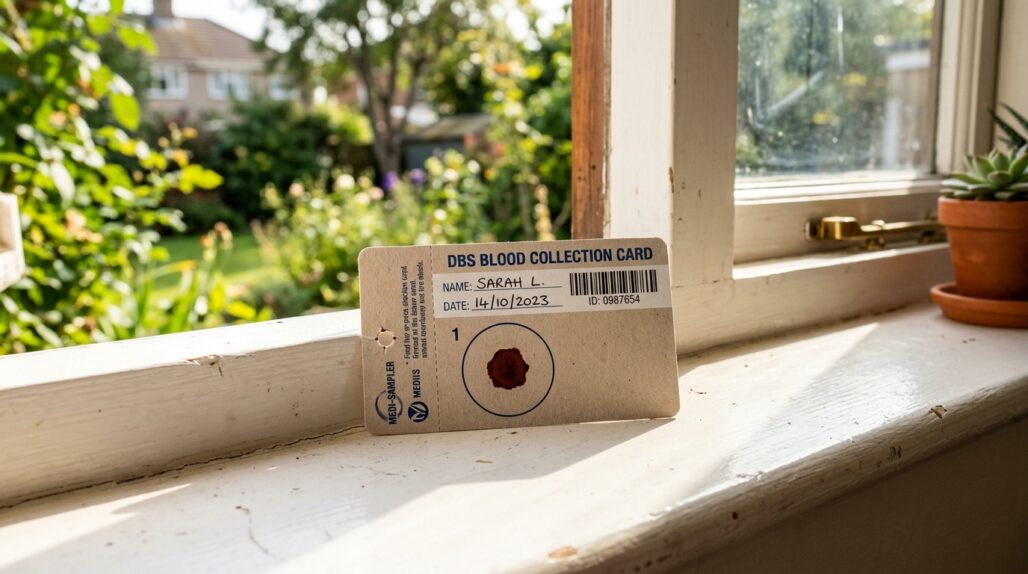
All three options below are finger-prick, dried-blood-spot kits you collect at home and mail back. The important difference is the lab and the depth of the report, not the act of pricking your finger.
A note on the lab, because it is the thing most people skip. CLIA stands for the Clinical Laboratory Improvement Amendments, the United States standards that regulate lab testing quality. A kit processed in a CLIA-certified lab has met those quality requirements; a novelty strip that changes color does not. Both kits worth recommending here run in the same CLIA-certified central lab.
| Test kit | What it measures | Lab and method | Price (check current) |
|---|---|---|---|
| OmegaQuant Omega-3 Index Basic | One number: the EPA + DHA percentage in red blood cells | CLIA-certified central lab; dried blood spot, 2 to 4 weeks | Around $55 single as of writing |
| OmegaQuant Omega-3 Index Complete | 24 fatty acids, plus omega-6 to omega-3 and AA to EPA ratios and a trans-fat index | Same CLIA-certified lab; dried blood spot, 2 to 4 weeks | Around $110 single as of writing |
| Carlson Omega-3 Test Kit | The omega-3 index (EPA + DHA percentage), same as Basic | Analyzed by the OmegaQuant CLIA lab; finger prick, 2 to 4 weeks | Varies by retailer; often near the Basic price |
Here is how the picks shake out for real people.
Best for most people – OmegaQuant Omega-3 Index Basic. It gives you the single number that matters, from the lab whose method underpins the published research, at the lowest price of the three. If your goal is to find your baseline, change one thing, and re-test, this is enough.
Best for the data-minded – OmegaQuant Omega-3 Index Complete. Same lab, same finger-prick collection, but it reports 24 fatty acids plus your omega-6 to omega-3 ratio and a trans-fat index. Worth the extra cost only if you will actually use the wider picture; otherwise it is more numbers than action.
A solid alternative – Carlson Omega-3 Test Kit. Carlson is a long-standing supplement brand, but the useful detail is that the sample is analyzed by the same OmegaQuant CLIA lab. So the result is comparable to the Basic. Pick it on price and availability rather than expecting a different measurement.
What we did not recommend: instant color-change strips and any kit that does not name a CLIA-certified lab. If you cannot tell where the blood is analyzed, you cannot trust the percentage, and an unreliable number is worse than no number.
How to use the result: test, dose, re-test
An at-home omega-3 index is a screening and tracking tool, not a clinical diagnosis. It is genuinely reliable for this marker because the dried-blood-spot method is well validated, but it is still a nutrition number you act on by adjusting diet or a supplement, not a basis for treating a disease.
The loop is simple. Test once at baseline. If you are below the 8 percent desirable band and you want to move up, raise your oily-fish intake or add a fish-oil supplement, then re-test. OmegaQuant suggests re-testing every 3 to 4 months until your number and your diet are stable, then stretching to every 6 to 12 months. Three to four months is the right window because red cell membranes need that long to reflect the change.
When you go shopping for the supplement itself, two things drive how fast the number moves: the EPA plus DHA dose and the form. Our guide to the best omega-3 fish oil supplements walks through both, and if your aim is anti-inflammatory rather than general topping-up, see how much fish oil per day for inflammation for the dose ranges and where the evidence is strong versus thin.


As an Amazon Associate, UsefulVitamins.com earns from qualifying purchases at no extra cost to you.
We may earn a commission from the kits and supplements linked here, at no extra cost to you. It does not change which products we recommend.
The accuracy question, answered plainly
At-home finger-prick kits get a fair amount of skepticism, and some of it is deserved. For the omega-3 index specifically, the dried-blood-spot approach is one of the better-validated home methods, and the recommended kits run in a CLIA-certified lab using the same standardized process cited across the research literature. That is why a home omega-3 index can be acted on for nutrition decisions.
The caveats are about collection, not the lab. A skimpy blood spot, a smeared card, or a sample that sits in a hot mailbox for a week can degrade quality. Follow the instructions, fill the spot fully, and mail it back promptly. And remember the bigger frame from the AHA advisory and the Cochrane review: a higher index is a reasonable nutrition target, but it is not proven to prevent heart attacks for the average healthy person.
See a doctor before you chase the number if
This page is education, not medical advice, and an at-home test is a screening aid rather than a substitute for clinical care. Talk to a clinician before pushing your omega-3 intake up if any of the following apply to you.
- You take warfarin, a DOAC, clopidogrel, aspirin, or any other blood thinner or antiplatelet drug. High-dose omega-3 can add to bleeding risk, a caution the NIH Office of Dietary Supplements flags directly.
- You have a known bleeding disorder, or surgery scheduled soon.
- You are pregnant or breastfeeding and unsure what dose is appropriate.
- You have a history of atrial fibrillation, since some trials link very high-dose omega-3 to a higher rate of it.
For reference, the United States FDA considers up to 5 grams a day of combined EPA and DHA from supplements safe for general use, but that is a ceiling, not a target, and high doses are exactly where the medication interactions matter most. When in doubt, your doctor or pharmacist is the right call.

FAQ
Is an at-home omega-3 index test as accurate as a clinic blood draw? For this marker, the dried-blood-spot method used by CLIA-certified labs is well validated and comparable for tracking purposes. The main risk is collection error at home, so follow the instructions and mail the sample back quickly.
What is a good omega-3 index number? The commonly cited desirable range is 8 to 12 percent. Below 4 percent is considered undesirable. Treat 8 percent as a nutrition target associated with lower risk, not a guideline-mandated goal or a guarantee of any outcome.
How long until my index changes after starting fish oil? Plan on about 3 to 4 months. Red blood cells turn over slowly, so the index reflects roughly the last 13 weeks of intake. Re-testing sooner than that usually will not show the full change.
Do I need the Complete 24-fatty-acid panel or just the Basic? Most people only need the Basic single number to find a baseline and re-test. The Complete panel adds ratios and a trans-fat index, which is useful if you will actually act on that wider picture.
Can I raise my index with food instead of a supplement? Often yes. Regular oily fish such as salmon, sardines, or mackerel raises the index, and both the AHA and the Cochrane evidence lean toward food over pills for general health. A test tells you whether your diet alone is getting you there.
Is it safe to take high-dose omega-3 to hit 8 percent fast? Not without checking first if you take blood thinners, have a bleeding disorder, or have surgery coming up. The FDA ceiling for supplements is 5 grams a day of EPA plus DHA, but interactions matter, so raise the dose gradually and ask a clinician.
The bottom line
The omega-3 index is one of the few nutrition numbers you genuinely cannot guess, which is the whole case for testing. For most people the OmegaQuant Omega-3 Index Basic is the right buy: one clear number, from the CLIA-certified lab behind the research, at the lowest price. Step up to the Complete panel only if you want the full fatty-acid profile, and treat the Carlson kit as a comparable alternative since it runs through the same lab.
Then use the number the way it is meant to be used. Test at baseline, adjust your fish or fish-oil intake with help from the omega-3 EPA and DHA calculator, and re-test in 3 to 4 months to see whether it actually moved. If you take a blood thinner or have any of the red flags above, talk to your doctor before pushing the dose. This is a tool for understanding your own status, not a diagnosis.
This article is for education and is not medical advice. At-home tests are screening aids, not a replacement for clinical testing or your doctor's judgment.
Reviewed by the UsefulVitamins Editorial Team.
