
If you're weighing ashwagandha vs rhodiola for stress, you're asking a genuinely good question, because the honest answer is: they work through different mechanisms, at different times of day, and for somewhat different stress profiles — neither one is simply better. This article breaks down the RCT evidence for each, where each adaptogen has a measurable edge, and how to use the stacking question as a decision point rather than a reflex. You'll also get a practical decision table, drug-interaction notes for both, and a word count on why most readers should choose one rather than combining them.
Affiliate disclosure: this article contains affiliate links. As an Amazon Associate, UsefulVitamins.com earns from qualifying purchases at no extra cost to you.
Summary: ashwagandha vs rhodiola for stress at a glance
Short answer: For chronic stress with elevated cortisol and poor sleep, ashwagandha (KSM-66 or Sensoril) has stronger, more replicated RCT evidence. For stress-related fatigue and mental burnout where you need sharper daytime performance, rhodiola has the edge. Most people should pick one, not both.
Best for ashwagandha:
- Chronic stress lasting 3+ months with sleep disruption
- Elevated serum cortisol or wired-tired evenings
- No thyroid medication or autoimmune condition
Best for rhodiola:
- Mental fatigue and burnout under occupational stress
- Morning energy and focus deficits
- Stress that presents primarily as exhaustion rather than anxiety
Not ideal for — ashwagandha:
- People on levothyroxine or other thyroid hormone replacements
- Anyone on immunosuppressants (tacrolimus, cyclosporine, biologics)
- Pregnancy and breastfeeding
Not ideal for — rhodiola:
- People on antidepressants (SSRIs, SNRIs, MAOIs)
- Anyone sensitive to stimulating herbs (insomnia, anxiety)
- Stress that's primarily emotional rather than fatigue-driven
Decision shortcut: If you wake at 3 AM with a racing mind, start with ashwagandha. If you drag through the day feeling flat and burned out despite adequate sleep, start with rhodiola.
What you'll find in this guide
- How each adaptogen works
- Chronic stress RCT evidence: head to head
- Cortisol vs fatigue: where each one wins
- Timing, dosing, and the biphasic rhodiola rule
- The stacking question: one or two?
- Drug interactions
- Frequently asked questions
How ashwagandha and rhodiola actually work {#how-each-works}
These two adaptogens are often mentioned together, but their mechanisms point in different directions.
Ashwagandha: the cortisol-axis brake
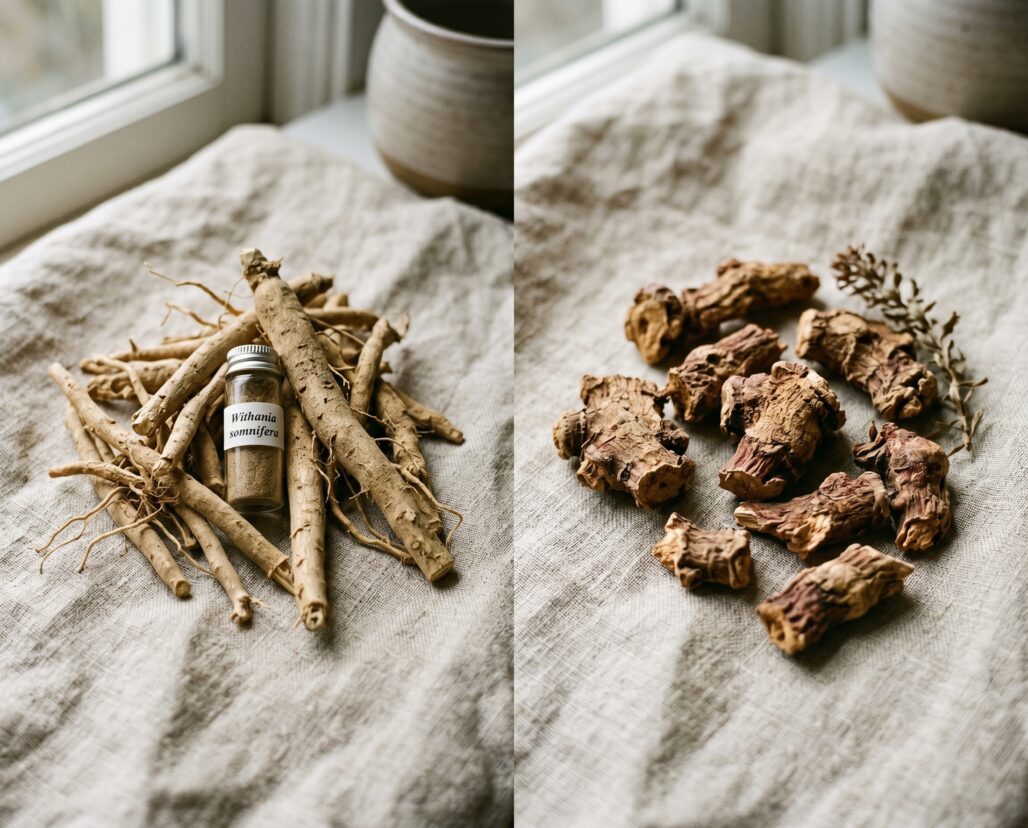
Ashwagandha (Withania somnifera) is a root from the Solanaceae family. Its primary bioactive compounds are withanolides — steroidal lactones that appear to modulate the hypothalamic-pituitary-adrenal (HPA) axis. The proposed mechanism: withanolides reduce the HPA axis's output signal, dampening cortisol release under chronic stress. Think of cortisol as a thermostat stuck at high. Ashwagandha works on the thermostat's setpoint, not by turning off the heater entirely.
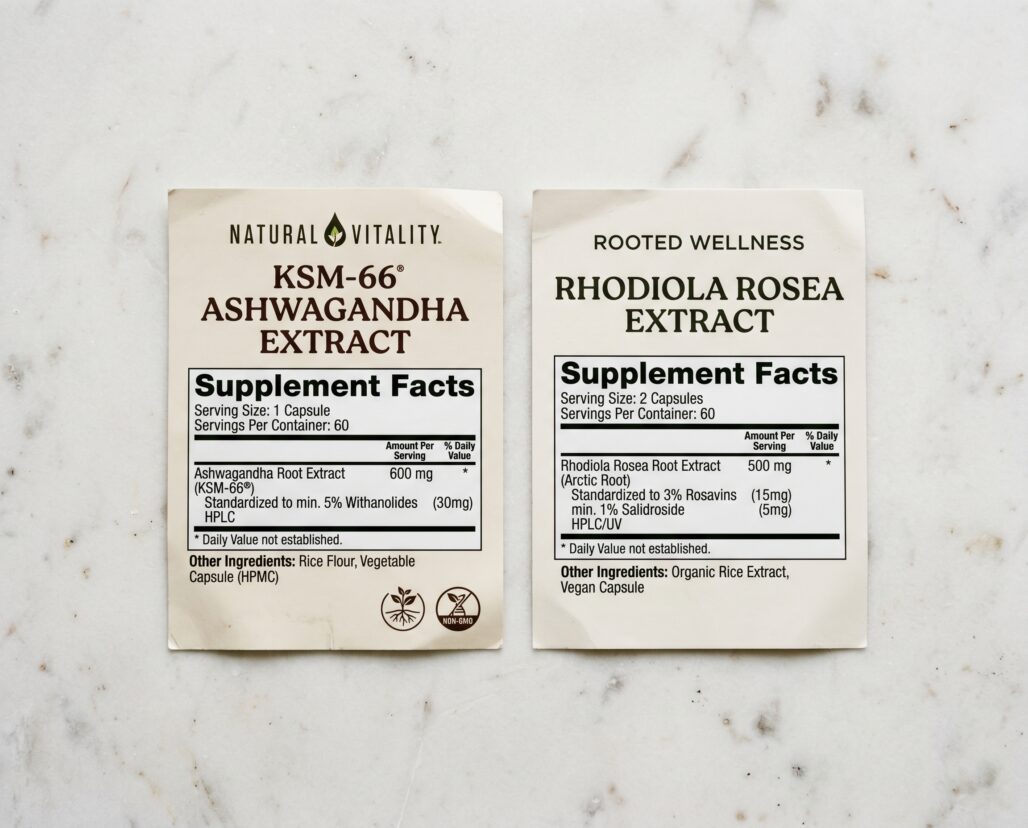
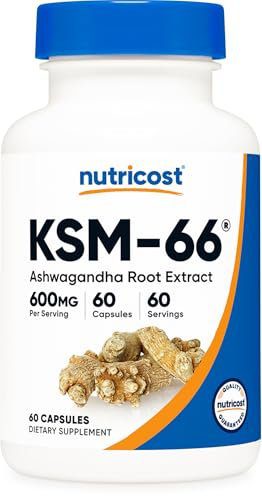
The extract families with the cleanest clinical record are KSM-66 (full-spectrum root, standardized to 5% withanolides) and Sensoril (root + leaf, standardized to 10% withanolides). Loose "ashwagandha root powder" on a label, with no withanolide disclosure, tells you nothing meaningful about potency.
Rhodiola: the fatigue-buffer at the cellular level
Rhodiola rosea is a root from the Arctic and mountainous regions of Europe and Asia. Its key marker compounds are rosavins (rosavin, rosin, rosarin) and salidroside. The SHR-5 extract used in the most-cited human trials is standardized to 3% rosavins and 1% salidroside.
Rhodiola's proposed mechanism is different from ashwagandha's. Rather than blunting the HPA axis, it appears to influence monoamine neurotransmitters (serotonin, dopamine, norepinephrine) and to reduce stress-induced depletion of ATP in muscle and neuronal tissue. This is why rhodiola's most replicated clinical effects cluster around fatigue and alertness rather than serum cortisol reduction.
Actionable takeaway: The mechanism difference matters for picking your tool. If stress manifests primarily as a cortisol-driven anxiety response (wired-tired, poor sleep, elevated morning cortisol), ashwagandha targets that pathway. If it manifests as depletion and fog (flat mood, poor focus, exhaustion), rhodiola targets that pathway. These profiles often overlap — but starting with the better-matched one first is smarter than stacking both by default.
Chronic stress RCT evidence: head to head {#rct-evidence}
Ashwagandha's strongest trial
The landmark evidence comes from a 2012 placebo-controlled RCT (Chandrasekhar et al., n=64). Adults with a history of chronic stress received KSM-66 ashwagandha at 300mg twice daily for 60 days. At 60 days, the ashwagandha group showed significant reductions in perceived stress scores (p<0.0001) and serum cortisol (p=0.0006) versus placebo.
A 2019 follow-up (Salve et al., n=58) tested two doses of ashwagandha root extract (250mg/day and 600mg/day) over 8 weeks. Both doses reduced PSS scores and serum cortisol versus placebo; the 600mg group showed stronger cortisol reduction (p<0.0001). Sleep quality also improved significantly across both dose arms.
These two trials together represent the strongest repeated-dose, placebo-controlled evidence for any stress-targeted adaptogen in healthy adults.
Rhodiola's strongest trial
The primary evidence for rhodiola on stress-related fatigue comes from a 2009 Phase III RCT (Olsson et al., n=60). Participants with stress-related burnout received SHR-5 at 576mg/day for 28 days. At 4 weeks, the rhodiola group showed significant improvements on Pines' burnout scale and attention/concentration measures versus placebo. Cortisol awakening response also differed between groups at the end of the trial.
A separate pilot study of a combination extract containing rhodiola, schisandra, and eleuthero (Aslanyan et al., n=40, PMID 20374974) found significant improvements in attention speed and accuracy under stressful conditions after a single dose.
The honest comparison
| Dimension | Ashwagandha | Rhodiola |
|---|---|---|
| Strongest trial design | Chandrasekhar 2012, RCT n=64, 60 days | Olsson 2009, Phase III RCT n=60, 28 days |
| Primary outcome measured | Serum cortisol + perceived stress (PSS) | Burnout scale + attention |
| Cortisol reduction | Replicated across 2 trials | Cortisol awakening response improved in 1 trial |
| Fatigue / burnout | Not the primary endpoint | Primary endpoint, significant |
| Duration of effect evidence | Up to 60 days (8 weeks in Salve 2019) | Up to 28 days |
| Number of independent replication trials | 2+ for cortisol endpoint | 1 primary stress-related RCT (SHR-5) |
Actionable takeaway: Ashwagandha's cortisol-reduction evidence is broader and better replicated. Rhodiola's fatigue and burnout evidence is specific and significant, but the trial base is smaller. Neither is "clinically proven" in the FDA-drug sense — both are OTC dietary supplements with promising but not definitive human trial evidence.
But traditional use is not the same as RCT evidence, and the number of RCTs matters. If cortisol reduction is your goal, ashwagandha has the stronger RCT basis.
Cortisol vs fatigue: where each one wins {#cortisol-vs-fatigue}
Stress has two common presentations that often get lumped together but respond differently to adaptogens.
Presentation A — HPA overactivation: Elevated or dysregulated cortisol, difficulty winding down in the evening, light or disrupted sleep, anxiety under pressure, an inability to "turn off" the stress response. This presentation overlaps with burnout's early stages, before depletion sets in.
Presentation B — depletion and burnout: Flatness, low motivation, difficulty concentrating, fatigue that persists despite rest, reduced emotional range. This is the later stage of chronic stress, where the HPA axis may actually be under-responsive (blunted cortisol) rather than overactive.
Ashwagandha's RCT evidence is most relevant to Presentation A — it was tested in chronically stressed adults, measured cortisol reduction, and showed improvements in sleep quality as a secondary endpoint (Salve 2019).
Rhodiola's RCT evidence fits Presentation B more closely — the Olsson 2009 trial enrolled participants with stress-related burnout, and the primary endpoints were fatigue and cognitive performance.
The real question isn't whether ashwagandha works in lab conditions — it's whether your stress profile matches the people who were enrolled in the relevant trials. A chronically fatigued burnout patient is not the same as a chronically anxious high-cortisol patient.
Timing, dosing, and the biphasic rhodiola rule {#timing-and-dosing}
Ashwagandha: take it in the evening
In the Chandrasekhar 2012 trial, participants took one 300mg capsule twice daily. Many practitioners and subsequent trials suggest that taking at least one dose in the evening capitalizes on ashwagandha's cortisol-lowering and sleep-supporting effects. The NCCIH ashwagandha fact sheet notes short-term use (up to 3 months) appears safe, with liver injury reported in rare cases.
Look for products standardized to 5%+ withanolides (KSM-66) or 10%+ withanolides (Sensoril). Standardization labels matter more than pretty branding. "Ashwagandha root powder 500mg" with no withanolide disclosure is not the same product as 300mg KSM-66 at 5% withanolides.
Rhodiola: take it in the morning, and watch the dose ceiling
Rhodiola's stimulating properties mean evening dosing often disrupts sleep. The Olsson 2009 trial used 576mg/day in divided doses taken in the morning hours. Taking rhodiola after midday is a common cause of user-reported insomnia.
Rhodiola also has a documented biphasic dose response. At lower doses (typically 200–400mg/day), the stimulating effects predominate and are useful for fatigue. At higher doses (above 600–700mg/day), adverse effects including anxiety and paradoxical sedation have been reported in clinical monitoring; this dose-response pattern is not unique to rhodiola — several adaptogens and stimulants share it — but it is particularly relevant here because many commercial products push single-capsule doses that exceed the evidence-supported range.
In the Olsson 2009 trial, the 576mg/day dose produced the significant fatigue effects. There is no strong human evidence that higher doses produce proportionally better outcomes.
Actionable takeaway: Ashwagandha is an evening-friendly adaptogen with a relatively linear dose response in the clinical range. Rhodiola is a morning-only adaptogen with a dose ceiling. If you take rhodiola and feel more anxious rather than less fatigued, reducing the dose is the first intervention.
The stacking question: should you take both? {#stacking-question}
Stacking ashwagandha and rhodiola is a common suggestion in adaptogen communities. Most readers should not start there.
The practical case for picking one first: the mechanisms are complementary enough that adding the second before establishing whether the first works makes it impossible to attribute any effect. If you start both simultaneously and feel better, you don't know which one helped. If you feel worse, you don't know which one caused it.
The case for a careful stack: a reader with chronic stress (ashwagandha indication) who also presents with significant daytime fatigue and burnout (rhodiola indication) has a partially overlapping profile. In that scenario, a stack at LOW doses of each can be reasonable — but only after one has established that each is individually tolerated.
Use this decision table before stacking:
| Question | Your answer |
|---|---|
| Have you tried ashwagandha alone for at least 6 weeks? | Yes / No |
| Have you tried rhodiola alone for at least 4 weeks? | Yes / No |
| Are you on any antidepressant, thyroid, or immunosuppressant medication? | Yes / No |
| Does your stress present as both elevated anxiety AND significant fatigue? | Yes / No |
| Are you willing to reduce each dose by ~30% when stacking? | Yes / No |
If you answered "No" to the first two questions, you are not ready to stack. If you answered "Yes" to any medication question, stacking requires prescriber sign-off, not just research.
The combination that makes sense: chronic stress patient (3+ months), no relevant medications, ashwagandha at 300mg KSM-66 once daily (evening) plus rhodiola at 200–300mg SHR-5 once daily (morning). These are the low ends of the evidence-supported ranges, not the maximums.
The combination that rarely makes sense: two full clinical-trial doses of both adaptogens simultaneously from day one, without establishing individual tolerance.
Drug interactions: condensed but specific {#drug-interactions}
Ashwagandha
Per the NCCIH ashwagandha fact sheet and Memorial Sloan Kettering's integrative herbs database:
- Thyroid medication: Ashwagandha may suppress TSH and elevate T3/T4. Anyone on levothyroxine or other thyroid hormone replacement should not take ashwagandha without physician monitoring. This is a hard contraindication, not a soft warning.
- Immunosuppressants: Withanolides modulate immune function, which can interfere with tacrolimus, cyclosporine, biologics, and other drugs used to suppress the immune system.
- Sedatives and anticonvulsants: Additive CNS depressant effects have been reported. Use caution with benzodiazepines, barbiturates, and antiepileptic drugs.
- Diabetes medication: Ashwagandha may lower blood glucose; combined use with antidiabetics can push glucose too low.
- Pregnancy: The NCCIH advises avoiding ashwagandha during pregnancy. Traditional Ayurvedic use of ashwagandha includes abortifacient applications at high doses.
Rhodiola
Per Memorial Sloan Kettering's integrative herbs database for rhodiola:
- Antidepressants (SSRIs, SNRIs, MAOIs): Rhodiola inhibits monoamine oxidase (MAO) activity. Combined with antidepressants that affect serotonin or norepinephrine pathways, this raises the risk of serotonergic side effects. A case report documented tachyarrhythmia in a patient combining rhodiola with an antidepressant. This interaction is clinically relevant and not a theoretical concern.
- Stimulants and CNS stimulants: Rhodiola's MAO inhibition may enhance the stimulant and blood-pressure-elevating effects of CNS stimulants.
- CYP3A4 and CYP2C9 substrates: Rhodiola inhibits these liver enzymes, potentially affecting the metabolism of warfarin, phenytoin, and other narrow-therapeutic-window drugs.
- Antihypertensives: Additive blood-pressure-lowering effects have been noted.
- Pregnancy and breastfeeding: Safety data are insufficient. The NCCIH states that little is known about rhodiola use during pregnancy. Avoid.
Frequently asked questions {#faq}
Which is better for anxiety — ashwagandha or rhodiola?
For anxiety that accompanies chronic stress, ashwagandha has stronger and more replicated RCT evidence. The Chandrasekhar 2012 trial measured perceived stress (PSS) and saw significant reduction versus placebo. Rhodiola's evidence is weighted more toward fatigue and cognitive performance than toward anxiety specifically. That said, if your anxiety is driven primarily by exhaustion and mental depletion, rhodiola's fatigue-relief effects may reduce anxiety indirectly. If your stress shows up mainly as anxiety rather than fatigue, it is also worth weighing l-theanine versus ashwagandha for stress, since l-theanine targets calm without sedation.
How long before ashwagandha works for stress?
In the Chandrasekhar 2012 RCT, significant cortisol reduction and PSS improvement were measured at 60 days. Some participants reported subjective improvement earlier. If you see no effect at 8 weeks of standardized KSM-66 at 300mg twice daily, the evidence suggests it likely will not work for your stress profile.
Can I take rhodiola every day?
The Olsson 2009 Phase III trial used daily dosing for 28 days. Some practitioners recommend cycling (5 days on, 2 days off) to avoid potential tolerance, though no human RCT has specifically tested this. Daily dosing is fine for short-term use; take it in the morning only, and be alert to the dose-ceiling effect above roughly 600mg/day.
Does rhodiola raise cortisol or lower it?
The Olsson 2009 trial found that the cortisol awakening response differed significantly between rhodiola and placebo groups, but the direction of effect was complex — rhodiola appeared to normalize the cortisol response rather than simply suppressing it. Rhodiola is not a cortisol-suppressor in the way ashwagandha is. This is consistent with its primary evidence base being fatigue and burnout, not HPA-axis overactivation.
Can I take ashwagandha and rhodiola together?
For most readers, no — not as a starting point. Establish that each works individually and is tolerated first. For a person with chronic stress plus significant daytime fatigue and burnout, a low-dose stack (evening ashwagandha + morning rhodiola) is a reasonable second step, provided no relevant medications are involved. See the decision table above.
Which adaptogen works faster?
Rhodiola's fatigue-related effects have been documented at 4 weeks (Olsson 2009) and even in single-dose acute testing (Aslanyan et al., 2010, n=40). Ashwagandha's cortisol and PSS effects were significant at 60 days in the primary trial. If you need a faster-acting adaptogen for acute mental fatigue, rhodiola's evidence profile is faster. Ashwagandha requires a longer commitment.
As an Amazon Associate, I earn from qualifying purchases. Product recommendations are based on real reviews and independent research.
Related reading
- Best Adaptogens for Stress: A Practical 2026 Guide — the upstream cluster hub covering the full adaptogen landscape for stress
- Ashwagandha: The Complete Evidence-Based Guide — deeper look at KSM-66 vs Sensoril, full side-effect profile, and who should avoid it
- Rhodiola Rosea: The Complete Evidence-Based Guide — full breakdown of SHR-5, rosavins vs salidrosides, and how to dose correctly
Taking this alongside other products? StackMyMed (our companion app) logs your full stack, finds the optimal timing for each dose, and flags interactions, so you are not tracking it all by hand.
Conclusion: the bottom line on ashwagandha vs rhodiola
Ashwagandha has the stronger evidence base for chronic stress with cortisol involvement — two independent RCTs have replicated meaningful serum cortisol and perceived-stress reductions at 60 days. Rhodiola has a clear, specific edge for stress-related fatigue and burnout, with faster onset and a distinct mechanism that does not duplicate what ashwagandha does. Both have meaningful drug interaction profiles that should stop anyone on thyroid medication, antidepressants, or immunosuppressants from self-experimenting without physician guidance.
Next steps:
- If your stress presents as anxiety and poor sleep: read the full Ashwagandha Complete Guide to evaluate KSM-66 vs Sensoril and pick a verified-potency product
- If your stress presents as flat energy and burnout: read the full Rhodiola Complete Guide and pay close attention to the morning-only dosing and dose-ceiling notes
- If you're on prescription medication: review the drug-interaction section above with your prescriber before starting either adaptogen
- To compare both against the full adaptogen field: see Best Adaptogens for Stress
This article is for informational purposes and not medical advice. Herbal adaptogens — even traditional ones — can interact with thyroid medication, antidepressants, anticoagulants, immunosuppressants, blood-pressure drugs, and more. Consult a licensed physician before starting any adaptogen, particularly if you are pregnant, nursing, taking prescription medications, or managing a chronic condition.
As an Amazon Associate, I earn from qualifying purchases. Product recommendations are based on real reviews and independent research.
